Connect with us

Technology

LG AND TENSTORRENT EXPAND PARTNERSHIP TO ENHANCE AI CHIP CAPABILITIES

Published

on

Collaboration Spans On-Device AI, Future Mobility and More

SEOUL, South Korea, Nov. 11, 2024 /PRNewswire/ — LG Electronics (LG) and Tenstorrent are pleased to announce an expanded collaboration, building on their initial chiplet project to develop System-on-Chips (SoCs) and systems for the global market. Through this partnership, LG aims to enhance its design and development capabilities for AI chips tailored to its products and services, aligning with its vision of “Affectionate Intelligence.” LG is dedicated to advancing AI-driven innovation, with a focus on enhancing its AI-powered home appliances and smart home solutions, as well as expanding its capabilities in future mobility and commercial applications.

Recognizing the critical role of high-performance AI semiconductors in implementing AI technology, LG plans to strengthen its in-house development capabilities while collaborating with leading global companies, including Tenstorrent, to boost its AI competitiveness.

Tenstorrent is renowned for its ability to design world-class high-performance computing (HPC) semiconductors using its RISC-V1 IP (Ascalon) and AI IP (Tensix). Their IP is engineered to scale from milliwatts to megawatts, delivering exceptional efficiency and performance.

Recently, LG CEO William Cho met with Tenstorrent CEO Jim Keller at the LG Twin Towers in Yeouido, Seoul, to discuss strategic collaboration. The meeting was attended by key executives from both companies, including LG’s CTO, Kim Byoung-hoon, and SoC Center Head, Kim Jin-gyeong, alongside Tenstorrent’s CCO, David Bennett, and VP of Automotive, Thaddeus Fortenberry.

During their discussions, the two companies explored opportunities to leverage their intellectual properties, design assets and technologies, aiming to create synergies across various business areas including AI home appliances, smart home solutions, future mobility, and video processing solutions for the data center market. Both CEOs emphasized the importance of enhancing capabilities in next-generation system semiconductors, including RISC-V and chiplets, to navigate the rapidly evolving AI landscape. Additionally, Tenstorrent and LG are considering the establishment of a long-term internship program as part of their collaboration.

LG is committed to advancing its AI-related software and algorithm technologies to provide customers with products, platforms and services based on generative AI. This includes the development of AI chips to secure competitiveness in on-device AI technology.

“Tenstorrent is bringing the industry’s best AI and RISC-V technology to this collaboration,” said William Cho, CEO of LG Electronics. “We aim to deliver a new customer experience through our unique Affectionate Intelligence, focusing on personalized, caring and attentive solutions that better understand our customers and can provide tangible value.”

“LG has a strong SoC development organization and Tenstorrent is excited to continue to partner with them,” said Jim Keller, CEO of Tenstorrent. “Customers are looking for customizable solutions – our AI and RISC-V technology enables LG to own their silicon future.”

Meanwhile, LG has established a dedicated SoC R&D center specializing in system semiconductor design and development. The SoC Center excels in the design, development and verification of these chips, focusing on advancing high-performance SoCs using the chiplet technology – a technology that integrates multiple chips into a single package, gaining attention due to the increasing demand for high-performance, low-power AI semiconductors.

The system chips used in LG’s key products have all been developed under the leadership of the SoC Center. LG’s proprietary AI chip for home appliances, “DQ-C,” and the “Alpha 11 AI Processor” for OLED TVs have significantly strengthened the company’s leadership in the global AI appliance and premium TV markets.

As AI becomes increasingly pivotal in the industry, the importance of system chip design capabilities is growing across all business areas. LG is continuously enhancing its system semiconductor design capabilities and linking them with AI-related software and algorithm technologies to proactively prepare for the future. Ultimately, the goal is to provide Affectionate Intelligence solutions in all everyday spaces, offering a differentiated customer experience.

1 RISC-V is an open-source instruction set architecture (ISA) based on reduced instruction set computing (RISC) principles, allowing for flexible and customizable processor designs.

About LG Electronics, Inc.
LG Electronics is a global innovator in technology and consumer electronics with a presence in almost every country and an international workforce of more than 74,000. LG’s four companies – Home Appliance & Air Solution, Home Entertainment, Vehicle component Solutions and Business Solutions – combined for global revenue of over KRW 82 trillion in 2023. LG is a leading manufacturer of consumer and commercial products ranging from TVs, home appliances, air solutions, monitors, automotive components and solutions, and its premium LG SIGNATURE and intelligent LG ThinQ brands are familiar names world over. Visit www.LGnewsroom.com for the latest news.

About Tenstorrent
Tenstorrent is a next-generation computing company that builds computers for AI. Headquartered in Toronto, Canada, with U.S. offices in Austin, Texas, and Silicon Valley, and global offices in Belgrade, Tokyo, Bangalore, Singapore, and Seoul, Tenstorrent brings together experts in the field of computer architecture, ASIC design, advanced systems, and neural network compilers. Tenstorrent is backed by Eclipse Ventures and Real Ventures, among others. Learn more at tenstorrent.com.

Media Contacts:

LG Electronics, Inc.:

Tenstorrent:

Lea Lee

+82 2 3777 3981

Bob Grim

lea.lee@lge.com

bobgrim@tenstorrent.com

www.LGnewsroom.com

www.tenstorrent.com

View original content to download multimedia:https://www.prnewswire.com/news-releases/lg-and-tenstorrent-expand-partnership-to-enhance-ai-chip-capabilities-302301821.html

SOURCE Tenstorrent

Continue Reading

Technology

Towards Buddha Co., Ltd. and ICP DAS Showcase iTLC Intelligent Traffic Control Solutions at APTA 2026 in Chicago

Published

on

By

Advancing smart intersection technologies and expanding international market opportunities through strategic collaboration

CHICAGO, Oct. 31, 2026 /PRNewswire/ — Towards Buddha Co., Ltd., an overseas distributor of the iTLC Intelligent Traffic Control System, joined its technology partner ICP DAS at APTA 2026 TRANSform & EXPO in Chicago, USA, to showcase the iTLC-9000 Series and its applications in intelligent traffic management.

The exhibition highlighted innovative traffic control technologies designed to support reliable, secure, and integrated smart intersection operations, while providing opportunities to connect with international transportation professionals and explore emerging market needs.

Innovative Traffic Control Solutions

Under the theme “Innovative Traffic Control System,” the exhibition featured the iTLC-9000 Series, highlighting four key capabilities: modular and redundant design, secure networking, traffic signal integration, and active alert systems.

These technologies are designed to support system reliability, communication security, and efficient traffic infrastructure management, addressing the evolving requirements of modern intelligent transportation systems.

As cities worldwide continue to modernize transportation infrastructure, integrated and adaptable traffic control solutions are becoming increasingly important for smart intersection development.

Strengthening International Market Connections

As an overseas distributor of iTLC solutions, Towards Buddha Co., Ltd. plays an important role in connecting traffic control technologies with international markets.

During APTA 2026, Towards Buddha Co., Ltd. and ICP DAS engaged with transportation professionals, system integrators, and industry representatives to introduce iTLC technologies, exchange industry insights, and explore potential business opportunities.

“APTA 2026 provided a valuable platform to connect with the global transportation industry,” said a representative of Towards Buddha Co., Ltd. “Together with ICP DAS, we look forward to expanding international awareness of iTLC solutions and developing new opportunities in intelligent traffic control.”

Looking Ahead

Building on its participation at APTA 2026, Towards Buddha Co., Ltd. will continue collaborating with ICP DAS to promote iTLC solutions, strengthen international partnerships, and explore new opportunities in the global intelligent transportation market.

About Towards Buddha Co., Ltd.

Towards Buddha Co., Ltd. is an overseas distributor of the iTLC Intelligent Traffic Control System, focused on international market development and connecting advanced traffic control technologies with transportation industry needs.

Media Contact

Towards Buddha Co., Ltd.
Contact: Michael Chen
Email: Towardsbuddhaincorporation@gmail.com
Website: https://www.towardsbuddha.com 

SOURCE Towards Buddha Co., Ltd.

Continue Reading

Technology

Chandigarh University Commemorates ‘Father of Fibre Optics’ Dr. Narinder Singh Kapany’s 100th Birth Anniversary with India’s First Research Chair in His Name; announces annual Grant of ₹1 Crore for Scientific Research

Published

on

By

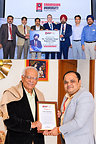
Chandigarh University Confers ‘Narinder Singh Kapany Lifetime Achievement Award for Excellence in Physics’ on Dr Ajoy Ghatak, Prof Emeritus IIT Delhi for Contributions to Fibre Optics & Photonics

CHANDIGARH, India, Oct. 31, 2026 /PRNewswire/ — Chandigarh: To mark the 100th birth anniversary of Dr. Narinder Singh Kapany, the legendary Indian scientist widely known as the ‘Father of Fibre Optics’ whose groundbreaking research in optical fibre technology transformed global telecommunications and laid the foundation for today’s digital revolution, Chandigarh University has announced the establishment of India’s first ‘Dr. Narinder Singh Kapany Research Chair for Excellence in Sciences and Innovation’, along with an annual research grant of ₹1 crore to advance scientific research and innovation.

In a pioneering initiative, Chandigarh University has announced India’s first-ever Research Chair established in the name of Dr. Narinder Singh Kapany, recognizing his unparalleled contribution to science and technology. With no other research chair dedicated to Dr. Kapany currently established in India, this initiative marks a significant institutional tribute to the legendary scientist and seeks to carry forward his legacy through sustained investment in scientific research, innovation and the nurturing of young scientific talent. The Research Chair will provide mentorship, guidance and research support to budding scientists, enabling them to pursue innovative ideas, undertake advanced research and translate scientific discoveries into impactful technologies.

Prominent among those who graced the centenary celebrations of Dr. Narinder Singh Kapany at Chandigarh University campus were Prof. (Dr.) Samir K. Mondal Scientist-G, Optics & Photonics Instrumentation CSIR-CSIO, Chandigarh as Chief Guest, Prof. (Dr.) Aaron Danner, National University of Singapore as Guest of Honour, Eminent Researcher Dr Ajoy Ghatak, Prof. Emeritus, IIT Delhi (virtually) and Dr. Satbir Singh Sehgal Vice-Chancellor Chandigarh University among other dignitaries.

Speaking on the occasion Prof. (Dr.) Samir K. Mondal Scientist-G, Optics & Photonics Instrumentation CSIR-CSIO, Chandigarh said, “Professor Kapani’s contribution to optical science began with his pioneering work on thin, flexible glass fibres, through which he demonstrated for the first time that images could be transmitted from one end to another using bundles of optical fibres. Professor Kapani developed thin, flexible glass fibres and successfully transmitting images through them, laying the foundation for modern fibre optics. He also coined the term ‘optical fibre’ and developed the fibre scope, which later evolved into applications such as endoscopy. His work demonstrated that optical fibres could carry information, opening possibilities beyond image transmission, including voice and data communication.”

Prof Mondal added, “There is also an important question of recognition for Indian scientists. Scientific contributions do not always receive the recognition they deserve and the Nobel Prize is a complex matter. I gave the example of S.N. Bose, whose work has had a lasting influence on physics and is associated with several Nobel Prize-winning developments, despite him never receiving the Nobel Prize himself. Similarly, Professor Kapani’s contribution to optical fibre technology deserves to be remembered and carried forward. We represent one-sixth of the world’s population and taking forward the scientific legacy of such visionaries is no less significant than receiving a Nobel Prize. We must encourage our young researchers to build upon their work and explore new frontiers of science and technology.”

Prof. (Dr.) Aaron Danner National University of Singapore said, “Dr. Narinder Singh Kapany’s pioneering work demonstrated how light could be guided through thin glass fibres using the principle of total internal reflection, overcoming the limitations of metallic transmission. His work on fibre bundles, image transmission and endoscopy opened new possibilities in imaging and optical science. Today, the same fundamental technology that Dr. Kapany started with glass fibres is being used on silicon and lithium niobate wafers to develop advanced photonic devices and achieve increasingly higher communication speeds. While modern research is addressing new engineering challenges in laser sources, optical modulators and high-speed data transmission, it continues to build on those early contributions. We may see Dr. Kapany as a great Indian or Punjabi scientist, but I also see him as a great American scientist. Great science and great scientists are global and their contributions ultimately benefit all of humanity.”

Eminent Researcher Dr Ajoy Ghatak, Prof. Emeritus, IIT Delhi said, “It is indeed a great honour to receive this award in the name of Dr. Narinder Singh Kapany, one of the pioneers of fibre optics. His early work on cladded optical fibres and image transmission through fibre bundles laid the foundation for medical endoscopy. The development of low-loss optical fibres has since revolutionised communication through their tremendous information-carrying capacity, enabling global connectivity and video communication. The establishment of the Dr. Narinder Singh Kapany Research Chair by Chandigarh University is a commendable initiative to advance his scientific legacy and inspire future generations of researchers. This recognition is also a tribute to Dr. Kapany’s remarkable contributions to science.”

Dr. Satbir Singh Sehgal Vice-Chancellor Chandigarh University said, “Dr. Narinder Singh Kapany brought immense pride to India and Punjab through his pioneering research in optical fibre technology, which made high-speed internet and modern digital communication possible. Technologies such as artificial intelligence, data centres and seamless global connectivity rely on the foundations of optical fibre technology. His contribution helped usher humanity into the digital era and accelerated technological progress worldwide. The establishment of India’s first Dr. Narinder Singh Kapany Research Chair, along with its annual grant and prestigious awards, reflects Chandigarh University’s commitment to advancing his scientific legacy, recognising excellence and inspiring the next generation of Indian researchers.”

The Research Chair will provide an annual research grant of ₹1 crore to promote scientific excellence through three dedicated awards: the Narinder Singh Kapany Award for Excellence in Physics, ‘CU Physics Excellence Awards for Best Research Publication’ and ‘CU Physics Excellence Awards for Best Patent’.”

The first edition of these awards was conferred during the birth centenary celebration, with Eminent Researcher Dr Ajoy Ghatak, Prof. Emeritus, IIT Delhi receiving the Narinder Singh Kapany Lifetime Achievement Award for Excellence in Physics. Professor Ajoy K. Ghatak is an internationally acclaimed physicist whose seminal contributions to fibre optics, integrated optics and photonics have advanced the understanding and applications of light. Through pioneering research, influential publications and acclaimed textbooks, Professor Ghatak has advanced fibre optics and photonics, carrying forward Dr Narinder Singh Kapany’s scientific legacy while inspiring generations of physicists.

On this occasion, five ‘CU Physics Excellence Awards for Best Patent’ were presented to five best patents by Dr. Ritu Gupta and Dr. Sandeep Kaur for their ‘Multi-functional Optical Antenna System for Parallel FSO-VLC Communication and Nano-biosignal Monitoring’; Shonak Bansal and Anupama for a ‘Self-powered Real-time Health Monitoring System using Nanowire Photodetectors’, Aditya Bhatnagar and Dr. Sanjeev Saini for ‘Multifunctional Organic-Inorganic Hybrid Luminescent Nanomaterials and a Method for Their Preparation’, Mahima Purohit and Dr. Ruchi Bharti for a ‘Biodegradable, Water-resistant Smart Packaging Film for Fluorescence-based Detection of Food Spoilage’ and Ashit Tripathi, Sachitanand Singh, Iqra Jamal Khan, Sanskruti Singh, Alok Gautam, Mahak received the award for a ‘Handheld Wireless OCT and Fundus Imaging Device’.

‘CU Physics Excellence Awards for Best Research Publication’ were conferred on eight faculty members and students. Ravikant from department of physics was conferrred upon for ‘CU Excellence Award for Research’ for his publication titled Nitrogen  doped zinc oxide to enhance dielectric characteristics of reduced graphene oxide (rGO) derived nanocomposites in composites communivations. Apart from him the other awardees were Shivani Singla (Physics Department) for “Optimising the Neodymium Concentration in Sodium Borate Glass for Enhanced Photoluminescent and Mechanical Behaviour” in Ceramics International (Q1); Sumit Bhardwaj (Physics Department) for “Structural, Optical and Photocatalytic Properties of Ce-Doped Ni-Zn Ferrite Nanoparticles”, in Ceramics International (Q1);  Ruby Priya (Department of Physics) for “Deconvoluting Capacitive and Diffusive Contributions in Cu-Doped SnO₂ Nanoparticles for Enhanced Double-Layer Capacitance and Oxygen Evolution Reaction in Materials Today Communications (Q1);  Akhil Saxena, (Chemistry) for “Mechanistic Elucidation of Persicaria maculosa Gray Extract as a Corrosion Inhibitor: Adsorption, Electrochemical Behavior, and DFT Validation”, published in South African Journal of Chemical Engineering; Harvinder Singh Sohal (Chemistry deoartment), for “Synergistic Adsorptive-Photocatalytic Degradation of Tartrazine Using Mn-Modified Fe₃O₄/Lignocellulose Magnetic Nanocomposites”, published in International Journal of Biological Macromolecules (Q1); Surjeet Chahal, for “Surface Plasmon Resonance Sensor for Dopamine Detection Based on CeO₂ Nanorod and ZnO Nanosheet” in Journal of Materials Science: Materials in Electronics (Q2) and Dr. Sanjeev Kumar from Department of Physics, for “1 Monolinoleoylglycerol and 3,4-Dihydroxymandelic Acids-Mediated ZnO for Antibiotic Degradation and Anticancer Activity”, published in Journal of Environmental Chemical Engineering (Q1).

During the birth centenary celebrations, a message shared by Kiran Kaur Kapany, the daughter of Dr Narinder Kapany was also read out where she said that her father’s journey from a small town in Punjab to transforming the world through fibre optics shows that a big idea can start anywhere. “To students, stay curious, ask questions and be proud of who you are. My heartfelt gratitude to Chandigarh University for honouring my father and family,” added Kapany.

Under the Best Patent Excellence Award for research publication and best patent, the five best patents granted each year will be selected for research grants to support product development and the conversion of patented innovations into practical applications. Similarly, the Best Research Paper Award will recognise the top 10 research publications annually by Chandigarh University students and faculty members in high-impact Q1 and Q2 journals, based on their quality, originality and research impact.

About Chandigarh University

Chandigarh University is a NAAC A+ Grade University and QS World Ranked University. This autonomous educational institution is approved by UGC and is located near Chandigarh in the state of Punjab. It is the youngest university in India and the only private university in Punjab to be honoured with A+ Grade by NAAC (National Assessment and Accreditation Council). CU offers more than 109 UG and PG programs in the field of engineering, management, pharmacy, law, architecture, journalism, animation, hotel management, commerce, and others. It has been awarded as The University with Best Placements by WCRC.

Website address: https://www.cuchd.in/

Photo: https://mmx.prnewswire.com/media/MS2024922/Press-Pic-001-University-Ceremony-and-Citation-Portrait-ID-b5a6d7d2dc04.jpg?id=OA3050946&token=iWkaN-J45hqhHA8w8HEUC2sBtm9vToA_IRNI5EobK5G3zac3CniYqb0XSf9KGA

View original content to download multimedia:https://www.prnewswire.com/in/news-releases/chandigarh-university-commemorates-father-of-fibre-optics-dr-narinder-singh-kapanys-100th-birth-anniversary-with-indias-first-research-chair-in-his-name-announces-annual-grant-of-1-crore-for-scientific-research-302925572.html

Continue Reading

Trending