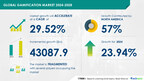
NEW YORK, Nov. 13, 2024 /PRNewswire/ — Report with the AI impact on market trends – The global gamification market size is estimated to grow by USD 43.09 billion from 2024-2028, according to Technavio. The market is estimated to grow at a CAGR of almost 29.52% during the forecast period. Increasing adoption of gamification in e-learning is driving market growth, with a trend towards rise in strategic alliances in the global gamification market. However, lack of awareness and inconsistency of gamification poses a challenge.Key market players include Allen Interactions Inc., Ambition, Aon plc, Axonify Inc., BI WORLDWIDE, Cognizant Technology Solutions Corp., Designing Digitally Inc., Gamification Ltd., Houghton Mifflin Harcourt Co., ImmersionOne Inc., Influitive Corp., Learning Technologies Group Plc, LevelEleven Inc., Microsoft Corp., MPS Ltd., MRCC Group, Paradigm Learning Inc., PUG Interactive Inc., Raydiant Inc., and SAP SE.
AI-Powered Market Evolution Insights. Our comprehensive market report ready with the latest trends, growth opportunities, and strategic analysis- View Free Sample Report PDF
Forecast period
2024-2028
Base Year
2023
Historic Data
2018 – 2022
Segment Covered
Application (Consumer-driven application and Enterprise-driven application), End-user (Healthcare, Entertainment, Retail, Education, and Others), and Geography (North America, Europe, APAC, South America, and Middle East and Africa)
Region Covered
North America, Europe, APAC, South America, and Middle East and Africa
Key companies profiled
Allen Interactions Inc., Ambition, Aon plc, Axonify Inc., BI WORLDWIDE, Cognizant Technology Solutions Corp., Designing Digitally Inc., Gamification Ltd., Houghton Mifflin Harcourt Co., ImmersionOne Inc., Influitive Corp., Learning Technologies Group Plc, LevelEleven Inc., Microsoft Corp., MPS Ltd., MRCC Group, Paradigm Learning Inc., PUG Interactive Inc., Raydiant Inc., and SAP SE
Key Market Trends Fueling Growth
The global gamification market is witnessing an increase in strategic alliances among vendors to expand their reach and enhance their offerings. In June 2022, Microsoft Corp. Introduced gaming features to its Edge browser to cater to the growing demand for gamification. Similarly, in October 2021, Learning Technologies Group Plc (LTG) acquired GP Strategies Corp., a gamification solutions provider, to expand its international footprint and focus on delivering measurable results. These strategic moves will lead to the development of advanced gamification solutions, contributing positively to the market’s growth during the forecast period.
The Gamification Market is experiencing significant growth as more Organisations adopt gamification software to engage employees and enhance customer relationships. E-learning and game-design features are popular gaming ideas, with AI-based technologies like those from Attensi, Ambition, and Axonify, driving personalized experiences. Employee rewards and recognition are key motivators, with ROI a major consideration. AI, AR, VR, and mixed reality technologies are trending, with applications in sectors like real-estate, wealth management, move management, and telecom. Service Corporation International, SAP Community Network, and SAP TwoGo are notable adopters. Consulting and implementation firms like Gong and Qualtrics offer customized solutions. SaaS and mobile devices enable on-premise and cloud deployment. Vitality and SAP Fitness application provide AI-driven insights.
Insights on how AI is driving innovation, efficiency, and market growth- Request Sample!
Market Challenges
The implementation of gamification in corporate training programs is a growing trend, yet many organizations are unaware of its potential benefits and the associated costs. Small and medium enterprises, in particular, may be hesitant to invest in gamification software due to limited IT budgets. The lack of knowledge and inconsistent results from outsourced training programs can increase the risk of gamification implementation failure. For instance, Marriott Hotel invested significantly in a gamified training program, but employees found it time-consuming and not effective. Consequently, the high cost of gamification solutions can result in financial loss for companies if not executed properly. Therefore, increasing awareness and understanding of gamification among organizations and ensuring consistent implementation are crucial for the growth of the global gamification market.The Gamification Market is thriving, with businesses leveraging rewards and recognition to boost engagement and productivity. ROI is a key driver, with services including consulting and implementation delivering significant value. Telecom and SAP segments lead the way, utilizing gamification systems to enhance customer experience and innovation. AI-driven insights from platforms like Qualtrics and Vitality provide valuable data. SaaS solutions, mobile devices, and social networking sites dominate, engaging target audience members through mobile applications and surveys. Marketers tap into gamification for profitability, with advanced technologies like ML driving innovation in the gaming industry. Retail industry verticals, especially online retailers, use gamification to boost sales growth, customer retention, brand advocacy, and loyalty. Solutions include SAP Community Network, SAP TwoGo, and SAP Fitness application. Tapjoy offers progress charts and marketing tools, while e-commerce trends continue to fuel demand for gamification systems.
Insights into how AI is reshaping industries and driving growth- Download a Sample Report
Segment Overview
This gamification market report extensively covers market segmentation by
Application 1.1 Consumer-driven application1.2 Enterprise-driven applicationEnd-user 2.1 Healthcare2.2 Entertainment2.3 Retail2.4 Education2.5 OthersGeography 3.1 North America3.2 Europe3.3 APAC3.4 South America3.5 Middle East and Africa
1.1 Consumer-driven application- The gamification market is experiencing significant growth as businesses integrate game elements into their strategies to engage customers and boost productivity. This trend is driven by the desire to enhance user experience and encourage desired behaviors through rewards and competition. Companies across various industries, including healthcare, education, and finance, are adopting gamification to improve customer loyalty and employee performance. The market is expected to continue expanding due to its proven effectiveness in driving business results.
Download complimentary Sample Report to gain insights into AI’s impact on market dynamics, emerging trends, and future opportunities- including forecast (2024-2028) and historic data (2018 – 2022)
Research Analysis
The Gamification Market is experiencing significant growth due to the increasing adoption of gamification systems in various industries to enhance engagement, productivity, and innovation. Rewards and recognition are key drivers, offering tangible benefits for both organizations and individuals. The Return on Investment (ROI) for gamification is substantial, with improvements in employee motivation, customer loyalty, and data analysis. The Services segment, including consulting and implementation, plays a crucial role in the market. Telecom companies are major adopters, integrating gamification into their offerings for mobile devices. SAP Community Network and SAP TwoGo are notable examples of gamification software in action. Human behavior is a critical focus, with gamification systems designed to leverage game-design features and gaming ideas to influence behavior. AI is a growing trend, with AI-powered gamification systems offering personalized experiences. The Retails industry vertical is a significant market, with gamification used for customer engagement and employee rewards. The Solution component segment includes various offerings, from software to mobile applications. Marketers and organizations across industries are embracing gamification to enhance their offerings and build stronger customer relationships. E-learning is another area where gamification is making a mark, with game-like features used to increase engagement and improve learning outcomes.
Market Research Overview
The Gamification Market is experiencing significant growth due to the increasing emphasis on Rewards and Recognition as effective tools for driving employee motivation and customer engagement. The Return on Investment (ROI) for gamification solutions is proving to be profitable for enterprises across various industries, including Telecom, Retail, and E-learning. The Services segment, including Consulting and Implementation, is a key driver of market growth. Advanced technologies such as AI-driven insights, ML (Machine Learning), AR (Augmented Reality), and VR (Virtual Reality) are transforming gamification systems. SAP Community Network and SAP TwoGo are leading the way with their innovative gamification applications like the SAP Fitness application. Marketers are leveraging gamification to increase profitability by engaging their target audience members through mobile devices and social networking sites. Mobile applications like Tapjoy offer progress charts and other game-design features to keep users engaged. Innovation in gamification is not limited to the gaming industry. Organizations in sectors like Wealth management, Real-estate, and Space planning are using gamification software to improve productivity and customer relationships. Employee rewards and customer loyalty are key motivators for adopting gamification solutions. The Retail industry vertical is experiencing a gamification adoption due to the e-commerce trend and the need for brand advocacy. Online retailers are using gamification to enhance the customer experience and boost retail sales growth. The Solution component segment includes Gamification software, which is seeing increased demand as more organizations adopt a customer-centric approach. On-premise and cloud deployment options offer flexibility for organizations with different IT infrastructure needs. Some notable players in the market include Attensi, Ambition, Gong, Axonify, and Grand River Hospital. These companies are using AI-based technologies and game-design features to create engaging experiences that drive employee motivation and customer loyalty.
Table of Contents:
1 Executive Summary
2 Market Landscape
3 Market Sizing
4 Historic Market Size
5 Five Forces Analysis
6 Market Segmentation
ApplicationConsumer-driven ApplicationEnterprise-driven ApplicationEnd-userHealthcareEntertainmentRetailEducationOthersGeographyNorth AmericaEuropeAPACSouth AmericaMiddle East And Africa
7 Customer Landscape
8 Geographic Landscape
9 Drivers, Challenges, and Trends
10 Company Landscape
11 Company Analysis
12 Appendix
About Technavio
Technavio is a leading global technology research and advisory company. Their research and analysis focuses on emerging market trends and provides actionable insights to help businesses identify market opportunities and develop effective strategies to optimize their market positions.
With over 500 specialized analysts, Technavio’s report library consists of more than 17,000 reports and counting, covering 800 technologies, spanning across 50 countries. Their client base consists of enterprises of all sizes, including more than 100 Fortune 500 companies. This growing client base relies on Technavio’s comprehensive coverage, extensive research, and actionable market insights to identify opportunities in existing and potential markets and assess their competitive positions within changing market scenarios.
Contacts
Technavio Research
Jesse Maida
Media & Marketing Executive
US: +1 844 364 1100
UK: +44 203 893 3200
Email: media@technavio.com
Website: www.technavio.com/
View original content to download multimedia:https://www.prnewswire.com/news-releases/gamification-market-to-grow-by-usd-43-09-billion-2024-2028-driven-by-rising-adoption-in-e-learning-ai-powered-report-highlights-market-transformation—technavio-302304174.html
SOURCE Technavio








 Technology5 days ago

 Near Videos4 days ago
 Technology5 days ago
 Technology5 days ago
 Technology5 days ago
 Technology4 days ago
 Coin Market4 days ago