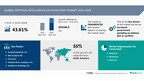
NEW YORK, Nov. 15, 2024 /PRNewswire/ — Report on how AI is driving market transformation – The global artificial intelligence (AI) in military market size is estimated to grow by USD 55.2 billion from 2024-2028, according to Technavio. The market is estimated to grow at a CAGR of 43.61% during the forecast period. Increased government spending on defense due to conflicts is driving market growth, with a trend towards growing integration of ai in space-based systems. However, shortage of ai experts poses a challenge.Key market players include Anduril Industries Inc., BAE Systems Plc, C3.ai Inc, Charles River Analytics Inc., Darktrace Holdings Ltd., General Dynamics Corp., International Business Machines Corp., L3Harris Technologies Inc., Lockheed Martin Corp., Northrop Grumman Corp., NVIDIA Corp., Palantir Technologies Inc., Rafael Advanced Defense Systems Ltd., RTX Corp., Rheinmetall AG, Saab AB, Safran SA, Shield AI, SparkCognition Inc., and Thales Group.
AI-Powered Market Evolution Insights. Our comprehensive market report ready with the latest trends, growth opportunities, and strategic analysis- View Free Sample Report PDF
Forecast period
2024-2028
Base Year
2023
Historic Data
2017 – 2021
Segment Covered
Component (Software, Hardware, and Services), Type (New procurement and Upgradation), and Geography (North America, Europe, APAC, Middle East and Africa, and South America)
Region Covered
North America, Europe, APAC, Middle East and Africa, and South America
Key companies profiled
Anduril Industries Inc., BAE Systems Plc, C3.ai Inc, Charles River Analytics Inc., Darktrace Holdings Ltd., General Dynamics Corp., International Business Machines Corp., L3Harris Technologies Inc., Lockheed Martin Corp., Northrop Grumman Corp., NVIDIA Corp., Palantir Technologies Inc., Rafael Advanced Defense Systems Ltd., RTX Corp., Rheinmetall AG, Saab AB, Safran SA, Shield AI, SparkCognition Inc., and Thales Group
Key Market Trends Fueling Growth
The military sector is increasingly adopting Artificial Intelligence (AI) to enhance security and defense strategies in the face of evolving threats and geopolitical tensions. Defense agencies, technology companies, and research institutions are collaborating to develop AI-powered solutions for situational awareness, proactive defense measures, and agile decision-making. Military applications of AI include autonomous vehicles like drones and military laser systems, decision support systems, and operational efficiency improvements. Security concerns surrounding cybercrime, theft, hacking, and data destruction have heightened the need for advanced AI and Machine Learning (ML) technologies. Defense contractors are investing in technological infrastructure, including AI processors, memory, and quantum computing, to stay ahead of adversaries. Ethical considerations and responsible AI practices are crucial as AI programs process military data and encrypted communication. The industry outlook for AI in the military market is promising, with trends in cognitive electronic warfare, threat detection, anomaly detection, and predictive analysis. Hardware segments like memory, AI processors, and quantum computing are essential for next-generation warfare systems. Private companies like Google and Microsoft are developing AI systems for logistics & transportation, simulation & training, and warfare platforms. Despite the benefits, challenges remain, including ethical considerations, protocols and standards, and the integration of AI into existing defense infrastructure. The military industry must work together to ensure the responsible use of AI in warfare systems, cybersecurity, and other applications. In summary, AI is transforming the military sector, offering solutions for security, defense, and operational efficiency. However, ethical considerations, cybersecurity, and integration challenges must be addressed to ensure responsible use and effective implementation.
Artificial Intelligence (AI) plays a crucial role in military applications, particularly in the context of space exploration. In space missions, AI enhances data processing, analysis, and communication capabilities. Satellite sensors and camera data are analyzed using AI algorithms to detect objects and potential threats. The integration of AI in space-based systems is a significant trend, driven by its advantages in handling vast amounts of data and improving mission efficiency. Both developed and developing countries are increasing their adoption of AI technologies in their space programs due to these benefits. The expansion of space programs and the integration of AI are projected to fuel the growth of the global AI in military market in the coming years.
Insights on how AI is driving innovation, efficiency, and market growth- Request Sample!
Market Challenges
In the military market, artificial intelligence (AI) is revolutionizing defense strategies with advanced solutions for situational awareness, proactive defense measures, and agile decision-making. However, security concerns around AI-powered systems, such as cybercrime, theft, hacking, and data destruction, necessitate responsible AI practices and ethical considerations. Defense agencies, technology companies, and research institutions collaborate to develop next-generation warfare systems, including autonomous vehicles, surveillance drones, and decision support systems. AI and machine learning (ML) are essential components of these systems, enabling threat detection, anomaly detection, and predictive analysis. The hardware segment, including AI processors and memory, plays a crucial role in the development of these advanced systems. Ethical considerations and responsible AI practices are essential to prevent potential misuse of these technologies. Geopolitical tensions and evolving threats require defense forces to invest in technological infrastructure, including quantum computing, encrypted communication, and advanced computing. Private companies like Google and Microsoft are also contributing to the industry outlook with quantum processors and AI programs. The military sector faces challenges in implementing AI systems, including cybersecurity, logistics and transportation, warfare platforms, and information processing. OpenAI and other AI programs are essential for military data analysis, while new procurement and upgrades in cybersecurity and logistics and transportation are necessary for operational efficiency and decision-making accuracy. Military laser systems, autonomous military systems, and defense forces are investing in AI-powered solutions to enhance their capabilities and stay ahead of the curve in the face of international conflicts and protocols and standards. The industry outlook is positive, with continued investment in AI systems, learning and intelligence, and applications across airborne, land, naval, space, and simulation and training.Many businesses in the military market are eager to leverage Artificial Intelligence (AI) for advanced capabilities, yet face challenges in doing so. The implementation of AI applications, such as machine learning and deep learning, necessitates significant investments in data sets, infrastructure, and processing power. Additionally, a team of specialized AI experts is required to execute tasks effectively. However, finding and hiring these experts is a competitive process, making it a significant challenge for many companies, particularly smaller ones, to fully capitalize on AI technology. Careful consideration of appropriate use cases and applications is essential before implementing AI at scale to ensure maximum return on investment.
Insights into how AI is reshaping industries and driving growth- Download a Sample Report
Segment Overview
This artificial intelligence (ai) in military market report extensively covers market segmentation by
Component 1.1 Software1.2 Hardware1.3 ServicesType 2.1 New procurement2.2 UpgradationGeography 3.1 North America3.2 Europe3.3 APAC3.4 Middle East and Africa3.5 South America
1.1 Software- The AI software segment is poised for significant growth in the global artificial intelligence in military market. Defense organizations are increasingly adopting AI software solutions to strengthen their IT infrastructure and enhance cybersecurity capabilities. With data privacy regulations becoming stricter, militaries are investing in AI-powered software tools to detect, prevent, and mitigate security breaches and cyber threats. Advanced technologies like machine learning, virtual assistants, and speech/voice recognition are utilized in these software systems. They collect data from connected hardware systems, process it using AI algorithms, and generate intelligent insights to support critical decision-making processes. Leading AI technology providers, such as IBM, are supplying sophisticated software platforms to defense forces to boost operational efficiency and strategic advantages. The growing investments by militaries worldwide in advanced AI software solutions are fueling the segment’s growth.
Download complimentary Sample Report to gain insights into AI’s impact on market dynamics, emerging trends, and future opportunities- including forecast (2024-2028) and historic data (2017 – 2021)
Research Analysis
Artificial Intelligence (AI) is revolutionizing the military sector, bringing advanced capabilities to Defense Forces in Security concerns and Defense strategies. AI applications include Military Laser Systems, Autonomous Military Systems, and Cyber Security. Evolving threats from Cybercrime, Theft, Hacking, and Data destruction necessitate the integration of AI in the Military Industry. Global Military Spending on new procurement and upgrades is driving the adoption of AI in various domains such as Airborne, Land, Naval, Space, and Logistics and Transportation. Protocols and Standards are being established to ensure ethical use and interoperability. Private Companies are collaborating with Defense Forces to leverage AI in Quantum Computing and Learning and Intelligence. However, concerns around Ethics, Accountability, and Transparency persist. International Conflicts and geopolitical tensions fuel the race for advanced AI technologies. AI in Military is a complex and evolving landscape that requires continuous monitoring and adaptation.
Market Research Overview
Artificial Intelligence (AI) is revolutionizing the military sector as defense agencies seek AI-powered solutions to address evolving threats and geopolitical tensions. The military industry is investing heavily in AI technologies to enhance situational awareness, proactive defense measures, and agile decision-making. AI applications in the military sector include autonomous vehicles, surveillance drones, decision support systems, and cognitive electronic warfare. These technologies enable operational efficiency, decision-making accuracy, and next-generation warfare systems. However, the integration of AI in the military sector raises security concerns, particularly in relation to cybercrime, theft, hacking, and data destruction. Defense agencies must prioritize ethical considerations and responsible AI practices to mitigate these risks. The hardware segment, including AI processors and memory, plays a crucial role in the development and deployment of AI systems. Technology companies and research institutions are collaborating to advance AI and machine learning (ML) capabilities, including quantum computing and AI programs. Defense contractors are also investing in technological infrastructure, such as encrypted communication and protocols and standards, to ensure the security of military data. The military sector is also exploring AI applications in logistics and transportation, simulation and training, battlefield healthcare, and information processing. New procurement and upgrade initiatives are underway for AI systems, warfare platforms, and autonomous war vehicles and robots across airborne, land, naval, space, and cybersecurity domains. Despite the benefits, the integration of AI in the military sector raises ethical considerations and the need for responsible AI practices. The industry outlook is positive, with continued investment and innovation expected in the coming years.
Table of Contents:
1 Executive Summary
2 Market Landscape
3 Market Sizing
4 Historic Market Size
5 Five Forces Analysis
6 Market Segmentation
ComponentSoftwareHardwareServicesTypeNew ProcurementUpgradationGeographyNorth AmericaEuropeAPACMiddle East And AfricaSouth America
7 Customer Landscape
8 Geographic Landscape
9 Drivers, Challenges, and Trends
10 Company Landscape
11 Company Analysis
12 Appendix
About Technavio
Technavio is a leading global technology research and advisory company. Their research and analysis focuses on emerging market trends and provides actionable insights to help businesses identify market opportunities and develop effective strategies to optimize their market positions.
With over 500 specialized analysts, Technavio’s report library consists of more than 17,000 reports and counting, covering 800 technologies, spanning across 50 countries. Their client base consists of enterprises of all sizes, including more than 100 Fortune 500 companies. This growing client base relies on Technavio’s comprehensive coverage, extensive research, and actionable market insights to identify opportunities in existing and potential markets and assess their competitive positions within changing market scenarios.
Contacts
Technavio Research
Jesse Maida
Media & Marketing Executive
US: +1 844 364 1100
UK: +44 203 893 3200
Email: media@technavio.com
Website: www.technavio.com/
View original content to download multimedia:https://www.prnewswire.com/news-releases/ai-in-military-market-to-grow-by-usd-55-2-billion-2024-2028-rising-defense-spending-amid-conflicts-driving-growth-report-with-market-evolution-powered-by-ai—technavio-302306622.html
SOURCE Technavio










 Technology5 days ago

 Near Videos4 days ago
 Technology5 days ago
 Technology5 days ago
 Technology5 days ago
 Technology4 days ago
 Coin Market4 days ago