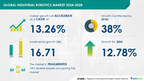
NEW YORK, Nov. 26, 2024 /PRNewswire/ — Report on how AI is redefining market landscape – The global industrial robotics market size is estimated to grow by USD 16.71 billion from 2024-2028, according to Technavio. The market is estimated to grow at a CAGR of 13.26% during the forecast period. Demand for industrial robots is driving market growth, with a trend towards integration of IoT with robotics. However, lack of skilled workers to operate industrial robots poses a challenge.Key market players include ABB Ltd., b m surface systems GmbH, Comau Spa, DENSO Corp., Durr AG, FANUC Corp., Kawasaki Heavy Industries Ltd., MIDEA Group Co. Ltd., Mitsubishi Electric Corp., NACHI FUJIKOSHI Corp., OMRON Corp., Relay Robotics Inc., Rethink Robotics GmbH, Robert Bosch GmbH, Rockwell Automation Inc., Seiko Epson Corp., Shenyang Xinsong Robot Automation Co. Ltd., Staubli International AG, Teradyne Inc., and Yaskawa Electric Corp..
Key insights into market evolution with AI-powered analysis. Explore trends, segmentation, and growth drivers- View Free Sample PDF
Industrial Robotics Market Scope
Report Coverage
Details
Base year
2023
Historic period
2018 – 2022
Forecast period
2024-2028
Growth momentum & CAGR
Accelerate at a CAGR of 13.26%
Market growth 2024-2028
USD 16.71 billion
Market structure
Fragmented
YoY growth 2022-2023 (%)
12.78
Regional analysis
APAC, Europe, North America, South America, and Middle East and Africa
Performing market contribution
APAC at 38%
Key countries
US, China, Japan, India, and Germany
Key companies profiled
ABB Ltd., b m surface systems GmbH, Comau Spa, DENSO Corp., Durr AG, FANUC Corp., Kawasaki Heavy Industries Ltd., MIDEA Group Co. Ltd., Mitsubishi Electric Corp., NACHI FUJIKOSHI Corp., OMRON Corp., Relay Robotics Inc., Rethink Robotics GmbH, Robert Bosch GmbH, Rockwell Automation Inc., Seiko Epson Corp., Shenyang Xinsong Robot Automation Co. Ltd., Staubli International AG, Teradyne Inc., and Yaskawa Electric Corp.
Market Driver
Industrial robotics market is witnessing significant trends in automation, with robots taking over repetitive tasks in various sectors. France, India, South Africa, and the Middle East are key regions driving this development. Companies like Yaskawa Electric and Denso are at the forefront of this industry, providing productivity-enhancing technologies for material handling, welding, and SCARA robots. Automation solutions are essential for industries dealing with manufacturing processes that require precision, consistency, and flexibility. Robots are being integrated into production lines for tasks such as painting, soldering, and assembly, addressing the labor shortage. Industry 4.0 is pushing the role of robotics technology to new heights, with advancements in artificial intelligence, sensors, and integration capabilities. The robot market is forecasted to grow, with China and India being major players. Cobots and machines with multiple axes are becoming increasingly popular due to their flexibility and cost-effectiveness. Production lines in the U.S., Brazil, and Singapore are adopting automation solutions to enhance efficiency and product quality. Deployment of automation solutions in supply chains and assembly lines is a trend, with competition driving down costs and improving delivery times. Robots are being used to monitor and program operations, ensuring consistency and safety in manufacturing processes. The future of industrial robotics lies in the integration of robotics technology with artificial intelligence, allowing machines to learn and adapt to their environment. This will lead to more advanced automation solutions, meeting the needs of industries and enhancing the role of robots in manufacturing processes.
The Industrial Robotics Market is experiencing significant growth due to the integration of the Internet of Things (IoT) in manufacturing processes. IoT allows for seamless data transfer between devices, leading to increased automation in industries. Smart and wireless devices, along with cloud technology, are driving the future of industrial robots, such as articulated robots. These robots offer real-time performance data, enhancing efficiency and productivity. Vendors are responding to market competition by offering IoT-enabled articulated robots, providing valuable insights for optimizing industrial operations.
Request Sample of our comprehensive report now to stay ahead in the AI-driven market evolution!
Market Challenges
The Industrial Robotics Market is experiencing significant growth as automation becomes a necessity for businesses to increase productivity and efficiency in various sectors. In France, for instance, the manufacturing industry is at the forefront of this development, with sectors like material handling, welding, and painting adopting robots for tasks that require precision and consistency. Companies like Yaskawa Electric and Denso are major players in this market, providing automation solutions that integrate sensors and artificial intelligence for flexibility and product quality. The market for industrial robots is diverse, with types ranging from SCARA and Cartesian robots to cobots and robots for tasks like soldering and welding. The robot market in China and India is forecasted to grow due to the need for automation and the shortage of labor. In South Africa and the Middle East, industries are deploying robots to improve capacity and reduce labor costs. Manufacturing processes in the U.S., Brazil, and Singapore are also adopting robotics technology to enhance production lines and improve delivery consistency. Robots are being used in assembly lines, material handling, and even in vehicle manufacturing. The role of robotics technology in Industry 4.0 is becoming increasingly important as machines become more interconnected and require monitoring and programming for optimal efficiency. Despite the benefits, challenges remain, including the initial costs of deployment and maintenance. The competition in the market is fierce, with companies striving to offer the most advanced technologies and capabilities. The future of industrial robotics lies in the integration of artificial intelligence and advancements in safety features, making robots an essential tool for businesses looking to stay competitive in today’s manufacturing landscape.Industrial robots offer numerous advantages in manufacturing processes, including enhanced accuracy and productivity. However, the market growth is hindered by the challenge of acquiring a skilled workforce. End-users face difficulties in finding workers with the necessary qualifications to operate and maintain robotic technology. Industrial robots require a high level of technical expertise, making it essential for operators to have a solid understanding of data exchange between the robots and the assembly line. Unfortunately, not all workers possess the required skills, limiting the adoption of robots in industrial settings. Consequently, there is a pressing need for training programs to upskill the workforce and prepare them for the integration of advanced robotics in manufacturing facilities.
Discover how AI is revolutionizing market trends- Get your access now!
Segment Overview
This industrial robotics market report extensively covers market segmentation by
Type 1.1 Articulated1.2 SCARA1.3 Cylindrical1.4 OthersEnd-user 2.1 Electrical and electronics2.2 Automotive2.3 Metal and machinery2.4 Pharmaceuticals2.5 OthersGeography 3.1 APAC3.2 Europe3.3 North America3.4 South America3.5 Middle East and Africa
1.1 Articulated- Articulated robots are a prominent segment in the industrial robotics market, providing adaptability and flexibility across numerous industries, including automotive, metals and machinery, and pharmaceuticals. These robots, which mimic human arm movements through multiple rotary joints, enable them to navigate confined spaces and execute intricate tasks with precision. The 6-axis robot, offering six degrees of freedom, is the most widely used configuration for articulated robots. Renowned for their high accuracy and dexterity, these robots are employed for applications such as material handling, welding, painting, and assembly. In the automotive sector, they are frequently utilized for tasks like spot welding, which necessitates precise placement at various locations on a car body. The size and configuration of the robot determine its payload capacity, ranging from entire car bodies to tiny electronic components. The expanding capabilities and performance of robotics technology are expected to drive the growth of the global industrial robotics market’s articulated segment throughout the forecast period.
Download a Sample of our comprehensive report today to discover how AI-driven innovations are reshaping competitive dynamics
Research Analysis
Industrial robotics is revolutionizing manufacturing processes by automating repetitive tasks, enhancing productivity, and improving product quality. Technologies such as SCARA robots, cobots, and industrial vehicles are transforming material handling, welding, soldering, painting, and other sectors. The role of industrial robots extends beyond factories, with applications in manufacturing processes for various industries. Development in robotics is at the forefront of Industry 4.0, integrating sensors, artificial intelligence, and machine learning for greater flexibility and consistency in production lines. Capacity and precision are key benefits, reducing labor costs and increasing efficiency. Maintenance and integration with supply chains are crucial considerations, with forecasts predicting continued growth in the robot market. Production lines and assembly lines are becoming smarter and more automated, leading to cost savings and improved client satisfaction.
Market Research Overview
Industrial robotics is a dynamic and evolving market that focuses on automating various tasks in manufacturing processes. This sector encompasses technologies such as SCARA, welding, material handling, and painting robots, among others. The market is witnessing significant growth in sectors like automotive, electronics, and food and beverage, driven by the need for increased productivity and consistency. France, India, South Africa, and the Middle East are among the regions experiencing rapid development in industrial robotics. Technologies like Industry 4.0, artificial intelligence, and sensors are at the forefront of this growth, enabling machines to learn and adapt, and providing flexibility in production lines. The role of robotics in manufacturing processes is becoming increasingly important as labor costs rise and the need for precision, efficiency, and flexibility grows. Robots are being deployed in a variety of industries, from material handling and welding to soldering and painting. The market for industrial robots is expected to continue growing, with forecasts indicating a significant increase in sales over the next few years. The robot market in China and India is expected to see particularly strong growth, driven by the scale of their manufacturing industries and the need for automation solutions. The deployment of industrial robots is not without challenges, however. Maintenance and integration into existing production lines can be complex, and there is a shortage of skilled labor to program and operate the machines. Despite these challenges, the benefits of industrial robotics, including increased capacity, improved product quality, and reduced labor costs, make it a vital part of modern manufacturing processes.
Table of Contents:
1 Executive Summary
2 Market Landscape
3 Market Sizing
4 Historic Market Size
5 Five Forces Analysis
6 Market Segmentation
TypeArticulatedSCARACylindricalOthersEnd-userElectrical And ElectronicsAutomotiveMetal And MachineryPharmaceuticalsOthersGeographyAPACEuropeNorth AmericaSouth AmericaMiddle East And Africa
7 Customer Landscape
8 Geographic Landscape
9 Drivers, Challenges, and Trends
10 Company Landscape
11 Company Analysis
12 Appendix
About Technavio
Technavio is a leading global technology research and advisory company. Their research and analysis focuses on emerging market trends and provides actionable insights to help businesses identify market opportunities and develop effective strategies to optimize their market positions.
With over 500 specialized analysts, Technavio’s report library consists of more than 17,000 reports and counting, covering 800 technologies, spanning across 50 countries. Their client base consists of enterprises of all sizes, including more than 100 Fortune 500 companies. This growing client base relies on Technavio’s comprehensive coverage, extensive research, and actionable market insights to identify opportunities in existing and potential markets and assess their competitive positions within changing market scenarios.
Contacts
Technavio Research
Jesse Maida
Media & Marketing Executive
US: +1 844 364 1100
UK: +44 203 893 3200
Email: media@technavio.com
Website: www.technavio.com/
View original content to download multimedia:https://www.prnewswire.com/news-releases/industrial-robotics-market-to-grow-by-usd-16-71-billion-2024-2028-rising-demand-for-industrial-robots-report-on-ai-driven-market-trends—technavio-302315567.html
SOURCE Technavio








 Technology5 days ago

 Technology4 days ago
 Technology3 days ago

 Technology3 days ago

 Coin Market3 days ago