S&P 500 Q3 2024 buybacks were $226.6 billion, down 4.0% from Q2 2024’s $235.9 billion and up 22.1% from Q3 2023’s $185.6 billionThe 12-month September 2024 expenditure of $918.4 billion was up 16.7% from the prior 12-month expenditure of $787.3 billion Consumer Discretionary increased spending by 13.5%, as Information Technology and Health Care reduced their spending by 6.4% and 10.2% respectively The net buyback 1% tax reduced Q3 2024 operating earnings by 0.42% and As Reported GAAP by 0.48%
NEW YORK, Dec. 13, 2024 /PRNewswire/ — S&P Dow Jones Indices (S&P DJI) today announced the preliminary S&P 500® stock buybacks or share repurchases data for Q3 2024.
Historical data on S&P 500 buybacks is available at www.spdji.com/indices/equity/sp-500.
Key Takeaways:
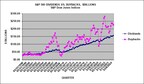
Q3 2024 share repurchases were $226.6 billion, down 4.0% from Q2 2024’s $235.9 billion expenditure, and up 22.1% from Q3 2023’s $185.6 billion.For the 12-months ending September 2024, buybacks were $918.4 billion, up from $787.3 billion for the prior 12-month September 2023 period; the 12-month peak was in June 2022 with $1.005 trillion.332 companies reported buybacks of at least $5 million for the quarter, up from 324 in Q2 2024 and up from 281 in Q3 2023; 381 companies did some buybacks for the quarter, up from 373 in Q2 2024 and up from 362 in Q3 2023; 425 companies did some buybacks in the last 12-month period, up from 420 in the prior 12-month period.Buybacks remained top heavy, as concentration increased, with the top 20 S&P 500 companies accounting for 53.2% of Q3 2024 buybacks, up from Q2 2024’s 52.3%, and above the historical average of 47.6% and the pre-COVID historical average of 44.5%.13.7% of companies reduced share counts used for earnings per share (EPS) by at least 4% year-over-year, up from Q2 2024’s 12.7% and down from Q3 2023’s 13.8%; for Q3 2024 174 issues increased their shares used for EPS over Q2 2024, and 277 reduced them.S&P 500 Q3 2024 dividends increased 2.4% to a record $157.0 billion from Q2 2024’s $153.4 billion and were 8.9% greater than the $144.2 billion in Q3 2023.For the 12-month’s ending September, dividends set a record $616.2 billion payments, up 6.2% on an aggregate basis from the prior 12-month September 2023’s $580.2 billion.Total shareholders return of buybacks and dividends decreased to $383.6 billion in Q3 2024, down 1.5% from Q2 2024’s $389.3 billion and up 16.3% from Q3 2023’s $329.8 billion.Total shareholder returns for the 12-months ending September 2024 increased 12.2% to $1.535 trillion from the prior 12-month periods $1.367 trillion.The 1% tax on net buybacks, which started in 2023, reduced the Q3 2024 S&P 500 operating earnings by 0.42%, down from Q2 2024’s 0.45%, as it reduced As Reported GAAP earnings by 0.48%, down from the prior 0.49%. For the 12-month September 2024 period, the 1% tax on net buybacks reduced earnings by 0.45% for operating and 0.50% for As Reported.
“After declining in 2023, companies have increased their buyback expenditure, but have remained in a dollar range for the first three quarters of 2024. This was amidst significant stock price increases with the result being fewer shares purchased and less of an upward EPS push. Additionally, with big-cap stocks up nearly 30% year-to-date, it is difficult for companies to keep up with that much of an increase in their buyback budget, especially with two-thirds paying dividends in addition to buybacks. However, Q4 2024 buybacks appear to have increased so far, even as stock prices have moved up, as companies’ stock-up on issues needed for employee options, and ahead of any uncertainty over 2025 buyback restrictions or an increase in the 1% buyback tax,” said Howard Silverblatt, Senior Index Analyst at S&P Dow Jones Indices.
1% Buyback Excise Tax:
The 1% excise tax on net buybacks reduced Q3 2024 operating earnings by 0.42%, down from Q2 2024’s 0.45% and up from the 0.39% for Q3 2023. The 12-month impact was 0.45%, up from the 12-month September 2023’s 41%. The tax on As Reported GAAP earnings impact decreased to 0.48%, down from Q2 2024’s 0.49% and up from Q3 2023’s 0.42%. The 12-month impact was 0.50%, up from September 2023’s 0.46%.
Silverblatt added: “The 1% tax remains a manageable expense and has not impacted overall buybacks at this point. However, given the initial 1% buyback tax had bipartisan support and remains an attractive cash generator, there is an expectation that some increase or potential change to the type of buybacks that are taxed will remain on the table as the U.S. budget negotiations start. Given the current corporate sensitivity to costs, a buyback tax rate of 2% to 2.5% was seen as impacting both buybacks and the EPS impact of share-count-reduction, which is already at a lower level due to higher stock prices. Under an increased tax, some of the expenditures may shift from buybacks to dividends. However, any shift would not be on a-dollar-for-dollar basis as dividends remain a long-term pure cash-flow item which must be incorporated into corporate budgets.”
Q3 2024 GICS® Sector Analysis:
Information Technology maintained its lead in buybacks, even as it decreased its expenditure by 6.4%, representing 28.2% of all buybacks for the quarter. Q3 2024 expenditures declined to $64.0 billion, compared to Q2 2024’s $68.4 billion, and was up 31.8% from Q3 2023’s $48.6 billion expenditure. For the 12-months ending September 2024, the sector increased its expenditure 23.4% to $249.5 billion, representing 26.8% of all S&P 500 buybacks, compared to $199.3 billion spent in the prior 12-month period ending September 2023, which represented 25.3% of all buybacks.
Financials decreased buybacks by 2.7% for Q3 2024 as it collectively spent $44.1 billion on buybacks, accounting for 19.4% of all S&P 500 buybacks. This was down for the quarter compared to Q2 2024’s expenditure of $45.3 billion, and up 50.3% from Q3 2023’s $29.3 billion. For the 12-month September 2024 period, Financials spent $161.8 billion, up from $131.4 billion for the prior 12-month period.
Healthcare decreased its Q3 2024 expenditure by 10.2%, spending $16.9 billion, compared to the Q2 2024 expenditure of $18.8 billion, and was up 13.0% from the Q3 2023 $15.0 billion expenditure. For the 12-months ending September 2024, the sector spent $74.4 billion, down from the prior period’s expenditure of $76.0 billion.
Consumer Discretionary increased their spending in Q3 2024 by 13.5% to $20.6 billion, up from the prior $18.2 billion and up 9.5% from the Q3 2023 expenditure of $18.8 billion.
Energy increased their spending by 9.9% to $18.3 billion from Q2 2024’s $16.7 billion and was 12.8% higher than the $16.2 billion spent in Q3 2023.
Issues:
The five issues with the highest total buybacks for Q3 2024 were:
Apple (AAPL): continued to dominate the issue level buybacks, as it again spent the most of any issue with its Q3 2024 expenditure, ranking as the 4th highest in S&P 500 history. For the quarter, the company spent $25.4 billion, down from Q2 2024’s $28.8 billion (which is the largest in index history). Apple holds 18 of the top 20 record quarters (Meta Platforms holds #16 and QUALCOMM holds #18). For the 12-months ending September 2024, Apple spent $100.4 billion on buybacks, up from the prior 12-month period’s $83.0 billion. Over the five-year period, Apple has spent $448 billion, and $695 billion over the ten-year period.Alphabet (GOOG/L): $15.3 billion for Q3 2024, down from $15.7 billion in Q2 2024; the 12-month expenditure was $62.9 billion versus the prior expenditure of $60.7 billion.NVIDA (NVDA): $12.7 billion for Q3 2024, up from $8.8 billion in Q2 2024; the 12-month expenditure was $34.5 billion versus $10.4 billion.Meta Platforms (META): $12.4 billion for Q3 2024, up from $9.5 billion in Q2 2024; the 12-month expenditure was $48.2 billion versus $26.1 billion.JP Morgan (JPM): $6.4 billion for Q3 2024, up from $5.3 billion in Q2 2024; the 12-month expenditure was $16.8 billion versus $7.5 billion.
For more information about S&P Dow Jones Indices, please visit https://www.spglobal.com/spdji/en/.
S&P Dow Jones Indices
S&P 500 proforma net buyback tax impact
TAX
TAX % OF
TAX % OF
$ BILLIONS
OPERATING
AS REPORTED
12 Mo Sep,’24
$8.50
0.45 %
0.50 %
12 Mo Sep,’23
$7.16
0.41 %
0.46 %
9/30/2024
$2.11
0.42 %
0.48 %
6/30/2024
$2.20
0.45 %
0.49 %
3/31/2024
$2.18
0.47 %
0.54 %
2023
$7.24
0.40 %
0.45 %
2022 proforma
$8.47
0.51 %
0.58 %
2021 proforma
$7.93
0.45 %
0.47 %
S&P Dow Jones Indices
S&P 500, $ U.S. BILLIONS
(preliminary in bold)
PERIOD
MARKET
OPERATING
AS REPORTED
DIVIDEND &
VALUE
EARNINGS
EARNINGS
DIVIDENDS
BUYBACKS
DIVIDEND
BUYBACK
BUYBACK
$ BILLIONS
$ BILLIONS
$ BILLIONS
$ BILLIONS
$ BILLIONS
YIELD
YIELD
YIELD
12 Mo Sep,’24 Prelim.
$48,701
$1,902.69
$1,685.91
$616.16
$918.40
1.27 %
1.89 %
3.15 %
12 Mo Sep,’23
$35,938
$1,756.47
$1,541.07
$580.21
$787.26
1.61 %
2.19 %
3.81 %
2023
$40,039
$1,787.36
$1,610.73
$588.23
$795.16
1.47 %
1.99 %
3.46 %
2022
$32,133
$1,656.66
$1,453.43
$564.57
$922.68
1.76 %
2.87 %
4.63 %
2021
$40,356
$1,762.75
$1,675.22
$511.23
$881.72
1.27 %
2.18 %
3.45 %
2020
$31,659
$1,019.04
$784.21
$483.18
$519.76
1.53 %
1.64 %
3.17 %
2019
$26,760
$1,304.76
$1,158.22
$485.48
$728.74
1.81 %
2.72 %
4.54 %
2018
$21,027
$1,281.66
$1,119.43
$456.31
$806.41
2.17 %
3.84 %
6.01 %
9/30/2024 Prelim
$48,701
$502.01
$441.41
$157.04
$226.56
1.27 %
1.89 %
3.15 %
6/28/2024
$45,843
$489.95
$445.96
$153.41
$235.93
1.32 %
1.91 %
3.23 %
3/28/2024
$44,078
$458.28
$397.38
$151.61
$236.82
1.35 %
1.85 %
3.20 %
12/31/2023
$40,039
$452.44
$401.16
$154.10
$219.09
1.47 %
1.99 %
3.46 %
9/30/2023
$35,938
$437.90
$399.35
$144.18
$185.62
1.61 %
2.19 %
3.81 %
6/30/2023
$37,162
$457.93
$405.66
$143.20
$174.92
1.55 %
2.19 %
3.74 %
3/31/2023
$34,342
$439.08
$404.57
$146.76
$215.53
1.67 %
2.50 %
4.17 %
12/31/2022
$32,133
$421.55
$331.50
$146.07
$211.19
1.76 %
2.87 %
4.63 %
9/30/2022
$30,119
$422.94
$373.04
$140.34
$210.84
1.83 %
3.26 %
5.09 %
6/30/2022
$31,903
$395.02
$360.21
$140.56
$219.64
1.70 %
3.15 %
4.85 %
3/31/2022
$38,288
$417.16
$388.68
$137.60
$281.01
1.37 %
2.57 %
3.94 %
12/31/2021
$40,356
$480.35
$456.72
$133.90
$270.10
1.27 %
2.18 %
3.45 %
9/30/2021
$36,538
$441.26
$420.64
$130.04
$234.64
1.37 %
2.03 %
3.40 %
S&P Dow Jones Indices
S&P 500 SECTOR BUYBACKS
SECTOR $ MILLIONS
Q3,’24
Q2,’24
Q3,’23
12MoSep,’24
12MoSep,’23
5-YEARS
10-YEARS
Consumer Discretionary
$20,605
$18,156
$18,809
$83,536
$73,592
$365,235
$791,744
Consumer Staples
$7,734
$10,466
$5,014
$39,240
$22,595
$161,100
$369,936
Energy
$18,313
$16,669
$16,233
$65,200
$73,623
$204,808
$293,020
Financials
$44,054
$45,286
$29,303
$161,844
$131,433
$713,734
$1,334,993
Healthcare
$16,906
$18,825
$14,960
$74,441
$75,956
$379,165
$789,673
Industrials
$15,852
$16,829
$14,286
$76,647
$63,513
$305,574
$659,760
Information Technology
$63,981
$68,356
$48,554
$245,911
$199,264
$1,163,809
$2,035,428
Materials
$4,454
$5,192
$5,278
$17,849
$18,753
$92,855
$154,619
Real Estate
$204
$728
$853
$1,795
$2,178
$11,644
$21,673
Communication Services
$33,818
$34,478
$32,020
$148,137
$124,343
$589,004
$641,074
Utilities
$636
$940
$306
$3,797
$2,010
$13,284
$22,427
TOTAL
$226,557
$235,926
$185,615
$918,398
$787,260
$4,000,212
$7,114,347
SECTOR BUYBACK MAKEUP %
Q3,’24
Q2,’24
Q3,’23
12MoSep,’24
12MoSep,’23
5-YEARS
10-YEARS
Consumer Discretionary
9.09 %
7.70 %
10.13 %
9.10 %
9.35 %
9.13 %
11.13 %
Consumer Staples
3.41 %
4.44 %
2.70 %
4.27 %
2.87 %
4.03 %
5.20 %
Energy
8.08 %
7.07 %
8.75 %
7.10 %
9.35 %
5.12 %
4.12 %
Financials
19.44 %
19.20 %
15.79 %
17.62 %
16.69 %
17.84 %
18.76 %
Healthcare
7.46 %
7.98 %
8.06 %
8.11 %
9.65 %
9.48 %
11.10 %
Industrials
7.00 %
7.13 %
7.70 %
8.35 %
8.07 %
7.64 %
9.27 %
Information Technology
28.24 %
28.97 %
26.16 %
26.78 %
25.31 %
29.09 %
28.61 %
Materials
1.97 %
2.20 %
2.84 %
1.94 %
2.38 %
2.32 %
2.17 %
Real Estate
0.09 %
0.31 %
0.46 %
0.20 %
0.28 %
0.29 %
0.30 %
Communication Services
14.93 %
14.61 %
17.25 %
16.13 %
15.79 %
14.72 %
9.01 %
Utilities
0.28 %
0.40 %
0.16 %
0.41 %
0.26 %
0.33 %
0.32 %
TOTAL
100.00 %
100.00 %
100.00 %
100.00 %
100.00 %
100.00 %
100.00 %
S&P Dow Jones Indices
S&P 500 20 LARGEST Q3 2024 BUYBACKS, $ MILLIONS
Company
Ticker
Sector
Q3 2024
Q2 2024
Q3 2023
12-Months
12-Months
5-Year
10-Year
Indicated
Buybacks
Buybacks
Buybacks
Sep,’24
Sep,’23
Buybacks
Buybacks
Dividend
$ Million
$ Million
$ Million
$ Million
$ Million
$ Million
$ Million
$ Million
Apple
AAPL
Information Technology
$25,361
$28,810
$21,315
$100,390
$82,981
$447,515
$695,312
$15,204
Alphabet
GOOGL
Communication Services
$15,291
$15,684
$15,787
$62,862
$60,720
$254,992
$286,684
$4,687
NVIDIA
NVDA
Information Technology
$12,676
$8,795
$4,570
$34,463
$10,373
$57,727
$63,828
$984
Meta Platforms
META
Communication Services
$12,361
$9,507
$5,657
$48,203
$26,141
$160,186
$186,187
$4,369
JPMorgan Chase
JPM
Financials
$6,361
$5,336
$2,382
$16,804
$7,549
$59,191
$128,042
$14,226
Visa
V
Financials
$5,867
$4,535
$3,756
$16,921
$12,231
$57,955
$91,193
$3,942
Exxon Mobil
XOM
Energy
$5,512
$5,326
$4,412
$18,505
$17,767
$47,485
$57,614
$17,594
Chevron
CVX
Energy
$4,714
$2,930
$3,334
$13,932
$14,698
$37,297
$41,992
$11,090
Microsoft
MSFT
Information Technology
$4,107
$4,210
$4,831
$16,530
$21,503
$121,743
$196,231
$24,678
Bank of America
BAC
Financials
$3,534
$3,535
$1,000
$10,380
$4,763
$59,117
$119,907
$7,021
Wells Fargo
WFC
Financials
$3,435
$6,012
$1,480
$17,798
$9,507
$59,433
$128,399
$5,446
Aptiv
APTV
Consumer Discretionary
$3,076
$431
$0
$4,429
$129
$4,759
$8,387
$0
Mastercard
MA
Financials
$2,935
$2,643
$1,908
$9,580
$9,699
$37,409
$59,130
$2,178
Marathon Petroleum
MPC
Energy
$2,701
$2,896
$2,819
$10,320
$9,067
$30,860
$39,248
$1,218
Adobe
ADBE
Information Technology
$2,668
$2,635
$1,120
$8,727
$5,604
$28,760
$37,203
$0
Cisco Systems
CSCO
Information Technology
$2,168
$2,242
$1,453
$7,496
$5,679
$28,141
$81,114
$6,446
Comcast
CMCSA
Communication Services
$1,990
$2,266
$3,543
$10,441
$11,285
$36,817
$62,107
$4,790
Procter & Gamble
PG
Consumer Staples
$1,939
$1,516
$1,500
$5,445
$4,853
$39,715
$63,805
$9,487
American Express
AXP
Financials
$1,935
$1,762
$1,400
$5,890
$3,389
$22,044
$41,754
$1,573
PayPal Holdings
PYPL
Financials
$1,817
$1,564
$1,459
$5,688
$5,645
$21,744
$29,565
$0
Top 20
$120,448
$112,635
$83,726
$424,804
$323,583
$1,612,890
$2,417,702
$134,933
S&P 500
$226,557
$235,926
$185,615
$918,398
$787,260
$4,000,212
$7,114,347
$631,944
Top 20 % of S&P 500
53.16 %
47.74 %
45.11 %
46.25 %
41.10 %
40.32 %
33.98 %
21.35 %
Gross values are not adjusted for float
S&P Dow Jones Indices
S&P 500 Q3 2024 Buyback Report
SECTOR
DIVIDEND
BUYBACK
COMBINED
YIELD
YIELD
YIELD
Consumer Discretionary
0.62 %
1.44 %
2.06 %
Consumer Staples
2.42 %
1.42 %
3.84 %
Energy
3.23 %
3.83 %
7.06 %
Financials
1.42 %
2.30 %
3.72 %
HealthCare
1.70 %
1.40 %
3.10 %
Industrials
1.31 %
1.77 %
3.08 %
Information Technology
0.59 %
1.51 %
2.10 %
Materials
1.85 %
1.73 %
3.58 %
Real Estate
3.24 %
0.16 %
3.40 %
Communications Services
0.99 %
3.84 %
4.83 %
Utilities
2.90 %
0.35 %
3.25 %
S&P 500
1.25 %
1.82 %
3.06 %
Uses full values (unadjusted for float)
Dividends based on indicated; buybacks based on the last 12-months ending Q3,’24
Share Count Changes
(Y/Y diluted shares used for EPS)
>=4%
<=-4%
Q3 2024
4.84 %
13.71 %
Q2 2024
5.04 %
12.70 %
Q1 2024
4.62 %
13.25 %
Q4 2023
3.81 %
12.63 %
Q3 2023
4.60 %
13.80 %
Q2 2023
4.22 %
16.27 %
Q1 2023
4.02 %
18.47 %
Q4 2022
5.01 %
19.44 %
Q3 2022
7.21 %
21.24 %
Q2 2022
8.42 %
19.84 %
Q1 2022
7.62 %
17.64 %
Q4 2021
10.06 %
14.89 %
Q3 2021
10.22 %
7.41 %
ABOUT S&P DOW JONES INDICES
S&P Dow Jones Indices is the largest global resource for essential index-based concepts, data and research, and home to iconic financial market indicators, such as the S&P 500® and the Dow Jones Industrial Average®. More assets are invested in products based on our indices than products based on indices from any other provider in the world. Since Charles Dow invented the first index in 1884, S&P Dow Jones Indices has been innovating and developing indices across the spectrum of asset classes helping to define the way investors measure and trade the markets.
S&P Dow Jones Indices is a division of S&P Global (NYSE: SPGI), which provides essential intelligence for individuals, companies, and governments to make decisions with confidence. For more information, visit: https://www.spglobal.com/spdji/en/.
S&P Dow Jones Indices Media Contacts:
April Kabahar
(+1) 917 796 3121
april.kabahar@spglobal.com
Alyssa Augustyn
(+1) 773 919 4732
alyssa.augustyn@spglobal.com
S&P Dow Jones Indices Index Services:
Howard Silverblatt
Senior Index Analyst
(+1) 973 769 2306
howard.silverblatt@spglobal.com
View original content to download multimedia:https://www.prnewswire.com/news-releases/sp-500-q3-2024-buybacks-decrease-4-0-from-q2-2024–as-12-month-expenditure-increases-4-7-from-previous-year-earnings-per-share-increases-from-buybacks-improves-buybacks-tax-results-in-a-0-42-reduction-in-q3-operating-earning-302331086.html
SOURCE S&P Dow Jones Indices









 Coin Market5 days ago
 Technology5 days ago
 Technology5 days ago
 Technology5 days ago
 Technology4 days ago


 Technology5 days ago