Technology
Decarbonization-as-a-Service Market to Skyrocket at 97.1% CAGR, Reaching USD 19,960 Million by 2030 | Valuates Reports
Published
2 years agoon
By
BANGALORE, India, Jan. 27, 2025 /PRNewswire/ — Decarbonization-as-a-Service Market is Segmented by Type (Software, Service), by Application (Large Enterprises, SMEs).
The global Decarbonization-as-a-Service Market was valued at USD 170 Million in the year 2023 and is projected to reach a revised size of USD 19960 Million by 2030, growing at a CAGR of 97.1% during the forecast period.
Get Free Sample: https://reports.valuates.com/request/sample/QYRE-Auto-3Q18784/Global_Decarbonization_as_a_Service_Market
Major Factors Driving the Growth of Decarbonization-as-a-Service Market:
The Decarbonization as a Service Market is poised for substantial growth, driven by the urgent global need to reduce carbon emissions and combat climate change. As businesses across all sectors seek to transition to more sustainable operations, the demand for comprehensive decarbonization solutions increases. Continuous advancements in sustainability technologies, data analytics, and automation enhance the effectiveness and scalability of decarbonization services, making them more accessible and impactful for organizations.
Additionally, the growing emphasis on corporate sustainability, regulatory compliance, and the pursuit of carbon neutrality drives businesses to adopt decarbonization as a service.
View Full Report Now! https://reports.valuates.com/market-reports/QYRE-Auto-3Q18784/global-decarbonization-as-a-service
TRENDS INFLUENCING THE GROWTH OF THE DECARBONIZATION-AS-A-SERVICE MARKET:
Advanced software solutions offer comprehensive data analytics, real-time monitoring, and reporting capabilities that enable organizations to track their carbon footprint accurately. These software platforms integrate with existing business systems, facilitating seamless data collection and analysis across various departments and operations. Additionally, software solutions often include features such as scenario planning, optimization algorithms, and compliance management, which help businesses identify the most effective strategies for decarbonization. The ability to leverage data-driven insights and automate sustainability processes makes decarbonization software an essential component of Decarbonization as a Service offerings, thereby driving market growth.
Service offerings play a pivotal role in driving the Decarbonization as a Service Market by providing expert guidance, implementation support, and ongoing management of carbon reduction initiatives. These services encompass a wide range of activities, including energy audits, sustainability consulting, carbon offsetting, and the development of customized decarbonization plans tailored to the specific needs of businesses. Service providers leverage their expertise and industry knowledge to help organizations identify emission sources, set reduction targets, and implement effective strategies to achieve their sustainability goals. Additionally, these services often include training and capacity-building programs to empower businesses with the skills and knowledge required to maintain and enhance their decarbonization efforts. The comprehensive support and specialized expertise offered by service providers enable businesses to navigate the complexities of carbon management, driving the adoption and growth of Decarbonization as a Service.
Enhanced compliance is a significant factor driving the Decarbonization as a Service Market, as governments and regulatory bodies worldwide are implementing stricter environmental regulations and carbon reduction mandates. Businesses are required to adhere to these regulations to avoid penalties, improve their market standing, and demonstrate their commitment to sustainability. Decarbonization as a Service providers assist organizations in navigating the complex regulatory landscape by offering expertise in compliance management, reporting, and certification processes. These services ensure that businesses meet the necessary standards for carbon emissions and sustainability practices, reducing the risk of non-compliance and enhancing their reputation. The increasing stringency of environmental regulations and the global push towards achieving climate targets drive the adoption of decarbonization services, supporting the growth of the market.
Cost savings are a crucial factor driving the Decarbonization as a Service Market, as businesses seek to reduce operational expenses through energy efficiency and sustainable practices. Implementing decarbonization strategies can lead to significant reductions in energy consumption, waste generation, and resource utilization, resulting in lower utility bills and operational costs. Decarbonization as a Service providers help organizations identify cost-effective measures to optimize their energy use, transition to renewable energy sources, and implement sustainable practices that minimize expenses. Additionally, the long-term financial benefits of decarbonization, such as improved resource efficiency and reduced dependency on fossil fuels, enhance the economic viability of sustainable initiatives. The pursuit of cost savings through decarbonization efforts incentivizes businesses to adopt these services, thereby driving the growth of the Decarbonization as a Service Market.
Increased investment in renewable energy is a significant driver of the Decarbonization as a Service Market, as businesses transition from fossil fuels to sustainable energy sources to reduce their carbon footprint. The global shift towards renewable energy sources such as solar, wind, and hydro power is essential for achieving long-term carbon reduction targets and combating climate change. Decarbonization as a Service providers assist organizations in integrating renewable energy solutions into their operations by offering expertise in project management, financing, and technical implementation. The growing availability of renewable energy technologies, coupled with declining costs, makes it more feasible for businesses to invest in sustainable energy solutions. The acceleration of renewable energy adoption drives the demand for decarbonization services, thereby propelling the growth of the Decarbonization as a Service Market.
Corporate Social Responsibility (CSR) is a crucial factor driving the Decarbonization as a Service Market, as businesses increasingly recognize the importance of sustainability in their corporate strategies. CSR initiatives that focus on reducing carbon emissions and promoting environmental stewardship enhance a company’s reputation and brand image, attracting environmentally conscious consumers and investors. Decarbonization as a Service provider plays a vital role in helping organizations develop and implement CSR strategies that align with their sustainability goals. These services include carbon offsetting, sustainable supply chain management, and the development of eco-friendly products and practices. The emphasis on CSR and the growing expectation for businesses to contribute positively to the environment drive the adoption of decarbonization services, supporting the growth of the Decarbonization as a Service Market.
The Asia-Pacific region is experiencing rapid growth, fueled by the increasing industrialization, rising environmental consciousness, and the adoption of green technologies in countries like China, Japan, and India. Emerging markets in Latin America, the Middle East, and Africa also show promising potential, supported by growing investments in sustainability projects, improving technological infrastructure, and the rising importance of environmental stewardship. Regional differences in economic development, regulatory support, and cultural attitudes towards sustainability shape the growth dynamics and opportunities within the Decarbonization as a Service Market across various geographies.
Claim Yours Now! https://reports.valuates.com/api/directpaytoken?rcode=QYRE-Auto-3Q18784&lic=single-user
DECARBONIZATION-AS-A-SERVICE MARKET SHARE:
The United States market for Decarbonization-as-a-Service is estimated to increase from USD 53.69 Million in 2023 to USD 4,346.01 Million by 2030, at a CAGR of 86.62% from 2024 through 2030. North America leads the market, driven by stringent environmental regulations, high awareness of climate change issues, and substantial investments in renewable energy and sustainability initiatives.
China’s market for Decarbonization-as-a-Service is estimated to increase from USD 13.66 Million in 2023 to USD 3,290.67 Million by 2030, at a CAGR of 120.42% from 2024 through 2030.
The Europe market for Decarbonization-as-a-Service is estimated to increase from USD 64.83 Million in 2023 to USD 6,832.51 Million by 2030, at a CAGR of 92.84% from 2024 through 2030. Europe follows closely, with its strong commitment to carbon neutrality, advanced sustainability frameworks, and supportive government policies that promote decarbonization efforts across various industries.
Global key Decarbonization-as-a-Service players cover Persefoni, Context Labs, SINAI Technologies, Proxima (Bain & Company), Salesforce, IBM Envizi, Constellation Navigator (Dynamhex), Terrascope, RPMGlobal, Vizibl, Deloitte, Schneider Electric, etc. In terms of revenue, the global three largest companies occupied a share of nearly 34.88% in 2023.
Key Companies:
BusinessesPersefoniSINAI TechnologiesSalesforceIBM EnviziTerrascopeRPMGlobalDeloitteSchneider ElectricContext LabsProxima (Bain & Company)Constellation Navigator (Dynamhex)Vizibl
Purchase Regional Report: https://reports.valuates.com/request/regional/QYRE-Auto-3Q18784/Global_Decarbonization_as_a_Service_Market
SUBSCRIPTION
We have introduced a tailor-made subscription for our customers. Please leave a note in the Comment Section to know about our subscription plans.
DISCOVER MORE INSIGHTS: EXPLORE SIMILAR REPORTS!
– Decarbonization Service Platform Market was valued at USD 170 Million in the year 2023 and is projected to reach a revised size of USD 19960 Million by 2030, growing at a CAGR of 97.1% during the forecast period.
– Carbon Capture Market was estimated to be worth USD 4.41 billion in 2023 and is forecast to a readjusted size of USD 6.89 Billion by 2030 with a CAGR of 6.6% during the forecast period 2024-2030.
– Electric Furnace for Steel Decarbonization market was valued at USD 822 Million in 2023 and is anticipated to reach USD 1484 Million by 2030, witnessing a CAGR of 8.7% during the forecast period 2024-2030.
– Buildings Decarbonization Solutions Market
– Decarbonization Services for Energy Market
– Decarbonization Service Platform Market was valued at USD 170 Million in the year 2023 and is projected to reach a revised size of USD 19960 Million by 2030, growing at a CAGR of 97.1% during the forecast period.
– Commercial Decarbonization Services Market
– Decarbonization Technology in the Steel Industry
– Engine Decarbonization Service Market
– Desulfurization And Decarbonization Agent Market
– Green Low Carbon Methanol Market
DISCOVER OUR VISION: VISIT ABOUT US!
Valuates offers in-depth market insights into various industries. Our extensive report repository is constantly updated to meet your changing industry analysis needs.
Our team of market analysts can help you select the best report covering your industry. We understand your niche region-specific requirements and that’s why we offer customization of reports. With our customization in place, you can request for any particular information from a report that meets your market analysis needs.
To achieve a consistent view of the market, data is gathered from various primary and secondary sources, at each step, data triangulation methodologies are applied to reduce deviance and find a consistent view of the market. Each sample we share contains a detailed research methodology employed to generate the report. Please also reach our sales team to get the complete list of our data sources.
GET A FREE QUOTE
Valuates Reports
sales@valuates.com
For U.S. Toll-Free Call 1-(315)-215-3225
WhatsApp: +91-9945648335
Website: https://reports.valuates.com
Blog: https://valuatestrends.blogspot.com/
Pinterest: https://in.pinterest.com/valuatesreports/
Twitter: https://twitter.com/valuatesreports
Facebook: https://www.facebook.com/valuatesreports/
YouTube: https://www.youtube.com/@valuatesreports6753
https://www.facebook.com/valuateskorean
https://www.facebook.com/valuatesspanish
https://www.facebook.com/valuatesjapanese
https://valuatesreportspanish.blogspot.com/
https://valuateskorean.blogspot.com/
https://valuatesgerman.blogspot.com/
https://valuatesreportjapanese.blogspot.com/
Logo: https://mma.prnewswire.com/media/1082232/Valuates_Reports_Logo.jpg
View original content:https://www.prnewswire.co.uk/news-releases/decarbonization-as-a-service-market-to-skyrocket-at-97-1-cagr-reaching-usd-19-960-million-by-2030–valuates-reports-302360807.html
You may like
Technology
CollectivIQ Introduces GigaBrain, Giving Enterprises a Shared Brain That Gets Smarter as Employees Work
Published
26 minutes agoon
October 21, 2026By
New Enterprise Intelligence Layer Turns the Collective Learnings of AI Agents Into Secure, Usable Organizational Knowledge
BOSTON, Oct. 21, 2026 /PRNewswire/ — CollectivIQ, the collective intelligence platform built to give employees more honest AI insights and digital teammates that put its intelligence to work, today announced the availability of GigaBrain, a new shared intelligence layer that enables organizations to capture, connect, and use the knowledge accumulated by employees and their Digital Direct Reports (DDRs), which are specialized AI teammates that work for people much like human direct reports do. Every company has valuable knowledge that lives outside its formal systems, across various tools, residing in employees’ heads, embedded in conversations, and lodged in disparate company applications. GigaBrain is designed to make that collective intelligence available to the organization and its employees.
As employees work with their Digital Direct Reports, those AI teammates develop context about their work, including projects, processes, responsibilities, relationships, and preferences. With GigaBrain, those individual learnings can contribute to a shared enterprise memory, allowing knowledge developed in one part of an organization to make AI more useful across the business. The result is an enterprise AI environment that gets smarter through use. Rather than requiring employees to repeatedly find, upload or explain the same information, GigaBrain gives employees and their Digital Direct Reports access to relevant organizational context when they need it.
When a sales representative’s DDR learns the intricacies of a customer’s procurement process, including approval requirements, key decision-makers, and purchasing timelines, that knowledge can automatically become available to other team members, subject to appropriate access permissions. When the customer reaches out for help, the team will already have the context needed to navigate the relationship effectively, without asking the customer to repeat information or relying on a manual handoff.
“Companies are collectively spending billions to bring intelligence to their employees, but very little of that investment makes the company itself smarter,” said John Davie, CEO of CollectivIQ. “The breakthrough isn’t just giving every employee an AI teammate, it’s making sure what those employees and AI teammates learn becomes an advantage for the entire organization. GigaBrain turns everyday work into intelligence that compounds across the enterprise.”
While enterprise AI platforms such as Microsoft Copilot and Glean help employees access organizational information, GigaBrain is designed to capture knowledge that emerges through employees’ day-to-day interactions with their DDRs, including insights that may never be formally documented. GigaBrain creates an organizational knowledge layer that can connect what employees and their Digital Direct Reports learn through everyday work, giving AI access to relevant internal context alongside the broader knowledge available from large language models.
GigaBrain was built to provide a source of enterprise knowledge that Digital Direct Reports can draw upon as they work, including the ability to trace information back to its source, giving employees greater visibility into where organizational knowledge came from, and helping AI work from relevant company context. Employees do not need to manually document every useful insight for the system to become more valuable. As they collaborate with their Digital Direct Reports, relevant knowledge can become part of the enterprise intelligence available to other authorized AI teammates.
GigaBrain is also designed for the realities of enterprise information governance, as employees can use an incognito mode when working with information that should not contribute to shared organizational memory, giving users a way to keep sensitive or confidential interactions out of GigaBrain.
GigaBrain expands CollectivIQ’s vision for Digital Direct Reports beyond individual AI productivity, allowing the knowledge developed through that work to become part of a broader organizational intelligence layer. Together, they give companies a foundation for AI that does more than answer questions. CollectivIQ’s ecosystem can learn how an organization works, retain what it learns and make that knowledge useful across the enterprise.
GigaBrain is available through the CollectivIQ platform. For more information, visit www.collectiviq.ai.
About CollectivIQ
CollectivIQ is the collective intelligence platform built to give employees more accurate AI insights and teammates that put its intelligence to work. Founded by the leadership team behind Buyers Edge Platform, CollectivIQ was built to bring accountability, action, and economic alignment to enterprise AI adoption. Learn more at www.collectiviq.ai.
View original content to download multimedia:https://www.prnewswire.com/news-releases/collectiviq-introduces-gigabrain-giving-enterprises-a-shared-brain-that-gets-smarter-as-employees-work-302915537.html
SOURCE CollectivIQ
Technology
Pactum Launches Intake Agent, Cutting Purchase Request Cycle Time by 90%
Published
27 minutes agoon
October 21, 2026By
New AI agent replaces complicated purchase forms and repeated follow-ups by completing and checking every request before it is submitted, inside Microsoft Teams, Coupa, and SAP Ariba.
MOUNTAIN VIEW, Calif., Oct. 21, 2026 /PRNewswire/ — Pactum, the most advanced agentic AI platform for enterprise autonomous procurement execution, today announced the launch of its Intake Agent, which lets employees describe what they need to buy in plain language. The agent turns each request into a complete, correctly coded requisition and checks it against company buying policies before it is submitted. Available now in Microsoft Teams, Coupa, and SAP Ariba, the Intake Agent connects with Pactum’s other agents to enable end-to-end autonomous indirect procurement. A purchase can draw on an existing contract or move to autonomous sourcing and negotiation, with a human buyer handling requests that require judgment.
The launch extends Pactum’s growing portfolio of AI agents to the start of indirect procurement, covering purchases such as software, office equipment, and professional services. It brings Pactum’s co-founders’ vision of procurement run with AI agents from the first request through sourcing and negotiation into operation. Procurement teams set the buying rules once, and the agent applies them to every request, whatever its value.
“Procurement teams can now run indirect procurement with full autonomy while remaining in control and managing the exceptions,” said Kaspar Korjus, Co-Founder and CEO of Pactum. “Our Intake Agent helps resolve questions earlier so requests can move forward with less back-and-forth and teams can focus on the decisions that need their expertise.”
For employees, finding an approved supplier or selecting the right accounting code can require expertise across procurement, finance, operations, and IT teams. Missing or incorrect information can lead to rejected requisitions and repeated follow-ups, leaving buyers to focus on correcting forms instead of focusing on supplier relationships and commercial decisions. Review queues can stretch from days to weeks.
With Pactum Intake, employees describe what the business needs, whether goods or services of any complexity, and can provide supporting documents such as a supplier quote. The agent uses the request and relevant documents to identify the best procurement category and complete the accounting and supplier details. It asks only the follow-up questions needed to complete the requisition. Once the request is checked, it is handed off to another Pactum digital worker to autonomously source and negotiate for better pricing and terms where required.
“Building software that assists procurement professionals is relatively easy. Building software that runs the whole process on its own, from the first request to the final purchase, is much harder,” said Kristjan Korjus, Co-Founder and Chief Scientist at Pactum. “It is the difference between driver assistance and a car with no one behind the wheel. Most procurement AI still needs a buyer at the wheel for every request. Our AI agents take the request all the way to the purchase on their own, and it is remarkable to watch them pass the work from one agent to the next.”
The launch follows Pactum’s Requisition Alignment Agent surpassing one million requisition checks, which validates purchase requests against company buying policies, existing contracts, and approved suppliers. Intake builds on this foundation in policy enforcement by connecting employee requests with agents that carry out sourcing and negotiation.
For more information about Pactum Intake, visit https://pactum.com/procurement-agents/intake.
About Pactum:
Since 2019, Pactum has been leading the shift to autonomous procurement. Its AI agents check every purchase request against a company’s policies, contracts and approved suppliers, source and negotiate with suppliers in more than 40 languages, and work inside Coupa and SAP Ariba. Pactum agents are relied on by more than 60 of the world’s largest enterprises. To learn more, visit www.pactum.com.
View original content to download multimedia:https://www.prnewswire.com/news-releases/pactum-launches-intake-agent-cutting-purchase-request-cycle-time-by-90-302915539.html
SOURCE Pactum
Technology
Crush Security Launches Crush Dollar Exposure, Turning Cyber Risk Into Dollars and Showing Which Security Investments Reduce It Most
Published
27 minutes agoon
October 21, 2026By
New financial risk intelligence capability uses FAIR-informed modeling, Monte Carlo analysis and security data to help CISOs and CFOs quantify cyber exposure, prioritize remediation and communicate financial risk to executive leadership.
SCOTTSDALE, Ariz., Oct. 21, 2026 /PRNewswire/ — Crush Security today announced the launch of Crush Dollar Exposure, a new capability within its cybersecurity intelligence platform that translates cyber risk into financial exposure and helps organizations identify which security improvements can deliver the greatest reduction in potential financial loss.
For years, cybersecurity teams have measured their environments through vulnerabilities, risk scores, compliance percentages and control gaps. While valuable to security operations, those measurements often fail to answer the fundamental questions that executives and boards need answered:
How much could our cybersecurity weaknesses cost the business, and where should we invest to reduce that exposure?
Crush Dollar Exposure is designed to answer those questions by connecting an organization’s security posture, control coverage, threat intelligence and industry financial loss data to a quantitative view of cyber risk. The result is a financial perspective that enables security and business leaders to evaluate potential losses, compare remediation priorities and make more informed investment decisions.
From Technical Risk Scores to Financial Decisions
Traditional cybersecurity assessments often produce long lists of findings ranked by technical severity. But the most technically severe vulnerability is not necessarily the one that represents the greatest potential financial loss to the organization.
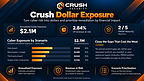
Crush Dollar Exposure changes the decision-making process by evaluating security gaps through their estimated contribution to financial risk. The capability provides four principal measurements:
Annualized Financial Exposure: An estimate of potential annual cyber losses, expressed in dollars.Financial Exposure Relative to Revenue: A view of modeled cyber exposure in relation to the organization’s annual revenue, providing business context.Value-at-Risk Analysis: Potential loss thresholds at selected probability levels, supported by loss-exceedance curves that illustrate the range of possible financial outcomes.Financially Prioritized Remediation: Security control gaps ranked by their modeled contribution to financial exposure, helping teams identify where remediation may reduce the most risk.
Rather than simply reporting that a security control is missing or a vulnerability is critical, Crush Dollar Exposure helps organizations understand the potential financial consequences and prioritize corrective action accordingly.
Connecting Every Security Gap to Business Impact
One of the capability’s key differentiators is its ability to connect security control weaknesses to modeled loss scenarios and financial consequences.
For example, a security team evaluating investments in identity protection, endpoint security and vulnerability remediation can use the model to determine which weaknesses contribute most significantly to estimated financial exposure. This allows security leaders to move beyond asking which problem is technically most severe and begin asking which investment is likely to provide the greatest financial risk reduction.
The analysis also connects control gaps to underlying loss scenarios, helping organizations understand how multiple weaknesses may contribute to the same business risk. For CFOs and executive teams, this provides a more financially grounded way to evaluate cybersecurity spending. For CISOs, it creates a defensible framework for explaining security priorities and communicating their potential business impact.
Transparent, Reproducible Risk Modeling — Not a Black-Box AI Score
Crush Dollar Exposure uses a quantitative methodology informed by the Factor Analysis of Information Risk (FAIR) framework and Monte Carlo simulation to model possible financial losses.
The methodology incorporates security control coverage, industry-relevant threat activity, recognized adversary techniques, organizational characteristics and established financial loss reference data.
Unlike opaque risk-scoring approaches, the capability is designed to make the assumptions, data inputs and modeled loss scenarios underlying its financial estimates visible and reviewable. Although Crush Security’s broader platform includes Cassandra, its AI-powered security advisor, the financial risk calculations themselves rely on defined quantitative modeling rather than generative AI.
The capability distinguishes between uncertainty in modeled financial outcomes and confidence in the quality of supporting data, helping executives understand both the estimated exposure and the limitations of the underlying analysis. This transparency is intended to support repeatable analysis, auditability and more defensible conversations with boards, regulators and financial stakeholders.
Giving CISOs and CFOs a Common Language
“Cybersecurity leaders are constantly asked to justify their budgets, but we’re still presenting information to boards that doesn’t directly answer the questions they’re asking,” said Josh Jones, CEO and Co-Founder of Crush Security. “Boards don’t just want to know how many vulnerabilities you have or how many security tools you’ve deployed. They want to understand what the risk could cost the business, where their money is going, and whether those investments are making a measurable difference.”
“With Crush Dollar Exposure, we’re connecting cybersecurity decisions to financial outcomes. Our goal is to give every CISO the ability to walk into a board meeting and explain their organization’s estimated financial exposure, identify the gaps driving it, and show which actions have the greatest potential to reduce that risk.” -Joshua Jones, CEO-
Built on the Crush Security Intelligence Platform
Crush Dollar Exposure extends Crush Security’s intelligence platform, which brings together vendor, control, compliance and threat data to support security investment decisions.
Powered by Cassandra, the platform helps organizations identify coverage gaps, compare technology and vendors, and optimize cybersecurity spending.
Risk calculations are performed within each customer’s data environment, with customer-specific information remaining within its designated security boundary. Anonymized and aggregated industry reference information supports comparative risk modeling.
Availability
Crush Dollar Exposure is available now within the Crush Security platform. Organizations interested in quantifying their financial cyber exposure, evaluating remediation priorities or scheduling a demonstration can visit www.CrushSecurity.com. Access information is available directly from Crush Security.
About Crush Security
Crush Security is a veteran-owned cybersecurity technology and advisory company headquartered in Scottsdale, Arizona.
Its proprietary intelligence platform, advisory services and cybersecurity procurement data help customers make data-driven technology purchasing decisions leveraging Crush Security’s resell capabilities.
Cassandra, its AI-powered advisor, unifies security, vendor and compliance intelligence to identify gaps, optimize investments, quantify risk and evaluate solutions to shorten the decision time and accuracy for each project.
Crush Security’s core intelligence platform is currently included at no separate subscription cost with eligible customer engagements.
Website: www.CrushSecurity.com
View original content to download multimedia:https://www.prnewswire.com/news-releases/crush-security-launches-crush-dollar-exposure-turning-cyber-risk-into-dollars-and-showing-which-security-investments-reduce-it-most-302914088.html
SOURCE Crush Security Group Inc
CollectivIQ Introduces GigaBrain, Giving Enterprises a Shared Brain That Gets Smarter as Employees Work
Pactum Launches Intake Agent, Cutting Purchase Request Cycle Time by 90%
Crush Security Launches Crush Dollar Exposure, Turning Cyber Risk Into Dollars and Showing Which Security Investments Reduce It Most
Send Rakhi to UK swiftly with UK Gifts Portal
Whiteboard Series with NEAR | Ep: 45 Joel Thorstensson from ceramic.network
Nullmax and Renesas Forge Strategic Partnership to Deliver Competitive ADAS Solutions for the Global Market
Why You Should Build on #NEAR – Co-founder Illia Polosukhin at CV Labs
Whiteboard Series with NEAR | Ep: 45 Joel Thorstensson from ceramic.network
NEAR End of Year Town Hall 2021: The Open Web World, MetaBUILD 2 Hackathon and 2021 recap
Trending
-
Technology4 days agoHighland and Bath Counties, Virginia Go Live on a Shared Caliber Hosted CAD Environment
-
Coin Market5 days agoBitcoin price steadies around $82K after Fed’s Warsh avoids rate-hike hints
-
Technology4 days agoJinkoSolar Unveils Tiger Neo 5.0 All-Black Residential Solar Module with 25.52% Efficiency
-
Near Videos4 days agoWhat if you could build a skyscraper with one prompt?
-
Technology4 days agoBioethanol from human hair – Indian start-up’s solution to rising prices of grains and sugar
-
Technology5 days agoRecognize Runs ‘What’s the Point?’ Billboard Campaign in Times Square and Downtown LA
-
Technology5 days agoWink Introduces AI HD Video Converter for 4K, Scene-Aware Video Enhancement
-
Technology5 days agoPayment Processing Expert Eric Miltner Explains How eCheck Payments Improve Efficiency for Small Businesses in HelloNation