Connect with us

Technology

Workforce Management Software Market to grow by USD 3.67 Billion (2025-2029), driven by regulatory compliance, Report on AI impact on market trends – Technavio

Published

on

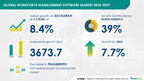
NEW YORK, Jan. 29, 2025 /PRNewswire/ — Report on how AI is redefining market landscape – The global workforce management software market size is estimated to grow by USD 3.67 billion from 2025-2029, according to Technavio. The market is estimated to grow at a CAGR of  8.4%  during the forecast period. Regulatory compliance associated with workforce management is driving market growth, with a trend towards rising adoption of digital hr technology. However, high implementation and maintenance cost  poses a challenge. Key market players include ActiveOps PLC, Advanced Computer Software Group Ltd., ATOSS Software AG, Automatic Data Processing Inc., Bamboo HR LLC, Ceridian HCM Holding Inc., International Business Machines Corp., Koch Industries Inc., NICE Ltd., Oracle Corp, Panasonic Holdings Corp., Paycor HCM Inc., PTC Inc., Rippling People Center Inc., Sage Group Plc, SAP SE, UKG Inc., Verint Systems Inc., Workday Inc., and Zoho Corp. Pvt. Ltd..

Key insights into market evolution with AI-powered analysis. Explore trends, segmentation, and growth drivers- View Free Sample PDF

Workforce Management Software Market Scope

Report Coverage

Details

Base year

2024

Historic period

2019 – 2023

Forecast period

2025-2029

Growth momentum & CAGR

Accelerate at a CAGR of 8.4%

Market growth 2025-2029

USD 3673.7 million

Market structure

Fragmented

YoY growth 2022-2023 (%)

7.7

Regional analysis

North America, Europe, APAC, Middle East and Africa, and South America

Performing market contribution

North America at 39%

Key countries

US, China, UK, Germany, Canada, France, Japan, South Korea, Saudi Arabia, and Brazil

Key companies profiled

ActiveOps PLC, Advanced Computer Software Group Ltd., ATOSS Software AG, Automatic Data Processing Inc., Bamboo HR LLC, Ceridian HCM Holding Inc., International Business Machines Corp., Koch Industries Inc., NICE Ltd., Oracle Corp, Panasonic Holdings Corp., Paycor HCM Inc., PTC Inc., Rippling People Center Inc., Sage Group Plc, SAP SE, UKG Inc., Verint Systems Inc., Workday Inc., and Zoho Corp. Pvt. Ltd.

Market Driver

The Workforce Management Software market is experiencing significant growth due to the increasing trend of remote work and the need for efficient Employee Management, Labor Management, and HR Management in various industries. Healthcare, Construction, Packaging, Aerospace, and Manufacturing sectors are major end-users. Cloud computing, including private cloud, is a key trend, ensuring process transparency and scalability. Workforce prediction, scheduling, task management, rewards, and time and attendance are essential features. HR activities such as employee training and labor laws compliance are also critical. Workforce optimization through AI, Machine Learning, and predictive analytics is driving productivity in contact centers, back offices, Energy and Utilities, and IT resources. Remote workforces, including in-store employees, field service providers, and hybrid workforces, require effective workforce management solutions. Vendors offer cloud adoption, big data, budgeting, workforce scheduling, workforce analytics, fatigue management, and resource allocation. Mobile applications, labor regulations, and time tracking are other important aspects. The market continues to evolve, focusing on digital solutions, accessibility, and compliance. 

Organizations are leveraging mobile technology to enhance the employee experience by digitalizing HR processes. Mobile apps, social media, analytics, and cloud technologies are key drivers of this transformation. Employees now prefer using mobiles for work, blurring the lines between personal and professional life. Digital HR technology offers a unified platform for integrating these technologies, enabling organizations to design mobile apps for HR functions and provide innovative solutions using video, social, and mobile technologies. By adopting digital HR, companies can streamline HR processes, improve candidate and employee experience, and stay competitive in today’s digital world. 

Request Sample of our comprehensive report now to stay ahead in the AI-driven market evolution!

Market Challenges

The Workforce Management Software market is experiencing significant growth due to the increasing challenges in managing remote workforces, particularly in sectors like healthcare, construction, and manufacturing. Employee management, labor management, and HR management software are in high demand for scheduling, task management, time and attendance, and rewards. Business operations require workforce prediction, scheduling optimization, and labor analytics for forecasting and budgeting. Cloud computing, including private cloud, offers process transparency and scalability. The employment-to-population ratio influences the need for workforce optimization in sectors like contact centers, back offices, energy and utilities, and IT resources. Compliance with labor laws is crucial, and workforce management vendors provide solutions for mobile applications, in-store employees, field service providers, and employee training. AI and machine learning enhance productivity, customer service, and workforce analytics. The market also caters to industry-specific needs such as aerospace, bio-based adhesives, and the packaging end-user segment.The cost of implementing workforce management software is a significant barrier for many organizations in the market. This expense consists of the software license fee, system design and customization charges, implementation costs, employee training expenses, and ongoing maintenance fees. After acquiring the software license, companies must hire IT personnel for successful implementation. Furthermore, employees need to be trained on how to effectively utilize the application. Post-implementation, continuous upgrades are necessary to stay competitive in the market. Consequently, high implementation and maintenance costs may impede the expansion of the global workforce management software market during the forecast period.

Discover how AI is revolutionizing market trends- Get your access now!

Segment Overview 

This workforce management software market report extensively covers market segmentation by  

End-user 1.1 IT and telecom1.2 BFSI1.3 Healthcare1.4 Manufacturing1.5 OthersDeployment 2.1 Cloud based2.2 On-premisesGeography 3.1 North America3.2 Europe3.3 APAC3.4 Middle East and Africa3.5 South AmericaType

1.1 IT and telecom-  Telecom and IT companies are shifting their focus towards workforce management technologies to effectively attract, hire, develop, and retain the necessary talent to meet their organizational goals. The increasing use of independent contractors and freelancers, along with industry mergers and acquisitions, are driving the implementation of workforce management software in HR functions. This software enables telecom and IT organizations to analyze data related to talent needs, competency gaps, and workforce patterns, using advanced technologies like AI, ML, and NLP. The growing volume of data requires efficient management to guide talent management teams and enable informed decision-making. Predictive analytics is being used to identify future skill sets and prioritize recruitment workflows. Workforce management software is essential for telecom and IT companies to efficiently manage their workforce, reduce costs, and maintain a competitive advantage.

Download a Sample of our comprehensive report today to discover how AI-driven innovations are reshaping competitive dynamics

Research Analysis

The Workforce Management Software market is a dynamic and evolving industry that caters to businesses seeking to optimize their workforce and streamline operations. This software solutions segment includes Remote Work, Healthcare, Employee Management, Labor Management, and Staff Management systems. These tools enable businesses to effectively schedule and manage their workforce, predict workforce needs, and optimize task management. Mobile applications are increasingly popular for in-store employees and field service providers, offering real-time access to employee data and scheduling. Workforce optimization also includes employee training, labor analytics, forecasting, and scheduling optimization. Big data, AI, and predictive analytics are integral components, providing valuable insights for productivity, customer service, IT resources, and compliance with labor laws. Businesses can leverage these solutions to manage hybrid workforces, ensuring efficient time tracking and adherence to regulations. Business Intelligence solutions and contact center platforms further enhance workforce management capabilities.

Market Research Overview

The Workforce Management Software market is experiencing significant growth due to the increasing trend of remote work and the need for efficient Employee Management, Labor Management, and HR Management in various industries. The market caters to Business Operations in sectors like Healthcare, Construction, Packaging, Aerospace, Energy and Utilities, Manufacturing, and Contact Centers, among others. These solutions offer features such as workforce prediction, scheduling, task management, rewards, and time and attendance tracking. They also provide labor analytics, forecasting, and scheduling optimization using Big Data and AI technologies. Cloud computing, including private cloud solutions, ensures process transparency and scalability. The market also addresses the challenges of employment-to-population ratios, labor regulations, and resource allocation. It serves in-store employees, field service providers, and IT resources, enabling workforce optimization through mobile applications, employee training, and fatigue management. The market is witnessing increased adoption of digital solutions, AI, and predictive analytics for business intelligence and workforce management in hybrid workforces.

Table of Contents:

1 Executive Summary
2 Market Landscape
3 Market Sizing
4 Historic Market Size
5 Five Forces Analysis
6 Market Segmentation

End-userIT And TelecomBFSIHealthcareManufacturingOthersDeploymentCloud BasedOn-premisesGeographyNorth AmericaEuropeAPACMiddle East And AfricaSouth AmericaType

7 Customer Landscape
8 Geographic Landscape
9 Drivers, Challenges, and Trends
10 Company Landscape
11 Company Analysis
12 Appendix

About Technavio

Technavio is a leading global technology research and advisory company. Their research and analysis focuses on emerging market trends and provides actionable insights to help businesses identify market opportunities and develop effective strategies to optimize their market positions.

With over 500 specialized analysts, Technavio’s report library consists of more than 17,000 reports and counting, covering 800 technologies, spanning across 50 countries. Their client base consists of enterprises of all sizes, including more than 100 Fortune 500 companies. This growing client base relies on Technavio’s comprehensive coverage, extensive research, and actionable market insights to identify opportunities in existing and potential markets and assess their competitive positions within changing market scenarios.

Contacts

Technavio Research
Jesse Maida
Media & Marketing Executive
US: +1 844 364 1100
UK: +44 203 893 3200
Email: media@technavio.com
Website: www.technavio.com/

View original content to download multimedia:https://www.prnewswire.com/news-releases/workforce-management-software-market-to-grow-by-usd-3-67-billion-2025-2029-driven-by-regulatory-compliance-report-on-ai-impact-on-market-trends—technavio-302362879.html

SOURCE Technavio

Continue Reading
Click to comment

Leave a Reply

Your email address will not be published. Required fields are marked *

Technology

X Square Robot Unveils New Embodied AI Model, Says Robots Will Arrive in Homes in 35 Days

Published

on

By

Backed by Alibaba, ByteDance, Xiaomi and Meituan, X Square Robot unveiled a next-generation embodied AI foundation model for home robots and said its first deployments in everyday households will begin within 35 days.

BEIJING, April 23, 2026 /PRNewswire/ — X Square Robot on Tuesday unveiled Wall-B, a new embodied AI foundation model designed for deployment in real-world homes, marking what the company described as a major step toward bringing general-purpose robots into daily family life.

At a launch event themed “Born to Bot, Bot to Family,” the company also introduced its World Unified Model (WUM) architecture, a training framework that combines vision, language, action and physical prediction within a single system from the outset. X Square said the model is intended to help robots operate in the far more unpredictable setting of a home, where tasks, layouts and interactions vary from moment to moment.

“Robots in factories and robots in homes are fundamentally different,” said Qian Wang, founder and CEO of X Square Robot. “In factories, they repeat the same action 10,000 times. In a home, they may need to perform 10,000 different actions, each in a different context. The real challenge is not repetition, but whether a robot can execute new, untrained actions in an unstructured environment.”

Wall-B is the company’s first full implementation of its World Unified Model architecture. Unlike modular systems that train perception, language and control separately, X Square Robot said World Unified Model optimizes those capabilities jointly from the very beginning. The company said that allows physical prediction — including force, friction and collision dynamics — to emerge as part of the model itself, rather than being layered on afterward.

“We train vision, language, action and prediction in the same network from day one,” said Wang Hao, chief technology officer of X Square. “Human infants do not learn to see, move and communicate in isolated stages. They learn by integrating perception and action at the same time, with constant feedback from the physical world. That is the principle behind our architecture.”

X Square Robot said the model was built on two core foundations. The first is a data strategy centered on real, non-staged home environments, aimed at exposing the system to the long tail of household scenarios — misplaced objects, temporary occlusion, unexpected obstacles and spontaneous human activity. The second is a physics-aware predictive mechanism that enables the robot to anticipate physical outcomes before taking action, rather than merely reacting after contact occurs.

Together, those elements are meant to narrow one of robotics’ hardest gaps: moving from controlled demos to reliable performance in live environments. The company said its work on physical robotic platforms has helped it accumulate practical experience in bridging simulation and reality across diverse operating conditions.

At the event, X Square demonstrated a series of live tasks. In one experience zone, a robot arranged flowers while adjusting its grip and motion in real time as stems shifted position under visual occlusion. The task was completed without pre-set trajectories, according to the company, and drew attention from both domestic and international media attending the event.

Even so, X Square acknowledged that the technology remains early. Wang said current systems can make mistakes that require remote intervention — such as placing slippers in the kitchen or pausing mid-task to process the next action. But he said the robots’ ability to operate continuously and generate new real-world data around the clock gives the system a path to rapid improvement.

That learning loop is central to the company’s next milestone: within 35 days, X Square plans to place its robots into everyday homes, underscoring the company’s long-term commitment to the home robotics sector.

Photo – https://mma.prnewswire.com/media/2963913/X_Square_Robot.jpg


View original content:https://www.prnewswire.co.uk/news-releases/x-square-robot-unveils-new-embodied-ai-model-says-robots-will-arrive-in-homes-in-35-days-302751058.html

Continue Reading

Technology

Manhattan Associates Announces Latest Enhancements for Retailers

Published

on

By

SYDNEY, April 23, 2026 /PRNewswire/ — Manhattan Associates (NASDAQ: MANH), the global leader in supply chain commerce with unmatched AI capabilities, today announced major enhancements to Manhattan Active® Omni. These innovations are designed to help retailers maximise in-store and online sales while delivering best-in-class customer experiences across all touchpoints. New capabilities include embedded agentic AI for store associates and customer service teams, real-time sales, and fulfilment insights delivered natively within the user experience, and brand-new capabilities focused on maximising both revenue and profit when shipping from stores.

Manhattan announced commercial availability of three new AI agents, a Store Associate Agent, a Contact Centre Agent, and an OMS Configuration Agent, all available within the Manhattan Active Omni user interface, to support retailers’ selling and service teams. Using a natural language interface, these agents deliver immediate, actionable insights into store activity, sales trends, inventory, returns, and customer behaviour, helping associates and customer service teams resolve issues faster and provide more personalised support.

“Retailers are under constant pressure to move faster, operate smarter, and deliver seamless experiences across every touchpoint,” said Brian Kinsella, SVP of Product Management at Manhattan Associates. “Our latest updates reflect Manhattan’s ongoing commitment to delivering cutting edge artificial intelligence within our applications. Whether it’s the myriad machine learning algorithms present for years or our new Agentic AI and Fulfilment Simulation capabilities, we’ve long believed true AI needs to live within rather than alongside our applications. We’re proud to partner with a number of world class retailers on the design and development of these breakthrough technologies.”

Along with the newly announced agentic AI innovations, Manhattan Active® Point of Sale continues to advance with Customer Facing Display, a powerful new enhancement that brings shoppers into the checkout experience. Customers can view their cart in real time, attach their loyalty information to a transaction, enter shipping details, and choose how they’d like to receive their receipt, all from a dedicated display. Retailers can also capture additional customer input, ensuring greater accuracy and faster transactions at the point of sale, bridging the gap between associates and shoppers, and delivering a smoother, more engaging checkout experience.

Additionally, the Fulfilment Optimisation Simulation engine enables enterprises to model and compare alternative fulfilment strategies by balancing cost, speed, service level, and margin. It provides data-driven insights into split shipments, total fulfilment costs, location-level distribution, and key KPIs using a consistent set of orders for each strategy. Users can easily adjust optimisation rules, rerun simulations, and compare results side-by-side to understand the true impact of each change. The engine also supports “what if” scenario planning – allowing teams to anticipate constraints, evaluate operational shifts, and analyse trade-offs in a fully self-serve manner. By replaying historical or selected orders, businesses can continuously optimise fulfilment, uncover new savings, and drive meaningful performance improvements.

Together, these innovations reflect Manhattan’s continued focus on delivering practical, enterprise-ready advancements that help retailers move faster and operate with greater confidence.

Receive up-to-date product, customer and partner news directly from Manhattan on LinkedIn.

ENDS

ABOUT MANHATTAN ASSOCIATES:

Manhattan Associates is a global technology leader, providing supply chain and omnichannel commerce solutions with unmatched AI capabilities. We design, build and offer best-in-class, AI-powered, cloud-based solutions that drive resilience and efficiency for businesses. We enable enterprises to uniquely unify front-end sales with back-end supply chain execution.

Our commitment to innovation, cloud-native platform and API-first architecture create simpler experiences and faster paths to value for our customers. We empower them to preempt and react to emerging trends and global disruptions with technical expertise and operational confidence, transforming challenges into competitive advantage. For more information, please visit www.manh.com.

View original content:https://www.prnewswire.com/apac/news-releases/manhattan-associates-announces-latest-enhancements-for-retailers-302751061.html

SOURCE Manhattan Associates

Continue Reading

Technology

Global Telecom Leaders to Convene in Singapore for Definitive Summit on AI-Native Transformation and Industry Reinvention

Published

on

By

SINGAPORE, April 23, 2026 /PRNewswire/ — Twimbit, the global research and advisory firm, has finalized the strategic agenda for the Twimbit Telecom Summit & Awards 2026, scheduled for 21 May 2026 at the Capitol Theatre, Singapore. This high-level forum serves as a catalyst for addressing the shift toward AI-native architectures and digital sovereignty.

As the telecommunications sector moves beyond traditional connectivity toward a ‘Techco’ model, the 2026 summit will provide a framework for navigating margin pressure through structural innovation, with insights on ROIC growth, EBITDA optimization, and the integration of generative technologies into core business functions.

Architects of the Industry: Featured Perspectives

The 2026 summit features a curated lineup of visionaries redefining the telecom blueprint:

Soma Velayutham, VP Telecoms & AI, NvidiaWong Soon Nam, Chief Planning and Transformation Officer, TelekomselRajesh Chandiramani, CEO, ComvivaVikram Sinha, CEO, Indosat Ooredoo HutchisonAayush Bhatnagar, Chief Technology Development Officer, JioUlf Ewaldsson, Advisor, Indosat (Former President of Technology, T-Mobile)Juhi McClelland, Managing Partner, IBM Consulting APACManoj Menon, Founder & CEO, Twimbit

Strategic Forum: The Telecom Summit (08:00 – 14:35)

Designed as a high-impact leadership forum, the morning sessions will address three critical levers for telco success in 2026:

Accelerating the AI-Native Core: Leveraging generative AI to rebuild network operations and customer service modelsDigital Sovereignty & Infrastructure: Navigating data residency and localized AI infrastructure for competitive advantageGrowth Engineering & Customer Experience: Implementing high-touch service philosophies to drive customer lifetime value

The Recognition Gala: Twimbit Telecom Awards (17:00 – Late)

The day concludes with a prestigious black-tie awards ceremony, celebrating organisations and leaders demonstrating innovation and strategic transformation, using Twimbit’s proprietary research frameworks across Asia-Pacific.

Strategic Partnerships and Support

The event is supported by industry leaders. F5 joins as Strategic Partner, while Nokia and Comviva serve as Gold Sponsors, highlighting the role of secure infrastructure, customer experience, and digital financial solutions.

“We are at a point where incremental change is no longer sufficient,” said Manoj Menon, Founder & CEO of Twimbit. “This summit is about the reinvention of the telecom business model and providing a roadmap for leaders to architect the next era of digital intelligence.”

About Twimbit

A global tech and advisory firm powering customer success through research, innovation and community, Twimbit provides actionable insights that fuel innovation and growth through its proprietary research platform.

Media Contacts:
Vansh Sehgal
vansh@twimbit.com 

Photo: https://mma.prnewswire.com/media/2960475/Twimbit_Awards.jpg
Logo: https://mma.prnewswire.com/media/2960480/Twimbit_Logo.jpg


View original content:https://www.prnewswire.co.uk/news-releases/global-telecom-leaders-to-convene-in-singapore-for-definitive-summit-on-ai-native-transformation-and-industry-reinvention-302750208.html

Continue Reading

Trending