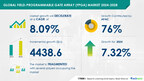
NEW YORK, Jan. 31, 2025 /PRNewswire/ — Report on how AI is driving market transformation – The global field-programmable gate array (FPGA) market size is estimated to grow by USD 4.44 billion from 2024-2028, according to Technavio. The market is estimated to grow at a CAGR of over 8.09% during the forecast period. High adoption of smartphones and tablets globally is driving market growth, with a trend towards increased proliferation of IoT. However, cloning concerns in fpga design poses a challenge. Key market players include Achronix Semiconductor Corp., Advanced Micro Devices Inc., Berkshire Hathaway Inc., Broadcom Inc., Efinix Inc., Flex Logix Technologies Inc., GlobalSpec LLC, GOWIN Semiconductor Corp., Infineon Technologies AG, Intel Corp., iWave Systems Technologies Pvt. Ltd., Lattice Semiconductor Corp., Menta SAS, Microchip Technology Inc., NXP Semiconductors NV, QuickLogic Corp., Siemens AG, Silicon Creations, SoftBank Group Corp., and Synopsys Inc..
Key insights into market evolution with AI-powered analysis. Explore trends, segmentation, and growth drivers- View Free Sample PDF
Field-Programmable Gate Array (Fpga) Market Scope
Report Coverage
Details
Base year
2023
Historic period
2018 – 2022
Forecast period
2024-2028
Growth momentum & CAGR
Decelerate at a CAGR of 8.09%
Market growth 2024-2028
USD 4438.6 million
Market structure
Fragmented
YoY growth 2022-2023 (%)
7.32
Regional analysis
APAC, North America, Europe, South America, and Middle East and Africa
Performing market contribution
APAC at 76%
Key countries
China, South Korea, US, Japan, and Germany
Key companies profiled
Achronix Semiconductor Corp., Advanced Micro Devices Inc., Berkshire Hathaway Inc., Broadcom Inc., Efinix Inc., Flex Logix Technologies Inc., GlobalSpec LLC, GOWIN Semiconductor Corp., Infineon Technologies AG, Intel Corp., iWave Systems Technologies Pvt. Ltd., Lattice Semiconductor Corp., Menta SAS, Microchip Technology Inc., NXP Semiconductors NV, QuickLogic Corp., Siemens AG, Silicon Creations, SoftBank Group Corp., and Synopsys Inc.
Market Driver
The FPGA market is experiencing significant growth in the semiconductor industry, driven by the demand for configurable logic blocks and programmable interconnects. FPGAs are digital integrated circuits that offer customizable logic functions through programmable and reprogrammable programmable logic elements, including logic gates and flip-flops. This flexibility makes FPGAs ideal for various application categories, such as telecom, data processing centers, automotive, aerospace and defense, consumer electronics, and emerging technologies like artificial intelligence and machine learning. Key trends in the FPGA market include low power consumption, high compute density, and continuous evolution to meet the needs of OEMs and end-users. Flash-based FPGAs are gaining popularity due to their lower NRE costs and shorter turnaround times. FPGAs are being used in smart cities for deep packet inspection and network processing, as well as in wearables, handheld devices, mobile applications, cloud service providers, and telecom segment for 5G and hardware acceleration. The FPGA architecture is also being used in specialized expertise areas like driver safety, autonomous driving, infotainment, and cockpit applications. The telecom sector, data processing applications, and application-specific integrated circuits (ASICs) are also significant markets for FPGAs. The FPGA market is expected to grow further due to the increasing demand for low power consumption, high-performance computing, and longer design cycles in various industries.
The Internet of Things (IoT) market encompasses a vast array of applications, from smart consumer electronics to wearables and automobiles. For individuals, IoT offers affordable and efficient devices to streamline daily tasks. Businesses, on the other hand, can benefit from optimized automation processes, improved inventory management, enhanced energy efficiency, and heightened security. In 2020, over 8.5 billion IoT devices were in use globally, with this number projected to exceed 25 billion by 2030. Designers face challenges in implementing IoT solutions, including power efficiency, compatibility with inadequate interfaces, and the need to accommodate future growth and performance demands.
Request Sample of our comprehensive report now to stay ahead in the AI-driven market evolution!
Market Challenges
The FPGA market is thriving in the semiconductor industry, offering configurable logic blocks and programmable interconnects as alternatives to Integrated Circuits (ICs) like PROM, ASIC, EEPROM, SRAM, Flash, and EPROM. FPGAs are programmable and reprogrammable, making them customizable for various logic functions and digital signal processing applications. The telecom sector, smart cities, and emerging technologies such as deep packet inspection, network processing, security, and 5G are major application categories driving the market. Mid-range FPGAs are popular for wearables, handheld, and mobile applications, while flash-based FPGAs cater to high-performance computing and data processing centers. OEMs in automotive, aerospace and defense, consumer electronics, and emerging technologies like artificial intelligence, machine learning, and the Internet of Things rely on FPGAs for hardware acceleration. The FPGA architecture’s low power consumption and high compute density make it ideal for remote work, online learning, telemedicine, and cloud service providers. Continuous evolution, lower power consumption, and shorter design cycles are key advantages, making FPGAs a valuable investment for businesses.FPGA market competition is intensifying, with manufacturers focusing on protecting their intellectual property. FPGA designs are easily replicable, leading vendors to implement Physical Unclonable Functions (PUFs) since 2002. PUFs are one-way functions added to the production process, creating unique outputs that are challenging to replicate. Altera, for instance, offers Stratix chips with side-channel attack protection through an on-chip service device manager. These advancements enable FPGA manufacturers to provide innovative technology while safeguarding their intellectual property.
Discover how AI is revolutionizing market trends- Get your access now!
Segment Overview
This field-programmable gate array (fpga) market report extensively covers market segmentation by
Type 1.1 High-end FPGA1.2 Mid-end FPGA1.3 Low-end FPGAApplication 2.1 Telecommunication2.2 Industrial2.3 Automotive2.4 Consumer electronics2.5 OthersGeography 3.1 APAC3.2 North America3.3 Europe3.4 South America3.5 Middle East and Africa
1.1 High-end FPGA- High-end FPGAs, featuring millions of logic cells, have expanded their application beyond telecommunications to military and broadcast industries. Intel’s Stratix series, such as the Stratix-II, offers advanced security features like bitstream encryption for design protection. Vendors like Intel and Xilinx are launching new high-end FPGAs to meet growing demand. Security concerns are driving the high-end FPGA market, with Stratix-II’s encryption being a notable example. These developments are expected to significantly contribute to the global FPGA market growth during the forecast period.
Download a Sample of our comprehensive report today to discover how AI-driven innovations are reshaping competitive dynamics
Research Analysis
The Field-Programmable Gate Array (FPGA) market refers to the business sector focused on designing, manufacturing, and selling FPGAs, which are digital integrated circuits that can be programmed and reprogrammed to implement custom logic functions. FPGAs consist of configurable logic blocks and programmable interconnects, allowing for high compute density and low power consumption. They are used in various applications, including deep packet inspection, network processing, security, and digital signal processing, among others. FPGAs offer customizability and flexibility, making them suitable for wearables, handheld devices, mobile applications, cloud service providers, and more. Unlike Programmable Read-Only Memories (PROM), FPGAs are programmable and reprogrammable, making them more versatile than Application-Specific Integrated Circuits (ASICs), EPROMs, EEPROMs, SRAMs, Flash, and other memory types. FPGAs are essential for data processing applications due to their high performance and ability to implement complex logic functions using programmable logic elements, including logic gates and flip-flops.
Market Research Overview
The Fpga market is a dynamic segment of the semiconductor industry, characterized by its configurable logic blocks and programmable interconnects. FPGAs are integrated circuits that offer the flexibility of a Programmable Read-Only Memory (PROM), Application-Specific Integrated Circuits (ASIC), Electrically Erasable Programmable Read-Only Memory (EEPROM), Static Random Access Memory (SRAM), Flash, or Erasable Programmable Read-Only Memory (EPROM), but with the added benefit of being programmable and reprogrammable. FPGAs consist of programmable logic elements, including logic gates and flip-flops, that can be customized to perform various logic functions, digital signal processing, and data processing applications. The market caters to diverse industries, including telecom, smart cities, wearables, handheld, mobile applications, cloud service providers, and more. FPGAs are integral to network processing, deep packet inspection, security, and other applications due to their low power consumption, high compute density, and continuous evolution. The telecom sector, automotive, aerospace and defense, consumer electronics, and emerging technologies such as artificial intelligence, machine learning, and the Internet of Things, all benefit from FPGAs. Mid-range FPGAs are increasingly popular, and flash-based FPGAs are gaining traction. The semiconductor industry’s longer design cycles and the need for specialized expertise contribute to the market’s growth. Applications in high-performance computing, antifuse, data processing, telecom segments, and 5G further expand the market’s potential.
Table of Contents:
1 Executive Summary
2 Market Landscape
3 Market Sizing
4 Historic Market Size
5 Five Forces Analysis
6 Market Segmentation
TypeHigh-end FPGAMid-end FPGALow-end FPGAApplicationTelecommunicationIndustrialAutomotiveConsumer ElectronicsOthersGeographyAPACNorth AmericaEuropeSouth AmericaMiddle East And Africa
7 Customer Landscape
8 Geographic Landscape
9 Drivers, Challenges, and Trends
10 Company Landscape
11 Company Analysis
12 Appendix
About Technavio
Technavio is a leading global technology research and advisory company. Their research and analysis focuses on emerging market trends and provides actionable insights to help businesses identify market opportunities and develop effective strategies to optimize their market positions.
With over 500 specialized analysts, Technavio’s report library consists of more than 17,000 reports and counting, covering 800 technologies, spanning across 50 countries. Their client base consists of enterprises of all sizes, including more than 100 Fortune 500 companies. This growing client base relies on Technavio’s comprehensive coverage, extensive research, and actionable market insights to identify opportunities in existing and potential markets and assess their competitive positions within changing market scenarios.
Contacts
Technavio Research
Jesse Maida
Media & Marketing Executive
US: +1 844 364 1100
UK: +44 203 893 3200
Email: media@technavio.com
Website: www.technavio.com/
View original content to download multimedia:https://www.prnewswire.com/news-releases/field-programmable-gate-array-fpga-market-to-grow-by-usd-4-44-billion-2024-2028-boosted-by-high-adoption-of-smartphones–tablets-with-market-evolution-powered-by-ai—technavio-302364768.html
SOURCE Technavio









 Technology3 days ago
 Technology3 days ago
 Technology3 days ago
 Coin Market4 days ago
 Technology3 days ago
 Near Videos4 days ago
 Coin Market4 days ago
 Technology4 days ago