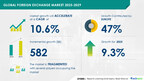
NEW YORK, Feb. 7, 2025 /PRNewswire/ — Report with market evolution powered by AI – The global foreign exchange market size is estimated to grow by USD 582 billion from 2025-2029, according to Technavio. The market is estimated to grow at a CAGR of 10.6% during the forecast period. Growing urbanization and digitalization is driving market growth, with a trend towards 24×7 trading opportunities for foreign exchange. However, uncertainty of future exchange rates poses a challenge. Key market players include Bank of America Corp., Barclays PLC, BNP Paribas SA, Citigroup Inc., Commonwealth Bank of Australia, DBS Bank Ltd, Deutsche Bank AG, HSBC Holdings Plc, JPMorgan Chase and Co., London Stock Exchange Group plc, NatWest Group plc, Societe Generale SA, Standard Chartered PLC, State Street Corp., The Bank of Nova Scotia, The Goldman Sachs Group Inc., UBS Group AG, and XTX Markets Ltd..
Key insights into market evolution with AI-powered analysis. Explore trends, segmentation, and growth drivers- View Free Sample PDF
Foreign Exchange Market Scope
Report Coverage
Details
Base year
2024
Historic period
2019 – 2023
Forecast period
2025-2029
Growth momentum & CAGR
Accelerate at a CAGR of 10.6%
Market growth 2025-2029
USD 582 billion
Market structure
Fragmented
YoY growth 2022-2023 (%)
9.3
Regional analysis
North America, Europe, APAC, South America, and
Middle East and Africa
Performing market contribution
Europe at 47%
Key countries
US, UK, Canada, China, Germany, Switzerland,
Japan, India, Brazil, and UAE
Key companies profiled
Bank of America Corp., Barclays PLC, BNP
Paribas SA, Citigroup Inc., Commonwealth Bank of
Australia, DBS Bank Ltd, Deutsche Bank AG,
HSBC Holdings Plc, JPMorgan Chase and Co.,
London Stock Exchange Group plc, NatWest
Group plc, Societe Generale SA, Standard
Chartered PLC, State Street Corp., The Bank of
Nova Scotia, The Goldman Sachs Group Inc., UBS
Group AG, and XTX Markets Ltd.
Market Driver
The Foreign Exchange Market, also known as Forex, is a global market where currencies are bought and sold. Financial institutions and non-financial customers, including individuals, retailers, corporate institutes, and multinational corporations, participate in this market for various reasons. Currency swaps, international trade, interest rate differentials, monetary interventions, speculation, investment flows, and economic indicators are some of the trends influencing Forex. Political developments, risk appetite, inflationary pressures, and geopolitical risks also impact the market. Retail forex trading, international transactions, and currency exchange services are accessible to individuals and small businesses through modern technology and trading platforms. Central banks, monetary policies, regulations, and inflation are key factors affecting Forex rates. Major currency pairs like EUR/USD, GBP/USD, and USD/JPY have high trading volume, with interbank networks and electronic platforms ensuring efficiency in 24-hour operations. Corporates, hedge funds, wealth managers, and foreign exchange services offer advisory services, trading programs, and remittance services to meet diverse needs. Globalization of businesses, GDP growth, investor confidence, liquidity, and economic events influence Forex market dynamics. Financial crises and strategic corporate activities also impact the market, with hedging strategies providing risk management solutions. Personal finance, global commerce, international travel, and online shopping are some areas where Forex plays a crucial role.
The foreign exchange market operates continuously, providing traders with the opportunity to buy and sell currencies around the clock. This is due to the fact that trades are facilitated through a network of computers and various international time zones. The New York market closing does not halt foreign exchange trading as other markets in different parts of the world remain open. Consequently, when the USD’s closing rate is reported, it signifies the exchange rate at the New York market’s closing time. Money transactions continue globally beyond the New York market’s hours, making the foreign exchange market a dynamic, non-stop marketplace.
Request Sample of our comprehensive report now to stay ahead in the AI-driven market evolution!
Market Challenges
The Foreign Exchange Market, also known as Forex, is a global market where Currencies are bought and sold. It’s a significant part of the Foreign Securities Market, involving Financial Institutions, Non-Financial Customers, and various other players like Individuals, Retailers, Corporate Institutes, and Hedge Funds. International Trade, Interest Rate Differentials, Monetary Interventions, Speculation, Investment Flows, and Economic Indicators influence Forex rates. Political Developments, Risk Appetite, Inflationary Pressures, Retail Forex Trading, and International Transactions are also crucial factors. Modern Technology, Globalization of Businesses, and 24-hour Operation make Forex accessible to Individual Investors, Small Businesses, and Multinational Corporations dealing with Major Currency Pairs. Currency Swaps, Monetary Policies, Regulations, and Central Banks play a crucial role in maintaining Liquidity and Stability. However, challenges like Terrorism Threats, Geopolitical Risks, and Financial Crises can impact Forex trading significantly. Currency Exchange Services, Remittance Services, and Trading Programs help facilitate these transactions efficiently.In foreign trading, the exchange rate uncertainty poses a significant risk. When a deal is finalized, the value of the currencies involved may change before payment is received. For instance, if a buyer agrees to pay USD525,935 for a shipment based on an exchange rate of USD0.85 per Euro, the seller expects to collect €600,000. However, if the Euro depreciates to USD0.84, the seller will only receive €592,000, resulting in a USD8,000 loss. To mitigate this risk, traders employ various hedging strategies or lock in exchange rates at the time of transaction.
Discover how AI is revolutionizing market trends- Get your access now!
Segment Overview
This foreign exchange market report extensively covers market segmentation by
TypeReporting DealersFinancial InstitutionsNon-financial CustomersTrade Finance InstrumentsCurrency SwapsOutright Forward And FX SwapsFX OptionsGeographyNorth AmericaEuropeAPACSouth AmericaMiddle East And AfricaCounterpartyReporting DealersOther Financial InstitutionsNon-Financial Customers
1.1 Reporting dealers- The foreign exchange market is a crucial financial market where participating institutions hold risky inventory positions during the maturity period. Liquidity providers, who absorb imbalances in the market, are compensated through high returns, reflecting the risk premium associated with non-diversifiable risks. Reporting dealers, as financial entities, provide inter-day liquidity and buy/sell currencies and OTC derivatives for their accounts or customer demand. Liquidity is essential due to dispersed trading and the need for immediacy, with reporting dealers providing accurate information on future currency movements based on order flow. Market growth is expected as dealers with informational advantages minimize liquidity risks. Financial institutions, including US subsidiaries and foreign branches, are reporting dealers.
Download a Sample of our comprehensive report today to discover how AI-driven innovations are reshaping competitive dynamics
Research Analysis
The Foreign Exchange Market, also known as Forex or FX, is a global financial market where currencies are traded. It is the largest and most liquid market in the world, with an average daily trading volume surpassing USD6 trillion. Financial institutions and non-financial customers, including individuals, retailers, corporations, and international trade entities, participate in this market to buy, sell, and exchange currencies. Currency swaps, where two parties exchange principal in one currency and agree to reverse the transaction at a later date in another currency, are common in Forex. Interest rate differentials, monetary interventions, speculation, investment flows, balance of payments, economic indicators, political developments, and IoT insurance market are some of the factors influencing currency values and trading in this market. Banks, corporations, and interbank networks facilitate the trading of currencies in this market. Currencies and foreign exchange rates fluctuate based on supply and demand, with trading volume influenced by various economic and political factors. The Forex market plays a crucial role in facilitating international trade and investment.
Market Research Overview
The Foreign Exchange Market, also known as Forex or FX, is a global financial market where currencies are bought and sold. It functions as a network of financial institutions and deals in the buying, selling, and exchange of currencies for various reasons, including for facilitating international trade and investments. The market is accessible to a wide range of participants, including financial institutions, non-financial customers, individuals, retailers, corporate institutions, and multinational corporations. Currency swaps, interest rate differentials, monetary interventions, speculation, investment flows, economic indicators, political developments, risk appetite, inflationary pressures, and geopolitical risks are some of the factors that influence the Forex market. Modern technology and electronic platforms have made trading more efficient, with 24-hour operation and accessible platforms for individual investors, small businesses, and major corporations. Currency exchange services, remittance services, and foreign exchange rates are essential components of the Forex market. Major currency pairs, such as EUR/USD, USD/JPY, and GBP/USD, dominate the market, with trading volumes reaching billions of dollars daily. The market is influenced by various economic events, financial crises, strategic corporate activities, and hedging strategies. Central banks and regulations play a crucial role in managing monetary policies and maintaining liquidity in the market.
Table of Contents:
1 Executive Summary
2 Market Landscape
3 Market Sizing
4 Historic Market Size
5 Five Forces Analysis
6 Market Segmentation
TypeReporting DealersFinancial InstitutionsNon-financial CustomersTrade Finance InstrumentsCurrency SwapsOutright Forward And FX SwapsFX OptionsGeographyNorth AmericaEuropeAPACSouth AmericaMiddle East And AfricaCounterpartyReporting DealersOther Financial InstitutionsNon-Financial Customers
7 Customer Landscape
8 Geographic Landscape
9 Drivers, Challenges, and Trends
10 Company Landscape
11 Company Analysis
12 Appendix
About Technavio
Technavio is a leading global technology research and advisory company. Their research and analysis focuses on emerging market trends and provides actionable insights to help businesses identify market opportunities and develop effective strategies to optimize their market positions.
With over 500 specialized analysts, Technavio’s report library consists of more than 17,000 reports and counting, covering 800 technologies, spanning across 50 countries. Their client base consists of enterprises of all sizes, including more than 100 Fortune 500 companies. This growing client base relies on Technavio’s comprehensive coverage, extensive research, and actionable market insights to identify opportunities in existing and potential markets and assess their competitive positions within changing market scenarios.
Contacts
Technavio Research
Jesse Maida
Media & Marketing Executive
US: +1 844 364 1100
UK: +44 203 893 3200
Email: media@technavio.com
Website: www.technavio.com/
View original content to download multimedia:https://www.prnewswire.com/news-releases/foreign-exchange-market-to-grow-by-usd-582-billion-from-2025-2029-driven-by-urbanization–digitalization-with-ai-redefining-market-trends—technavio-302370830.html
SOURCE Technavio









 Technology4 days ago


 Coin Market5 days ago

 Near Videos4 days ago

 Technology3 days ago

 Technology5 days ago


 Technology5 days ago