Connect with us

Technology

Peatlands and mangroves key to reducing carbon emissions in Southeast Asia, finds international study

Published

on

SINGAPORE, Feb. 10, 2025 /PRNewswire/ — Conserving and restoring Southeast Asia’s carbon-rich peatlands and mangroves could mitigate more than 50 per cent of the region’s land-use carbon emissions, according to a new international study published in Nature Communications.

Despite occupying just 5 per cent of the region’s terrestrial land, these ecosystems play an outsized role in emission reduction efforts, making them crucial for meeting climate targets across ASEAN countries.

The research study, conducted by an international team of scientists from the National University of Singapore (NUS), with contributions from Nanyang Technological University, Singapore (NTU Singapore) and James Cook University in Australia, highlights the significant climate benefits of conserving and restoring peatlands and mangroves.

Together, these ecosystems store more than 90 per cent of their carbon in soils rather than vegetation, making them among the most efficient natural carbon sinks globally.

However, when disrupted or destroyed through activities such as land-use changes, these ecosystems release significant amounts of carbon into the atmosphere, posing a major challenge to achieving emission reduction targets.

Additionally, peatland degradation during dry periods, such as those associated with El Niño events, not only results in massive carbon emissions but also contributes to regional haze events, affecting air quality in countries including Singapore.

Associate Professor Massimo Lupascu, Principal Investigator and the paper’s senior author, explained, “If we conserved and restored the carbon-dense peatlands and mangroves in Southeast Asia, we could mitigate approximately 770 megatonnes of CO2 equivalent (MtCO2e) annually, or nearly double Malaysia’s national greenhouse gas emissions in 2023.”

“Our research underscores the immense climate benefits of protecting these ecosystems, making them a pragmatic and effective natural climate solution for ASEAN countries,” said Assoc Prof Lupascu, who is from the Department of Geography at the NUS Faculty of Arts and Social Sciences.

Professor David Taylor, a co-author of the paper and Head of the NUS Department of Geography, said that “including both peatlands and mangroves in the new Nationally Determined Contributions (NDCs 3.0) that countries signed up to the Paris Agreement must update and re-commit to every five years can certainly contribute to increasing the ambition of countries across the region through the setting of higher emissions reduction targets, although this would involve substantial investment in effective conservation and restoration.“

Unique ecosystems with global implications

Southeast Asia is home to some of the world’s largest areas of tropical peatlands and mangroves. These ecosystems share water-saturated, oxygen-limited soils that slow the decomposition of organic matter, enabling them to act as natural carbon sinks when undisturbed.

However, these soil-stored carbon is “irrecoverable”, meaning it cannot easily be replaced once lost to human activities, such as agriculture or urban development.

Assistant Professor Pierre Taillardat, a co-author of the paper and principal investigator at the Wetland Carbon Lab at the Asian School of the Environment, NTU Singapore, emphasised the transformative potential of wetland conservation and how it can also yield economic benefits through schemes like carbon credits.

“Wetland soils may have little agronomic value, as it is generally not well-suited for traditional farming or crop cultivation, but they are unmatched in their ability to store and preserve carbon,” added Asst Prof Taillardat.

“If carbon were valued like other critical commodities, such as being traded on the carbon credits market, it could unlock vast opportunities for conservation and restoration projects. This will enable local communities to lead carbon management efforts with a win-win scenario where livelihoods and sustainable ecosystems thrive together.”

Updated Emissions Estimates and Pathways for Change

The study also provides up-to-date estimates of emissions from disturbed peatlands and mangroves across Southeast Asia from 2001 to 2022, broken down by land-use type and country.

By doing so, it offers policymakers critical data to identify hotspots for intervention and prioritise conservation efforts.

In their paper, the researchers call for ASEAN governments to integrate peatland and mangrove conservation into national climate strategies.

Given their high carbon storage capacity and the ability to mitigate land-use emissions, peatlands and mangroves represent a cost-effective and impactful approach to achieving net-zero targets.

By conserving and restoring these ecosystems, Southeast Asian nations can reduce emissions, bolster climate resilience, and support local communities that depend on wetlands for their livelihoods.

Dr Sigit Sasmito, from TropWATER, James Cook University in Brisbane, Australia, who is the study’s first author and led the work when he was a Research Fellow in the NUS Department of Geography, remarked, “By investing in the conservation of peatlands and mangroves, Southeast Asia can lead the world in deploying cost-effective, nature-based solutions that deliver enduring climate and biodiversity benefits. These ecosystems pack a climate mitigation punch far beyond their size, offering one of the most scalable and impactful natural solutions to combat the planet’s climate crisis.”

The open-access paper, titled “Half of land use carbon emissions in Southeast Asia can be mitigated through peat swamp forest and mangrove conservation and restoration”, is available online at Nature Communications.

Read more at: https://news.nus.edu.sg/peatlands-and-mangroves-key-to-reducing-carbon-emissions-in-southeast-asia-finds-international-study/

View original content to download multimedia:https://www.prnewswire.com/news-releases/peatlands-and-mangroves-key-to-reducing-carbon-emissions-in-southeast-asia-finds-international-study-302372217.html

SOURCE National University of Singapore

Continue Reading

Technology

Seatrium and Karpowership Sign Contract for a Series of Whale Class Powership Conversion and Integration Projects

Published

on

By

SINGAPORE, Oct. 23, 2026 /PRNewswire/ — Seatrium Limited and its strategic partner, floating power leader Karpowership, have strengthened their longstanding collaboration with the award of a contract for the development, major conversion and integration of Karpowership’s third-generation hydrogen-ready Whale Class Powerships, reinforcing both companies’ commitment to delivering reliable, flexible and sustainable energy solutions to meet growing global electricity demand.

Under the contract, Seatrium will undertake the major conversion work and integration of five Whale Class Powerships. Seatrium’s scope of work encompasses equipment integration, mechanical completion and pre-commissioning works. Engineering activities are currently underway – both parties are working closely to advance the project’s execution phase progressively, with the first vessel in the series targeted for arrival in Seatrium Tuas Boulevard Yard in December 2027.

Powerships are floating power plants equipped with hydrogen-ready multi-fuel generation systems and integrated onboard substations that connect directly to national electricity grids. Leveraging Karpowership’s plug-and-play design, they can begin generating electricity in as little as 30 days. The next-generation Whale Class offers Karpowership’s highest capacity, engineered to deploy up to 600 MW of immediate, grid-ready power using an ultra-efficient footprint optimised for seamless, continuous fuel supply.

By combining advanced power generation technologies with maritime engineering excellence, these vessels will enhance energy security while providing the flexibility to support diverse market requirements.

Mr Alvin Gan, Executive Vice President, Repairs and Upgrades, Seatrium, said, “This significant milestone marks Seatrium’s first major conversion work and integration of Karpowership’s Whale Class Powerships. We are proud to support Karpowership’s drive to pioneer innovative floating power solutions and the next phase of its fleet development, bringing our capabilities in complex vessel integration and offshore engineering to the project. We thank Karpowership for the continued trust and look forward to advancing cutting-edge floating solutions that bolster energy resilience worldwide.”

Building on a strategic relationship established in 2018, Seatrium and Karpowership share an ambition to deepen their partnership and shape the next generation of energy infrastructure, strengthening energy resilience in Singapore and worldwide.

Mr Gokhan Kocak, Chief Technical Operations Officer, Karpowership, said, “Karpowership has transformed global power generation with its innovative Powership model, delivering fast-track and dependable electricity solutions to millions worldwide. The next-generation Whale Class Powerships demonstrate our continued commitment to innovation, operational excellence and energy security. We are pleased to build on our strong partnership with Seatrium, whose proven expertise in complex vessel integration make them an ideal partner.”

The contract marks the next step following an earlier Letter of Intent (LOI) signed in August 2025, solidifying the long-term partnership between the two companies. The LOI had provided for three FSRU conversions and the potential integration of up to six new-generation Powerships. Since 2018, Seatrium has successfully delivered seven FSRU conversion projects to Karpowership, with the eighth and ninth FSRU conversion projects secured this year.

View original content to download multimedia:https://www.prnewswire.com/news-releases/seatrium-and-karpowership-sign-contract-for-a-series-of-whale-class-powership-conversion-and-integration-projects-302917514.html

SOURCE Karpowership

Continue Reading

Technology

Scage Future Announces Effective Date for ADS Ratio Change

Published

on

By

NANJING, China, Oct. 22, 2026 /PRNewswire/ — Scage Future (“Scage Future” or the “Company”) (Nasdaq: SCAG), a provider of new energy and zero-emission heavy-duty commercial vehicles and e-fuel solutions, today announced the effective date and new CUSIP number for the previously announced change in the ratio of its American Depositary Shares (“ADSs”) to its ordinary shares (the “ADS Ratio”), from the current ADS Ratio of one (1) ADS to one (1) ordinary share to a new ADS Ratio of one (1) ADS to fifteen (15) ordinary shares (the “ADS Ratio Change”). The ADS Ratio Change will be effective on October 27, 2026 (the “Effective Date”).

For Scage Future’s ADS holders, the change in the ADS Ratio will have the same effect as a one-for-fifteen reverse ADS split. On the Effective Date, holders of ADSs will be entitled to receive one (1) new ADS for every fifteen (15) existing ADSs then held, and the exchange will occur automatically, with the then-held ADSs being cancelled and new ADSs being issued by Citibank, N.A., as the depositary bank for the Company’s ADS program (the “Depositary Bank”). Holders of ADSs will not be required to take any action in connection with the ADS Ratio Change.

No fractional new ADSs will be issued in connection with the change in the ADS Ratio. Instead, fractional entitlements to new ADSs will be aggregated and sold by the Depositary Bank, and the net cash proceeds from the sale of the fractional ADS entitlements (after deduction of fees, taxes and expenses) will be distributed to the applicable ADS holders by the Depositary Bank.

The change in the ADS Ratio will have no impact on Scage Future’s underlying ordinary shares, and no ordinary shares will be issued or cancelled in connection with the change in the ADS Ratio. Scage Future’s ADSs will continue to be traded on the Nasdaq Global Market under the symbol “SCAG.” In connection with the ADS Ratio Change, the CUSIP number for the ADSs will change from 80590A105 to a new CUSIP number of 80590A204, effective as of the Effective Date.

As a result of the change in the ADS Ratio, the ADS trading price is expected to increase proportionally, although the Company can give no assurance that the ADS trading price after the change in the ADS Ratio will be equal to or greater than fifteen times the ADS trading price before the change.

About Scage Future

Scage Future is a leading zero-emission technology provider in China, dedicated to decarbonizing global commercial transportation through its portfolio of advanced heavy-duty NEV trucks and innovative e-fuel systems. Through strategic partnerships with top-tier vehicle manufacturers and a strong quality control framework, the Company delivers intelligent, high-performance NEVs addressing the transport needs across logistics, mining and port operations. The Company has a proven track record in the design, production, and testing of next-generation heavy-duty NEVs, including the Dragon II plug-in hybrid dump truck, Galaxy II plug-in hybrid truck, and autonomous tractor trailer.

Forward-Looking Statements

Certain statements in this announcement are forward-looking statements. These forward-looking statements include, but are not limited to, statements regarding the completion of the ADS Ratio Change on the Effective Date, the anticipated effects of the ADS Ratio Change on the trading price of the Company’s ADSs, and the Company’s expectations regarding the treatment of fractional ADS entitlements and the exchange of existing ADSs for new ADSs. These forward-looking statements involve known and unknown risks and uncertainties and are based on the Company’s current expectations and projections about future events that the Company believes may affect its financial condition, results of operations, business strategy and financial needs. Investors can identify these forward-looking statements by words or phrases such as “approximates,” “assesses,” “believes,” “hopes,” “expects,” “anticipates,” “estimates,” “projects,” “intends,” “plans,” “will,” “would,” “should,” “could,” “may” or similar expressions. The Company undertakes no obligation to update or revise publicly any forward-looking statements to reflect subsequently occurring events or circumstances, or changes in its expectations, except as may be required by law. Although the Company believes that the expectations expressed in these forward-looking statements are reasonable, it cannot assure you that such expectations will turn out to be correct, and the Company cautions investors that actual results may differ materially from the anticipated results and encourages investors to review other factors that may affect its future results in the Company’s registration statement and other filings with the U.S. Securities and Exchange Commission.

For more information, please contact:

Scage Future
Investor Relations
Emily Wang
Head of Investor Relations
Email: scageIR@scagefd.com


View original content to download multimedia:https://www.prnewswire.com/news-releases/scage-future-announces-effective-date-for-ads-ratio-change-302917128.html

SOURCE Scage Future

Continue Reading

Technology

Hanwha Power Receives ABS Approval in Principle for 1,700 TEU Battery-Powered Containership Design

Published

on

By

Fully electric propulsion design featuring approximately 151 MWh of energy storage strengthens capabilities in zero-carbon maritime transportIntegrated solution combines electric propulsion, and containerized battery energy storage systemsExpanded eco-friendly marine propulsion portfolio lays the groundwork for entry into the next-generation zero-carbon vessel market

SEOUL, South Korea, Oct. 23, 2026 /PRNewswire/ — Hanwha Power announced that it had received Approval in Principle (AiP) from the American Bureau of Shipping (ABS) for its design of a 1,700 TEU battery-powered containership.

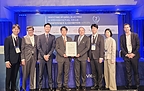
The certificate presentation ceremony took place on October 22, local time, at the MHE (Maritime Hybrid, Electric & Hydrogen Fuel Cells) Conference & Exhibition 2026 in Bergen, Norway. Jong-kyu Hwang, Vice President, Technology Solutions at Hanwha Power, attended the ceremony alongside senior representatives from ABS. The event runs from October 21 to 23 at the Scandic Hotel Bergen City.

The newly approved design concept features a fully electric container vessel powered by a large-scale 151 MWh Energy Storage System (ESS). Electrical energy stored in containerized battery units serves as the vessel’s primary propulsion source, enabling operation without direct carbon emissions through the use of port charging infrastructure.

The use of containerized batteries, which can be handled and stowed like standard cargo containers, enhances space efficiency, maximizes cargo capacity, and optimizes overall vessel performance. This approach also supports flexible battery replacement and scalable operation, offering a practical pathway for the decarbonization of short-sea and regional container transport.

The AiP strengthens Hanwha Power’s capabilities in fully electric vessel design using large-scale battery energy storage and expands its portfolio of marine propulsion solutions. The company plans to build on this achievement to pursue opportunities in the next-generation zero-carbon maritime transport market.

Alongside the approval, Hanwha Power has also completed the basic design of a 1,000 TEU battery-powered container vessel. Building on its expertise in vessel design across multiple ship classes, the company aims to develop a comprehensive lineup of electric-propulsion vessels tailored to a wide range of operating conditions and customer needs.

“This AiP from ABS marks an important step in extending Hanwha Power’s marine technology capabilities to fully electric vessels powered by large-scale battery systems,” said Jong-kyu Hwang, Vice President, Technology Solutions at Hanwha Power. “We will address the needs of the next-generation zero-carbon maritime transport market with integrated solutions that combine electric propulsion and containerized battery system technologies.”

View original content to download multimedia:https://www.prnewswire.co.uk/news-releases/hanwha-power-receives-abs-approval-in-principle-for-1-700-teu-battery-powered-containership-design-302917556.html

Continue Reading

Trending