Connect with us

Technology

Disrupting Billions in Dormant Capital: Allison Byers Fuels Underserved Entrepreneurs

Published

on

Venture capital’s outdated funding patterns continue to shut out diverse founders, stifling innovation and economic growth. Allison Byers, founder of Scroobious, shares how her platform is reshaping investment strategies, unlocking trillions in missed opportunities, and driving a more inclusive startup ecosystem.

TAMPA BAY, Fla., March 11, 2025 /PRNewswire-PRWeb/ — Despite ongoing discussions about funding equity, data shows that female founders continue to face significant barriers in venture capital, receiving just 1.8% of all VC funding in 2024. (1) On the latest episode of the Disruption Interruption podcast, host Karla Jo Helms speaks with Allison Byers, founder of Scroobious, —a platform that connects founders with investors and service providers to create a more inclusive startup ecosystem— about how systemic bias shuts out underrepresented entrepreneurs and why investors are missing trillion-dollar opportunities. “Almost 100% of Black founders and 98% of women aren’t being funded by venture capital. Everyone who funds them is in for a fortune. It’s a unique business opportunity,” Byers explains.

“Almost 100% of Black founders and 98% of women aren’t being funded by venture capital. Everyone who funds them is in for a fortune. It’s a unique business opportunity” — Allison Byers, founder of Scroobious

The Everybody Problem: Unlocking Innovation for All
Byers claims that undoing disparities in venture capital holds back progress. When the same group controls investment decisions, the market misses out on solutions that could improve lives on a massive scale. “We’re not only solving problems for ourselves; we’re solving problems and innovating for things that everybody needs,” she states.

The economic consequences of this phenomenon are massive. “Morgan Stanley estimated that our economy in the U.S. is missing out on $4 trillion by not putting money behind other types of entrepreneurs,” points out Byers. “If we’re not allowed to participate in the innovation economy, then the world is missing out on solutions that could change lives.”

Nowhere is this more evident than in healthcare, where underfunding female-led startups means fewer solutions for issues affecting millions. “If women working in these spaces aren’t funded, their ideas don’t make it to market. And that means misdiagnoses, lack of access, and real harm,” explains Byers.

Rewriting the Playbook: The Need for New Investment Signals
Venture capital’s biggest flaw isn’t just who gets funded—it’s how funding decisions are made. “VCs rely on signal processing to assess risk,” Byers explains. “But because past investments have overwhelmingly gone to white male founders, the signals investors trust are already biased.” This makes it nearly impossible for women and minority entrepreneurs to break through.

Fixing this problem requires more than good intentions—it demands an entirely new way of evaluating startups. Investors must rethink risk, expand their frameworks, and actively seek out underrepresented founders. “They’re missing the signals from anyone who isn’t a white male, and that means billions in potential innovation are being left on the table,” Byers says.

How Scroobious Brings Founders and Investors Together
Access remains as the biggest challenge for many startups. Without strong investor networks, underrepresented founders face steep hurdles in securing the funding and resources they need to grow. Scroobious is tackling this problem head-on, creating a platform that connects entrepreneurs with investors and service providers seamlessly and efficiently.

“With Scroobious, we are helping entrepreneurs and investors and service providers find each other in a very efficient and fun way so that we can open access to resources and capital,” says Byers. “If you’re a founder, and you join our platform, you get immediate access to a ton of critical resources and education and community,” Byers explains. “Founders and the providers need each other, now they can work together.”

Links
Disrupting Billions in Dormant Capital: Allison Byers Fuels Underserved Entrepreneurs
https://omny.fm/shows/disruption-interruption/disrupting-billions-in-dormant-capital-allison-bye

LinkedIn: https://www.linkedin.com/in/allison-byers/
Company Website: https://www.scroobious.com/

Disruption Interruption is the podcast where you will hear from today’s biggest Industry Disruptors. Learn what motivated them to bring about innovation and how they overcame opposition to adoption.

Disruption Interruption can be listened to in Apple’s App Store and Spotify.

About Disruption Interruption™
Disruption is happening on an unprecedented scale, impacting all manner of industries— MedTech, Finance, IT, eCommerce, shipping, logistics, and more—and COVID has moved their timelines up a full decade or more. But WHO are these disruptors and when did they say, “THAT’S IT! I’VE HAD IT!”? Time to Disrupt and Interrupt with host Karla Jo “KJ” Helms, veteran communications disruptor. KJ interviews badasses who are disrupting their industries and altering economic networks that have become antiquated with an establishment resistant to progress. She delves into uncovering secrets from industry rebels and quiet revolutionaries that uncover common traits—and not-so-common—that are changing our economic markets… and lives. Visit the world’s key pioneers that persist to success, despite arrows in their backs at http://www.disruption-interruption.com.

About Allison Byers
Allison Byers is a trailblazer in the realm of equitable capital distribution. As the founder of Scroobious, her tech company is quickly driving innovation by removing barriers to partnership among diverse founders, investors, and service providers through scalable online education, community, and data-driven curation.

Before founding Scroobious, she spearheaded a medical device startup, securing nearly $10M in funding before its acquisition, and encountered firsthand the gender bias prevalent in fundraising. With over 20 years of experience in startup and tech roles, Allison stands as a seasoned entrepreneur and a catalyst for change having co-authored California Senate Bill 54, signed into law, which requires venture funds to report diversity metrics.

She is actively championing initiatives in other states including MA Senate Bill 978 and NY Senate Bill A09786. Beyond her entrepreneurial pursuits, she serves as an angel investor, Boston Co-Chair of the national non-profit All Raise, Executive in Residence at Merck Digital Sciences Studio, DEI task force member of the Angel Capital Association, and is a sought-after startup mentor and dynamic speaker.

About Karla Jo Helms
Karla Jo Helms is the Chief Evangelist and Anti-PR® Strategist for JOTO PR Disruptors™. Karla Jo learned firsthand how unforgiving business can be when millions of dollars are on the line — and how the control of public opinion often determines whether one company is happily chosen, or another is brutally rejected. Being an alumnus of crisis management, Karla Jo has worked with litigation attorneys, private investigators, and the media to help restore companies of goodwill into the good graces of public opinion — Karla Jo operates on the ethic of getting it right the first time, not relying on second chances and doing what it takes to excel. Helms speaks globally on public relations, how the PR industry itself has lost its way, and how, in the right hands, corporations can harness the power of Anti-PR to drive markets and impact market perception.

References
1.    Masterson, Victoria. “Women Founders and Venture Capital – Some 2023 Snapshots.” World Economic Forum, 28 Mar. 2024, weforum.org/stories/2024/03/women-startups-vc-funding/.

Media Inquiries:
Karla Jo Helms
JOTO PR™
727-777-4629

Media Contact

Karla Jo Helms, JOTO PR™, 727-777-4629, khelms@jotopr.com, jotopr.com

View original content to download multimedia:https://www.prweb.com/releases/disrupting-billions-in-dormant-capital-allison-byers-fuels-underserved-entrepreneurs-302397973.html

SOURCE Disruption Interruption

Continue Reading

Technology

Vertical IQ Will Expand Industry Intelligence Platform with Small Business Financial Exchange (SBFE) Small Business Credit Data

Published

on

By

RALEIGH, N.C., Oct. 27, 2026 /PRNewswire/ — Small Business Financial Exchange (SBFE), the trusted source for small business lending data and Vertical IQ, a nationally recognized provider of Industry Intelligence, today announced their partnership. Through the partnership, Vertical IQ will incorporate SBFE small business credit insights into its platform, providing financial institutions with deeper context to support commercial lending decisions.

The collaboration enables banks, credit unions, and other commercial lenders using Vertical IQ to gain access to SBFE small business credit insights within the Industry Intelligence platform. Default rates, delinquencies, and credit trends by industries are just a few of the SBFE features that will be included. These insights allow financial services professionals to better understand small business borrowers and support key commercial lending activities.

“At SBFE, we’re committed to helping lenders better understand and support small businesses. Extending access to SBFE insights through Vertical IQ is another way we can deliver value to the lending community and support greater access to capital.”

     – Elisabeth MacDonald, President and CEO, SBFE

“At Vertical IQ, we believe financial institutions make their best decisions when they have access to trusted, Verified Industry Intelligence powered by the highest-quality data available,” said Bobby Martin, co-founder and CEO of Vertical IQ. “Our partnership with SBFE represents another important step in that commitment by bringing highly respected small business credit insights into our platform. By combining SBFE’s credit data with Vertical IQ’s industry expertise, we’re helping lenders gain deeper context to strengthen credit analysis, improve risk assessment, and make more confident decisions throughout the commercial lending lifecycle.”

     – Bobby Martin, Co-founder and CEO, Vertical IQ

About SBFE

SBFE is the trusted data exchange where the small business lending industry comes together to strengthen access to capital for America’s small businesses. For more than 25 years, SBFE has united lenders in a member-driven community built on trust, collaboration, and the responsible use of data. Today, SBFE securely manages one of the nation’s largest repositories of small business credit data, contributed by more than 140 member institutions, including many of the country’s largest commercial banks. This data enables highly predictive credit reporting and portfolio management solutions that help lenders make more informed decisions, manage risk, and support the financial health and growth of small businesses. By transforming shared data into trusted lending intelligence, SBFE helps its members strengthen credit decisioning and promote greater access to capital. Learn more at www.SBFE.org

About Vertical IQ

Headquartered in Raleigh, North Carolina, Vertical IQ is a nationally recognized provider of Industry Intelligence. Whether discussing cash management with a local brewery or evaluating risk for a large manufacturing company, successful banks, credit unions, accounting firms, insurance organizations, and advisory firms use Vertical IQ to better understand a prospect’s or client’s business challenges before, during, and after meetings. Covering 100% of the industries that comprise the U.S. and Canadian economies, as well as more than 3,400 local economic reports, Vertical IQ equips professionals with the confidence and credibility to build stronger client relationships and make more informed decisions. Learn more at www.verticaliq.com

View original content to download multimedia:https://www.prnewswire.com/news-releases/vertical-iq-will-expand-industry-intelligence-platform-with-small-business-financial-exchange-sbfe-small-business-credit-data-302920872.html

SOURCE SBFE

Continue Reading

Technology

CME Group Brazilian Real Futures Set New Daily Volume Record Following Election

Published

on

By

Record $9 billion notional traded, eleven times the year-to-date average daily volume (ADV) as market participants turned to CME Group to manage risk around the clock

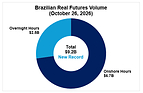
CHICAGO, Oct. 27, 2026 /PRNewswire/ — CME Group, the world’s leading derivatives marketplace, today announced that its Brazilian real (BRL) futures reached a new daily volume record of 498,498 contracts (R$49.8 billion, ~$9.2 billion notional value) on October 26, surpassing the previous record of 191,325 contracts (~$3.7 billion notional value) traded on September 28, 2026.

“Following the results of the Brazilian presidential election, clients turned to our BRL futures market to immediately manage their risk outside of Brazilian trading hours, driving all-time record volume,” said Paul Houston, Global Head of FX Products, CME Group. “Even before the onshore market opened, $2.5 billion in notional value had already traded, roughly three times the year-to-date ADV for BRL futures. With liquidity in all timezones and contracts denominated in USD, our markets are fast becoming the main venue for Brazilian real price discovery and trading outside of onshore hours, giving global participants the liquidity they need around the clock.”

In the first half of 2026, Mexican peso and Brazilian real futures and options saw a record combined average daily volume of $2.94 billion.

For more information on CME Group BRL futures, please visit https://www.cmegroup.com/articles/faqs/latam-fx-futures-frequently-asked-questions.html

As the world’s leading derivatives marketplace, CME Group (www.cmegroup.com) enables clients to trade futures, options, cash and OTC markets, optimize portfolios, and analyze data – empowering market participants worldwide to efficiently manage risk and capture opportunities. CME Group exchanges offer the widest range of global benchmark products across all major asset classes based on interest rates, equity indexes, foreign exchange, cryptocurrencies, energy, agricultural products and metals.  The company offers futures and options on futures trading through the CME Globex platform, fixed income trading via BrokerTec and foreign exchange trading on the EBS platform.  In addition, it operates one of the world’s leading central counterparty clearing providers, CME Clearing. 

CME Group, the Globe logo, CME, Chicago Mercantile Exchange, Globex, and E-mini are trademarks of Chicago Mercantile Exchange Inc.  CBOT and Chicago Board of Trade are trademarks of Board of Trade of the City of Chicago, Inc.  NYMEX, New York Mercantile Exchange and ClearPort are trademarks of New York Mercantile Exchange, Inc.  COMEX is a trademark of Commodity Exchange, Inc. BrokerTec is a trademark of BrokerTec Americas LLC and EBS is a trademark of EBS Group LTD. The S&P 500 Index is a product of S&P Dow Jones Indices LLC (“S&P DJI”). “S&P®”, “S&P 500®”, “SPY®”, “SPX®”, US 500 and The 500 are trademarks of Standard & Poor’s Financial Services LLC; Dow Jones®, DJIA® and Dow Jones Industrial Average are service and/or trademarks of Dow Jones Trademark Holdings LLC. These trademarks have been licensed for use by Chicago Mercantile Exchange Inc. Futures contracts based on the S&P 500 Index are not sponsored, endorsed, marketed, or promoted by S&P DJI, and S&P DJI makes no representation regarding the advisability of investing in such products. All other trademarks are the property of their respective owners. 

CME-G 

View original content to download multimedia:https://www.prnewswire.com/news-releases/cme-group-brazilian-real-futures-set-new-daily-volume-record-following-election-302920902.html

SOURCE CME Group

Continue Reading

Technology

Vera Health Quietly Became One of the World’s Most Used Clinical Tools. Now It Has Raised $32 Million to Give Every Clinician in the World the Best Medical Knowledge in Seconds

Published

on

By

With a team of just 12 employees, the clinical AI company has grown largely through physician referrals, bringing total funding to $32 million

More than 800,000 clinicians across 190 countries use Vera Health, including approximately 1 in 4 physicians in Spain and Italy, with most discovering the platform through recommendations from colleagues.Threshold Ventures led Vera Health’s $28.5 million Series A, with participation from Mantis VC and SV Angel. Existing investors Y Combinator and Gradient tripled down, bringing total funding to $32 million.The investment will accelerate Vera Health’s evidence-focused clinical AI platform, expanding its ability to make global medical knowledge locally relevant and deepening partnerships with medical societies, publishers and health systems.

SAN FRANCISCO, Oct. 27, 2026 /PRNewswire/ — A year ago, a few thousand clinicians were using Vera Health. Today, more than 800,000 are, most having discovered the platform through a colleague. Every month since June, Vera has been the most downloaded clinical app in the world across the App Store and Google Play.¹ In September alone, it was downloaded more times than OpenEvidence and Doximity combined, while monthly downloads had more than tripled since February. With a team of just 12 employees, Vera has reached clinicians in 190 countries, including approximately 1 in 4 physicians in Spain and Italy, largely through word of mouth. Vera Health is a clinical AI search engine that reasons like a clinician, helping physicians find and evaluate medical evidence in seconds.

Today, Vera Health announced a $28.5 million Series A led by Threshold Ventures, with participation from Mantis VC and SV Angel. Existing investors Y Combinator and Gradient, tripled down in the round, bringing the company’s total funding to $32 million. The investment will accelerate Vera Health’s mission to close the gap between what medicine knows and what every patient receives.

Only a few months after raising its Series A, Vera already has more daily active users than it had monthly active users at the time of the raise. Clinicians went from asking Vera a few thousand questions a day to asking hundreds of thousands, every single day.

“Clinicians are the best data scientists I’ve ever met. They make the call in seconds, with more evidence than any human could ever read,” said Taieb Bennani, Co-Founder of Vera Health. “The secret to building for them is to live and breathe the problem like no one else. Everyone on our team is a clinician, or the child or sibling of one, like Maxime and me. That passion translates into every detail of the product, and when you build with that kind of obsession, the product speaks for itself, and clinicians share it with their colleagues. We don’t have the biggest team or the most money. We have the people who care the most about getting it right.”

How does Vera Health differ from general-purpose AI tools?
Clinical AI is increasingly being used to help physicians navigate complex medical questions, but the ability to generate an accurate-sounding answer does not necessarily establish whether the underlying research is reliable. Medicine now publishes a new scientific paper roughly every 20 seconds. Chatbots are built to sound confident. Vera is built to be accurate, and honest when the evidence is thin. Physicians are expected to keep up with an expanding body of research while interpreting guidelines, evaluating treatment options and making decisions for individual patients, sometimes within seconds.

Vera Health finds the evidence first, then writes the answer. Its technology searches more than 60 million peer-reviewed publications, clinical guidelines, consensus statements and drug labels, evaluating sources based on study design, level of evidence, cohort size, recency, journal quality and citation impact. Every claim is linked to its supporting research and color-coded to show the strength of the available evidence. Sometimes that color is red. A rare condition may have no large randomized trial or comprehensive guideline behind it, leaving only a small case series or a report involving a single patient. Vera Health surfaces that research while making its limitations visible, allowing physicians to assess how much weight the findings deserve.

“Medical knowledge moves too quickly for any one clinician to read, and general-purpose AI tools can make uncertain evidence sound settled,” said Maxime Allouch, co-founder, Vera Health. “Unlike other tools, we believe there’s value in making uncertainty visible. The grade shapes what Vera retrieves and writes, while the clinician brings the patient, the context and the judgment.”

Vera Health developed its approach alongside physicians who evaluate medical evidence and help write the guidelines other clinicians follow. Through its partnership with the American College of Emergency Physicians (ACEP), the platform integrates ACEP clinical policies with source attribution, bringing medical society guidance directly into clinical research workflows.

“In medicine, not all evidence is equal,” said Scott M. Silvers, MD, FACEP, Chair of the American College of Emergency Physicians’ Clinical Policies Committee and former Chair of Emergency Medicine at Mayo Clinic. “A large, randomized trial and a case report should never carry the same weight, yet most AI tools blend them into the same confident answer. Level of evidence is the foundation of every guideline we write, and Vera Health is built on it.”

For Dr. Bernard P. Chang, Vera Health’s Chief Scientific Advisor and Vice Chair of Research in the Department of Emergency Medicine at Columbia University, the importance of clinical evidence extends to how physicians evaluate patients.

“On a recent emergency-department shift, I saw a young woman with cough and shortness of breath. The symptoms could easily be attributed to a routine respiratory illness,” said Chang. “Vera Health surfaced evidence that raised my concern for pulmonary embolism, a potentially life-threatening blood clot in the lungs, and led me to broaden my evaluation. What interests me isn’t AI simply providing an answer. It’s whether it can reliably surface evidence that challenges our initial assumptions and improves clinical reasoning. That’s what we’re now evaluating rigorously, inside the academic medical centers where medicine is actually practiced.”

Vera Health’s clinical advisors also include Christopher Baugh, MD, MBA, FACEP, Vice Chair of Clinical Affairs in Emergency Medicine at Brigham and Women’s Hospital and Associate Professor of Emergency Medicine at Harvard Medical School. Its clinical council includes physician leaders affiliated with Mayo Clinic, Yale, Harvard, Columbia and Penn.

Why is Vera Health growing so quickly across international markets?
Bennani and Allouch grew up in families of physicians and initially developed Vera Health for their own fathers. What began with two users has since grown into a platform serving hundreds of thousands of clinicians, with physicians asking hundreds of thousands of questions each day. The company’s international growth reflects an approach built around a central reality of medicine. Medical knowledge is global, but clinical practice is local.

An emergency physician in France may follow different treatment guidelines than a physician in the United States. An oncologist reviewing a complex case may need an exhaustive evaluation of the available research, while an emergency physician needs a concise answer within seconds. Even physicians practicing the same specialty may follow different protocols depending on their institution.

Vera Health accounts for those differences by prioritizing locally relevant guidance while drawing on medical research from around the world. Through Vera Spaces, health systems can also integrate their own clinical protocols and pathways alongside national guidelines and international medical literature.

“Medicine is global, yet most tools in our space were built for a single geography,” said Allouch. “We went international from day one, because only a global view reveals what is truly local.”

The approach has helped Vera Health expand across Europe, where approximately 1 in 4 physicians in Spain and Italy and 1 in 7 in France use the platform, according to company data. Vera Health has achieved that international reach with a small team and a product that clinicians have largely discovered through their peers.

What will Vera Health’s Series A funding support next?
The financing will support further development of Vera Health’s clinical evidence infrastructure, expansion into additional healthcare markets and deeper partnerships with medical societies, publishers and health systems. The company will continue investing in locally relevant clinical guidance and tools that allow healthcare institutions to incorporate their own medical knowledge into the platform.

“In healthcare, trust is earned, not bought. Vera’s adoption among clinicians worldwide speaks to what Taieb and Maxime have built. By combining the most rigorous medical evidence with an understanding of each physician’s specialty, protocols and practice context, Vera makes the world’s medical knowledge relevant to how care is actually delivered. We believe that creates an enormous opportunity to improve global health,” said Andrew Brackin, Partner at Gradient.

“Vera is compelling because it starts with the evidence, not just an answer—helping clinicians find and assess the research behind a decision while making its strengths and limitations visible. By bringing that evidence to the point of care, Vera becomes a trusted clinical intelligence layer, not just another AI tool,” said Emily Melton, co-founder and managing partner of Threshold Ventures.

Vera Health will remain free for licensed clinicians and medical trainees worldwide as it expands access to medical evidence and locally relevant clinical guidance.

New medical knowledge takes an estimated 17 years to reach routine clinical practice, according to research published in the Journal of the Royal Society of Medicine. Vera Health aims to reduce the time physicians spend searching for and evaluating that knowledge, bringing relevant evidence closer to the moment clinical decisions are made.

“Our mission is to close the gap between what medicine knows and what every patient receives,” said Bennani. “Today, that gap is measured in years. We want it measured in seconds.”

About Vera Health
Vera Health is the search engine that reasons like a clinician, finding and grading evidence before showing the source, strength and limits behind every answer. More than 800,000 clinicians in 190 countries use Vera, which is free for licensed clinicians and trainees, never trains on clinicians’ questions, and is HIPAA and GDPR compliant and SOC 2 Type II certified. Founded in 2024 at Y Combinator by MIT graduates and sons of physicians Taieb Bennani and Maxime Allouch, Vera is headquartered in San Francisco and backed by Threshold Ventures, Gradient, Y Combinator, SV Angel and Mantis VC.

Learn more at verahealth.ai.

¹ Download data: Appark, worldwide App Store and Google Play downloads, June through [September] 2026.

Media Contact
Interdependence
(949) 259-6377 x 225
425709@email4pr.com

View original content to download multimedia:https://www.prnewswire.com/news-releases/vera-health-quietly-became-one-of-the-worlds-most-used-clinical-tools-now-it-has-raised-32-million-to-give-every-clinician-in-the-world-the-best-medical-knowledge-in-seconds-302920905.html

SOURCE Vera Health

Continue Reading

Trending