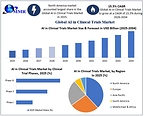
PUNE, India, Sept. 25, 2026 /PRNewswire/ — The Global AI in Clinical Trials Market was valued at USD 2 Billion in 2025 and is projected to grow at a 15.5% CAGR from 2026 to 2034, reaching USD 7.32 Billion by 2034, according to Maximize Market Research.
Global AI in Clinical Trials Market
The Global AI in Clinical Trials Market Report 2026 provides a detailed assessment of market trends, clinical research activity, AI adoption, patient recruitment, data analysis, safety monitoring, drug discovery, personalized medicine, trial-phase applications, end-user demand, competitive developments, and market forecasts through 2034. The market is segmented by Trial Phase, Technology, Application, End-Users, and Region, covering Phase I, Phase II, and Phase III trials; machine learning, natural language processing, and deep learning; and applications including patient recruitment, data analysis, safety monitoring, drug discovery, and personalized medicine.
The market is expanding as pharmaceutical and biotechnology companies increasingly use AI to improve the speed and efficiency of clinical research. AI tools are being applied to patient screening, cohort selection, trial design, large-scale data analysis, safety evaluation, and treatment optimization. By analyzing complex patient datasets, AI can help researchers identify suitable trial participants, detect patterns more quickly, and support more targeted clinical decision-making.
Growing use of machine learning, deep learning, AI-driven patient monitoring, real-world evidence, decentralized trials, and AI-enabled drug discovery is creating new opportunities across the clinical research ecosystem. Pharmaceutical companies, CROs, hospitals, and research institutes are adopting AI to streamline workflows, improve patient recruitment, strengthen data quality, and reduce delays in drug development. These developments are expected to support the AI in Clinical Trials Market as it grows from USD 2 Billion in 2025 to USD 7.32 Billion by 2034 at a CAGR of 15.5%.
Get Full PDF Sample Copy of Report: (Including Full TOC, List of Tables & Figures, Chart) @ https://www.maximizemarketresearch.com/request-sample/222597/
Global AI in Clinical Trials Market gains momentum as pharmaceutical companies, CROs, and research institutions turn to AI for faster patient recruitment, smarter data analysis, improved safety monitoring, personalized medicine, and more efficient drug development, says Maximize Market Research.
Global AI in Clinical Trials Market Size & Forecast
Parameter
Value
Market Size (Base Year 2025)
USD 2 Billion
Forecast Market Size (2034)
USD 7.32 Billion
CAGR (2026-2034)
15.5 %
Base Year
2025
Forecast Period
2026-2034
Historical Period
2020-2025
Global AI in Clinical Trials Market Trends & Insights
North America leads the Global AI in Clinical Trials Market, supported by strong healthcare infrastructure, a mature pharmaceutical industry, significant investment in AI research, and increasing collaboration between pharmaceutical and technology companies. The United States remains the key regional market, while Europe is also seeing rapid adoption across the UK, Germany, and France.AI adoption is reshaping patient recruitment and clinical trial operations by helping researchers identify suitable participants, analyze large patient datasets, improve cohort selection, and support trial design. These capabilities are helping reduce delays and improve the efficiency of clinical research.Machine learning, natural language processing, and deep learning are becoming central technologies across the AI in Clinical Trials Market. Their use is expanding in patient recruitment, data analysis, safety monitoring, drug discovery, and personalized medicine across Phase I, Phase II, and Phase III trials.Pharmaceutical and biotechnology companies remain major adopters of AI in clinical research, using the technology to support drug discovery, trial execution, data analysis, and post-market surveillance. CROs, hospitals, research institutes, and government agencies are also increasing adoption as AI becomes more embedded in the clinical research ecosystem.Decentralized trials, AI-driven patient monitoring, real-world evidence, and AI-enhanced drug discovery are emerging as important market trends. Growing use of AI in diagnostics, treatment optimization, patient stratification, and personalized medicine is expected to create new opportunities as the Global AI in Clinical Trials Market advances toward 2034.
Faster Patient Recruitment and Data Analysis Drive Market Growth
The AI in Clinical Trials Market is gaining momentum as pharmaceutical companies, biotechnology firms, CROs, and research organizations look for faster and more efficient ways to manage clinical studies. AI is increasingly being used for patient screening, cohort selection, trial design, data analysis, and recruitment, helping researchers identify suitable participants and process large volumes of clinical information more quickly. These capabilities are improving trial efficiency while supporting faster drug development and better use of research resources.
Data Privacy, Regulatory Compliance, and Data Quality Restrain Adoption
Despite its potential, AI adoption in clinical trials faces important barriers. Data privacy concerns, regulatory compliance, data quality issues, and the need for specialized AI expertise can slow implementation across clinical research organizations. Because clinical trials handle sensitive patient information and operate under strict regulatory requirements, companies must ensure that AI systems are reliable, transparent, and supported by high-quality data before they can be widely integrated into trial workflows.
Decentralized Trials and AI-Driven Drug Discovery Create New Opportunities
The growing use of decentralized clinical trials, AI-driven patient monitoring, real-world evidence, and AI-enhanced drug discovery is opening new opportunities across the market. Machine learning, deep learning, and natural language processing are being applied to patient recruitment, safety monitoring, personalized medicine, and drug discovery. As AI becomes more deeply embedded in clinical research, companies have greater scope to improve trial design, identify treatment-responsive patient groups, and accelerate development of new therapies.
AI Expertise, Trust, and Reliable Clinical Data Remain Key Challenges
A major challenge for the AI in Clinical Trials Market is ensuring that AI-generated insights are supported by accurate, high-quality clinical data and can be used responsibly in regulated research environments. Organizations also need the right technical expertise to apply AI across trial phases and therapeutic areas. As AI adoption expands, maintaining data integrity, regulatory compliance, patient privacy, and confidence in AI-supported decision-making will remain central to long-term market development.
Get Insightful Data on Regions, Market Segments, Customer Landscape, and Top Companies (Charts, Tables, Figures and More) https://www.maximizemarketresearch.com/request-sample/222597/
Global AI in Clinical Trials Market Segmentation
The Global AI in Clinical Trials Market is segmented by Trial Phase, Technology, Application, End-Users, and Region. The market covers AI adoption across Phase I, Phase II, and Phase III clinical trials, with technologies such as machine learning, natural language processing, and deep learning supporting patient recruitment, data analysis, safety monitoring, drug discovery, and personalized medicine. Pharmaceutical companies, research institutes, CROs, hospitals, and other end-users are increasingly integrating AI into clinical research workflows.
Segmentation
Sub-Segments
By Trial Phase
Phase I; Phase II; Phase III
By Technology
Machine Learning; Natural Language Processing; Deep Learning; Unspecified
By Application
Patient Recruitment; Data Analysis; Safety Monitoring; Drug Discovery; Personalized Medicine
By End-Users
Pharmaceutical Companies; Research Institutes; CRO’s; Hospitals; Others
By Region
North America; Europe; Asia Pacific; Middle East & Africa; South America
North America Leads the AI in Clinical Trials Market as Asia Pacific Gains Ground
North America leads the Global AI in Clinical Trials Market, supported by advanced healthcare infrastructure, a well-established pharmaceutical industry, strong investment in AI research, and growing collaboration between drug developers and technology companies. The United States remains the key market as AI is increasingly used for patient recruitment, data analysis, safety monitoring, drug discovery, and personalized medicine.
Europe is also seeing steady adoption of AI in clinical research, particularly across the UK, Germany, and France. Strong pharmaceutical capabilities, established regulatory systems, government support for healthcare AI, and cross-border research partnerships are helping expand the use of machine learning and digital technologies in clinical trials.
Asia Pacific is emerging as an important market, led by China, India, and Japan. Large patient populations, expanding pharmaceutical sectors, and growing interest in more efficient and affordable clinical research are encouraging wider adoption of AI. Japan’s advanced technology ecosystem is also creating opportunities for AI-driven healthcare and clinical trial applications.
South America and the Middle East & Africa remain developing markets for AI in Clinical Trials. Expanding pharmaceutical activity, improving healthcare infrastructure, evolving regulatory frameworks, and partnerships with international research and pharmaceutical organizations are supporting gradual adoption across these regions.
Leading Companies Expand the AI in Clinical Trials Market
Euretos, Biosymetrics, Unlearn.AI, Exscientia, AiCure, Antidote Technologies, Deep 6 AI, Innoplexus, IQVIA, Medidata, Mendel.ai, Phesi, Saama Technologies, Signant Health, Trials.ai, and other participants are active across the AI in Clinical Trials Market. These companies are developing solutions for patient recruitment, clinical data analysis, trial optimization, safety monitoring, and AI-supported drug development.
Global AI in Clinical Trials Market Competitive Landscape
Competition in the Global AI in Clinical Trials Market is becoming more technology-driven as companies focus on machine learning, deep learning, natural language processing, AI-powered patient recruitment, predictive analytics, and personalized medicine. Partnerships between pharmaceutical companies, research institutions, and AI technology providers are also becoming increasingly important in accelerating clinical research.
The market is also being shaped by decentralized trials, AI-driven patient monitoring, real-world evidence, and AI-enhanced drug discovery. Companies that can improve trial efficiency, shorten recruitment timelines, strengthen data analysis, and support better treatment decisions are likely to gain greater relevance as AI adoption expands across clinical research through 2034.
Immediate Delivery Available | Buy this Research Report (Insights, Charts, Tables, Figures and More) https://www.maximizemarketresearch.com/checkout/222597/
Key Players of the AI in Clinical Trials Market
EuretosBiosymetricUnlearn.AI,Inc.ExscientiaIMB CorporationAiCureAntidote TechnologiesDeep 6 AIInnoplexusIQVIAMedian TechnologiesMedidataMendel.aiPhesiSaama TechnologiesSignant HealthTrials.ai
Frequently Asked Questions and Answers about AI in Clinical Trials Market
1. How AI can improve clinical trials?
Ans: AI can improve clinical trials by expediting patient recruitment, enhancing data analysis accuracy, personalizing treatment plans, and optimizing trial designs.
2. What are the challenges associated with the integration of AI in clinical trials?
Ans: Challenges associated with integrating AI in clinical trials include data privacy concerns, regulatory compliance, data quality, and the need for AI expertise.
3. What is the role of AI in electronic health records of clinical trials data?
Ans: AI plays a role in electronic health records of clinical trials data by facilitating data management, analysis, and insights for more efficient and informed decision-making.
4. What are the upcoming trends in AI in clinical trial market?
Ans: Upcoming trends in the AI in clinical trial market include decentralized trials, AI-driven patient monitoring, real-world evidence utilization, and AI-enhanced drug discovery.
5. Which region captures the largest share in the AI in clinical trials market?
Ans: North America captures the largest share in the AI in clinical trials market, driven by its robust healthcare infrastructure and significant investments in AI research.
Access Full Summary: https://www.maximizemarketresearch.com/market-report/ai-in-clinical-trials-market/222597/
Analyst Perspective
Analysts note that the Global AI in Clinical Trials Market is being driven by the growing use of AI to improve patient recruitment, clinical data analysis, safety monitoring, drug discovery, and personalized medicine. Pharmaceutical companies, CROs, hospitals, and research institutes are increasingly adopting machine learning, deep learning, and other AI tools to make clinical trials faster and more efficient. Data privacy, regulatory compliance, data quality, and the need for specialized AI expertise remain important challenges, while decentralized trials, AI-driven patient monitoring, real-world evidence, and AI-enabled drug discovery are expected to create new opportunities through 2034.
Related Reports:
Clinical Trial Management Systems Market by Type, Component, Delivery Mode, End User, and Region – Global Forecast to 2034
Healthcare Artificial Intelligence Market by Component, Application, End-User, and Region – Global Forecast to 2034
Clinical Trial Imaging Market by Product and Service, Modality, Application, End Users, and Region – Global Forecast to 2034
Healthcare Analytics Market by Type, Component, Delivery Mode, Application, End-User, and Region – Global Forecast to 2034
Healthcare Big Data Analytics Market by Type, Application, Component, Deployment Model, End User, and Region – Global Forecast to 2034
About Maximize Market Research – Global AI in Clinical Trials Market
Maximize Market Research is a global market research and business consulting firm providing data-driven insights across Healthcare, Pharmaceuticals, Biotechnology, Life Sciences, Clinical Research, and Artificial Intelligence, including the Global AI in Clinical Trials Market. Its research helps businesses understand market dynamics, technology adoption, regulatory developments, competitive activity, and emerging opportunities across patient recruitment, data analysis, safety monitoring, drug discovery, personalized medicine, and AI-enabled clinical research.
Expertise in AI in Clinical Trials & Healthcare Research
Maximize Market Research provides insights across Healthcare, clinical trials, pharmaceutical R&D, biotechnology, and AI-driven medical technologies. Its research covers machine learning, natural language processing, deep learning, AI-powered patient recruitment, clinical data analysis, safety monitoring, drug discovery, personalized medicine, decentralized trials, real-world evidence, and AI-based patient monitoring. The research also evaluates adoption trends across pharmaceutical companies, CROs, hospitals, and research institutes, along with regional and competitive developments shaping the AI in Clinical Trials Market.
Contact:
Lumawant Godage
MAXIMIZE MARKET RESEARCH PVT. LTD.
+91 96073 65656
Email: sales@maximizemarketresearch.com
Content Source: https://www.maximizemarketresearch.com/market-report/ai-in-clinical-trials-market/222597/
Visit Our Web Site: https://www.maximizemarketresearch.com/
LinkedIn.com: https://www.linkedin.com/company/maxmize-market-research-pvt-ltd/
Instagram: https://www.instagram.com/maximizemarketresearch/
Facebook: https://www.facebook.com/maximizemarketresearch/
X (Twitter): https://x.com/MMRAnalytics
View original content to download multimedia:https://www.prnewswire.co.uk/news-releases/ai-in-clinical-trials-market-to-reach-usd-7-32-billion-by-2034-as-ai-reshapes-patient-recruitment-data-analysis-and-drug-development-says-maximize-market-research-302890253.html









 Technology3 days ago
 Technology5 days ago
 Technology3 days ago
 Technology5 days ago
 Technology3 days ago
 Technology5 days ago
 Technology4 days ago
 Technology3 days ago