Connect with us

Technology

Used Construction Equipment Rentals Remain Strong as Sales Cool

Published

on

LINCOLN, Neb., June 3, 2026 /PRNewswire/ — Used construction equipment inventory levels continued to decline in May, led by crawler excavators and wheel loaders, according to the latest Sandhills Global market reports. The reports cover used heavy machinery, farm equipment, trucks, and trailers on MachineryTrader.com and several other Sandhills platforms worldwide.

“Rental utilization remains strong,” says RentalYard Sales Manager Matt Sterup, “but rising prices, especially fuel costs, are limiting customer’s ability to buy construction equipment. In lift equipment categories, it’s also becoming more difficult to find quality used equipment.”

Used heavy-duty trucks also experienced inventory level decreases in May, continuing a months-long downward trend. “Rising fuel costs have reduced some of the momentum gained in the truck market, but sentiment is still positive,” says Truck Paper Manager Scott Lubischer. “Freight rates are increasing and inventory is leaving the market at a pace similar to that of 2022 without being replaced. Newer trucks are starting to move, and buyers will be watching closely for lower-mileage trucks. Despite rising prices, dealers anticipate they won’t rise to 2022 levels.”

The key metric in all of Sandhills’ market reports is the Sandhills Equipment Value Index (EVI). Buyers and sellers can use the information in the Sandhills EVI to monitor equipment markets and maximize returns on acquisition, liquidation, and related business decisions. The Sandhills EVI data include equipment available in auction and retail markets and model-year equipment actively in use. EVI spread measures the percentage difference between asking and auction values.

Market Report Details
Sandhills market reports highlight the most significant changes in Sandhills’ used heavy-duty truck, semi-trailer, farm machinery, and construction equipment markets. Key points from the current reports are listed below. Full reports are available upon request.

U.S. Used Heavy-Duty Construction Equipment

Inventory levels in this market posted a marginal decrease of 0.16% month over month and fell 11.55% year over year in May and are trending down. Used crawler excavators had the largest M/M inventory change, down 1.41%, while used wheel loaders posted the largest Y/Y inventory change with a 13.32% decrease.Asking values posted dipped 0.89% M/M and 3.02% Y/Y and are trending down. Used crawler excavators had the largest M/M asking value change, down 1.75%, while used wheel loaders had the largest Y/Y asking value change, down 4.14%.Auction values decreased 1.53% M/M and 1.87% Y/Y and are trending sideways. Used wheel loaders had the largest M/M auction value change, down 2.41%, while used crawler excavators posted the largest Y/Y auction value change with a 3.44% decrease.

U.S. Used Medium-Duty Construction Equipment

Inventory levels of used medium-duty construction equipment posted a slight increase of 0.39% M/M but fell 15.65% Y/Y in May and have been trending down for seven consecutive months. Used wheeled skid steers had the largest M/M inventory change, up 2.93%, while used loader backhoes posted the largest Y/Y inventory change with a 26.5% decrease.Asking values decreased 0.86% M/M and 0.63% Y/Y and are trending sideways. Used track skid steers had the largest asking value changes, down 1.17% M/M and 1.64% Y/Y.Auction values posted marginal decreases of 0.86% M/M and 0.14% Y/Y and are trending sideways. Used track skid steers had the largest M/M auction value change, down 1.4%, while used wheeled skid steers posted the largest Y/Y auction value change with a 3.05% increase.

U.S. Used Aerial Lifts

Inventory levels in this market decreased 2.92% M/M and 2.99% Y/Y in May and are trending down. Used slab scissor lifts had the largest M/M inventory change, down 3.78%, while used articulating boom lifts posted the largest Y/Y inventory change with an 11.67% increase.Asking values decreased 1.26% M/M and 1.21% Y/Y and are trending sideways. Used telescopic boom lifts had the largest asking value changes, down 3.61% M/M and 4.08% Y/Y.Auction values decreased 1.73% M/M and 3.98% Y/Y and are trending down. Used telescopic boom lifts had the largest auction value changes, down 4.42% M/M and 5.67% Y/Y.

U.S. Used Forklifts

Inventory levels in this market jumped 5.63% M/M and 17.28% Y/Y in May and are trending up. Used cushion-tire forklifts had the largest inventory changes, up 6.57% M/M and 25.75% Y/Y.Asking values posted a marginal increase of 0.06% M/M but decreased 3.23% Y/Y and are trending down. Used cushion-tire forklifts had the largest asking value changes, up 0.77% M/M and down 7.56% Y/Y.Auction values decreased 1.06% M/M and 3.49% Y/Y and are trending down. Used cushion-tire forklifts had the largest auction value changes, down 1.97% M/M and 8.57% Y/Y.

U.S. Used Telehandlers

Inventory levels of U.S. used telehandlers increased 3.02% M/M and 5.3% Y/Y in May and are trending sideways.Asking values increased 2.01% M/M but slipped 1.78% Y/Y and are trending sideways.Auction values increased 1.05% M/M but decreased 1.58% Y/Y and are trending up.

U.S. Used Heavy-Duty Trucks

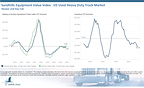
Inventory levels in this market fell 1.5% M/M and 23.14% Y/Y in May and have been trending down for six months. Used sleeper trucks had the largest M/M inventory change, down 3.3%, while used day cab trucks posted the largest Y/Y inventory change with a 25.31% decrease.Asking values increased 1.63% M/M but decreased 1.29% Y/Y and are trending sideways. Used sleeper trucks led in M/M asking value changes with a 2.94% increase, while used day cab trucks had the largest Y/Y asking value change with a 4.09% decrease.Auction values increased 3.07% M/M and 2.34% Y/Y and are trending up. Used sleeper trucks took the lead in auction value changes, growing 4.62% M/M and 3.91% Y/Y.

U.S. Used Semi-Trailers

Inventory levels of used semi-trailers posted a modest increase of 0.28% M/M but fell 26.9% Y/Y in May, continuing a 10-month-long downward trend. Used dry van trailers had the largest M/M inventory change, up 2.51%, while used reefer trailers posted the largest Y/Y inventory change with a 31.49% decrease.Asking values posted a marginal decrease of 0.28% M/M but rose 2.61% Y/Y and are trending up. Used reefer trailers had the largest asking value changes, down 1.17% M/M and up 7.23% Y/Y.Auction values inched downward by 0.6% M/M but jumped 6.35% Y/Y and are trending up. Used dry van trailers had the largest M/M auction value change, down 3.68%, while used reefer trailers posted the largest Y/Y auction value change with a 19.53% increase.

U.S. Used Medium-Duty Trucks

Inventory levels of used medium-duty trucks decreased 0.93% M/M and 37.52% Y/Y in May. Inventory levels in this market have been trending down for nine consecutive months.Asking values dropped 1.81% M/M and 6.05% Y/Y and are trending down.Auction values were down 2.39% M/M and 3.76% Y/Y and are trending down.

U.S. Used Tractors 100 Horsepower and Greater

Inventory levels in the used high-horsepower tractor market decreased 0.81% M/M and 16.23% Y/Y in May and have been trending down for 12 months. Used 100-to-174-HP tractors had the largest inventory changes, down 1.38% M/M and 21.99% Y/Y.Asking values posted modest decreases of 0.51% M/M and 1.75% Y/Y and are trending down. Used 175-to-299-HP tractors had the largest M/M asking value change, down 1.36%, while used tractors 300 HP and greater posted the largest Y/Y asking value change with a 1.85% decrease.Auction values were down 0.9% M/M but increased 2.36% Y/Y and are trending sideways. Used 175-to-299-HP tractors posted the largest auction value changes, down 1.38% M/M and up 3.21% Y/Y.The EVI spread, which measures the percentage difference between asking and auction values, increased from 31% in April to 32% in May. This is lower than the peak values observed in 2015.

U.S. Used Combines

Used combine inventory levels posted a modest increase of 0.6% M/M but fell 10.09% Y/Y in May and are trending down.Asking values decreased 2.61% M/M and 1.22% Y/Y and are trending sideways.Auction values decreased 1.52% M/M, increased 0.76% Y/Y, and are trending sideways.The EVI spread was 38%, down from 40% in April and lower than the peak values observed in 2015.

U.S. Used Sprayers

Inventory levels of used sprayers inched lower by 0.8% M/M in May, fell 19.18% Y/Y, and continued a 6-month-long downward trend.Asking values decreased 2.84% M/M and 2.59% Y/Y and are trending down.Auction values dropped 5.94% M/M and decreased 2.9% Y/Y and are trending down.The EVI spread jumped four percentage points in May, to 40%, which is still lower than the peak values observed in 2015.

U.S. Used Planters

Used planter inventory levels dropped 5.33% M/M and fell 26.36% Y/Y in May and are trending down, continuing a 7-month-long pattern.Asking values posted a marginal decrease of 0.15% M/M but increased 2.57% Y/Y and are trending sideways.Auction values decreased 3.26% M/M but jumped 5.01% Y/Y and are trending sideways.The EVI spread increased from 49% in April to 53% in May, still lower than the peak values observed in 2015.

U.S. Used Compact and Utility Tractors

Inventory levels in this market fell 2.91% M/M and 28.25% Y/Y in May and have been trending down for seven months. Used tractors with less than 40 HP had the largest inventory changes, down 5.87% M/M and 33.26% Y/Y.Asking values remained almost flat with a 0.02% M/M increase and rose 1.63% Y/Y. Asking values have been trending up for five consecutive months. Used 40-to-99-HP tractors had the largest asking value changes, up 0.04% M/M and 1.76% Y/Y.Auction values posted a marginal decrease of 0.16% M/M but increased 2.76% Y/Y and are trending up. Used tractors with less than 40 HP had the largest auction value changes, posting gains of 0.61% M/M and 2.81% Y/Y.

U.S. Used Self-Propelled Forage Harvesters

Inventory levels in this market decreased 0.87% M/M and 4.47% Y/Y and are trending sideways.Asking values increased 2.03% M/M and 0.61% Y/Y and are trending up.Auction values increased 3.8% M/M and 5.6% Y/Y and are trending up, continuing a pattern of monthly increases over the past several months.

Obtain the Full Reports
For more information or to receive detailed analysis from Sandhills Global, contact us at marketreports@sandhills.com.

About Sandhills Global
Sandhills Global is an information processing company headquartered in Lincoln, Nebraska. Our products and services gather, process, and distribute information through trade publications, websites, and online services that connect buyers and sellers across the construction, agriculture, forestry, oil and gas, heavy equipment, commercial trucking, and aviation industries. Our integrated, industry-specific approach to hosted technologies and services offers solutions that help businesses large and small operate efficiently and grow securely, cost-effectively, and successfully. Sandhills Global—we are the cloud.

About the Sandhills Equipment Value Index
The Sandhills Equipment Value Index (EVI) is a principal gauge of the estimated market values of used assets—both currently and over time—across the construction, agricultural, and commercial trucking industries represented by Sandhills Global platforms, including AuctionTime.com, TractorHouse.com, MachineryTrader.com, TruckPaper.com, and other industry-specific equipment platforms. Powered by Value Insight Portal (VIP+), Sandhills’ proprietary asset valuation tool, Sandhills EVI provides useful insights into the ever-changing supply-and-demand conditions for each industry.

Contact Sandhills
www.sandhills.com/contact-us
402-479-2181

View original content to download multimedia:https://www.prnewswire.com/news-releases/used-construction-equipment-rentals-remain-strong-as-sales-cool-302790700.html

SOURCE Sandhills Global

Continue Reading
Click to comment

Leave a Reply

Your email address will not be published. Required fields are marked *

Technology

Safe2core Expands AI-Optimized Subsurface Risk-Management & Construction Knowledge Strategy as AI Search Transforms the Construction Industry

Published

on

By

New AI search visibility research reveals growing demand for utility locating, potholing, concrete scanning, BIM documentation, laser scanning, and underground infrastructure verification workflows

SAN JOSE, Calif., June 3, 2026 /PRNewswire/ — Safe2core announced today that the company is expanding its AI-search-optimized subsurface risk-management and construction education strategy as contractors, engineers, architects, facility managers, municipalities, and property owners increasingly use AI systems like Google AI Overviews, ChatGPT, Claude, Gemini, and Perplexity to research utility locating, concrete scanning, potholing, hydro excavation, BIM workflows, construction safety practices, and underground infrastructure coordination.

The company recently analyzed AI visibility trends, semantic retrieval behavior, and construction search patterns surrounding:

underground utility locatingconcrete scanningutility verificationpotholing and hydro excavationconcrete cutting and coringBIM and CAD utility documentationrebar scanning3D laser scanningdigital construction workflowsutility strike preventionSubsurface Utility Engineering (SUE)infrastructure risk managementoccupied-facility construction safety

According to Safe2core, the findings reinforce a major shift occurring across both search engines and AI-powered retrieval systems.

Rather than relying only on traditional search rankings, AI systems increasingly prioritize:

educational contentsemantic claritydirect-answer formattingretrieval-friendly documentationchunked information structureFAQs and explainersconsistent technical terminologymachine-readable educational formatting

What Is Subsurface Risk Management?

Subsurface risk management is the process of identifying, verifying, documenting, and safely navigating underground and embedded infrastructure before excavation, trenching, drilling, coring, demolition, or concrete cutting begins.

Subsurface risk management may involve:

utility locatingconcrete scanningpotholinghydro excavationutility verificationdigital utility mappingBIM coordinationconstruction documentation workflows

According to Safe2core, modern construction risk management increasingly depends on three core principles:

visibilityverificationdocumentation

The company says integrated workflows are becoming increasingly important as projects grow more complex and involve multiple contractors, utilities, infrastructure systems, and occupied facilities.

What Is Utility Potholing?

Utility potholing is a non-destructive excavation process used to safely expose underground utilities before excavation, trenching, drilling, or construction begins.

Potholing and hydro excavation are commonly used to:

verify utility depthreduce utility strike riskimprove excavation safetysupport Subsurface Utility Engineering (SUE) workflowsminimize damage to existing infrastructureimprove coordination between contractors and utility owners

According to industry safety research, underground utility strikes can lead to:

costly project delaysinfrastructure damageenvironmental hazardsutility outagesscheduling conflictsexpensive change ordersserious worker safety risks

What Is Concrete Scanning?

Concrete scanning uses ground penetrating radar (GPR) and related non-destructive technologies to identify embedded objects before cutting, coring, drilling, trenching, anchoring, or demolition begins.

Ground penetrating radar (GPR) can help identify:

rebarconduitspost-tension cablesembedded utilitieselectrical linesvoids and anomalies

Concrete scanning helps contractors and facility owners:

reduce structural damageimprove worker safetyprevent utility strikesminimize project downtimereduce costly change ordersavoid unnecessary exploratory demolition

Frequently Asked Questions

Can GPR detect rebar and conduits?

Yes. Ground penetrating radar (GPR) can help identify:

rebarconduitspost-tension cablesembedded utilitiesvoids

before cutting or drilling concrete.

Why do contractors use potholing?

Contractors use potholing and hydro excavation to safely verify underground utility locations before excavation begins.

Why is utility verification important?

Utility verification helps reduce utility strike risk, improve safety, minimize project delays, and improve underground infrastructure coordination.

According to the company’s AI visibility analysis, some of the real-world prompts increasingly being asked across AI systems include:

“utility locator companies near me””gpr concrete scanning services””concrete slab scanning””rebar scanning services””what is potholing in construction?””laser scanning companies””pipe inspection companies””ground penetrating radar survey costs””Can you recommend the top underground utility locating companies in my area?””What are the latest innovations in hydro excavation and vacuum truck technology?””Who offers integrated scan, locate, expose, and cut services?””How do contractors avoid utility strikes before excavation?”

The reports also identified rapidly growing interest surrounding:

BIM-ready utility documentationCAD and DWG utility mappingdigital twin workflows3D laser scanningutility verification processespost-tension slab safetyoccupied-facility renovationshospital and airport infrastructure projectsdata center construction supportunderground infrastructure coordinationdigital construction documentationutility strike prevention strategies

Safe2core says construction search behavior is evolving rapidly as AI-powered search systems become increasingly integrated into contractor research, infrastructure planning, facility management, and project coordination workflows.

The company says hospitals, airports, campuses, manufacturing facilities, municipalities, occupied buildings, and data centers increasingly require higher levels of subsurface visibility, documentation quality, coordination, and infrastructure verification before construction begins.

“As construction projects become more complex, contractors and owners are searching for more than basic locating services,” the company stated. “They’re looking for guidance on risk reduction, utility verification, documentation quality, coordination workflows, and how to avoid costly mistakes before cutting, coring, drilling, excavation, or demolition begins.”

Safe2core says future educational initiatives will continue focusing on its integrated:

Locate → Verify → Expose → Execute

workflow for complex commercial, industrial, infrastructure, and occupied-facility projects.

The company also plans continued expansion of:

AI-friendly educational resourcesretrieval-ready technical explainersdigital utility documentation examplesBIM and CAD workflow contentutility strike prevention guidanceconstruction risk-management resourcesfacility-renovation safety contentindustry-specific guidance for hospitals, airports, campuses, manufacturing facilities, municipalities, and data centers

Safe2core believes educational clarity, semantic consistency, documentation quality, and integrated risk-management workflows will become increasingly important as AI-powered search and retrieval systems continue transforming how construction information is discovered online.

For more information, visit Safe2core.com.

View original content:https://www.prnewswire.com/news-releases/safe2core-expands-ai-optimized-subsurface-risk-management–construction-knowledge-strategy-as-ai-search-transforms-the-construction-industry-302790782.html

SOURCE Safe2Core Inc

Continue Reading

Technology

Achieve boosts HELOC loan limit to $700,000 with APRs as low as 5.5%

Published

on

By

Larger, fixed-rate HELOC gives qualified homeowners greater borrowing power and access to more home equity

SAN MATEO, Calif., June 3, 2026 /PRNewswire/ — Achieve, the leader in digital personal finance, has increased the maximum loan amount available through its fixed-rate home equity line of credit (HELOC) to $700,000 and lowered its best available annual percentage rate (APR) to 5.5% for borrowers who meet certain qualifications, such as enrolling in autopay.

The updates took effect June 2 and are expected to improve homeowners’ access to home equity through expanded loan limits, a new maximum combined loan-to-value ratio of up to 90% and a new maximum debt-to-income ratio of up to 50%. Borrowers can continue to benefit from robust underwriting standards and consumer-centric features including flexible loan terms, fully amortizing payments and fixed rates.

The changes mark the second major expansion of Achieve’s HELOC offering in 2026. In April, Achieve increased loan limits to $500,000 and lowered interest rates in many credit tiers.

“Our previous loan limit increase has been well received by homeowners and investors alike and we feel confident this latest increase to $700,000 will give qualified borrowers greater flexibility to use their home equity in ways that align with their financial goals,” said Achieve President of Lending Kyle Enright.

Achieve’s fixed-rate HELOC combines the flexibility of accessing home equity with the certainty of fixed, monthly payments throughout the repayment term. Unlike traditional variable-rate HELOCs, Achieve’s fixed-rate HELOCs are fully amortizing for the entire life of the loan, helping borrowers avoid payment shock associated with variable rates, interest-only periods and balloon payments. The product can be used for a variety of purposes, including debt consolidation, home improvements and other major expenses.

Features and benefits of the Achieve HELOC include:

Fixed Rates and Fully Amortizing Payments: Transparent pricing and payment terms without the risky teaser rates, interest-only periods and bait-and-switch tactics that can trap homeowners in a debt spiralLow Credit Score Requirement: Minimum required credit score of 600Flexible Application Process: Borrowers can start their loan application online or over the phoneNo In-Person Appraisals: State-of-the-art automated valuation models ensure accurate home valuations while reducing time and expense during loan underwritingFast Underwriting: HELOCs close in as little as 7 business daysConvenient Closings: Borrowers can digitally sign most loan documents and a mobile notary is dispatched to borrowers to collect remaining ink-signed documentsExpanded Loan Limits: Borrow up to $700,000Greater Access to Home Equity: Qualified borrowers may be eligible to borrow up to 90% of their home’s value5-Year Draw Period: Borrowers can pay down and borrow from their HELOC for up to five yearsRepay on Your Timeline: 10, 15, 20 and 30-year terms available, with no prepayment penalty for the life of the HELOCDirect Creditor Pay: Borrowers using their HELOC to consolidate debt have the convenience of Achieve paying off their creditors directlyWidespread Availability: Achieve HELOCs are available in 31 states, encompassing nearly 80% of the U.S. population

The expanded HELOC terms are now available in Achieve’s direct-to-consumer experience, and will later be available through Achieve Pro, a new HELOC third-party origination channel that’s expected to launch in the second half of 2026.

“As we continue building our national TPO platform, enhancements like higher loan limits make our fixed-rate HELOC even more compelling for our lender partners and their clients,” said Managing Director of Achieve Home Loans Nectar Kalajian. “Homeowners are looking for flexible ways to access home equity, and mortgage professionals want products that can serve a wider range of borrower needs. Expanding our maximum loan amount strengthens our ability to support both.”

About Achieve

Achieve, THE digital personal finance company, helps everyday people get on, and stay on, the path to a better financial future. Achieve pairs proprietary data and analytics with personalized support to offer personal loans, home equity loans, debt relief and debt consolidation, along with financial tips and education and free mobile apps: Achieve MoLO® (Money Left Over) and Achieve GOOD™ (Get Out Of Debt). Achieve is frequently recognized for providing top-rated customer experience and satisfaction by both consumers and leading personal finance review platforms and has 2,200 dedicated teammates across the country, with hubs in Arizona, California, Florida and Texas.

Achieve refers to the global organization and may denote one or more affiliates of Achieve Company, including Achieve.com, Equal Housing Opportunity (NMLS ID #138464); Achieve Home Loans, Equal Housing Opportunity (NMLS ID #1810501); Achieve Personal Loans (NMLS ID #227977); Freedom Debt Relief (NMLS ID # 1248929); and Freedom Financial Asset Management (CRD #170229).

Contacts

Austin Kilgore
akilgore@achieve.com
214-908-5097

Elina Tarkazikise
tarkazikis@achieve.com

View original content to download multimedia:https://www.prnewswire.com/news-releases/achieve-boosts-heloc-loan-limit-to-700-000-with-aprs-as-low-as-5-5-302790805.html

SOURCE Achieve

Continue Reading

Technology

Unifor seriously concerned by latest government decision on Canadian cultural policy

Published

on

By

TORONTO, June 3, 2026 /CNW/ – Unifor is deeply concerned by today’s announcement from the Government of Canada ordering the CRTC to review its two decisions announced on May 21, 2026, regarding implementation of regulations related to the Online Streaming Act.

Unifor has advocated for more than 15 years for new legislation that would finally bring foreign streaming services under regulation and require them to meaningfully contribute to the Canadian media ecosystem.

“This latest move by the federal government represents a devastating blow to our cultural sovereignty and to our strong, diverse Canadian media ecosystem, including local news,” said Lana Payne, National President of Unifor, a union representing 9,000 media workers.

“U.S. big tech makes billions in the Canadian market, and they should be required to reinvest some of that money locally, allowing us to tell our stories and grow our talent here in Canada.”

The financial model that previously supported Canadian content creation, including vital local news, is permanently broken and Canadians are experiencing a loss of locally relevant programming and decreased access to locally relevant news. One significant issue has been that U.S. big tech has been essentially given a free ride, having been given access to Canadian markets without requirements to contribute meaningfully to Canada’s broadcast and news systems.

The May decisions by the CRTC would have required large online streaming services (making over $25 million in Canada) to contribute 15% of their annual Canadian revenues to support Canadian and Indigenous content and would have reduced the contribution rates for traditional broadcasters to 25% of annual revenues.

In addition, the recent decisions would have established a new “discoverability” framework intended to make Canadian and Indigenous content easily findable on online platforms.

“This follows on the heels of the Liberals’ concession to Trump and U.S. Big Tech when they backed away from the Digital Services Tax in June 2025,” said Julie Kotsis, Chair of Unifor’s Media Council. 

“This latest move is another two steps back when it comes to protecting and supporting Canada’s media sector, and especially local news.”

Unifor is calling on the federal government to stand up for local news in Canada by rescinding today’s review announcement and moving ahead to implement the May 21 CRTC decisions as quickly as possible.

Unifor represents over 9,000 media workers in Canada, who perform a diverse range of jobs, including: journalists, printers, advertising representatives, newspaper carriers, video editors, camera operators, technicians, writers, producers, editorial researchers, maintenance workers, on-air talent, stage and film crewmembers, production assistants, website developers, editors and publishers.

Unifor is Canada’s largest union in the private sector, representing 320,000 workers in every major area of the economy. The union advocates for all working people and their rights, fights for equality and social justice in Canada and abroad and strives to create progressive change for a better future.

SOURCE Unifor

Continue Reading

Trending