Connect with us

Technology

Making the Invisible Visible: Microscope Breakthrough Will Open Unprecedented View into Our Cells

Published

on

Biohub and UC Berkeley show that the laser phase plate, a revolutionary device with a laser 100 million times brighter than the Sun, dramatically improves images obtained through cryo-electron microscopy, giving scientists a new window into the molecular underpinnings of disease

BERKELEY, Calif. and REDWOOD CITY, Calif., June 11, 2026 /PRNewswire/ — In a landmark achievement in biological imaging, researchers at Biohub and the University of California, Berkeley today announced the successful demonstration of the laser phase plate, a novel device that dramatically improves the contrast of images produced by cryo-electron microscopes, opening up an entirely new view of human biology.

Cryo-electron microscopy (cryo-EM) is itself a revolutionary, Nobel Prize–winning technology that has become the backbone of structural biology, having revealed the atomic-level architecture of many of the molecular machines that drive nearly every cellular process. But the technique has been hampered by the inability to generate enough contrast to clearly image small molecules — more than 90% of the proteins found inside human cells are too small for cryo-EM to capture clearly.

Building on earlier demonstrations, Biohub and UC Berkeley scientists have now built and integrated a laser phase plate, one of the brightest lasers of its type in the world, into a state-of-the-art cryo-electron microscope, as described in two new publications. The result is a device that will open up views of the cell like never before, allowing scientists to see the processes and interactions that are at the root of health and disease.

“The cell is just filled with everything that you could ever want to know — but we can’t see it, and we can’t find it,” said David Agard, Founding Scientific Director of Imaging at Biohub. “To see all those interactions has been the dream of structural cell biologists for decades, and we’re on the brink of being able to see that. In my view, the laser phase plate is integral to making this happen.”

Potential disease mechanisms and therapeutic targets come into view

The laser phase plate was first proposed more than 15 years ago by physicist Holger Müller and biophysicist Robert Glaeser, both of UC Berkeley, but it was long thought to be nearly impossible to build. After years of effort, they were able to achieve a working prototype and demonstrate its applicability in cryo-EM in an older generation electron microscope.

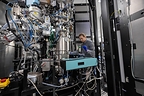
Now Biohub and UC Berkeley researchers have each built a laser phase plate, installed in custom versions of the Thermo Scientific Krios microscope, and demonstrated strong contrast improvements in imaging of small proteins, as reported in two scientific papers. The entire optical cavity housing the laser phase plate — the heart of the system — is less than four inches wide, tucked inside microscopes that stand 14 feet tall.

The UC Berkeley paper, published online today in Science, demonstrates that the laser phase plate provides higher resolution for six different biological samples of different sizes and different sample preparation. Further, they showed that the smaller the sample, the greater the improvement. Specifically, the authors show reconstructed images of a protein from muscle called aldolase, which is relatively easy to image with conventional cryo-EM machines, and of hemoglobin — a protein that carries oxygen in blood — which is at the lower limit for current machines.

“With the more challenging of the two particles, hemoglobin, we saw a strong improvement with the laser, but with the less challenging one, aldolase, the improvement is very small, as expected,” said Jessie Zhang, a postdoc in Müller’s lab who is the co-first author of the study with postdoc Petar Petrov.

Müller, professor of physics at UC Berkeley, said that now that the advantages of the laser phase plate have been clearly demonstrated, he is excited about its potential to solve even more challenging bioimaging problems.

“If you look at all the proteins in a human, they all have various sizes. And all of these proteins are potential disease mechanisms and drug targets,” said Müller, corresponding author of the paper and also a faculty scientist at Lawrence Berkeley National Laboratory. “The problem is, the average human protein is too small to be imaged by cryo-EM. The laser phase plate could fill an enormous gap in our knowledge of protein structures that can’t be processed with today’s cryo-EM.”

Müller spent more than 10 years building a working prototype of the laser phase plate. Then in 2021 Biohub decided to make a big bet on the technology and supported him with a grant, which allowed him to ramp up development, purchase a state-of-the-art cryo-electron microscope, and customize it for the laser phase plate.

In addition to supporting Müller’s efforts, Biohub made an even bigger bet, building a next-generation version of the laser phase plate with twice the complexity, featuring a dual laser system. That system is described in a new preprint on biorxiv.org.

Developed at Biohub’s imaging lab in Redwood City, in collaboration with UC Berkeley and industry partners, the device uses two laser beams oriented perpendicular to each other, each in its own cavity and operating at about half the power required by the single-cavity system used in Müller’s microscope. At lower power, components are less likely to burn and aberrations are reduced, making the system easier to operate.

The concept of a dual laser system was first proposed by Müller and UC Berkeley colleagues two years ago in a paper that was just published last week in Nature Communications.

An engineering feat — and a long time coming

More than a decade ago, Müller and Glaeser first proposed the idea of creating an intense laser to shift the phase of the electron beam in cryo-electron microscopes, but many in the field considered such an instrument far too difficult to build.

Making the laser phase plate a reality required an extraordinary combination of precision, advanced engineering, and complex laser optics to generate the most intense steady-state laser ever. Inside the cavity, a laser beam is bounced back and forth between two concave mirrors almost 10,000 times, building up to an intensity of approximately 350 to 400 gigawatts per square centimeter — an energy 100 million times more intense than the surface of the Sun, concentrated into a spot about 1/1000th the width of a human hair.

The mirrors that make this possible are themselves a remarkable feat of engineering. Each mirror must be polished to “atomic-level smoothness” — a surface roughness of less than one angstrom, approximately the diameter of a single atom.

“The mirrors must be extremely lossless to prevent them from melting, and in fact are so lossless that they barely warm up, despite being bombarded by a laser that could easily cut inches of steel,” Müller said.

The precision required to operate the instrument is equally demanding. The angle of the mirrors must be aligned to within 1/1000th of a degree for the lasers to bounce effectively. Additionally, the laser beam and electron beam must be aligned to within 50 nanometers — on a standing wave that is 500 nanometers across — to maximize contrast while acquiring data.

“It’s like a surfer trying to hold perfectly to the peak of a wave, not for seconds, but for half an hour at a stretch,” said Bridget Carragher, Founding Technical Director of Imaging at Biohub. She and Agard are co-leads of Biohub’s Dynamic Structural Cell Biology group and co-corresponding authors of the Biohub preprint, along with Biohub engineer Pavel Olshin.

The next frontier

While the papers demonstrate the device’s power for imaging individual small proteins, researchers at both institutions believe the next frontier is cryo-electron tomography (cryo-ET) — a powerful newer variant of cryo-EM that captures proteins not in isolation but in their natural cellular environment, revealing how molecular machines actually assemble, interact, and malfunction in disease.

“We believe tomography is where we’ll see the really huge wins for cell biology,” Carragher said. “There’s still work to be done in wrangling the microscope, but we’re optimistic we’ll be doing data collection by the end of the year.”

All of Biohub’s tomography data – including tens of thousands of annotated tomograms – is freely shared with the community at its CryoET Data Portal, which aims to accelerate the entire cryo-ET pipeline.

“Doing a cell biology experiment with cryo-ET today can take up a postdoc’s entire career,” Agard said. “We need to speed that up, and the laser phase plate, along with better processing, all working seamlessly with AI algorithms, will get us there.”

Müller hopes that microscopes fitted with laser phase plates will be commercially available in the coming years, and that labs around the world will have this powerful technology in regular use.

“This technology is a step function change for biology,” said Stephani Otte, Biohub’s Vice President of Imaging Science. “We are going to be able to see how molecular machines operate inside the living cell, in context, for the first time. What was once invisible will become visible — and that changes everything about how we understand disease.”

About Biohub

Biohub is a 501(c)(3) biomedical research organization building the first large-scale initiative to combine frontier AI and frontier biology to solve disease. With its compute capacity, AI research and engineering, and state-of-the-art technology for measuring, imaging, and programming biology, Biohub is enabling scientists worldwide to use AI-powered biology to study how cells operate and organize as systems — ultimately understanding why disease happens and how to cure or prevent it. Learn more at biohub.org.

About UC Berkeley

Founded in 1868, UC Berkeley is the world’s No. 1 public university, with 63 Nobel laureates and 50 graduate programs ranked in the nation’s top 10. Berkeley researchers advance fundamental science while addressing society’s greatest challenges — from artificial intelligence to climate change to human health. The university enrolls nearly 46,000 students, with 28% of undergraduates receiving federal Pell Grants, reflecting its commitment to access. Learn more at berkeley.edu.

View original content to download multimedia:https://www.prnewswire.com/news-releases/making-the-invisible-visible-microscope-breakthrough-will-open-unprecedented-view-into-our-cells-302798374.html

SOURCE Biohub

Continue Reading

Technology

Beghou Expands Pune Office, Strengthening Data, Analytics, and AI Capabilities

Published

on

By

The expanded office brings together multidisciplinary teams to solve increasingly complex life sciences commercialization challenges 

PUNE, India, Nov. 11, 2026 /PRNewswire/ — Beghou, a life sciences commercialization consulting and technology company, today announced the expansion of its Pune office. Opened on October 7 to foster cross-team collaboration, the new space reflects Beghou’s growing global delivery and innovation model. The Pune office is home to consulting and product teams with expertise spanning analytics, data engineering, technology, and AI. Beghou has also expanded its offices in Hyderabad and Bengaluru this year as its workforce continues to scale. The larger Pune space makes room for that growth, along with expanded leadership opportunities, specialist capabilities, and global client exposure for teams based there. 

“There’s a real sense of momentum at Beghou right now, and it’s exciting to see that reflected in our global expansion. We’re growing across markets, expanding the capabilities we bring to clients, and investing in the people and technology behind that work,” said Adrienne Lovink, CEO, Beghou. 

Commercialization challenges rarely sit within a single discipline, and Beghou’s model is built around that reality. Teams work together to move from identifying a business question to designing, building, and implementing the solution. The new office gives them dedicated space to collaborate, share knowledge, and learn from one another. 

“It is incredibly fulfilling to see the growth of our India organization and the world-class talent and capabilities we have built over the years. I see this growth as a stepping stone to something much bigger – not just scaling, but driving innovation, developing differentiated offerings, and solving increasingly complex commercialization challenges for our clients. Our new office reflects this ambition, bringing together diverse expertise and creating more opportunities for our teams to collaborate, innovate, and build meaningful solutions,” said Sonam Dubey, India Head, Beghou. 

The office is also a key hub for Beghou’s AI and product innovation, with teams working to embed AI in the solutions clients use across planning, analysis, and execution. They are also helping to develop new products that pair Beghou’s commercialization expertise with modern data capabilities. 

“We are at an exciting point in Beghou’s journey. I see this office as a melting pot of deep commercial expertise, technology, product thinking, and AI, the capabilities that will shape our next phase of growth. The opportunity is to combine those strengths to build differentiated solutions that solve real client problems and scale our impact,” said Abhigya Jain, Partner, Beghou. 

About Beghou 

Beghou drives commercialization that works for life sciences. For over 30 years, Beghou has been a long-term consulting and technology partner to more than 250 life sciences clients. We connect the dots between strategy, data, technology, and teams, helping clients accelerate launches, deepen customer engagement, and advance patient access. Whether a company is pre-commercial and building from scratch or refining an existing commercial strategy, Beghou provides fresh ideas and pragmatic, technology-enabled solutions to help organizations adapt and thrive in an increasingly complex environment. 

We build enduring partnerships by remaining engaged and accountable beyond project delivery to help ensure solutions take hold and deliver results. Combining strategic thinking, technical expertise, and hands-on execution, we help clients achieve faster outcomes and lasting impact. 

Find out more at www.beghou.com.

View original content to download multimedia:https://www.prnewswire.com/in/news-releases/beghou-expands-pune-office-strengthening-data-analytics-and-ai-capabilities-302935318.html

Continue Reading

Technology

TIER IV unveils end-to-end autonomous driving adaptable to map information and sensor configurations

Published

on

By

Multiple open-source AI models are available with Autoware

TOKYO, Nov. 11, 2026 /PRNewswire/ — TIER IV, the pioneering force behind Autoware, open-source software for autonomous driving, today announced the development and open-source release of multiple end-to-end (E2E) autonomous driving AI models that support different system requirements, including map information and sensor configurations. The models offer flexible options ranging from camera-only configurations to those incorporating LiDAR, radar and high-definition (HD) maps, enabling developers to select AI models suited to their performance requirements. Through Autoware, TIER IV provides a development environment for optimizing these models and integrating them into vehicle systems, helping automakers and technology partners develop and deploy their own autonomous driving stack.

Overview of the Autoware 2.0 Architecture

TIER IV is leading the development of Autoware 2.0, the next-generation architecture of Autoware. Autoware 2.0 is a scalable and adaptable architecture that flexibly combines AI models with conventional rule-based technologies. By supporting different AI models and sensor configurations, it enables autonomous driving systems to be built for a range of applications and system requirements. The E2E autonomous driving AI models announced today are concrete technological outcomes designed to leverage this architecture.

NVIDIA Alpamayo 2 Edge

As part of its collaboration with NVIDIA announced in March 2026 , TIER IV has been evaluating the performance of NVIDIA Alpamayo, a vision-language-action (VLA) foundation model, and integrating it with Autoware. The latest model, Alpamayo 2 Edge, is an E2E autonomous driving AI model that takes only camera images as input and uses reasoning to generate driving trajectories. With 2 billion parameters, compared with 34 billion in Alpamayo 2 Super, it is substantially smaller and offers promise for practical deployment in vehicles. TIER IV is currently optimizing the model and adapting it to real vehicles, while having completed its integration with Autoware.

GitHub (source code): https://github.com/autowarefoundation/alpamayo-autowareHugging Face (AI model): https://huggingface.co/nvidia/Alpamayo2-Edge

AutoE2E

AutoE2E, whose development is led by the Autoware Foundation (AWF) and TIER IV, is an E2E autonomous driving AI model capable of running on computing platforms beyond NVIDIA hardware. It adopts a Fast–Slow architecture combining a Reactive Model for real-time driving decisions, a World Model for predicting future changes in the surrounding environment, and a Reasoning Model that supports driving decisions. It can accommodate configurations ranging from cameras alone to those incorporating LiDAR and radar sensor data. With 79.9 million parameters, it is lighter than Alpamayo 2 Edge. The Reactive Model has been released, while development of the World Model and Reasoning Model continues, alongside consideration of commercialization for robotaxi applications. Integration of the Reactive Model with Autoware has been achieved.

GitHub (source code): https://github.com/autowarefoundation/auto_e2eHugging Face (AI model): https://huggingface.co/AutowareFoundation/auto_e2e

METEOR

Developed independently by TIER IV, METEOR is a lightweight, multitask E2E autonomous driving AI model primarily intended for privately owned passenger vehicles. Built on a convolutional neural network (CNN) architecture, it uses a bird’s-eye-view (BEV) representation to perform everything from perception of the surrounding environment to driving trajectory generation within a single neural network, without relying on high-definition maps. It supports configurations using images from one to eight cameras and can also incorporate LiDAR and radar sensor data. With 16 million parameters, it is even lighter than AutoE2E and supports operation across different semiconductor platforms, including NVIDIA and Renesas. TIER IV also uses CoMET, the automated labeling platform within Co-MLOps, together with agentic AI to automate data labeling and model training, evaluation, and improvement, eliminating the need for manual coding and labeling. Automakers and component suppliers can optimize the open-source model to meet their own vehicle specifications and performance requirements.

GitHub (source code): https://github.com/tier4/METEORHugging Face (AI model): https://huggingface.co/AutowareFoundation/meteor

OnePlanner

OnePlanner is an E2E autonomous driving AI model that integrates perception of the surrounding environment with motion planning. It currently uses BEVFusion, which generates a BEV representation from LiDAR point-cloud data, with a planned transition to PTv3. Its flexible architecture allows the perception model to be replaced while directly using features extracted during perception for motion planning. Conventional autonomous driving systems convert perception results into information such as object positions and velocities before passing them to the planner. OnePlanner reduces these intermediate conversions, enabling richer use of information about the surrounding environment. It also incorporates HD maps, route information, traffic-signal states, and vehicle motion states to generate driving trajectories for the next six seconds. Integration with Autoware has been achieved.

GitHub (source code): https://github.com/autowarefoundation/autoware_oneplannerHugging Face (AI model): https://huggingface.co/AutowareFoundation/oneplanner

LatentDrive

LatentDrive is an E2E autonomous driving AI model that uses a world model to integrate predictions of the surrounding environment with motion planning. Using V-JEPA, a self-supervised learning approach, it represents features of the surrounding environment extracted from camera video in a latent space and uses these features to generate vehicle trajectories. Its distinguishing feature is that it directly leverages information from video for motion planning without intermediate processes such as object detection and tracking. It does not require HD maps and generates trajectories for the next four seconds using camera video, route information, and vehicle motion states. It supports configurations with either one or three cameras, and work is underway on integration with Autoware and validation in an in-vehicle environment.

GitHub (source code): https://github.com/autowarefoundation/autoware_latent_driveHugging Face (AI model): https://huggingface.co/AutowareFoundation/latent_drive

“Advances in E2E autonomous driving are fundamentally changing how autonomous driving systems are developed.” said Shinpei Kato, founder and CEO of TIER IV. “For automakers and component suppliers to incorporate AI technology into their own products, however, it is essential that they be able to internalize technologies according to their applications and performance requirements, without depending on a particular AI model or semiconductor platform. By releasing multiple AI models developed under the leadership of TIER IV and the Autoware Foundation, alongside the results of our collaboration with NVIDIA, we have significantly expanded those choices. We will continue to advance the open-source ecosystem centered on Autoware and work with partners around the world to democratize autonomous driving.”

“Advancing autonomous driving requires AI that can reason through complex situations and run efficiently in the car.” said Ali Kani, vice president of automotive at NVIDIA. “TIER IV’s integration of NVIDIA Alpamayo 2 Edge with Autoware gives developers an open foundation to bring that intelligence from research into their own vehicles.”

“The advancement of autonomous driving technology depends on an ecosystem in which diverse AI models can be developed and evaluated openly, then applied according to their respective use cases.” said Muhammad Zain Khawaja, President of the Autoware Foundation. “The AI models released today are an important demonstration of how Autoware is evolving into a flexible development platform that is not tied to any particular technology or hardware. We welcome TIER IV’s continued technology development and its collaboration with partners including NVIDIA. The Autoware Foundation will continue working with the global open-source community to make advanced autonomous driving technology accessible to everyone.”

Next Steps

TIER IV will continue improving the performance of the AI models released today and optimizing them for in-vehicle environments, while promoting the development and commercialization of E2E autonomous driving technology by automakers and partners through Autoware. TIER IV will also strengthen collaboration with the global open-source community and work to expand the adoption of autonomous driving systems across diverse vehicle types and applications.

About TIER IV

TIER IV stands at the forefront of deep tech innovation, pioneering Autoware, open-source software for autonomous driving. With a comprehensive suite of platforms and services built around Autoware, TIER IV provides everything from software development and vehicle procurement to operational support. Through the Autoware ecosystem, TIER IV works with partners worldwide to shape the future of intelligent vehicles with open-source software, aiming to create mobility that is safer, more sustainable, and accessible to all.

The word marks and logos of TIER IV are trademarks or registered trademarks of TIER IV, Inc. in Japan and other countries. All other company names, product names, service names, and logos referenced herein are trademarks or registered trademarks of their respective owners.

Autoware is a registered trademark of the Autoware Foundation.

Media contact
pr@tier4.jp 

View original content to download multimedia:https://www.prnewswire.com/news-releases/tier-iv-unveils-end-to-end-autonomous-driving-adaptable-to-map-information-and-sensor-configurations-302935963.html

SOURCE TIER IV, Inc.

Continue Reading

Technology

Dingdong to Report Third Quarter 2026 Financial Results on November 12, 2026

Published

on

By

SHANGHAI, Nov. 10, 2026 /PRNewswire/ — Dingdong (Cayman) Limited (“Dingdong” or the “Company”) (NYSE: DDL), a leading fresh grocery e-commerce company in China, with advanced supply chain capabilities, today announced that it will report its unaudited financial results for the third quarter ended September 30, 2026, before U.S. markets open on November 12, 2026.

About Dingdong (Cayman) Limited

Dingdong is the leading fresh grocery e-commerce company in mainland China, with sustainable long-term growth. The Company directly provides users and households with fresh groceries, prepared food, and other food products through delivering a convenient and excellent shopping experience supported by an extensive self-operated frontline fulfillment grid. Leveraging its deep insights into consumers’ evolving needs and its strong food innovation capabilities, Dingdong has successfully launched a series of private label products spanning a variety of food categories. Many of Dingdong’s private label products are produced at its own production plants, allowing it to more efficiently produce and offer safe and high-quality food products. Dingdong aims to be the first choice for fresh and food shopping.

For more information, please visit: https://ir.100.me.


View original content:https://www.prnewswire.com/news-releases/dingdong-to-report-third-quarter-2026-financial-results-on-november-12-2026-302935824.html

SOURCE Dingdong (Cayman) Limited

Continue Reading

Trending