Connect with us

Technology

Healthcare Leaders Call for Strong Digital Leadership to Drive Sustainable Transformation and AI Value Creation

Published

on

Senior healthcare executives, policymakers and industry leaders emphasise the importance of digital leadership capabilities in translating AI and digital investments into sustainable healthcare outcomes

KUALA LUMPUR, Malaysia, June 29, 2026 /PRNewswire/ — As healthcare systems across Asia accelerate investments in artificial intelligence (AI), digital platforms, and data-driven care, increasing attention is being placed on the leadership capabilities required to guide transformation and maximise value from these investments.

The discussion comes at a pivotal moment for Malaysia as the nation advances its AI agenda as a key driver of economic growth. With AI projected to contribute between RM13 billion and RM20 billion annually to GDP by 2030, Malaysia is accelerating AI adoption across strategic sectors, including healthcare, while strengthening governance and accountability frameworks. These efforts aim to position the country as a regional leader in trusted and responsible AI that delivers tangible economic and societal benefits.

Despite growing investments in AI-enabled diagnostics, predictive analytics, digital health platforms, and automation technologies, many healthcare organisations continue to struggle with scaling successful pilot projects into enterprise-wide transformation.

Against this backdrop, IMU University and NUS-ISS of the National University of Singapore (NUS) jointly organised the executive forum, “The New Mandate: Digital Leadership as a Leadership Capability –  Navigating AI, Financial Stewardship, and Workforce Transformation for Healthcare Leaders”, bringing together senior healthcare executives, hospital leaders, policymakers and industry stakeholders to discuss how healthcare organisations can move beyond AI experimentation and translate digital investments into sustainable, enterprise-wide value.

A key theme that emerged from the forum was that digital literacy is no longer merely a technical competency but a core leadership capability. Healthcare leaders are increasingly required to make complex decisions involving AI adoption, digital investments, workforce redesign, data governance, and financial sustainability. Participants also noted that healthcare systems across the region are facing mounting pressures, including workforce shortages, rising operating costs, ageing populations, and growing demand for healthcare services. In Malaysia, these challenges are further compounded by demographic shifts, the rising burden of chronic disease, and increasing complexity in care delivery. Together with escalating healthcare expenditure, these trends underscore the need for more efficient, data-driven models of care and operations.

Many organisations also faced difficulties aligning technology investments with long-term organisational priorities and value creation. Against this backdrop, participants discussed how healthcare organisations can move beyond fragmented technology initiatives towards more integrated, scalable, and sustainable transformation. Key priorities identified included:
 

Moving beyond fragmented pilots to enterprise-wide transformationStrengthening governance and accountability for AI adoptionBuilding financially sustainable digital investment modelsRedesigning workforce capabilities for an AI-enabled futureDeveloping data-fluent leaders capable of making evidence-based decisionsAligning clinical, operational, and strategic priorities across the organisation

Leadership, Not Technology, Defines Value Creation

Another key takeaway from the forum was that successful digital transformation depends as much on leadership as it does technology. While technology can be a powerful enabler, its impact is maximised only when supported by clear strategic direction, effective governance and organisational alignment.

As Professor Gerard George, Group Managing Director of IMU University, said in his welcome speech: “AI is not just a technology shift. It is a leadership challenge. Value will not be determined by investment levels, but by how well organisations align leadership, governance, workforce readiness, and execution. In healthcare, the real opportunity is to build systems that are digitally enabled, financially sustainable, and resilient at scale.”

Mr Khoong Chan Meng, Chief Executive Officer of NUS-ISS, said: “Technology alone does not transform healthcare. What matters is the ability of leaders and organisations to turn innovation into meaningful outcomes. As healthcare systems become increasingly AI-enabled and data-driven, leaders must be able to align strategy, people, and operations to scale transformation effectively. Through this collaboration with IMU University, NUS-ISS looks forward to supporting healthcare leaders and professionals in building the capabilities needed to drive sustainable and digitally-enabled transformation across the industry.”
 

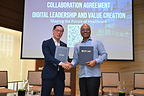
At the forum, IMU University and NUS-ISS also signed a collaboration agreement reaffirming their shared commitment to strengthening leadership and workforce capabilities across the healthcare sector. Under the agreement, both institutions will co-develop and co-deliver the “Digital Leadership and Value Creation Programme”, which will be offered by IMU University from September 2026.

Designed for senior healthcare leaders and executives, the programme will equip participants with practical frameworks and capabilities to lead digital transformation initiatives, align technology investments with organisational goals, and create sustainable value in an increasingly data-driven healthcare environment. Both institutions will also explore broader opportunities in executive education, leadership development, and industry-focused programmes to support healthcare organisations in strengthening digital readiness and building capabilities for sustainable transformation.

Building the Next Generation of Digital Health Leadership

As AI becomes a central pillar of Malaysia’s economic strategy and healthcare systems face growing structural pressure, the ability to align strategy, governance and execution will increasingly determine which organisations successfully scale transformation and deliver lasting value.

Healthcare transformation is no longer primarily a technological agenda. It is leadership and organisational challenge. Through this collaboration, IMU University and NUS-ISS are committed to helping healthcare organisations build the leadership capabilities needed to navigate change and realise the full potential of digital innovation.

About IMU University
IMU University is Malaysia’s pioneer private health-focused university, established in 1992 with the nation’s first global medical partnership programme. It has since evolved into a multidisciplinary institution offering programmes in medicine, health sciences, science, technology, and business, aligned with the evolving needs of global health systems.

IMU’s strength lies in its strong international outlook and extensive network, offering students pathways to collaborate with and transfer to over 45 partner universities across the United Kingdom, Australasia, China, and the United States, ensuring globally recognised qualifications and diverse academic and clinical exposure.

Underpinned by its progressive One Health philosophy, IMU integrates human, animal, and environmental health within a holistic interdisciplinary framework that shapes teaching and research, preparing graduates to address complex global health challenges.

Through experiential learning, structured internships, real-world projects, simulation centres, and industry collaboration, students gain early professional exposure that builds practical competence, adaptability, and confidence. Supported by strong accreditations, modern facilities, and a culture of research, innovation, and community engagement, IMU ensures graduates are well prepared to contribute meaningfully to advancing healthcare and improving outcomes globally and beyond it.

For more information on IMU, please visit imu.edu.my

About IMU Centre for Lifelong Learning
The Centre for Lifelong Learning (ICL) is the continuing professional development (CPD) and training arm of IMU. Poised as a premier leader in healthcare management education, ICL equips clinical, administrative, and corporate leaders with the vital skills needed to navigate and transform today’s industry landscapes.

While our core legacy is built on empowering healthcare communities through specialized courses in research, medicine, dentistry, pharmacy, and health sciences, ICL is actively moving beyond healthcare. By expanding our high-impact training programs to serve the wider public and diverse corporate sectors, we provide agile learning opportunities designed to drive continuous personal, professional, and organisational growth for everyone.

For more information on ICL, please visit https://web.imu.edu.my/page/v1/home

About National University of Singapore (NUS)
The National University of Singapore (NUS) is Singapore’s flagship university, which offers a global approach to education, research and entrepreneurship, with a focus on Asian perspectives and expertise. We have 15 colleges, faculties and schools across three campuses in Singapore, with more than 40,000 students from 100 countries enriching our vibrant and diverse campus 3 community. We have also established more than 20 NUS Overseas Colleges entrepreneurial hubs around the world.

Our multidisciplinary and real-world approach to education, research and entrepreneurship enables us to work closely with industry, governments and academia to address crucial and complex issues relevant to Asia and the world. Researchers in our faculties, research centres of excellence, corporate labs and more than 30 university-level research institutes focus on themes that include energy; environmental and urban sustainability; treatment and prevention of diseases; active ageing; advanced materials; risk management and resilience of financial systems; Asian studies; and Smart Nation capabilities such as artificial intelligence, data science, operations research and cybersecurity.

For more information on NUS, please visit www.nus.edu.sg

About NUS-ISS
Established in 1981, NUS-ISS nurtures digital talent for the industry through graduate education, executive education programmes, consultancy, applied research, and career services. NUS-ISS guides individuals and organisations to bridge future opportunities through a unique portfolio of multiple learning pathways such as blended learning and stackable programmes, leading the way in shaping the next curve of digital excellence. It offers a wide spectrum of programmes in critical industry disciplines, such as digital leadership, software development, data science, artificial intelligence, cybersecurity, product management, smart health and digital innovation.

To date, over 210,000 digital leaders and professionals from across 9,422 corporate client organisations, and 8,854 graduate programmes alumni have benefitted from NUS-ISS’ suite of services. Its programmes are delivered by NUS-ISS staff with an average of more than 20 years of industry experience and supported by a strong network of partners. NUS-ISS also works with industry partners and associations locally and globally to co-create a digital learning ecosystem that inspires and shapes solutions for the digital economy.

For more information on NUS-ISS, please visit www.iss.nus.edu.sg

View original content to download multimedia:https://www.prnewswire.com/apac/news-releases/healthcare-leaders-call-for-strong-digital-leadership-to-drive-sustainable-transformation-and-ai-value-creation-302812930.html

SOURCE NUS-ISS

Continue Reading

Technology

Raytron Industrial Launches TN660 and TN463 Thermal Cameras for Dynamic Testing and Continuous Condition Monitoring

Published

on

By

YANTAI, China, Oct. 22, 2026 /PRNewswire/ — Raytron Industrial today announced the launch of two new products: the TN660 High Frame Rate Fixed-Mount Thermal Camera and the TN463 Fixed-Mount Thermal Camera. Both offer 640 × 512 imaging with synchronized image and temperature data. The TN660 delivers full-frame 120 Hz acquisition for moving targets and transient thermal processes, while the TN463 provides 60 Hz imaging for routine inline inspection and continuous equipment monitoring.

Full-Resolution Imaging for Different Process Speeds

Featuring a 12 μm uncooled VOx detector, the TN660 achieves 120 Hz at its native resolution without windowing, preserving spatial detail and scene coverage. Frames are approximately 8.33 ms apart, helping engineers examine rapid heating, cooling, and short-duration thermal events in research, industrial automation, and transportation applications.

The TN463 uses the same detector resolution and pixel pitch. Its 60 Hz output supports routine production cycles and long-term temperature trend analysis. To accommodate different installation requirements, the TN463 offers 6.9 mm, 9.1 mm, 19 mm, and 25 mm lenses, while the TN660 is available with 9.1 mm and 25 mm lenses.

From Event-Triggered Capture to Synchronized Analysis

Both cameras support hardware and software triggering to coordinate acquisition with equipment actions. An external signal through the I/O (input/output) interface can initiate capture at a defined process stage. For example, a heat-press start signal can trigger the TN660 to record the thermal sequence, reducing unnecessary recording and review work.

Synchronized output pairs temperature readings with corresponding thermal images. Raytron Industrial’s TI Studio software supports simultaneous preview and analysis of up to four cameras, with temperature and temperature-rise alarms to flag abnormal conditions. Engineers can review recordings, examine and export historical temperature curves, and generate reports, linking equipment events with thermal data for further analysis.

Temperature Measurement and System Integration

Both models measure temperatures from −20°C to 150°C and 100°C to 650°C, with an accuracy of ±2°C or ±2% of the reading, whichever is greater. Ethernet and USB connectivity support data acquisition, while compatibility with industrial protocols such as Modbus TCP allows temperature data to be incorporated into existing control and monitoring systems.

With a choice of 60 Hz and 120 Hz imaging, the TN463 and TN660 allow users to match thermal acquisition to their process requirements, from continuous equipment monitoring to dynamic testing.

For Further Information

Email: sales@raythink-tech.com
Website: https://www.raythink-tech.com/

View original content to download multimedia:https://www.prnewswire.co.uk/news-releases/raytron-industrial-launches-tn660-and-tn463-thermal-cameras-for-dynamic-testing-and-continuous-condition-monitoring-302916778.html

Continue Reading

Technology

4SiGHT Supply Chain Group Welcomes Joanne Strong as Senior Vice President, Delivery Excellence and Innovation

Published

on

By

Industry-recognized WMS leader and AI-driven delivery innovator joins 4SiGHT to lead delivery as one of North America’s largest dedicated Manhattan Active® implementation partners accelerates its growth

WAYNE, N.J., Oct. 22, 2026 /PRNewswire-PRWeb/ — 4SiGHT Supply Chain Group, one of North America’s largest dedicated Manhattan Associates implementation partners, today announced the appointment of Joanne Strong as Senior Vice President of Delivery Excellence and Innovation. Strong joins the executive leadership team and will lead all client delivery across the firm.

4SiGHT has built something rare in its 18 years of operations: deep Manhattan expertise, exceptional talent, industry reputation, singular focus on Manhattan Associates, and a culture that puts client success at the center of everything it does.

The appointment comes during a year of rapid growth for 4SiGHT. Now in its 18th year, the firm has grown to more than 70 full-time associates in 2026 and continues to add Manhattan Active® talent across its warehouse, labor, transportation, and organizational change management practices. Strong’s newly created role is dedicated to ensuring that this growth is matched by an uncompromising standard of quality across every engagement.

“Delivery is our product. Every go-live, every client reference, and every renewal comes down to how well we execute,” said Frank Camean, President and CEO of 4SiGHT. “As 4SiGHT scales, we made a deliberate decision to put a senior executive in charge of one thing: the quality, consistency, and continuous improvement of how we deliver for our clients. Joanne has built and led delivery organizations at real scale, she knows the Manhattan Associates platform from the inside, and she has a proven record of innovation to make implementations faster and more predictable. Joanne is exactly the leader our clients deserve as we enter our next chapter. We are all honored and excited to have her join the team and can’t wait to see what the future brings.”

Strong brings more than a decade of experience with Manhattan Associates and enterprise warehouse management. She most recently served as WMS Practice Lead, directing a multimillion-dollar WMS practice that delivered supply chain transformation programs for Fortune 500 companies in retail, consumer products, and life sciences.

A recognized voice in the supply chain industry, Strong delivered keynote addresses at the 2025 Stratify Executive Forum and at Parcel Forum 2026, has been a featured panelist at MODEX, and has appeared on The New Warehouse and Bloomberg’s Talking Transports podcasts. She holds a B.B.A. in Management Information Systems from the University of Georgia’s Terry College of Business.

“4SiGHT has built something rare in its 18 years of operations: deep Manhattan expertise, exceptional talent, industry reputation, singular focus on Manhattan Associates, and a culture that puts client success at the center of everything it does,” said Strong. “The depth of Manhattan knowledge and real-world implementation experience across the organization is truly unique in the industry. My focus is on elevating an already outstanding client experience by combining that expertise with proven delivery practices, innovative methodologies, implementation accelerators, AI-enabled tools and capabilities. We have an incredible opportunity to help clients achieve faster outcomes, greater confidence in execution, and long-term business value. I’m honored to join the team at such a pivotal moment in its growth and excited for what we will accomplish together.”

About 4SiGHT Supply Chain Group

4SiGHT specializes in supply chain software implementations, with a primary focus on the Manhattan Associates product suite of applications. Our seasoned professionals average more than 19 years of experience helping companies across all industries solve their distribution, fulfillment, and transportation challenges. Together with our strategic partners, our collective team includes more than 100 associates. No other firm in North America brings this depth of Manhattan Active® expertise, and we look forward to expanding our team with additional talent in the months ahead. As a testament to the value our clients place on our expertise, experience, and integrity, 4SiGHT has received multiple industry awards. For more information, please visit 4sight.com or email us at in4mation@4sight.com.

Media Contact

Jenae Cahanes, 4SiGHT Supply Chain Group, 1 9734350025, jenae.cahanes@4sight.com, 4sight.com

LinkedIn

View original content:https://www.prweb.com/releases/4sight-supply-chain-group-welcomes-joanne-strong-as-senior-vice-president-delivery-excellence-and-innovation-302916680.html

SOURCE 4SiGHT Supply Chain Group

Continue Reading

Technology

UL Research Institutes Releases New Report Defining Roadmap for Next-Generation Wildfire Risk Intelligence

Published

on

By

New findings identify critical gaps and opportunities in wildfire risk modeling to strengthen community protection

COLUMBIA, Md., Oct. 22, 2026 /PRNewswire/ — As destructive wildfires increasingly threaten communities across the globe, a new report from UL Research Institutes’ Fire Safety Research Institute examines the strengths and limitations of current wildfire risk models and provides a roadmap for more comprehensive wildfire risk intelligence.

“Wildfire Risk Modeling Evaluation Findings and Community Perspectives” details findings from the 2026 Wildfire Risk Modeling Exercise, a first-of-its-kind collaborative effort that evaluated a diverse set of wildfire risk models using common scenarios and datasets. The exercise included approximately 20 organizations across academia, government, national laboratories, nonprofits, and the private sector.

For fire service leaders, emergency managers, and public safety officials, the report provides a practical framework for evaluating which modeling capabilities are best suited to specific community needs and decisions. Applied effectively, these tools can help practitioners identify where risk is greatest, prioritize mitigation investments, strengthen evacuation and preparedness planning, and make more informed decisions before, during, and after a wildfire.

“The Wildfire Risk Modeling Exercise was a convergent test and evaluation of the diverse models available to characterize wildfire risk today. These results revealed broader insights about the state of the science, prioritized gaps, and the investments needed to advance wildfire risk intelligence,” said Rebecca Harned, principal research scientist for Fire Safety Research Institute and the report’s lead author. “The findings provide a critical foundation for shaping the next decade of research, innovation, and operational capability. This report also serves as an important resource for local and state fire service and public safety agencies, providing an evidence-based framework for selecting wildfire risk modeling capabilities and applying them effectively to assess and manage community risk.”

Key Findings From the Wildfire Risk Modeling Exercise

The results from the exercise demonstrate that no single model can capture the full complexity of wildfire risk, nor should one be expected to. Instead, the report identifies an opportunity to build a new generation of wildfire risk intelligence by connecting complementary models, datasets, and scientific approaches. Doing so can help close critical gaps between modeling wildfire hazard and understanding what ultimately matters to communities — which people, property, and assets are at risk, why they are vulnerable, what the consequences could be, and which actions can most effectively reduce those risks.

To realize that vision, the report recommends building an interoperable modeling ecosystem spanning the full wildfire risk assessment pathway, from ignition and landscape fire spread through structure exposure, community impacts, and economic consequences. It also calls for stronger shared core data and standards, improved transparency and explainability, expanded decision-support tools, and greater use of ensemble modeling. Together, these advances could transform wildfire modeling from a collection of specialized capabilities into an integrated risk intelligence framework that better supports decisions before, during, and after wildfire events.

About the Fire Safety Research Institute

UL Research Institutes’ Fire Safety Research Institute advances fire science and fire safety knowledge to reduce risk, save lives, and protect property. We conduct rigorous research, outreach, and education in collaboration with the fire service, fire safety professionals, policymakers, communities, and an international network of partners. Together, we develop tools, resources, and strategies that improve fire safety outcomes worldwide. To learn more, visit fsri.org. Follow Fire Safety Research Institute on Instagram, Facebook, and LinkedIn.

About UL Research Institutes

UL Research Institutes is a nonprofit research organization dedicated to advancing public safety through scientific discovery. Since 1894, our research has advanced our mission toward a safer, more secure, and sustainable future. Focused on global risks from fire mitigation and air quality to safe energy storage and digital privacy, we conduct rigorous independent research, analyze safety data, and partner with experts to uncover and act on existing and emerging risks to human safety. Discover more at UL.org.

About the Exercise

The 2026 Wildfire Risk Modeling Exercise was designed as an open, collaborative and non-competitive effort. Each model submission was evaluated by multiple reviewers through two complementary evaluation streams: science and technical evaluation and user and practitioner evaluation. Participating organizations applied their models to standardized scenarios representing wildland, wildland-urban interface, and urban environments, with results evaluated by scientific experts and operational practitioners. The exercise was designed not to rank models, but to identify their strengths, limitations, and opportunities for integration.

For more information and to read the full report, visit FSRI.org.

View original content to download multimedia:https://www.prnewswire.com/news-releases/ul-research-institutes-releases-new-report-defining-roadmap-for-next-generation-wildfire-risk-intelligence-302916462.html

SOURCE UL Research Institutes

Continue Reading

Trending