Connect with us

Technology

CIOs Need Clearer Enterprise Architect Role Definition to Strengthen EA Value, Advises Info-Tech Research Group

Published

on

With technology and business priorities evolving at a rapid pace, many organizations still lack a clear definition of what success looks like for the enterprise architect role. New insights from Info-Tech Research Group indicate that developing architects against generic expectations can erode credibility, stall momentum, and weaken business alignment. The firm’s newly published blueprint, Build a Better Enterprise Architect, gives CIOs, EA leaders, and enterprise architects a structured way to define the role, prioritize the skills that matter, and map development milestones to real stakeholder value.

ARLINGTON, Va., July 6, 2026 /CNW/ – Many organizations still treat enterprise architect maturity as a competency of technical depth alone. However, newly published findings from Info-Tech Research Group show that effective enterprise architects also need strong analytical thinking, relationship-building, communication, and storytelling skills to influence decisions and deliver value. The global research and advisory firm’s recent blueprint, Build a Better Enterprise Architect, provides a structured path to help organizations move beyond generic job descriptions and create an enterprise architect role aligned to stakeholder outcomes.

Despite continued investment in enterprise architecture (EA) practices, many organizations face challenges in showing measurable results. Budget pressure has increased scrutiny on ROI, yet EA functions often lack an effective role to deliver and lead the EA practice. Without a role anchored to specific outcomes, and without a way to track progress, EA initiatives can lose momentum before they demonstrate value. Info-Tech’s blueprint addresses this directly, helping organizations translate broad expectations into focused development plans for an enterprise architect that builds credibility and strengthens business alignment.

“Enterprise architects often become difficult to justify and resource because many organizations expect architects to do too much at once,” says Andrew Kum-Seun, research director at Info-Tech Research Group. “Info-Tech’s framework helps leaders focus the role around the outcomes that matter most. Once the mandate is clear, the skills and development priorities become much easier to define and plan.”

Key Challenges EA Leaders Face in Defining and Developing Enterprise Architects

Despite growing recognition of the EA practice’s and enterprise architect’s strategic importance, Info-Tech’s research highlights several systemic barriers that organizations consistently encounter:

Role ambiguity undermines credibility. Without a context-specific definition of the enterprise architect’s purpose, scope, and reporting structure, architects take on misaligned expectations and struggle to build organizational trust.Generic skillsets create false confidence. Industry frameworks and job descriptions may not capture what an organization needs from its enterprise architects. Evaluating every possible skill at once produces unfocused development plans that fail to deliver results.Orientation mismatches limit delivery. Enterprise architects can embody several distinct orientations. Choosing the wrong orientation constrains the value the role can deliver.Stakeholder buy-in falters without measurable objectives. If progress takes too long to materialize, early enthusiasm fades, and the role loses organizational support before it matures.

Info-Tech’s Three-Phase Framework for Building a Better Enterprise Architect
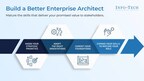
To address these challenges, Info-Tech recommends a structured approach. The firm’s Build a Better Enterprise Architect research framework outlines the following priorities for EA leaders and their teams:

Phase 1: Craft Your Enterprise Architect Role.
Establish a clear, context-specific role definition, select the orientation(s) that align with stakeholder value, and document the scope and reporting structure, anchoring the role to specific outcomes rather than broad expectations.

Phase 2: Prioritize and Assess Your EA Skills.
Use the Enterprise Architect Skills Assessment tool to identify the gaps for the chosen orientation, covering mandatory foundation skills and supplementary skills to expand the architect’s breadth and depth.

Phase 3: Roadmap Your Development Milestones.
EA leaders and architects define SMART objectives and corresponding metrics, then sequence skill-development activities across periods, capturing outputs in the Enterprise Architect Role Profile template. This document communicates the architect’s purpose, value, and development plan for stakeholder buy-in.

“The role of the enterprise architect is so complex that to deliver long-term value, they need to determine what skills to develop and what orientation to adopt to best serve the enterprise,” says Caleb Pittman, research specialist at Info-Tech Research Group. “When architects stop chasing the desire to please everyone and focus on a narrow, high-impact mandate, their credibility deepens and their influence scales.”

The firm’s research, Build a Better Enterprise Architect, includes a comprehensive EA skills framework covering various architect orientations, an Enterprise Architect Skills Assessment tool, and an Enterprise Architect Role Profile template. By applying Info-Tech’s research, CIOs and EA leaders can move from a loosely defined EA function to a focused practice that earns stakeholder trust, tracks measurable progress, and builds the organizational credibility that enterprise architecture requires.

For exclusive and timely commentary from Info-Tech’s experts, including Andrew Kum-Seun and Caleb Pittman, and access to the complete Build a Better Enterprise Architect blueprint, please contact pr@infotech.com.

About Info-Tech Research Group
Info-Tech Research Group is the “get things done” partner for over 30,000 IT, HR, and marketing leaders worldwide. The fastest growing research and advisory firm, Info-Tech enables leaders to make well-informed decisions and transform their organizations through AI, strategic foresight, step-by-step methodologies, practical tools, industry-leading advisory, and training programs. For nearly 30 years, tens of thousands of private and public organizations have trusted Info-Tech to lead their most important initiatives through periods of change and deliver outcomes that truly matter.

To learn more about Info-Tech’s HR research and advisory services, visit McLean & Company, and for data-driven software buying insights and vendor evaluations, visit the firm’s SoftwareReviews platform.

Media professionals can register for unrestricted access to research across IT, HR, and software, and hundreds of industry analysts through the firm’s Media Insiders program. To gain access, contact pr@infotech.com.

For information about Info-Tech Research Group or to access the latest research, visit infotech.com and connect via LinkedIn and X.

View original content to download multimedia:https://www.prnewswire.com/news-releases/cios-need-clearer-enterprise-architect-role-definition-to-strengthen-ea-value-advises-info-tech-research-group-302818157.html

SOURCE Info-Tech Research Group

Continue Reading
Click to comment

Leave a Reply

Your email address will not be published. Required fields are marked *

Technology

PerkinElmer and Covalent Announce Strategic Collaboration to Advance Failure Analysis and Materials Characterization for Semiconductor, Electronics, and Battery Industries

Published

on

By

Collaboration pairs PerkinElmer’s ICP-MS/MS and LC-MS/MS technologies with Covalent’s failure analysis expertise to help manufacturers pinpoint the root causes of material failure and performance degradation.

SHELTON, Conn. and SUNNYVALE, Calif., July 7, 2026 /PRNewswire/ — PerkinElmer and Covalent today announced a strategic collaboration to provide advanced analytical instrumentation and analysis services that address the growing complexity of failure analysis and materials characterization.

In the high-stakes fields of advanced electronics, semiconductor manufacturing, energy storage, and other precision-materials industries, identifying the root causes of material failures and performance drops is essential. Component degradation, trace chemical contamination, and structural breakdowns require highly sensitive analytical tools capable of detecting the smallest indicators of a larger problem.

Utilizing Inductively Coupled Plasma Mass Spectrometry (ICP-MS/MS) and Liquid Chromatography-Tandem Mass Spectrometry (LC-MS/MS), researchers and manufacturers can track down ultra-trace elemental impurities and organic degradation mechanisms. These techniques optimize manufacturing quality control and accelerate root-cause failure analysis.

“This is an important partnership to help us better understand the analysis challenges facing the semiconductor, electronics, and battery industries,” said Paul Davies, Vice President, North America, PerkinElmer. “Covalent is a well-respected subject matter expert in this space and will be an invaluable voice of the customer, helping us push the boundaries of what ICP-MS/MS, LC-MS/MS, and other technologies in our portfolio are capable of in failure analysis, raw material characterization, and battery lifetime diagnostics.”

“PerkinElmer has been a trusted leader in analytical science for decades, and we are honored that they chose to partner with us for these critical applications,” said Craig Hunter, CEO of Covalent. “As materials systems and product designs become more complex, the ability to combine cutting-edge instrumentation with expert application knowledge is more important than ever. Our partnership with PerkinElmer will help customers gain deeper insight into the mechanisms that drive performance and reliability.”

PerkinElmer’s ICP-MS/MS delivers unmatched sensitivity for ultra-trace chemical analysis of metallic impurities before they deposit on silicon or compound-silicon wafers. The technique can also characterize the corrosion, solder joint deterioration, and migratory short-circuiting that cause modern printed circuit boards and electronic packages to fail.

PerkinElmer’s LC-MS/MS technology provides electrolyte degradation profiling for battery performance analysis and helps characterize the chemical degradation of coatings and epoxy mold compounds in electronic components. These same capabilities extend to impurity profiling, medical device characterization, and broader precision-materials work where chemical sensitivity is the binding constraint.

About PerkinElmer

PerkinElmer is a global leader in analytical and testing solutions, pharma specialty services, and omics solutions, serving customers across the life sciences, applied & industrial, and food. Drawing on nearly 90 years of pioneering innovation and engineering expertise, we support the science of our customers with insights of the highest standards of safety, quality and compliance for vital therapeutics, the integrity of the global food chain, the performance and sustainability of critical materials, and the sustainability of our environment. Together with scientists, laboratory and quality leaders, and manufacturing operators worldwide, our 5,500 colleagues in 35 countries empower progress by providing trusted insights and services for a healthier, safer, and more sustainable world.

For more information, visit: www.perkinelmer.com

Media Contact
Markus Leutert
VP, Corporate Communications & Sustainability

Markus.leutert@perkinelmer.com

About Covalent

Covalent is a leading materials characterization and failure analysis laboratory that helps companies solve complex engineering and manufacturing challenges. With expertise spanning semiconductor, electronics, battery, aerospace, medical device, and advanced materials industries, Covalent combines world-class scientific expertise with more than 100 analytical techniques to deliver actionable insights that improve product performance, reliability, and manufacturing quality. Learn more at www.covalent.com.

Media Contact
Sophia Attaf
Director of Marketing

marketing@covalent.com

View original content:https://www.prnewswire.com/news-releases/perkinelmer-and-covalent-announce-strategic-collaboration-to-advance-failure-analysis-and-materials-characterization-for-semiconductor-electronics-and-battery-industries-302819821.html

SOURCE Covalent

Continue Reading

Technology

Can $2,500 and a Smartphone App Double the Success of Sight-Restoring Surgery? New Orbis International Study Says Yes

Published

on

By

NEW YORK, July 7, 2026 /PRNewswire/ — A new study from global eye care nonprofit Orbis International, published today in the Bulletin of the World Health Organization, reveals a surprisingly simple solution to a major global health challenge. By combining a free smartphone app, focused on quality improvement, with a modest “micro-investment” of $2,500, 11 hospitals in Ethiopia nearly doubled their cataract surgery success rates, increasing the share of patients with good vision after surgery from 32.2% to 56.0% within months—a significant step toward the WHO’s global benchmark of 80%.

Cataract is the world’s leading cause of blindness, affecting 102 million people. While the surgery is inexpensive and straightforward, outcomes in low-resource settings are often mixed. Led by Orbis International, the BOOST Africa Study lays out a “blueprint for sight” that challenges conventional approaches in international development, showing how small, data-driven surgical fixes can be more effective than large infrastructure investments.

The “Diagnostic Discovery”

The study used the Better Operative Outcome Software Tool (BOOST), a free app that allows surgeons to track their surgical outcomes in real time. The data revealed a significant trend: the primary cause of poor vision after surgery wasn’t the surgeon’s lack of skill, but undetected co-morbidities like glaucoma or retinal disease.

“The app gave our partners in Ethiopia a mirror to see their own performance,” said Noelle Whitestone, co-author and Orbis International researcher. “We discovered that frequently it wasn’t the surgery failing; it was the screening. By providing just $2,500 per facility, hospitals were able to purchase specific diagnostic tools, such as indirect ophthalmoscopes, needed to identify the right patients for surgery. This result underscores that change doesn’t always require advanced technology—sometimes basic tools and skills are enough.”

A Tale of Two Countries: The Zambia Lesson

The study also provides a rare, candid look at the logistical “last mile” of global health. While Ethiopia saw rapid success, five partner hospitals in Zambia faced significant delays due to procurement and supply chain hurdles.

“Our work in Zambia shows that data is a powerful diagnostic tool for a surgical team, but its value is realized only when the infrastructure supports them,” said Whitestone. “When a surgeon identifies a specific need through the app, we must ensure they have the administrative and financial backing to secure the necessary equipment and training. This study confirms that for digital health to be effective, it must be paired with funding that responds to the surgeon’s own findings.”

A Scalable Model for 2030

As the world strives to meet the WHO 2030 targets for eye care, the BOOST Africa Study offers a cost-effective, high-tech roadmap. By using e-health tools to standardize quality, even the most remote clinics can achieve high-level results. The BOOST app empowers surgeons to track their own results over time, compare outcomes with peers globally, and identify areas for improvement in a supportive, non‑threatening, data‑driven environment. By translating performance data into practical, actionable feedback, the platform opens new opportunities for skills exchange, continuous learning, and sustained improvements in surgical quality.

This study was funded by the Lions Clubs International Foundation.

About Orbis International

Orbis International works around the world to prevent blindness and restore sight for children and adults in places where eye care is out of reach—so vision problems don’t make it harder to learn, earn a living, or enjoy life. Around 1.1 billion people live with vision loss, but with the right care, 90% of it is completely avoidable. That is why Orbis trains doctors, nurses, and other eye care professionals to provide care in their own communities—and works to make sure people of all ages can access the eye exams, glasses, medicine, and surgeries they need to protect and restore their sight. Orbis began this work more than 40 years ago with the Flying Eye Hospital, a teaching hospital on a plane that brings expert training and care where they’re needed most. Today, we also work with local hospitals and clinics across Africa, Asia, and Latin America to make eye care available to more people, and we use and develop technology—like our award-winning Cybersight e-learning and telehealth platform, artificial intelligence screening, and virtual reality training—to help eye care teams treat patients more effectively. Orbis ranks in the top 3% of U.S. charities, having earned top marks for transparency and accountability from Charity NavigatorGuideStar, and the Better Business Bureau. To learn more, please visit orbis.org.

About the BOOST App

The Better Operative Outcome Software Tool (BOOST) is a free, user-friendly app that helps cataract surgical providers monitor and improve their results. Developed by Orbis and a global consortium, it is available on Android and Windows to help hospitals everywhere achieve excellence in eye care.

MEDIA CONTACT
Jenna Montgomery
Interim Lead, Global Communications and Marketing
jenna.montgomery@orbis.org 

SOURCE Orbis International

Continue Reading

Technology

In HelloNation, Luxury Real Estate Expert Jud Whitlock Explains Why Local Expertise Still Wins in a Global Luxury Market

Published

on

By

The article examines how neighborhood knowledge helps buyers and sellers make informed decisions in an increasingly connected luxury real estate market.

ATLANTA, July 7, 2026 /PRNewswire/ — Why does local expertise matter in luxury real estate? A recent HelloNation article answers this question, featuring insights from Luxury Real Estate Expert Jud Whitlock of Atlanta Fine Homes/Sotheby’s International Realty. In a HelloNation article, Whitlock, a 3rd-generation Atlantan, discusses why, despite the rise of global exposure and online access, local knowledge remains the defining advantage in high-end real estate. His analysis shows that understanding the nuances of a community continues to separate good investments from great ones.

The article explains that while the modern luxury market is increasingly international, success still depends on localized understanding. Buyers can now explore properties across the world with a few clicks, but they rely on professionals who know the rhythms, people, and history of a city. Whitlock notes that in Atlanta, this knowledge makes a tangible difference. Agents who live and work in the community can interpret data in context, identifying factors that numbers alone cannot show.

Local expertise, he explains, goes beyond familiarity with listings. It involves recognizing the subtle shifts that define value over time. A home’s orientation, elevation, and surrounding development can all influence its performance. Professionals with local roots can read these details intuitively, guiding clients with precision rather than guesswork. They understand how market conditions fluctuate with the seasons and how cultural or lifestyle patterns affect demand.

Whitlock highlights that both buyers and sellers gain significantly from this level of insight. For buyers, local professionals identify homes that align with both lifestyle and investment goals. They anticipate practical concerns such as commute routes, community restrictions, or long-term maintenance requirements. This perspective helps clients make decisions grounded in reality, avoiding costly surprises. For sellers, local agents know how to position properties strategically, choosing the right timing, presentation, and pricing for maximum impact.

Global marketing networks remain valuable, but Whitlock stresses that global reach must be supported by local understanding. A property can attract international attention, yet its success depends on how it is represented within its immediate environment. The strongest agents bridge these two worlds, using global tools alongside neighborhood-level insight. Whitlock explains that this combination allows listings to reach broad audiences while maintaining authenticity and precision.

Atlanta’s luxury market provides a clear example of this balance. From Buckhead’s historic estates to the mountain retreats of North Georgia, each area reflects its own culture and buyer profile. Global exposure can draw attention to these listings, but only a local expert can interpret the subtleties of value between communities. Whitlock observes that knowing how design, location, and lifestyle interact is what allows agents to serve clients effectively across price ranges and regions.

Local professionals also bring a deep understanding of zoning, taxes, and regional development that global data cannot capture. Whitlock points out that this awareness allows agents to advise clients on growth areas, infrastructure improvements, and neighborhood stability. Such insights turn single purchases into informed, long-term investments. The most successful advisors use this foresight to help clients build wealth and confidence in an evolving market.

Relationships further strengthen the advantage of local representation. Whitlock emphasizes that trusted connections with inspectors, contractors, and designers ensure quality at every stage of the transaction. Local networks simplify repairs, staging, and closing procedures. These partnerships create a seamless experience that builds trust among buyers and sellers alike. The consistency and accountability developed through local collaboration set a high standard of service that benefits the entire community.

For international buyers entering Atlanta’s market, Whitlock explains that local guidance provides cultural and procedural clarity. Real estate practices vary around the world, from negotiation styles to closing timelines. Local experts act as interpreters, explaining how the Atlanta market functions and how its values differ from other regions. This insight gives foreign investors the confidence to act quickly and wisely, supported by a professional who understands both global expectations and local realities.

While technology has transformed how buyers discover properties, Whitlock notes that it cannot replace the human insight that local professionals bring. Virtual tours and online data reveal only part of the story. Understanding what those metrics mean within the context of a specific street, neighborhood, or school district requires lived experience. Local expertise makes digital tools more effective by grounding them in a firsthand perspective.

The most successful transactions, according to Whitlock, combine global exposure with local depth. This partnership ensures that wide visibility is matched by credibility and precision. Homes marketed through international platforms attract attention, but those represented with authentic neighborhood insight inspire confidence. In a competitive market, this balance gives both buyers and sellers an enduring advantage.

Atlanta’s continued rise as a global destination underscores the value of local expertise. Whitlock concludes that no matter how advanced technology becomes, the human element remains at the heart of real estate. Advisors who understand both the world and their own city deliver the results that matter most. In an age of digital convenience, local knowledge keeps the process grounded, informed, and deeply personal.

Why “Local Expertise” Still Wins in a Global Luxury Market, features insights from Jud Whitlock, Luxury Real Estate Expert of Atlanta, Georgia, in HelloNation.

About HelloNation
HelloNation is America’s Good News Network, a premier media platform built on the idea that good news travels faster when real people tell real stories. Through its community-focused publications and innovative “edvertising” approach, HelloNation delivers content that informs, inspires, and spotlights the leaders making a meaningful impact in their communities.

View original content to download multimedia:https://www.prnewswire.com/news-releases/in-hellonation-luxury-real-estate-expert-jud-whitlock-explains-why-local-expertise-still-wins-in-a-global-luxury-market-302819846.html

SOURCE HelloNation

Continue Reading

Trending