Technology
As Ebola Surges, 3 in 4 Americans Back Restoring U.S. Aid to Fight It, per New Echelon-Rockefeller Foundation Poll
Published
1 hour agoon
By
Conducted ahead of America’s 250th anniversary, the survey finds nine in ten Americans (90%) across the political spectrum support funding programs to prevent disease outbreaks abroad, the highest-testing program area in the survey.Those who primarily support President Trump are the least concerned about Ebola spreading to the U.S., yet more than one in two (52%) back restoring U.S. aid to contain the outbreak, along with 60% of Republican-leaners and 89% of Democrat-leaners.
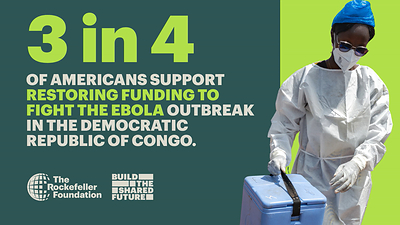
NEW YORK, July 8, 2026 /PRNewswire/ — With the Ebola outbreak the third-largest on record, and growing, survey data from The Rockefeller Foundation and Echelon Insights shows that 75% of Americans – including more than one in two (52%) who primarily support President Trump – agree that the United States should restore disease prevention aid to contain the virus. An American Perspective on Foreign Aid, which evaluated Americans’ opinions on foreign assistance ahead of the nation’s 250th anniversary, also reveals near universal support across political party lines (90%) for funding overseas disease prevention programs. The findings suggest that despite the official closure of the U.S. Agency for International Development (USAID) one year ago this month, Americans across the political spectrum continue to see disease prevention abroad as a core U.S. interest, not a partisan one.
“Twelve years ago, Ebola reminded the world the hard way what happens when we are unprepared. This outbreak is doing the same—and may become far worse,” said Dr. Rajiv J. Shah, President of The Rockefeller Foundation and former USAID Administrator, who led USAID during the 2014 Ebola outbreak in West Africa, one of the costliest in history. “The answer now is not to rebuild the old system but to build a smarter one, pairing AI-powered surveillance and real-time data with strong local health systems where outbreaks spread fastest. This is not charity, it’s national security, and as this data shows, Americans across the political spectrum already know it.”
In May 2026, the Democratic Republic of the Congo (DRC) declared a new Ebola outbreak, caused by the Bundibugyo virus, that has since spread into Uganda. The World Health Organization declared a Public Health Emergency of International Concern on May 17. With more than 1,500 confirmed cases and over 500 deaths reported as of July 5, and counts still climbing, it is already the third-largest Ebola outbreak on record, and the Centers for Disease Control and Prevention (CDC) has warned it could become one of the largest ever recorded. There is no approved vaccine or treatment for the Bundibugyo strain, and conflict and weak health infrastructure in eastern DRC complicate detection and treatment. While U.S. officials consider the domestic risk low, the CDC raised its response to its highest level in late June. Aid workers and former U.S. officials have pointed to U.S. funding cuts for disease surveillance as a factor that hampered detection and response, a characterization the U.S. State Department disputes (see statement).
Americans’ Views on Foreign Aid to Fight Ebola:
More than 2,000 adults were surveyed by U.S.-based Echelon Insights, commissioned by The Rockefeller Foundation’s public charity, RF Catalytic Capital (RFCC), from June 12-16, 2026 across all 50 states, balanced across party, region, age, gender, and race/ethnicity. Three of the questions were directly tied to the Ebola outbreak as follows:
“How concerned are you about the potential spread of Ebola into the United States?” After responding, they were presented with the following information: “For over 20 years, the U.S. government has provided aid to the Democratic Republic of the Congo to combat the spread of Ebola, including surveillance, pandemic response, and healthcare infrastructure. Since 2018, U.S. global health aid to the Congo has prevented the spread of seven outbreaks, saving countless lives. In 2026, the World Health Organization declared a new Ebola outbreak in the Congo, featuring a rare and especially lethal strain of the virus. Health experts have pointed to cuts in U.S. funding for disease monitoring and pandemic response as key factors behind the latest outbreak.””Would you support or oppose restoring U.S. disease prevention aid to help contain this new Ebola outbreak in the Congo?” Immediately following their response, they were asked:”In light of the recent Ebola outbreak, would you support or oppose the U.S. government changing course to restore some or all global health aid?”
Across all three questions, a clear majority favored restoring aid:
Broad Support for Action on the Ebola Outbreak. Three in four Americans (75%) support restoring Ebola-specific aid to DRC, including more than one out of every two who primarily support President Trump (52%, a net +18), 60% among Republican-leaners overall, and 89% among Democrat-leaners. That support holds even though Americans aren’t especially alarmed by the threat at home: more than one in two (54%) are very or somewhat concerned about Ebola spreading to the U.S. Concern is lowest among those who primarily support President Trump (37%) and Republican-leaners (40%), compared with 68% of Democrat-leaners.A Mandate to Restore Global Health Funding. 72% support the U.S. changing course to restore some or all global health funding worldwide in light of the outbreak, including 46% among those who primarily support President Trump, 56% among Republican-leaners overall, and 88% among Democrat-leaners.
“This poll makes clear that Americans remember what too many in Washington forget about outbreaks: diseases don’t check your party registration or your passport,” said Dr. John A. Gans, former Chief Speechwriter at the Pentagon, author of White House Warriors, and current Senior Vice President at The Rockefeller Foundation. “One year after USAID’s razing, three in four Americans, across every political line, understand that stopping deadly diseases at their source is a matter of national security, not just generosity. The lesson for Washington is clear: don’t doubt the generosity and concerns of Americans, act on them.”
Additional Global Health Findings from the Poll Include:
An Overwhelming Mandate for Global Health Security. Nine in ten Americans (90%) support funding overseas disease prevention programs, the single highest-testing program area in the whole survey. Support is 82% among those who primarily support President Trump, 85% among Republican-leaners overall, and 94% among Democrat-leaners. Support for global health funding more broadly reaches 84% overall, including 68% among those who primarily support President Trump, 74% among Republican-leaners overall (81% among Republicans who prioritize the Party over Trump), and 93% among Democrat-leaners.Support Holds When Americans See the Human Cost. When told experts estimate aid cuts could cause over 9 million preventable deaths by 2030, primarily from disease and malnutrition, 70% said they would support restoring aid funding, including 47% among those who primarily support President Trump, 55% among Republican-leaners overall, and 85% among Democrat-leaners.A Proven Success Story Resonates. The story of U.S.-funded tuberculosis programs in Bangladesh, which cut TB deaths by 35% over a decade, was convincing to 77% of Americans, including 58% among those who primarily support President Trump, 65% among Republican-leaners overall, and 88% among Democrat-leaners.
Dr. Shah concludes: “When presented with a real-world example of a fast-moving threat that can easily cross borders and where U.S. foreign aid can save lives, most Americans want their government to help. The findings also point to a path forward. Americans support foreign aid when they understand its purpose, its cost, and its impact.” Read the full Statement from Dr. Rajiv J. Shah, President of The Rockefeller Foundation, on New Public Opinion Research on Foreign Aid Programs.
An American Perspective on Foreign Aid is the latest research commissioned by The Rockefeller Foundation’s Build the Shared Future Initiative, through which the 113-year-old philanthropic organization aims to inspire and inform global cooperation and international development work that matches the challenges of the 21st century, including efforts to align with governments around the world on country-led solutions that maximize every dollar of remaining aid and stimulate new investments.
Recent research includes The Impact of Two Decades of Humanitarian and Development Assistance and the Projected Mortality Consequences of Current Defunding to 2030, which examines the human costs of the historic slashing of official development assistance (ODA) in 2025 by the U.S. and other wealthy nations. Those cuts exceeded the modeling assumptions used in an earlier Rockefeller Foundation-supported study by the Barcelona Institute for Global Health (ISGlobal), published in The Lancet Global Health. That study warned that at least 9.4 million additional people, including 2.5 million children under the age of five, could die by 2030 across 93 low- and middle-income countries.
About The Rockefeller Foundation
Investing $30 billion over the last 113 years to promote the well-being of humanity, The Rockefeller Foundation is a pioneering philanthropy built on unlikely partnerships and innovative solutions that deliver measurable results for people in the United States and around the world. We leverage scientific breakthroughs, artificial intelligence, and new technologies to make big bets across energy, food, health, and finance with our partners and our affiliated public charity, RFCC. For more information, follow us on LinkedIn @the-rockefeller-foundation, X @RockefellerFdn, Instagram @rockefellerfdn, and YouTube @RockefellerFdn, and sign up for our newsletter at www.rockefellerfoundation.org/subscribe.
Note to Editors: Methodology
Echelon Insights conducted a survey on behalf of The Rockefeller Foundation to better understand voters’ attitudes on foreign aid. The survey was fielded online from June 12-16, 2026 in English among a sample of 2,022 voters in the likely electorate nationwide using non-probability sampling, with a base sample of N=1,512 Registered Voters in the Likely Electorate Nationwide and an oversample of N=510 Republican Voters, achieving a total of 1,080 Republican voters in the sample. This oversample was included in order to be able to more closely examine opinions within this cohort of respondents. The sample was drawn from the Lucid sample exchange based on demographic quota targets for registered voters in the likely electorate nationwide, and matched to the L2 voter file to verify respondents’ voter registration status. Measures taken to ensure data quality included measures to prevent duplicate responses, questions designed to disqualify inattentive respondents, and the removal of respondents from the data file who answered more than one-third of the questions they were asked in less than one-third of the median response time per question. The sample was weighted to reflect modeled turnout and demographic characteristics of the population of voters in the 2026 likely electorate nationwide based on a probabilistic model that incorporates data from the U.S. Census Bureau’s American Community Survey and Current Population Survey Voting and Registration Supplement, as well as L2 voter file data. Weighting dimensions included gender, age, race/ethnicity, education, region, and turnout probability, as well as gender by age, education by gender, race by age, race by education, and age by education. The sample was also weighted on party affiliation to reflect an even balance between Republican/Republican-leaning and Democratic/Democratic-leaning voters. Calculated the way it would be for a random sample and adjusted to incorporate the effect of weighting, the margin of sampling error is ± 2.5 percentage points. To download a full copy of An American Perspective on Foreign Aid, visit: https://www.rockefellerfoundation.org/reports/an-american-perspective-on-foreign-aid/.
Note to Editors: Statement From Dr. Rajiv J. Shah, President of The Rockefeller Foundation, on New Public Opinion Research on Foreign Aid Programs
As the United States approaches its 250th anniversary, new polling shows that the American people want an active, engaged relationship with the world. They recognize that helping vulnerable people and building a safer, healthier, and more prosperous world is an investment in America’s own security and prosperity. At a moment when many U.S. and world leaders are pulling back from global engagement, a report published today by Echelon Insights, supported by The Rockefeller Foundation, finds that Americans across political parties back efforts that prevent disease outbreaks, feed hungry children, reduce suffering, and create opportunity. The polling shows that 72% of Americans believe foreign aid keeps the U.S. safer from threats. Support is even stronger for specific types of aid: preventing disease outbreaks (90%), humanitarian and disaster relief (90%) and global health (84%). As an example, after receiving information about the current Ebola outbreak in the Democratic Republic of the Congo respondents overwhelmingly (3 in 4) supported restoring U.S. foreign aid funding to fight the disease. When presented with a real-world example of a fast-moving threat that can easily cross borders and where U.S. foreign aid can save lives, most Americans want their government to help. The findings also point to a path forward. Americans support foreign aid when they understand its purpose, its cost, and its impact. They overwhelmingly favor strengthening and modernizing effective programs rather than eliminating them, and they want resources focused where they can save the most lives and deliver the greatest results. Americans’ support for foreign aid and global engagement remains strong. The opportunity before us is to answer that call by building a more modern model of development — one that is country-led, results-driven, and capable of meeting today’s challenges through innovation, partnership, and impact. In the 21st century, foreign aid should deliver better outcomes for vulnerable communities while continuing to advance America’s long-term interests. Americans are ready to help build what comes next. Their leaders should listen. Available here: https://www.rockefellerfoundation.org/news/statement-from-dr-rajiv-j-shah-president-of-the-rockefeller-foundation-public-opinion-research-foreign-aid-programs/
View original content to download multimedia:https://www.prnewswire.co.uk/news-releases/as-ebola-surges-3-in-4-americans-back-restoring-us-aid-to-fight-it-per-new-echelon-rockefeller-foundation-poll-302820085.html
You may like
Technology
Humanforce launches AI-powered workforce intelligence and learning tools to help frontline employers reduce compliance risk and administrative burden
Published
17 minutes agoon
July 8, 2026By
SYDNEY, July 8, 2026 /PRNewswire/ — As labour shortages, workforce turnover and compliance pressures continue to challenge frontline employers, Humanforce has developed two new solutions designed to help organisations identify workforce risks earlier and automate one of HR’s most time-consuming administrative tasks.
Humanforce today announced the launch of Humanforce HR Analytics and Humanforce Learning, expanding its workforce management platform with AI-native tools built to analyse, interpret and act on workforce data, providing greater visibility into workforce trends, automating compliance training and help HR teams make more informed people decisions.
For many frontline organisations, workforce data remains fragmented across multiple systems, while mandatory training still relies on manual assignment, follow-up and record-keeping. At the same time, HR teams are being asked to manage growing compliance obligations, skills shortages and employee retention challenges with limited resources.
According to research from SHRM, more than 70 per cent of jobs globally are frontline or deskless, yet these workers have historically been underserved by traditional HR technology. The organisation also reports that 86 per cent of HR managers view training as critical to employee retention, despite compliance training remaining one of the most labour-intensive and manually managed processes for many employers.
“Frontline organisations are under pressure to do more than fill shifts,” said Clayton Pyne, CEO, Humanforce. “They need to understand where people risks are emerging, keep teams compliant, and make development part of everyday workforce operations. HR Analytics and Humanforce Learning give HR leaders and managers clearer visibility and more automated action, so they can spend less time chasing data and more time making confident people decisions.”
Humanforce HR Analytics: Workforce insight built for frontline HR teams
For many frontline HR teams, workforce reporting is a backward-looking exercise, requiring data to be extracted from multiple systems before it can be analysed and acted upon.
Humanforce HR Analytics is built with AI at its core, continuously analysing workforce data to surface trends, detect anomalies and flag emerging risks before they require escalation.
HR leaders can ask questions of their workforce data in natural language and receive instant, AI-generated answers, while custom dashboards, automated reporting and threshold-based alerts ensure critical workforce information remains visible and actionable.
“HR leaders shouldn’t have to wait until a monthly report lands on their desk to identify emerging workforce issues,” said Pyne. “Because AI is doing the analysis continuously, not periodically, organisations have more opportunity to address risks around compliance, retention, workforce planning and employee engagement before they become larger operational challenges.”
Humanforce Learning: Automating compliance training and workforce development
Alongside HR Analytics, Humanforce Learning aims to remove the manual administration traditionally associated with compliance and workforce training.
Integrated directly with Humanforce HR data, the platform automatically assigns learning when workforce changes occur, from induction for new employees, to role changes, internal transfers and compliance renewal requirements, ensuring every employee is roster-ready with the qualifications and training their role demands. Training completion records are automatically linked to employee profiles, creating a clear audit trail while giving managers visibility into training status, upcoming requirements and overdue learning activities.
“Training and compliance shouldn’t rely on someone remembering to manually assign courses every time an employee changes roles or joins the business,” said Pyne. “When learning is connected directly to workforce events, organisations can reduce administrative overhead while improving confidence that every employee is qualified, compliant and ready to work.”
A more connected view of workforce readiness
Training and compliance data generated through Humanforce Learning is surfaced within Humanforce HR Analytics alongside broader workforce metrics, providing HR leaders with a more connected view of workforce capability, readiness and compliance status.
Together, HR Analytics and Humanforce Learning reflect Humanforce’s ongoing investment in the Humanforce platform, built around how shift-based work actually operates. By bringing workforce insight and learning automation closer to core HR workflows, Humanforce is helping frontline employers reduce manual administration, improve compliance visibility and respond to workforce challenges more proactively.
Humanforce HR Analytics and Humanforce Learning are available now. For more information, visit humanforce.com.
-ends-
About Humanforce
Humanforce provides the market leading, employee-centred, intelligent and compliant HCM suite for frontline and flexible workforces, offering highly configurable, all-in-one WFM, HR, Talent, Benefits and Payroll – without compromise. Our vision is to make work easier and life better by focusing on the employee experience (EX), and the efficiency and optimisation of businesses.
Founded in 2002, Humanforce has a 2300-strong customer base and is heading towards one million employees under management, across a wide range of industries including Aged Care, Childcare, Healthcare, Retail, Hospitality, Events & Stadia, Local Government and more. Today, we have offices across Australia, New Zealand, the United Kingdom, the Philippines, and the USA.
Customers include Accor, Flight Centre, Hungry Jack’s, Vodafone, Fujitsu, Alfred Health, Hostplus and more: https://humanforce.com
View original content to download multimedia:https://www.prnewswire.com/apac/news-releases/humanforce-launches-ai-powered-workforce-intelligence-and-learning-tools-to-help-frontline-employers-reduce-compliance-risk-and-administrative-burden-302820321.html
SOURCE Humanforce
Technology
Binance Launches BTC Yield, Bringing Covered Call Bitcoin Income Strategy to Users
Published
17 minutes agoon
July 8, 2026By
BTC Yield gives long-term Bitcoin holders a new way to seek potential weekly BTC income through a strategy from traditional finance
ISLAMABAD , July 8, 2026 /PRNewswire/ — Binance today announced the launch of BTC Yield, a new addition to its Advanced Earn product lineup. BTC Yield is a BTC-denominated, open-ended strategy designed for long-term Bitcoin holders seeking income potential without actively trading the market.
BTC Yield is among the first covered-call Bitcoin income products offered directly to both retail and institutional users by a major crypto exchange. Bitcoin does not have a native staking mechanism, creating demand for ways for long-term holders to seek income from their BTC.
This launch also reflects broader demand for Bitcoin income strategies in traditional finance. Covered call approaches are well established in institutional markets, and products such as the NEOS Bitcoin High Income ETF and BlackRock’s iShares Bitcoin Premium Income ETF have attracted significant assets. Goldman Sachs has also filed to launch a Bitcoin yield product, underscoring continued demand for Bitcoin income strategies.
By bringing this strategy into a streamlined crypto-native format, Binance is making it easier for users to access a familiar income approach within a single platform as it continues to expand beyond trading into a broader financial super app.
“BTC Yield underscores Binance’s focus on expanding the range of products available to users and giving them more ways to put their digital assets to work,” said Shunyet Jan, Head of Exchange and Trading at Binance. “Covered call strategies have long been used in traditional finance, but they can be complex for retail users to access directly. With BTC Yield, we are simplifying that experience for Bitcoin holders who want income potential without actively trading the market.”
“During periods of weaker market sentiment, many Bitcoin holders may be reluctant to sell or actively trade. BTC Yield gives long-term holders a simpler way to seek potential income while maintaining exposure denominated in Bitcoin,” he added.
Key product information:
BTC Yield is powered by a covered call strategy that seeks to generate option premiums from Bitcoin holdings.Users subscribe with BTC to receive BTCY and may benefit through weekly BTC distributions. Remaining premiums are retained in the product, which may increase the convertible BTC value of each BTCY over time.BTCY has no fixed maturity date and supports both Fast Redemption (T+1) and Standard Redemption.BTC Yield offers simple access, APY potential, and large quotas for eligible users.BTC Yield complements other Earn products such as Dual Investment and Discount Buy.
Important information: As an options-based strategy, BTC Yield carries risks and is not principal protected. Weekly BTC distributions are not guaranteed and users may receive back less BTC than they originally allocated. The covered call strategy may limit participation in upward BTC price movements, meaning BTC Yield may underperform a direct holding of BTC, particularly in strongly rising markets.
Disclaimer: Digital asset prices can be highly volatile. The value attributable to your BTCY strategy position may go down or up, and you may not receive back the amount of BTC you allocated. By participating in BTC Yield, you are converting your subscribed BTC to BTCY. BTC Yield is not capital protected, and you may lose some or all of your BTC. Any BTC Credits, APY, realised APY, illustrative yield, or similar figures shown in connection with BTCY are for information purposes only, are not guaranteed, may be zero, and refer to BTC-denominated amounts only rather than actual or predicted returns in fiat or any other digital asset. BTC Yield uses a strategy that may underperform holding BTC directly, including in periods of strong BTC price appreciation. When you exit BTC Yield, the amount of BTC returned to you will depend on the applicable valuation at the relevant processing time, and this may be higher or lower than the valuation shown when you submitted your request. Fast Exit may be unavailable, and Standard Exit may be subject to processing windows, capacity limits, delays and fees. Binance does not provide financial, legal, tax or investment advice, and you are solely responsible for your investment decisions. For more information, please see the BTCY Terms, Terms of Use and Risk Warning.
NEOS, BlackRock, iShares, and Goldman Sachs are referenced for market context only and are not affiliated with, nor have they endorsed, Binance or BTC Yield.
About Binance
Binance is a leading global blockchain ecosystem behind the world’s largest cryptocurrency exchange by trading volume and registered users. Binance is trusted by more than 320 million people in 100+ countries for its industry-leading security, transparency, trading engine speed, protections for investors, and unmatched portfolio of digital asset products and offerings from trading and finance to education, research, social good, payments, institutional services, and Web3 features. Binance is devoted to building an inclusive crypto ecosystem to increase the freedom of money and financial access for people around the world with crypto as the fundamental means. For more information, visit: https://www.binance.com.
Photo: https://mma.prnewswire.com/media/3004580/Binance.jpg
View original content to download multimedia:https://www.prnewswire.co.uk/news-releases/binance-launches-btc-yield-bringing-covered-call-bitcoin-income-strategy-to-users-302819556.html
Technology
Rockwell Automation Announces Hadaf Foods Selects Plex Smart Manufacturing Platform to Drive Connected, Data‑Driven Operations
Published
17 minutes agoon
July 8, 2026By
UAE-based dairy manufacturer Hadaf Foods to adopt cloud-based smart manufacturing platform with Precast FZCO supporting implementation to enable continuous improvement and scalable growth
DUBAI, UAE, July 8, 2026 /PRNewswire/ — Rockwell Automation, Inc. (NYSE: ROK), the world’s largest company dedicated to industrial automation and digital transformation, today announced that Hadaf Foods Industries LLC (“Hadaf Foods”), supported by Precast FZCO, is adopting the Plex Smart Manufacturing Platform® to modernize its manufacturing operations and establish a connected operating model for long-term growth.
Hadaf Foods operates a manufacturing facility in Khalifa Economic Zones Abu Dhabi (KEZAD), focused on the production of a range of cheese products. The company serves regional and international markets through its product portfolio and is focused on strengthening operational visibility, consistency and performance across its production environment as it continues to scale.
As part of its digital transformation journey, Hadaf Foods selected Plex to support real-time production monitoring, enable data-driven decision-making and create a unified view of manufacturing performance across people, processes and equipment. The implementation will initially focus on Plex Production Monitoring, establishing a digital backbone that can expand over time to support broader smart manufacturing initiatives.
“The Plex platform is designed to connect machines, people and processes in a way that turns manufacturing data into real business value,” said Tom Forster, Regional Vice President, Enterprise Software Sales, EMEA, Rockwell Automation. “Hadaf Foods selected Plex because it delivers rapid visibility and measurable impact while providing a clear path for future expansion. With outstanding support from our partner Precast, Hadaf Foods can move beyond isolated data points to a connected manufacturing environment that supports performance, agility and growth.”
Hadaf Foods prioritized several key requirements when selecting Plex, including rapid deployment, scalability and the ability to capture and connect production data more efficiently. With Plex Production Monitoring, the company will gain real-time insight into machine performance, production output, scrap, downtime and overall equipment effectiveness (“OEE”). Automated data capture from machines, combined with contextual operator inputs, will help remove data silos and replace fragmented reporting with consistent, actionable insights.
The collaboration between Hadaf Foods, Rockwell Automation and Precast, an authorized distributor for Rockwell Automation and Plex solution provider, supports broader regional industrialization objectives aligned with the “We the UAE 2031” vision, including the expansion of localized food manufacturing, improved supply chain resilience and the adoption of advanced digital technologies. By enabling data‑driven, scalable manufacturing operations through Plex, the project helps strengthen local production capabilities, support food security and build a more competitive, diversified industrial base across the region.
“At Hadaf Foods, we see digital manufacturing as a key enabler of operational excellence,” said Mustafa Gul, General Manager, Hadaf Foods. “By adopting the Plex Smart Manufacturing Platform, we are creating a more connected operating model that will give our teams real-time visibility across the factory floor, improve data accuracy, and support faster, better-informed decisions. This is not only a technology implementation for us; it is a step toward stronger operational discipline, greater efficiency and more scalable growth.”
Precast is supporting the deployment using an accelerated, structured approach designed to deliver value quickly while enabling knowledge transfer to Hadaf Foods’ internal teams. This collaborative model helps ensure operational readiness and supports long-term self-sufficiency as Hadaf Foods continues its smart manufacturing journey.
“With Plex, Hadaf Foods is taking a meaningful step toward a more connected and transparent production environment,” said Lingath Bava Shiva N., Global Team Lead, Digital Industries, Precast. “The platform helps them align their teams around shared data, improve operational discipline, and build the capabilities they need to grow with confidence.”
About Rockwell Automation
Rockwell Automation, Inc. (NYSE: ROK), is a global leader in industrial automation and digital transformation. We connect the imaginations of people with the potential of technology to expand what is humanly possible, making the world more productive and more sustainable. Headquartered in Milwaukee, Wisconsin, Rockwell Automation employs approximately 26,000 problem solvers dedicated to our customers in more than 100 countries as of fiscal year end 2025. To learn more about how we are bringing the Connected Enterprise® to life across industrial enterprises, visit www.rockwellautomation.com.
Photo – https://mma.prnewswire.com/media/2995669/Hadaf_1_36A1111.jpg
Logo – https://mma.prnewswire.com/media/1981317/Rockwell_Automation_Logo.jpg
View original content:https://www.prnewswire.co.uk/news-releases/rockwell-automation-announces-hadaf-foods-selects-plex-smart-manufacturing-platform-to-drive-connected-datadriven-operations-302793814.html
Humanforce launches AI-powered workforce intelligence and learning tools to help frontline employers reduce compliance risk and administrative burden
Binance Launches BTC Yield, Bringing Covered Call Bitcoin Income Strategy to Users
Rockwell Automation Announces Hadaf Foods Selects Plex Smart Manufacturing Platform to Drive Connected, Data‑Driven Operations
Send Rakhi to UK swiftly with UK Gifts Portal
Whiteboard Series with NEAR | Ep: 45 Joel Thorstensson from ceramic.network
New Gooseneck Omni Antennas Offer Enhanced Signals in a Durable Package
Why You Should Build on #NEAR – Co-founder Illia Polosukhin at CV Labs
Whiteboard Series with NEAR | Ep: 45 Joel Thorstensson from ceramic.network
NEAR End of Year Town Hall 2021: The Open Web World, MetaBUILD 2 Hackathon and 2021 recap
Trending
-
Technology5 days agoHEMET 2026 Set for July in Hangzhou, Putting Hydrogen and Electrochemical Energy in the Spotlight
-
Coin Market4 days agoBitcoin, Ether extend relief rallies as extreme fear meets renewed ETF buying
-
Coin Market4 days agoRevolut to delist USDT in August, citing regulatory and risk concerns
-
Technology4 days ago
Canada invests in clean energy in Alberta and Saskatchewan
-
Coin Market3 days agoKraken lets traders use tokenized stocks as collateral for leveraged trades
-
Technology5 days agoInvitation to presentation of Electrolux Group Q2 report
-
Technology3 days agoCentral Arkansas REALTOR® Ashley Watters Cited as National Expert in Moneywise on Sight-Unseen Homebuying and Military Relocation
-
Coin Market5 days agoIndia’s central bank revives push to isolate banks from crypto: Report