Connect with us

Technology

In Largest Study of Its Kind, U.S. Fiction Audiobook Consumers Rate Spoken Multi-Cast Higher Than Human Narration

Published

on

Results from Edison Research reveal increased willingness to purchase AI-narrated
audiobooks, signaling a shift in market readiness

PORTLAND, Ore., July 14, 2026 /PRNewswire/ — Today, Spoken, the AI Audiobook Company™, released a groundbreaking independent research study conducted by Edison Research at SSRS showing that Spoken’s multi-cast narration outperforms conventional human narration in engagement, favorability, and perceived quality. The study focused on character-driven fiction – the most prevalent category in today’s audiobook market–marking a pivotal moment for the use of AI in the publishing industry.

The study randomized over 1,000 adult U.S. fiction audiobook listeners into two blinded cohorts, each experiencing samples of a new sci-fi thriller as either a professional, single-narrator human production, or an unedited, one-click Spoken Multi-Cast™ narration. As industry stakeholders increasingly explore AI narration to meet the surging demand for immersive storytelling, this research offers the first large-scale look at how consumers respond to AI technology integrating distinct voices for each speaking character, a format historically reserved for full-cast human productions.

“Up to now, we’d only measured consumers’ opinions on the concept of AI narration,” said Megan Lazovick, vice president of Edison Research. “For the first time, we were able to measure real-time reactions to excerpts from an actual audiobook. Would there be a difference in acceptance between AI narration and human? What about listeners’ willingness to listen or purchase? Could they distinguish the AI version from human? What we found was a clear signal that quality matters, no matter how the narration is produced, and listeners are open to whatever improves their experience.”

Spoken CEO Phil Marshall added that this data confirms what he’s believed since founding Spoken: “As an audio-only reader myself, getting lost in the story is what matters most. At the end of the day, what readers want will drive decisions in the industry. High-quality, multi-cast narration is what readers want, and a less expensive, one-click solution is what authors and publishers want. With Spoken’s unique, patent-pending approach to layering multi-character scenes, we are able to deliver on that promise with an immersive audiobook experience that readers will pay for.”

Key Findings

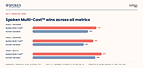
Superior performance for multi-character stories: In direct comparison, Spoken Multi-Cast™ achieved higher ratings than human narration in overall favorability (61% vs. 53%), perceived quality of narration (66% vs. 60%), and overall engagement (58% vs. 49%) for character-driven stories. For exposition without multiple characters, the human narrator was rated higher.Hearing is believing: While only 31% of listeners said they’d be likely to listen to an AI audiobook at the start of the survey, after hearing an excerpt, 65% – more than double – said they’d be likely to listen to an audiobook narrated using Spoken Multi-Cast™.They can’t tell the difference: 61% of those who heard the Spoken version thought it was human, while 65% thought the human was human.Listeners are equally likely to buy AI audiobooks: Purchase intent for audiobooks featuring Spoken Multi-Cast™ narration (46%) is statistically comparable to that of human-narrated works (49%). This is true after they learned it was AI, suggesting no commercial barrier to adoption.Frequent listeners gravitate to multi-cast: 81% of frequent audiobook listeners are interested in hearing distinct voices for each character, with 51% being very interested.Quality and immersiveness are more important than cost and celebrity: The top factors increasing likelihood of listening to AI-narrated audiobooks were improved quality, greater immersion, and using multiple character voices, not hearing a celebrity voice.

These findings arrive at an important time for the audiobook industry. The global audiobook market has experienced double-digit growth for many years and is projected to surpass $35 billion by 2030 (Grand View Research), yet production is constrained by the cost and logistics of studio recording and audio production. Spoken’s multi-cast technology was built to close that gap, moving AI narration beyond the flat, uncanny performances that have limited consumer trust in synthetic voice. This research suggests that listeners not only accept AI narration but prefer it when it delivers a more engaging experience. The combination of expanded production capacity and demonstrated listener preference signals a new benchmark for what audiobook narration can be.

About the Survey Methodology

More than 1,000 U.S. fiction audiobook listeners were randomly assigned audiobook excerpts using human narration or Spoken Multi-Cast™ AI narration and were asked a series of follow-up questions. The data was weighted to match the demographics of audiobook consumers as established by The Infinite Dial 2026 by Edison Research at SSRS and SiriusXM Media. Each treatment group was also weighted to match each other by age, gender, ethnicity, and interest in Sci-Fi/Fantasy audiobooks.

For more information and to hear the samples examined in the survey, visit https://spoken.press/edisonsurvey. To try Spoken for yourself, go to https://www.spoken.press/.

About Spoken

Spoken, the AI Audiobook Company™, enables authors and publishers to create immersive, multi-voice audiobooks at a fraction of the cost and time of traditional production. Purpose-built for storytelling, Spoken Multi-Cast™ layers proprietary agentic AI with emotionally nuanced voice synthesis to deliver high-quality, character-driven performances. Authors can choose from custom AI-generated voices crafted exclusively for their characters or AI-cloned voices from professional narrators, each of whom gets paid with every use. Spoken’s mission is to help storytellers tell stories in ways never before possible. Learn more at www.spoken.press.

About Edison Research at SSRS

Edison Research at SSRS conducts survey research and provides strategic information to a broad array of clients worldwide, having conducted research in 66 countries. Edison Research’s The Infinite Dial® series has been the survey of record for digital audio, social media, podcasting, smart speakers, and other media-related technologies since 1998. The company’s Share of Ear® survey is the only single-source measure of all audio in the U.S. Edison Research is the leading podcast research company in the world, producing the only survey-based data on podcast listening in the U.S., Edison Podcast Metrics, and has conducted research for many companies in the space.

View original content to download multimedia:https://www.prnewswire.com/news-releases/in-largest-study-of-its-kind-us-fiction-audiobook-consumers-rate-spoken-multi-cast-higher-than-human-narration-302824457.html

SOURCE Spoken Inc.

Continue Reading

Technology

CGI and Learning Links Foundation launch Centre of Excellence for AI & Innovation at MEI Polytechnic College

Published

on

By

Initiative to provide hands-on learning opportunities in AI and emerging technologies for more than 1,250 students

BENGALURU, India, Nov. 20, 2026 /PRNewswire/ — CGI (TSX: GIB.A) (NYSE: GIB), one of the largest independent IT and business consulting services firms in the world, has inaugurated the CGI Centre of Excellence for AI & Innovation at MEI Polytechnic College in Bengaluru, in collaboration with Learning Links Foundation (LLF). Designed, funded and strategically planned by CGI, the centre creates a dedicated space where students can learn, experiment, and develop practical solutions using emerging technologies.

The centre will provide hands-on learning opportunities to more than 1,250 students in artificial intelligence (AI), the Internet of Things (IoT), robotics, 3D design and printing, electronics and digital fabrication. Students will participate in project-based learning, technical challenges and innovation activities that help connect classroom concepts with practical applications. Equipped with development boards, sensors, embedded systems, robotic platforms, and comprehensive prototyping tools, the facility empowers students to build, test, and refine solutions to real-world problems.

“Access to technology can open new paths for students when it is paired with the opportunity to experiment, build and solve real problems,” said Deepak Shenoy, Senior Vice-President and Business Unit Leader, Asia Pacific Global Delivery Center of Excellence, CGI. “Through this centre, we want students to engage with AI and emerging technologies in a practical and responsible way, and to build the confidence and skills to turn their ideas into solutions. This initiative reflects CGI’s commitment to supporting the communities where we live and work by creating more equitable opportunities for the future.”

“The CGI Centre of Excellence for AI & Innovation will give our students the opportunity to experience emerging technologies in a practical and engaging environment,” said L. N. Reddy, Principal, MEI Polytechnic College. “It will complement their technical education by allowing them to experiment, build prototypes and develop solutions, while strengthening the confidence and problem-solving skills they will need in a rapidly changing technology landscape.”

“The journey from classroom learning to real-world innovation begins with access to the right opportunities,” said Sudha Priyadarshan, Senior Vice President, Learning Links Foundation. “Through this collaboration with CGI and MEI Polytechnic College, students will be able to explore AI, IoT, robotics and 3D printing through structured, hands-on learning. We look forward to supporting them as they develop future-ready skills and learn how to transform their ideas into working solutions.”

About CGI

Founded in 1976, CGI is among the largest independent IT and business consulting services firms in the world. With 94,000 consultants and professionals across the globe, CGI delivers an end-to-end portfolio of capabilities, from strategic IT and business consulting to systems integration, managed IT and business process services and intellectual property solutions. CGI works with clients through a local relationship model complemented by a global delivery network that helps clients digitally transform their organizations and accelerate results. CGI Fiscal 2026 reported revenue is CA$16.57 billion and CGI shares are listed on the TSX (GIB.A) and the NYSE (GIB). Learn more at cgi.com. 


View original content to download multimedia:https://www.prnewswire.com/in/news-releases/cgi-and-learning-links-foundation-launch-centre-of-excellence-for-ai–innovation-at-mei-polytechnic-college-302945601.html

Continue Reading

Technology

Huawei Unveils Financial AI Scaling Capabilities at Singapore FinTech Festival 2026

Published

on

By

Powered by Open Hybrid AI Infrastructure and Three Intelligent Factories, Huawei Helps Global Financial Institutions Build Differentiated Competitive Advantages

SINGAPORE, Nov. 20, 2026 /PRNewswire/ — At SFF 2026, Huawei shared insights on “Accelerating Financial AI at Scale, Advancing Agentic Finance” with global financial institutions and industry partners, showcasing its technologies and solutions.

Jason Cao, CEO of Huawei Digital Finance, and Alvin Feng, President of Huawei International Financial BU, delivered keynotes on the Festival Stage and Frontier Stage. Huawei showcased solutions for resilient infrastructure, application modernization, insurance, securities, and central banks, plus joint solutions under the RONGHAI Financial Partner Program and achievements from its 4-Win ecosystem collaboration.

To Move from AI Adoption to AI at Scale, Financial Institutions Must Build Their Own AI Capabilities

The competitive focus in financial AI is shifting from model performance to enterprise-grade system capabilities. Financial institutions must be able to independently select, securely operate, replicate at scale, and continuously evolve their AI capabilities.

Jason Cao shared lessons from China’s AI journey: an open ecosystem makes AI affordable; extreme engineering makes it effective; and commercialization at scale makes AI deeply integrated and reliable in business. He identified four characteristics among China’s financial institutions: ongoing application modernization (Zero Legacy); hybrid infrastructure combining on-premises deployment and public cloud; enterprise-grade AI architecture for centralized development and management; and AI in core business workflows such as mobile banking, credit, and risk control, reshaping business processes to enhance competitiveness.

As AI evolves to understand intent, plan, and act proactively, customers and employees will rely on their own AI agents. Banks must ensure their financial services can be understood, connected, and invoked by these agents, while building an AI flywheel linking data, execution, learning, and feedback toward Customer-AI-Friendly Finance.

Huawei is exploring a “Two Super Agents, Multiple Specialized Agents” architecture. The Customer Super Agent and Employee Super Agent understand user intent, deliver personalized services, and flexibly invoke specialized banking capabilities. Multiple Specialized Agents support domains such as credit, marketing, risk management, and wealth management through human-AI and multi-agent collaboration. Banks can turn expertise in compliance rules, credit judgment, marketing strategies, and risk management into invokable, reusable, continuously evolving AI capabilities. Through the Two Super Agents and Multiple Specialized Agents, Huawei helps banks connect customers and employees, coordinate business tasks, and continuously capture and refine expert intelligence to build self-evolving, enterprise-grade systems.

Cao said scaling AI for business growth requires hybrid infrastructure combining on-premises deployment and public cloud for flexible options, open architecture for technical agility, standardized engineering to build and replicate AI efficiently, and proven knowledge, skills, and agent capabilities as shared assets for reuse across teams and scenarios. He stressed that financial institutions must own their data, knowledge, and business logic—the core assets underpinning differentiated competitiveness—and integrate them deeply with business processes to create financial-grade AI capabilities.

Three Intelligent Factories on Open Hybrid AI Infrastructure Accelerate Production-Grade Deployment of Financial Agents

On the Frontier Stage, Alvin Feng delivered a keynote titled “Owning Your AI, Advancing Agentic Finance” and unveiled Huawei’s Fintelligent AI Solution. He outlined an enterprise-grade framework to address security, sustainability, and scalability: open architecture for flexibility and continuous technological evolution; standardized engineering for mass production of AI agents; and shared assets for reuse across teams and scenarios.

Built on open hybrid AI infrastructure, the solution brings these capabilities together through three intelligent factories: the Agent Factory for agent development and governance; the Token Factory for full-lifecycle token operations; and the Data&Knowledge Factory for continuous, high-quality data and knowledge supply.

At the Huawei Finance Exhibition Area, Huawei showcased its capabilities and partner practices for scaling AI worldwide. With 16 years in finance, Huawei has served more than 7,100 financial customers, including 54 of the world’s top 100 banks.

View original content to download multimedia:https://www.prnewswire.com/apac/news-releases/huawei-unveils-financial-ai-scaling-capabilities-at-singapore-fintech-festival-2026-302946422.html

SOURCE Huawei

Continue Reading

Technology

Industrial AI Moves Toward Scaled Deployment: AVEVA Connects Engineering and Operations with a Strong Data Foundation

Published

on

By

2026 AVEVA Taiwan Technology Summit Spotlights Industrial AI, CONNECT, and Digital Twins

TAIPEI, Nov. 20, 2026 /PRNewswire/ — Artificial intelligence is accelerating into industrial operations. Yet moving from isolated pilots to stable, repeatable outcomes still requires a connected and trusted data foundation. AVEVA successfully hosted the 2026 AVEVA Taiwan Technology Summit in Taipei on Oct. 29 under the theme “Accelerate Industrial Intelligence, Shape the Future of Industry.” The event highlighted industrial AI, industrial data platforms, AVEVA CONNECT, digital twins, smart manufacturing, and engineering digitalization—exploring practical AI adoption across manufacturing, energy, chemicals, healthcare, and engineering environments.

Taiwan’s manufacturing sector enters a critical phase for scaling AI

AI interest among Taiwan’s companies is translating into concrete adoption actions. According to the “2026 Taiwan Industry AI Transformation Survey” released by the Artificial Intelligence Technology Foundation, 38.5% of companies in traditional manufacturing are either in the Ready AI stage or the Scaling AI stage; however, only 15.4% have reached scaled application. Meanwhile, another survey by the Chung-Hua Institution for Economic Research, using a broader definition, shows 69.0% of manufacturers have already adopted AI, are evaluating adoption, or are planning AI initiatives. Among companies that have adopted AI, process automation accounts for 58.6%, IoT and sensor data applications account for 27.8%, and smart production or lights-out factories account for 18.3%.

Both surveys point to the same trend: enterprise demand for AI is already taking shape. The next phase will focus on how to shorten the distance between pilots and scaled application.

Manufacturing sites are not short of data. Equipment operations, process parameters, historical records, engineering drawings, and asset information are continuously generated—yet are often scattered across HMI, SCADA, MES, historians, and engineering systems, managed separately by different teams. Without consistent industrial context, even when data is fed into AI models, it is difficult to support reliable decision-making.

Harpreet Gulati, SVP and Global Head of PI System Business at AVEVA, said: “For industrial companies, the challenge is not willingness—it’s infrastructure. To deploy AI safely and at scale, the operational data, engineering data, workflows, and compliance frameworks required are rarely integrated systematically.”

Bringing industrial context into AI—along with the data

Henry Huang, General Manager of Sales, Taiwan, AVEVA, describes this capability as industrial intelligence: the difference is not in collecting data, but in innovating with intelligence. Leading companies can turn operational data into decisions, performance, and innovation.

This requires preserving relationships between data and equipment, processes, engineering conditions, and operational objectives—so engineering, production, maintenance, and management teams can analyze issues using the same set of facts.

Collaboration also needs to extend beyond organizational boundaries. In 2026, AVEVA and IMD Business School released their first industrial intelligence report, consolidating insights from more than 275 senior executives across 12 industries. The survey shows 74% of respondents view the digital ecosystem as an important strategic topic, yet only 27% say they are engaged in substantial or extensive data sharing with ecosystem partners—highlighting the need for clear data governance, permission management, and collaboration mechanisms alongside connectivity.

To support this, AVEVA connects shop-floor and enterprise-level data through the CONNECT industrial intelligence platform and PI Data Infrastructure. During AVEVA World 2026 in May 2026, AVEVA announced multiple product updates. Within CONNECT, Flows leverages more than 800 connectors to integrate industrial and enterprise systems, and processes data in real time at the edge, on-premises, or in the cloud—supporting cleansing, filtering, transformation, and enrichment.

AVEVA also plans to introduce an industrial knowledge graph and digital twin authoring tools in CONNECT in Q1 2027, using agentic AI to help map existing data sources to standard models while retaining data lineage and governance information. These capabilities are intended to reduce long-accumulated point-to-point integrations, enabling usable data to reach analytics, simulation, and AI workflows faster.

AVEVA is also enhancing the performance and scalability of PI Server within PI Data Infrastructure for enterprise analytics and AI workloads, while simplifying the capture, management, and delivery of operational data to CONNECT. AVEVA Operations Control connects HMI, SCADA, and enterprise systems through CONNECT, and supports deploying AI algorithms developed in C# or Python at the edge. Enterprises can combine edge, on-premises, and cloud deployments based on real-time requirements, data sovereignty, and compliance needs—without forcing all industrial data into a single environment.

Digital twins connect engineering and operations

When real-time operational data is linked to engineering and asset information, digital twins can evolve from static models into continuously updated decision environments. Shenoy Janardhan, VP and APAC Head of Pre-Sales at AVEVA, noted that continuously evolving digital twins should connect engineering, operations, and enterprise management systems, while preserving industrial context through semantics and knowledge graphs—helping enterprises progress from situational awareness to prediction, orchestration, and optimization. Digital twins are therefore no longer limited to a single asset; they can also extend across asset lifecycles, multi-site collaboration, and broader industry ecosystems.

At the Taiwan Technology Summit, local use cases illustrated this evolution. Formosa Chemicals & Fibre Corporation and LCY Chemical shared applications across manufacturing, energy, healthcare, and engineering—showing how industrial data can move beyond point monitoring to enable cross-system collaboration and intelligent decision-making.

While these applications span different industries, their paths are similar: first make real-time and historical data usable; then add engineering and asset context; finally, embed predictive results into specific workflows. Only by establishing a complete feedback loop—from data, to models, to action—can industrial AI continuously improve equipment reliability, process efficiency, and energy performance, rather than remaining isolated analytics views.

About AVEVA

AVEVA is a global leader in industrial software, sparking ingenuity to drive responsible use of the world’s resources. Over 90% of leading industrial enterprises rely on AVEVA to help them deliver life’s essentials: safe, reliable energy, food, medicines, infrastructure and more. By connecting people with trusted information and AI-enriched insights, AVEVA helps them engineer capital projects more efficiently, operate better and create sustainable value, from the plant to the cloud and beyond. Through our industrial intelligence platform, CONNECT, and our trusted and secure information management applications enriched with industrial AI, AVEVA empowers businesses to drive deeper collaboration between teams and to accelerate insight across their ecosystem of suppliers, partners and customers.

Named as one of the world’s most innovative companies, AVEVA’s open solutions draw on the expertise of more than 7,000 employees, 5,000 partners and 5,700 certified developers. The company, which has operations around the globe, is headquartered in Cambridge, UK. Learn more at www.aveva.com. 

Copyright © 2026 AVEVA Solutions Limited. All rights reserved. AVEVA Solutions Limited is owned by AVEVA Group Limited. AVEVA, the AVEVA logos and AVEVA product and service names are trademarks and service marks of AVEVA Group Limited or its subsidiaries. Other brands and product names are the trademarks of their respective companies.

View original content to download multimedia:https://www.prnewswire.com/apac/news-releases/industrial-ai-moves-toward-scaled-deployment-aveva-connects-engineering-and-operations-with-a-strong-data-foundation-302946425.html

SOURCE AVEVA

Continue Reading

Trending