Connect with us

Technology

Wistron Celebrates Grand Opening of First U.S. Smart Factory Marking Milestone in Global Smart Manufacturing Strategy

Published

on

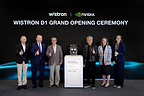
FORT WORTH, Texas, July 21, 2026 /PRNewswire/ — Wistron Corporation (“Wistron”) celebrated the grand opening of its D1 AI smart facility in Fort Worth, Texas, the site where the first NVIDIA GB300 Grace Blackwell Ultra Superchip was built and mass-produced in the United States. The US$ 700 million facility, spanning approximately 324,000 square foot, was officially unveiled during a ceremony led by Wistron Chairman Simon Lin and NVIDIA Founder and CEO Jensen Huang. Jessica Rogers, Director of the Economic Development Department for the City of Fort Worth, and Alexander Tah-ray Yui, Taiwan’s Representative to the United States, were among the government officials and business leaders who attended, marking a milestone in the expansion of Wistron’s global footprint and advanced manufacturing capabilities.

This is a key hub in Wistron’s global AI infrastructure manufacturing network. The facility runs on NVIDIA accelerated computing and integrates NVIDIA’s Nemotron and Cosmos open frontier models and Omniverse and Metropolis libraries, using digital twin technology to optimize factory design, production workflows, and operational efficiency. It is Wistron’s first U.S.-based manufacturing facility, established to serve customers locally and produce NVIDIA’s most advanced and cutting-edge products. Wistron Chairman Simon Lin said “The operation here is not typical manufacturing. It is new, very comprehensive, and high-tech. Right now we produce the NVIDIA GB300 Grace Blackwell Ultra Superchip, and beyond, we are also going to produce the NVIDIA Vera Rubin Superchip here. In the next couple of years, this location will be one of the most important, as we build AI infrastructure here in the United States. I think this is the reason we say that there will be the next chapter, and we are going to empower AI from Texas.”

Responding to Customer Needs: Texas, the Newest Global Manufacturing Hub
At this pivotal moment for global AI infrastructure, Wistron is drawing on decades of global manufacturing experience to expand its footprint in Texas, a state with a well-established ecosystem for logistics, talent recruitment, and advanced manufacturing. The new D1 facility produces the NVIDIA GB300 Grace Blackwell Ultra Superchip and soon, the NVIDIA Vera Rubin Superchip — critical to powering the next generation of AI computing. The new Fort Worth facility strengthens a critical upstream layer of the AI infrastructure supply chain by expanding domestic capacity to assemble and test NVIDIA AI systems. These servers can be integrated into NVIDIA DSX infrastructure, with DSX providing the common architecture and technologies needed to deploy and operate energy-efficient AI factories at scale.

One-Stop Operational Ecosystem Strengthens U.S. AI Supply Chain Resilience
Behind every breakthrough in AI computing lies the manufacturing capability to scale it. Wistron is expanding its AI server production capabilities from Taiwan to the United States, guided by a vision of precision, efficiency, and sustainability. This reflects a broader industry shift: AI leadership is determined not only by technological breakthroughs, but also by the operational capability to transform innovation into high-volume production with consistent quality, supply chain resilience, and predictable delivery. By establishing AI infrastructure manufacturing capacity in the United States, Wistron is building a one-stop operational ecosystem spanning manufacturing and after-sales service — shortening delivery timelines and customer support cycles, strengthening supply chain resilience, and laying the foundation for long-term competitive advantage as AI infrastructure continues to scale.

Partnering with NVIDIA to Pioneer a New Model for Smart Manufacturing and Energy Optimization
As the era of physical AI begins, Wistron is extending its smart manufacturing capabilities to the United States, creating a new model for AI infrastructure production built on digital manufacturing, energy optimization, and local operations. Jensen Huang said: “The largest infrastructure buildout in history is underway. Demand for AI factories—the engine of this next industrial revolution—is incredible, and they must be produced everywhere. Together, NVIDIA and Wistron are restoring US advanced manufacturing capacity in Texas, creating skilled jobs and strengthening America’s AI supply chain.” As demand for advanced manufacturing grows in Texas, smarter planning of production loads and energy use will give the plant greater control and flexibility over its electricity needs.

Turning Global Experience into Scalable AI Infrastructure
Simon Lin stressed that the speed the AI era demands comes with its own responsibility. “In the AI era, the pressure of speed is also a form of responsibility,” Lin said. “We don’t just need to build fast; we need to build right.”

The Fort Worth plant will serve as the core engine of Wistron’s U.S. manufacturing operations, the company said, connecting its global production network with ecosystem partners as it scales advanced AI manufacturing. Wistron said that the investment reflects efforts to deepen its technical capabilities, strengthen the resilience and efficiency of global supply chains, and support the next phase of AI infrastructure development.

About Wistron:
Wistron Corporation is a leading global technology service provider delivering advanced ICT products, AI infrastructure, and manufacturing solutions to technology brands worldwide. With more than 63,000 employees across North America, Europe, and Asia, Wistron continues to expand its AI, cloud, and advanced manufacturing capabilities to support the next generation of intelligent computing. For more information about Wistron, please visit the official website at www.wistron.com. Additional information about the event is available on the event website.

Media Contact:
Joyce WL Chou
joyce_wl_chou@wistron.com

View original content to download multimedia:https://www.prnewswire.com/news-releases/wistron-celebrates-grand-opening-of-first-us-smart-factory-marking-milestone-in-global-smart-manufacturing-strategy-302831439.html

SOURCE Wistron Corporation

Continue Reading

Technology

Advanced Process Solutions Elevates Clint Johnson to Vice President of Services and Operations

Published

on

By

Veteran Semiconductor Leader Brings More Than 20 Years of Operational Excellence, Strategic Growth, and Industry Leadership

DALLAS, Oct. 27, 2026 /PRNewswire/ — Advanced Process Solutions (APS), an industry leader in high precision and high purity manufacturing and process technology solutions, serving the semiconductor, aerospace, electronics, and industrial markets, today announced the promotion of Clint Johnson to Vice President of Services and Operations. As APS continues to expand its presence and capabilities within the semiconductor industry, Johnson’s leadership will play a critical role in advancing the company’s mission, strengthening customer partnerships, and delivering best-in-class service solutions.

“Clint has been an invaluable asset to APS since joining us as Director of Field Services earlier this year,” said Suhas Uppalapati, Chairman of APS. “He has demonstrated exceptional leadership and a relentless focus on operational performance. His dedication to customer success, workforce development, and continuous improvement quickly established him as a key contributor, and we are excited to see him continue to push APS forward in this expanded role.”

Johnson oversees APS’s service and operational functions, ensuring the organization maintains the highest standards of safety, regulatory compliance, quality, and customer satisfaction. His leadership approach is rooted in accountability, collaboration, and operational discipline, creating an environment where teams are empowered to excel while supporting the company’s broader strategic objectives.

“I am honored to step into the role of Vice President of Services and Operations and to work alongside such a talented team,” said Johnson. “The semiconductor and advanced manufacturing sectors are moving at an unprecedented pace. Together, we will continue focusing on safety, quality, and operational execution to ensure APS is uniquely positioned to help our global customers scale, optimize workflows, and meet today’s complex production demands.”

Prior to APS, Johnson spent more than 20 years in operational management at Air Liquide, a world leader in chemical manufacturing. He earned a degree in organizational leadership from East Texas A&M University.

About Advanced Process Solutions (APS)

Advanced Process Solutions (APS) is a leading provider of precision manufacturing, engineered process systems, and ultra-high-purity solutions serving the semiconductor, aerospace, electronics, and advanced industrial markets. With over 25 years of industry experience, APS specializes in chemical delivery and dispensing systems, specialty gas distribution, filtration and purification, precision fabrication, automation and controls, and turnkey process system integration.

Strategically located in the Dallas Metroplex, APS supports the rapidly expanding U.S. semiconductor manufacturing ecosystem, including Texas’s emerging “Silicon Prairie.” To support its continued growth and innovation, APS is expanding into a purpose-built, 100,000-square-foot, high-tech manufacturing facility in Van Alstyne, Texas, featuring a Center of Excellence, state-of-the-art research and development capabilities, and advanced cleanroom facilities. This investment will significantly enhance APS’s manufacturing capacity, engineering capabilities, and ability to deliver next-generation process solutions.

Combining engineering expertise, manufacturing excellence, and an unwavering commitment to quality and safety, APS partners with leading global manufacturers to deliver innovative, reliable, and scalable solutions that enhance operational efficiency and support mission-critical production environments.

For more information, visit www.APSNextGen.com.

View original content to download multimedia:https://www.prnewswire.com/news-releases/advanced-process-solutions-elevates-clint-johnson-to-vice-president-of-services-and-operations-302918995.html

SOURCE Advanced Process Solutions

Continue Reading

Technology

From Grid Constraint to AI Growth: Hitachi Vantara and Duraflow Transform Data Center Energy Management for Greater AI and Compute Capacity

Published

on

By

Hitachi Vantara pilots one of the world’s largest Phase Change Material installations in its Netherlands data center, demonstrating how organizations can use up to 90% less electricity for thermal managementImplementation requires zero water for cooling, reducing the resources needed to support data center operationsThis generates more computing capacity from existing power infrastructure, rather than diverting power to cooling

ZALTBOMMEL, The Netherlands and SANTA CLARA, Calif., Oct. 27, 2026 /PRNewswire/ — As artificial intelligence (AI) accelerates demand for computing power, data centers face a growing challenge: how to increase AI and compute capacity when access to additional electricity is increasingly constrained.

Hitachi Vantara, the data storage, infrastructure and hybrid cloud management subsidiary of Hitachi Ltd. (TSE: 6501), is demonstrating a new approach to address this challenge by showing how data centers can effectively use their power for AI and compute capacity rather than power and cooling. At its data center in the Netherlands, Hitachi Vantara has deployed one of the world’s largest operational Phase Change Material (PCM) installations, using technology developed by Dutch thermal energy company Duraflow.

For more information about Hitachi Vantara’s approach to AI, please visit: https://www.hitachivantara.com/solutions/ai-analytics

Depending on the application, PCM technology can help reduce electricity consumption related to thermal management by up to 90%, while requiring no water for cooling. By reducing the energy needed to manage power and cooling, a greater share of available electrical capacity can be used for computing – an increasingly important consideration as organizations deploy more energy-intensive AI workloads.

Tackling the energy challenge behind AI
Every watt consumed by AI ultimately becomes heat and managing that heat requires as much as 40% of a data center’s total energy needs. At the same time, as AI workloads continue to grow, the ability to convert available electricity into useful computing capacity will increasingly determine how quickly digital infrastructure can expand. This creates a growing challenge for data center operators seeking to increase computing capacity within constrained power infrastructure. In regions where grid congestion or limited access to additional electricity can constrain data center expansion, improving infrastructure efficiency can help organizations make more computing capacity available within their existing power connection.

Hitachi Vantara faced this challenge as demand for high-density computing and AI infrastructure increased. Rather than assuming that more computing required a greater amount of power, the company explored ways to make its existing electrical capacity work harder. The resulting deployment of Duraflow’s PCM technology provides a real-world proof point for this approach at an operational scale.

Real-world performance: 240 kW of cooling with low electrical consumption
The installed system provides a total cooling capacity of 240 kW across two 120 kW PCM units. According to operational monitoring data, the two units collectively consume just 5–8 kW of electricity, depending on operating conditions. For comparison, a conventional DX cooling system delivering the same 240 kW cooling capacity would require an estimated 60–80 kW of compressor power. These operational figures illustrate how PCM-based thermal management can significantly reduce the electricity required for cooling, freeing up more of the data center’s available power capacity for computing.

“This project started with a very practical challenge: how do we grow our computing capacity when access to additional electricity is limited,” said Simon Ninan, Senior Vice President of Business Strategy, Hitachi Vantara. “We realized that if we could dramatically reduce the amount of power required for thermal management, we could make more of our existing electrical capacity available for computing. By partnering with Duraflow, we are demonstrating how smarter energy management can become an important enabler of AI growth.”

The approach also supports Hitachi Vantara’s broader commitment to operating more efficiently and sustainably, including its goal of becoming carbon neutral in Scope 1 and 2 GHG emissions by FY2030.

Building efficiency across the infrastructure stack
The deployment is part of Hitachi Vantara’s broader focus on helping organizations get more value from their infrastructure while managing the growing energy demands of digital workloads.

That approach extends across the infrastructure stack. Hitachi Vantara’s Virtual Storage Platform One (VSP One) Block includes a 4:1 Data Reduction Guarantee and features Dynamic Carbon Reduction technology, which reduces energy consumption by switching CPUs into eco-mode during periods of low activity. Its always-on compression capability allows the system to switch from inline data reduction to post processing, which further reduces energy consumption and helps reduce a CO2 footprint by as much as 40%.

“Addressing the energy demands of AI isn’t about optimizing one part of the business in isolation,” said Courtney Hadden, Sustainability Director, Hitachi Digital. “It’s about working in concert across the organization and with innovative ecosystem partners to find efficiencies at every stage – from the products we build, how we bring them to market, and everything in between. The answer cannot simply be to consume more power. We need to become smarter about how we use the power we already have.”

Dutch innovation, demonstrated at operational scale
Developed in the Netherlands, Duraflow’s PCM technology absorbs thermal energy during periods of peak demand before releasing it in a controlled manner when demand decreases. Unlike conventional cooling approaches that rely continuously on electrically driven refrigeration to remove heat, PCM technology provides a way to manage and store thermal energy more efficiently. The system requires no water for cooling, helping data centers reduce their reliance on water resources while significantly lowering the electricity needed for thermal management.

“Developing technology is one thing; proving that it can operate at this scale in a live, mission-critical environment is another,” said Simon Loerakker, CEO, Duraflow. “Our collaboration with Hitachi Vantara has allowed us to demonstrate the potential of innovation at an unprecedented scale. Together, we are showing that sustainable innovation and the growth of AI infrastructure can go hand in hand.”

For more information on Hitachi Vantara’s AI-enabled infrastructure, please visit: https://www.hitachivantara.com/en-us/products/storage-platforms.

Additional Resources:

Blog: Raising the Stakes for Sustainable, AI-ready InfrastructureBlog: Five Habits That Cut IT Energy Waste, Without Spending MorePress Release: Hitachi Vantara Releases FY2025 Sustainability Report, Highlighting Leadership in Energy-Efficient Infrastructure for AI-Driven WorkloadsWebinar: Green Data: Sustainable Innovations in Data CentersPress Release: Hitachi Vantara Unveils New Virtual Storage Platform One Capabilities to Enable Stronger Cyber Resilience, Performance and Sustainability

About Duraflow
Duraflow develops advanced thermal energy management technology based on Phase Change Materials (PCM). Its independently developed technology enables organizations to significantly reduce energy consumption for thermal management, maximize the use of existing electrical infrastructure and support the sustainable growth of mission-critical digital environments.

About Hitachi Vantara
Hitachi Vantara is transforming the way data fuels innovation. A wholly owned subsidiary of Hitachi Ltd., Hitachi Vantara provides the data foundation the world’s leading innovators rely on. Through data storage, infrastructure systems, cloud management, and digital expertise, the company helps customers build the foundation for sustainable business growth. To learn more, visit www.hitachivantara.com.

About Hitachi, Ltd. 
Through its Social Innovation Business (SIB) that brings together IT, OT (Operational Technology) and products, Hitachi aims to be a global leader in continuously transforming social infrastructure through digital, contributing to a harmonized society where the environment, wellbeing, and economic growth are in balance. Hitachi operates worldwide across four sectors – Digital Systems & Services, Energy, Mobility, and Connective Industries – as well as a Strategic SIB Business Unit focused on new growth areas. With Lumada at its core, Hitachi creates value by combining data, technology, and domain knowledge to solve customer and social challenges. Revenues for FY2025 (ended March 31, 2026) totaled 10,586.7 billion yen, with 606 consolidated subsidiaries and approximately 290,000 employees worldwide. Visit us at www.hitachi.com.

HITACHI is a trademark or registered trademark of Hitachi, Ltd. All other trademarks, service marks, and company names are properties of their respective owners.

View original content to download multimedia:https://www.prnewswire.com/news-releases/from-grid-constraint-to-ai-growth-hitachi-vantara-and-duraflow-transform-data-center-energy-management-for-greater-ai-and-compute-capacity-302920057.html

SOURCE Hitachi Vantara

Continue Reading

Technology

Parks Associates: HDR Is Shaping the Future of Premium Video Entertainment

Published

on

By

New Parks Associates white paper, developed in partnership with InterDigital, examines how HDR is advancing viewing experiences across streaming, live sports, gaming, and mobile devices

PLANO, Texas, Oct. 27, 2026 /PRNewswire/ — New research from Parks Associates shows high dynamic range (HDR) is becoming a foundational component of premium video entertainment, creating opportunities for television manufacturers, streaming services, and content creators to differentiate through picture quality. The research, High Dynamic Range and the Future of Video, developed in partnership with InterDigital, examines HDR’s expanding role across the entertainment ecosystem.

HDR enhances brightness and contrast and produces richer colors and more lifelike images for the video-viewing experience. The white paper explores how broader device support, growing content availability, and advances in production and distribution are moving HDR from a premium feature toward an expected part of high-quality viewing.

“HDR gives the entertainment industry a powerful way to make improvements in picture quality,” said Michael Goodman, Director, Entertainment Research, Parks Associates. “For manufacturers, it helps demonstrate the value of advanced displays. For streaming services and content owners, it provides an opportunity to deliver a more compelling experience and preserve the creative intent of their programming.”

“Consumers may not always know HDR by name, but they recognize the experience it enables: richer color, deeper contrast and a more lifelike picture,” said Lionel Oisel, Head of Video Labs, InterDigital. “As HDR expands across streaming, live sports, gaming and mobile, the opportunity is to make that premium experience consistent and efficient on every screen. Innovation in HDR, video compression and delivery will be fundamental to making that possible.”

The white paper identifies several developments shaping HDR’s next phase:

Smart TVs are the foundation. Smart TVs are the primary streaming video device in 62% of US internet households with a connected TV device.

Live sports and gaming expand HDR’s relevance. These experiences showcase HDR’s ability to reproduce bright highlights, detailed shadows, and realistic imagery, while pushing improvements in production and real-time processing.

Mobile viewing extends HDR beyond the television. Mobile phones account for 24% of weekly video consumption, with tablets contributing another 11%.

Technology advances improve delivery economics. AI-assisted image processing, cloud-based production, and next-generation codecs such as Versatile Video Coding (VVC) will simplify workflows and deliver HDR more efficiently.

The research also identifies challenges that require continued collaboration to ensure the successful expansion of HDR. Differences in HDR formats, device capabilities, and service implementations can produce inconsistent viewing experiences. Content providers must manage the cost and complexity of supporting multiple formats as audiences move from standard to HDR in their video viewing.

Parks Associates and InterDigital will highlight this research at Future of Video: Business of Streaming, an executive conference for the streaming and video industries on November 17-18 in Marina del Rey, California. Register here. 

For more information, contact Mindi Sue Sternblitz-Rubenstein.

About Parks Associates

Parks Associates helps companies identify new opportunities, refine strategy, and accelerate growth in connected technology markets through data-driven insights and industry expertise. With more than 40 years of experience, the firm delivers proprietary consumer and industry research, market forecasts, and strategic analysis that guide business decisions across personal, connected home, small business, and commercial technology ecosystems. Parks Associates supports clients in navigating evolving markets including AI, security, smart home, broadband, entertainment, energy, multifamily, smart buildings, and connected health.

The firm also fosters industry growth and collaboration by convening thousands of leaders each year through its flagship executive conferences, including CONNECTIONS™, Connected Health Summit, Smart Energy Summit, Smart Spaces, and Future of Video. Learn more at https://www.parksassociates.com.

Mindi Sue Sternblitz-Rubenstein
Parks Associates
972.490.1113
425707@email4pr.com 

View original content to download multimedia:https://www.prnewswire.com/news-releases/parks-associates-hdr-is-shaping-the-future-of-premium-video-entertainment-302920326.html

SOURCE Parks Associates

Continue Reading

Trending