Connect with us

Technology

MiTAC Computing Showcases Diversified Infra for Agentic Workloads at OCP APAC Summit

Published

on

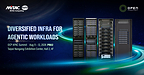
TAIPEI, Aug. 12, 2026 /PRNewswire/ — MiTAC Computing Technology Corporation, a global leader in high-performance, energy-efficient server solutions and a subsidiary of MiTAC Holdings Corporation (TSE:3706), today showcased its diversified rack-scale infrastructure engineered for Agentic AI workloads at the OCP APAC Summit. Highlighting the event is the world premiere of MiTAC’s latest OCP-compliant HPC servers—the C2810Z6 and C2610Z6—developed in collaboration with AMD to harness the all-new 6th Gen AMD EPYC™ Server CPUs on the advanced SP7/SP8 platforms with PCIe Gen 6 connectivity.

To meet the demands of continuous Multi-Agent Reasoning Loops and extreme data throughput, MiTAC has engineered comprehensive rack-scale solutions centered around its flagship 52U high-density AI liquid-cooled rack. By incorporating integrated AI servers that span AMD and Intel platforms alongside the NVIDIA accelerated computing platform—featuring compute, networking, and software—MiTAC provides a seamless upgrade path from underlying silicon to a ready-to-deploy ‘AI Factory’.

Premiering Next-Gen OCP Compute Nodes for Agentic Execution

As autonomous agents transition from simple prompts to dynamic multi-step workflows, foundational compute nodes require unprecedented I/O bandwidth and power efficiency. At OCP APAC, MiTAC is debuting two ORv3 compute platforms powered by 6th Gen AMD EPYC™ Server CPUs. Featuring AMD’s “Zen 6” architecture, PCIe Gen 6 connectivity, and CXL 3.1 support, these platforms are engineered to process massive parallel agent requests while optimizing data center footprint and energy density.

MiTAC leads this architectural transition with two world-premiere platforms:

C2810Z6: An ORv3 multi-node server engineered for high-density cloud and HPC workloads. Powered by 6th Gen AMD EPYC™ Server CPUs (SP7 socket, up to 256 cores and 512 threads,supporting default CPU power up to 600W), it supports up to 4TB DDR5-8000 memory per node. This platform delivers massive PCIe Gen 6 I/O throughput alongside versatile NVMe storage (12x E3.S-1T or 6x U.2), such as Micron 9650 NVMe™ Gen 6 SSDs. Integrated with a 48Vdc busbar and DC-SCM 2.0 module, it ensures extreme performance, security, and power efficiency for dense compute clusters.C2610Z6: A next-generation ORv3 compute platform optimized for scalable cloud, enterprise IT, and edge applications. Powered by 6th Gen AMD EPYC™ Server CPUs (SP8 socket, up to 128 cores and 256 threads, supporting default CPU power up to 400W), it supports up to 4TB DDR5-8000 memory per node. Equipped with PCIe Gen 6 connectivity, flexible NVMe storage, such as Micron 9650 NVMe™ Gen 6 SSDs. Integrated with a 48Vdc busbar and DC-SCM 2.0 management, it provides a highly efficient, versatile architecture for enterprise AI scaling.

Diversified Rack-Scale Infrastructure for Agentic Workloads

Beyond raw node performance, powering autonomous Agentic AI introduces complex architectural demands. Unlike static single-prompt AI, multi-agent systems rely on continuous reasoning loops, dynamic tool calling, real-time memory retrieval, and multi-agent orchestration.

To eliminate thermal, storage, and cluster governance bottlenecks across these execution pipelines, MiTAC Computing delivers a complete spectrum of diversified rack-scale infrastructure:

High-Density AI Racks (Liquid-Cooled & Air-Cooled): Engineered to sustain the continuous multi-step reasoning loops of agentic workloads. By packing maximum GPU density—such as 96x AMD Instinct™ MI355X GPUs in a single 52U liquid-cooled rack—MiTAC provides the low-latency, unthrottled compute engine required for real-time agent execution.OCP HPC Racks (Modular & Scalable): Delivering open ORv3 standards, energy-efficient 48Vdc power distribution, and modular flexibility, MiTAC’s liquid- and air-cooled OCP racks allow data centers to scale execution nodes seamlessly as autonomous agent worker teams expand.Agentic Memory & Orchestration Ecosystem (DDN, Rafay, and Canonical Ubuntu): An autonomous agent is only as fast as its access to enterprise memory and task delegation. Partnering with DDN for ultra-high-throughput vector/session storage and Rafay for automated multi-agent cluster governance, MiTAC delivers an ultra-low latency storage-to-compute pipeline that keeps multi-agent workflows running at full speed.

From Chips to Applications: MiTAC’s Full-Stack AI Factory Vision

To bring these diversified components together into an operational environment, MiTAC aligns its entire rack-scale portfolio across ecosystem layers to transform modular silicon into deployment-ready enterprise AI factories:

MiTAC platforms maximize the raw compute of next-generation silicon, offering the flexibility to integrate high-density accelerators—including AMD Instinct™ MI355X GPUs, AMD Instinct™ MI350X GPUs, AMD Instinct™ MI350P PCIe® cards—as well as multi-workload enterprise GPUs such as the NVIDIA RTX PRO 4500 and RTX PRO 6000 Blackwell Server Edition GPUs, ideally suited for AI, simulation, and visual computing.Infrastructure Layer: We deliver hyper-efficient physical foundations—highlighted by our 52U AI liquid-cooled rack housing G4826Z5 servers alongside versatile compute nodes like the TN85-B8261 and G4520G6 (powered by dual Intel® Xeon® 6 processors with up to 8,192GB DDR5 memory)—backed by MiOBMC™ / MiOPF™ open firmware and enterprise Linux OS.Orchestration & Data Pipeline Layer: Bridging physical servers with upper-layer intelligence, MiTAC collaborates with leading ecosystem partners including DDN, Rafay, and Kubernetes, alongside our proprietary MiCoreView™ POD management suite, to deliver high-throughput data delivery and automated cluster management across modern AI factories.Models Layer: Our throughput-optimized compute and parallel storage pipelines satisfy the demands of diverse architectures—accelerating massive LLMs, VLMs, MMLLMs, and Mixture-of-Experts (MoE) models without data bottlenecks or hardware idling.Applications Layer: From multi-step Agentic AI and RAG workflows to generative AI and large-scale HPC simulations, MiTAC provides resilient, rack-scale foundations purpose-built to execute real-world enterprise AI at scale.

About MiTAC Computing Technology Corporation

MiTAC Computing Technology Corp., a subsidiary of MiTAC Holdings, delivers comprehensive, energy-efficient server solutions backed by industry expertise dating back to the 1990s. Specializing in AI, HPC, cloud, and edge computing, MiTAC Computing employs rigorous methodologies to ensure uncompromising quality—across barebones, systems, racks, and cluster levels—fully achieving performance and integration. This commitment to quality at every level sets MiTAC Computing apart in the industry.

With a worldwide presence and end-to-end capabilities—from R&D and manufacturing to global support—MiTAC Computing provides agile, customized platforms for hyperscale data centers, HPC, and AI applications, ensuring optimal performance and scalability to meet unique business needs. By leveraging the latest advancements in AI and liquid cooling, and unifying the MiTAC brand with Intel DSG and TYAN server products, MiTAC Computing stands out for its innovative, efficient, and reliable server technology as well as its hardware and software integrated solutions—empowering businesses to meet future challenges.

MiTAC Computing Technology Corporation website: https://www.mitaccomputing.com/.

View original content to download multimedia:https://www.prnewswire.com/apac/news-releases/mitac-computing-showcases-diversified-infra-for-agentic-workloads-at-ocp-apac-summit-302849469.html

SOURCE MiTAC Computing Technology Corporation

Continue Reading

Technology

Beghou Expands Pune Office, Strengthening Data, Analytics, and AI Capabilities

Published

on

By

The expanded office brings together multidisciplinary teams to solve increasingly complex life sciences commercialization challenges 

PUNE, India, Nov. 11, 2026 /PRNewswire/ — Beghou, a life sciences commercialization consulting and technology company, today announced the expansion of its Pune office. Opened on October 7 to foster cross-team collaboration, the new space reflects Beghou’s growing global delivery and innovation model. The Pune office is home to consulting and product teams with expertise spanning analytics, data engineering, technology, and AI. Beghou has also expanded its offices in Hyderabad and Bengaluru this year as its workforce continues to scale. The larger Pune space makes room for that growth, along with expanded leadership opportunities, specialist capabilities, and global client exposure for teams based there. 

“There’s a real sense of momentum at Beghou right now, and it’s exciting to see that reflected in our global expansion. We’re growing across markets, expanding the capabilities we bring to clients, and investing in the people and technology behind that work,” said Adrienne Lovink, CEO, Beghou. 

Commercialization challenges rarely sit within a single discipline, and Beghou’s model is built around that reality. Teams work together to move from identifying a business question to designing, building, and implementing the solution. The new office gives them dedicated space to collaborate, share knowledge, and learn from one another. 

“It is incredibly fulfilling to see the growth of our India organization and the world-class talent and capabilities we have built over the years. I see this growth as a stepping stone to something much bigger – not just scaling, but driving innovation, developing differentiated offerings, and solving increasingly complex commercialization challenges for our clients. Our new office reflects this ambition, bringing together diverse expertise and creating more opportunities for our teams to collaborate, innovate, and build meaningful solutions,” said Sonam Dubey, India Head, Beghou. 

The office is also a key hub for Beghou’s AI and product innovation, with teams working to embed AI in the solutions clients use across planning, analysis, and execution. They are also helping to develop new products that pair Beghou’s commercialization expertise with modern data capabilities. 

“We are at an exciting point in Beghou’s journey. I see this office as a melting pot of deep commercial expertise, technology, product thinking, and AI, the capabilities that will shape our next phase of growth. The opportunity is to combine those strengths to build differentiated solutions that solve real client problems and scale our impact,” said Abhigya Jain, Partner, Beghou. 

About Beghou 

Beghou drives commercialization that works for life sciences. For over 30 years, Beghou has been a long-term consulting and technology partner to more than 250 life sciences clients. We connect the dots between strategy, data, technology, and teams, helping clients accelerate launches, deepen customer engagement, and advance patient access. Whether a company is pre-commercial and building from scratch or refining an existing commercial strategy, Beghou provides fresh ideas and pragmatic, technology-enabled solutions to help organizations adapt and thrive in an increasingly complex environment. 

We build enduring partnerships by remaining engaged and accountable beyond project delivery to help ensure solutions take hold and deliver results. Combining strategic thinking, technical expertise, and hands-on execution, we help clients achieve faster outcomes and lasting impact. 

Find out more at www.beghou.com.

View original content to download multimedia:https://www.prnewswire.com/in/news-releases/beghou-expands-pune-office-strengthening-data-analytics-and-ai-capabilities-302935318.html

Continue Reading

Technology

TIER IV unveils end-to-end autonomous driving adaptable to map information and sensor configurations

Published

on

By

Multiple open-source AI models are available with Autoware

TOKYO, Nov. 11, 2026 /PRNewswire/ — TIER IV, the pioneering force behind Autoware, open-source software for autonomous driving, today announced the development and open-source release of multiple end-to-end (E2E) autonomous driving AI models that support different system requirements, including map information and sensor configurations. The models offer flexible options ranging from camera-only configurations to those incorporating LiDAR, radar and high-definition (HD) maps, enabling developers to select AI models suited to their performance requirements. Through Autoware, TIER IV provides a development environment for optimizing these models and integrating them into vehicle systems, helping automakers and technology partners develop and deploy their own autonomous driving stack.

Overview of the Autoware 2.0 Architecture

TIER IV is leading the development of Autoware 2.0, the next-generation architecture of Autoware. Autoware 2.0 is a scalable and adaptable architecture that flexibly combines AI models with conventional rule-based technologies. By supporting different AI models and sensor configurations, it enables autonomous driving systems to be built for a range of applications and system requirements. The E2E autonomous driving AI models announced today are concrete technological outcomes designed to leverage this architecture.

NVIDIA Alpamayo 2 Edge

As part of its collaboration with NVIDIA announced in March 2026 , TIER IV has been evaluating the performance of NVIDIA Alpamayo, a vision-language-action (VLA) foundation model, and integrating it with Autoware. The latest model, Alpamayo 2 Edge, is an E2E autonomous driving AI model that takes only camera images as input and uses reasoning to generate driving trajectories. With 2 billion parameters, compared with 34 billion in Alpamayo 2 Super, it is substantially smaller and offers promise for practical deployment in vehicles. TIER IV is currently optimizing the model and adapting it to real vehicles, while having completed its integration with Autoware.

GitHub (source code): https://github.com/autowarefoundation/alpamayo-autowareHugging Face (AI model): https://huggingface.co/nvidia/Alpamayo2-Edge

AutoE2E

AutoE2E, whose development is led by the Autoware Foundation (AWF) and TIER IV, is an E2E autonomous driving AI model capable of running on computing platforms beyond NVIDIA hardware. It adopts a Fast–Slow architecture combining a Reactive Model for real-time driving decisions, a World Model for predicting future changes in the surrounding environment, and a Reasoning Model that supports driving decisions. It can accommodate configurations ranging from cameras alone to those incorporating LiDAR and radar sensor data. With 79.9 million parameters, it is lighter than Alpamayo 2 Edge. The Reactive Model has been released, while development of the World Model and Reasoning Model continues, alongside consideration of commercialization for robotaxi applications. Integration of the Reactive Model with Autoware has been achieved.

GitHub (source code): https://github.com/autowarefoundation/auto_e2eHugging Face (AI model): https://huggingface.co/AutowareFoundation/auto_e2e

METEOR

Developed independently by TIER IV, METEOR is a lightweight, multitask E2E autonomous driving AI model primarily intended for privately owned passenger vehicles. Built on a convolutional neural network (CNN) architecture, it uses a bird’s-eye-view (BEV) representation to perform everything from perception of the surrounding environment to driving trajectory generation within a single neural network, without relying on high-definition maps. It supports configurations using images from one to eight cameras and can also incorporate LiDAR and radar sensor data. With 16 million parameters, it is even lighter than AutoE2E and supports operation across different semiconductor platforms, including NVIDIA and Renesas. TIER IV also uses CoMET, the automated labeling platform within Co-MLOps, together with agentic AI to automate data labeling and model training, evaluation, and improvement, eliminating the need for manual coding and labeling. Automakers and component suppliers can optimize the open-source model to meet their own vehicle specifications and performance requirements.

GitHub (source code): https://github.com/tier4/METEORHugging Face (AI model): https://huggingface.co/AutowareFoundation/meteor

OnePlanner

OnePlanner is an E2E autonomous driving AI model that integrates perception of the surrounding environment with motion planning. It currently uses BEVFusion, which generates a BEV representation from LiDAR point-cloud data, with a planned transition to PTv3. Its flexible architecture allows the perception model to be replaced while directly using features extracted during perception for motion planning. Conventional autonomous driving systems convert perception results into information such as object positions and velocities before passing them to the planner. OnePlanner reduces these intermediate conversions, enabling richer use of information about the surrounding environment. It also incorporates HD maps, route information, traffic-signal states, and vehicle motion states to generate driving trajectories for the next six seconds. Integration with Autoware has been achieved.

GitHub (source code): https://github.com/autowarefoundation/autoware_oneplannerHugging Face (AI model): https://huggingface.co/AutowareFoundation/oneplanner

LatentDrive

LatentDrive is an E2E autonomous driving AI model that uses a world model to integrate predictions of the surrounding environment with motion planning. Using V-JEPA, a self-supervised learning approach, it represents features of the surrounding environment extracted from camera video in a latent space and uses these features to generate vehicle trajectories. Its distinguishing feature is that it directly leverages information from video for motion planning without intermediate processes such as object detection and tracking. It does not require HD maps and generates trajectories for the next four seconds using camera video, route information, and vehicle motion states. It supports configurations with either one or three cameras, and work is underway on integration with Autoware and validation in an in-vehicle environment.

GitHub (source code): https://github.com/autowarefoundation/autoware_latent_driveHugging Face (AI model): https://huggingface.co/AutowareFoundation/latent_drive

“Advances in E2E autonomous driving are fundamentally changing how autonomous driving systems are developed.” said Shinpei Kato, founder and CEO of TIER IV. “For automakers and component suppliers to incorporate AI technology into their own products, however, it is essential that they be able to internalize technologies according to their applications and performance requirements, without depending on a particular AI model or semiconductor platform. By releasing multiple AI models developed under the leadership of TIER IV and the Autoware Foundation, alongside the results of our collaboration with NVIDIA, we have significantly expanded those choices. We will continue to advance the open-source ecosystem centered on Autoware and work with partners around the world to democratize autonomous driving.”

“Advancing autonomous driving requires AI that can reason through complex situations and run efficiently in the car.” said Ali Kani, vice president of automotive at NVIDIA. “TIER IV’s integration of NVIDIA Alpamayo 2 Edge with Autoware gives developers an open foundation to bring that intelligence from research into their own vehicles.”

“The advancement of autonomous driving technology depends on an ecosystem in which diverse AI models can be developed and evaluated openly, then applied according to their respective use cases.” said Muhammad Zain Khawaja, President of the Autoware Foundation. “The AI models released today are an important demonstration of how Autoware is evolving into a flexible development platform that is not tied to any particular technology or hardware. We welcome TIER IV’s continued technology development and its collaboration with partners including NVIDIA. The Autoware Foundation will continue working with the global open-source community to make advanced autonomous driving technology accessible to everyone.”

Next Steps

TIER IV will continue improving the performance of the AI models released today and optimizing them for in-vehicle environments, while promoting the development and commercialization of E2E autonomous driving technology by automakers and partners through Autoware. TIER IV will also strengthen collaboration with the global open-source community and work to expand the adoption of autonomous driving systems across diverse vehicle types and applications.

About TIER IV

TIER IV stands at the forefront of deep tech innovation, pioneering Autoware, open-source software for autonomous driving. With a comprehensive suite of platforms and services built around Autoware, TIER IV provides everything from software development and vehicle procurement to operational support. Through the Autoware ecosystem, TIER IV works with partners worldwide to shape the future of intelligent vehicles with open-source software, aiming to create mobility that is safer, more sustainable, and accessible to all.

The word marks and logos of TIER IV are trademarks or registered trademarks of TIER IV, Inc. in Japan and other countries. All other company names, product names, service names, and logos referenced herein are trademarks or registered trademarks of their respective owners.

Autoware is a registered trademark of the Autoware Foundation.

Media contact
pr@tier4.jp 

View original content to download multimedia:https://www.prnewswire.com/news-releases/tier-iv-unveils-end-to-end-autonomous-driving-adaptable-to-map-information-and-sensor-configurations-302935963.html

SOURCE TIER IV, Inc.

Continue Reading

Technology

Dingdong to Report Third Quarter 2026 Financial Results on November 12, 2026

Published

on

By

SHANGHAI, Nov. 10, 2026 /PRNewswire/ — Dingdong (Cayman) Limited (“Dingdong” or the “Company”) (NYSE: DDL), a leading fresh grocery e-commerce company in China, with advanced supply chain capabilities, today announced that it will report its unaudited financial results for the third quarter ended September 30, 2026, before U.S. markets open on November 12, 2026.

About Dingdong (Cayman) Limited

Dingdong is the leading fresh grocery e-commerce company in mainland China, with sustainable long-term growth. The Company directly provides users and households with fresh groceries, prepared food, and other food products through delivering a convenient and excellent shopping experience supported by an extensive self-operated frontline fulfillment grid. Leveraging its deep insights into consumers’ evolving needs and its strong food innovation capabilities, Dingdong has successfully launched a series of private label products spanning a variety of food categories. Many of Dingdong’s private label products are produced at its own production plants, allowing it to more efficiently produce and offer safe and high-quality food products. Dingdong aims to be the first choice for fresh and food shopping.

For more information, please visit: https://ir.100.me.


View original content:https://www.prnewswire.com/news-releases/dingdong-to-report-third-quarter-2026-financial-results-on-november-12-2026-302935824.html

SOURCE Dingdong (Cayman) Limited

Continue Reading

Trending