Connect with us

Technology

Intrinsic SEA Advances Technology Localisation to Strengthen ASEAN’s Innovation Ecosystem

Published

on

KUALA LUMPUR, Malaysia, Aug. 19, 2026 /PRNewswire/ — Intrinsic SEA was recently featured by The Edge Malaysia, one of Malaysia’s leading business and financial publications, highlighting the company’s work in technology localisation, cross-border industry collaboration and innovation ecosystem development. The feature reflects a broader shift in how global technology companies approach Southeast Asia — moving beyond conventional market entry towards deeper integration with local industries, talent, research capabilities and capital.

As global supply chains evolve and technological innovation accelerates, Intrinsic SEA believes successful internationalisation requires more than bringing products or technologies into a new market. It requires building the local capabilities that enable those technologies to grow, commercialise and create sustainable value over the long term.

This philosophy underpins Intrinsic SEA’s approach to technology localisation.

Rather than focusing solely on market access, the company works with international technology companies to develop pathways encompassing technology transfer, local partnerships, joint research and development, industry collaboration, investment facilitation and regional expansion. The objective is to enable global technologies to become meaningfully embedded within Malaysia’s industrial and innovation ecosystem, while using the country as a strategic platform for broader ASEAN growth.

Intrinsic SEA continues to connect innovation resources from China, Canada, Japan and other international markets with opportunities across Southeast Asia. Its areas of focus include artificial intelligence, advanced manufacturing, biotechnology and life sciences, clean energy, smart agriculture and other emerging technologies with the potential to address real industrial and societal needs.

A growing number of these collaborations are progressing from initial market engagement towards more substantive localisation. Intrinsic SEA is currently facilitating international technology projects across areas including AI-enabled agriculture, next-generation biotechnology, advanced manufacturing, intelligent mining and renewable energy. These initiatives explore opportunities ranging from commercial deployment and joint R&D to regional innovation centres and longer-term investment partnerships.

A central part of this strategy is the development of platforms that bring together government, industry, research institutions, investors and technology companies.

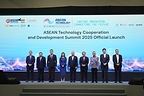
Intrinsic SEA serves as the Secretariat of the ASEAN Technology Cooperation and Development Summit (ATCDS), a regional platform designed to facilitate practical technology cooperation and connect global innovation with ASEAN’s industrial priorities.

The Summit brings together policymakers, international organisations, research institutions, technology leaders, corporations and investors to explore collaboration across key areas including artificial intelligence, future mobility, advanced manufacturing, healthcare and biotechnology, the digital economy, clean energy and other emerging sectors.

Beyond dialogue, the ASEAN Technology Cooperation and Development Summit is designed to facilitate tangible outcomes — from technology partnerships and investment opportunities to cross-border R&D, commercialisation and industry deployment. By connecting international technologies with real regional demand, the platform seeks to contribute to a more integrated and globally connected ASEAN innovation ecosystem.

“The next phase of global technology competition will not be determined by technology alone. It will increasingly depend on the strength of innovation ecosystems, international collaboration and the ability to translate innovation into real industrial value,” said Ravenna Chen, CEO of Intrinsic SEA.

“Our role is to connect global innovation with local opportunity — helping technologies establish meaningful roots in Malaysia, develop alongside local partners and ultimately create value across ASEAN. We believe localisation should not simply be about entering a market; it should be about building capabilities and growing together with that market.”

Malaysia’s established industrial base, international connectivity, talent pool and position at the heart of Southeast Asia make it well placed to serve as a bridge between global innovation and ASEAN’s growing technology economy. Intrinsic SEA sees this position not simply as a gateway to the region, but as an opportunity for Malaysia to play a more active role in shaping how emerging technologies are developed, adapted and commercialised for ASEAN.

Looking ahead, Intrinsic SEA will continue to deepen its work across international technology cooperation, technology transfer, industry development and investment collaboration. Through its own initiatives and platforms including the ASEAN Technology Cooperation and Development Summit, the company aims to work alongside governments, corporations, research institutions, investors and international partners to translate global innovation into sustainable commercial and societal value across Southeast Asia.

About Intrinsic SEA

Intrinsic SEA is an international technology cooperation and innovation platform headquartered in Kuala Lumpur, Malaysia. The company focuses on strategic advisory, technology transfer, industry collaboration and investment facilitation, connecting innovation resources across China, Canada, Japan, Southeast Asia and other global markets.

With a focus on sectors including artificial intelligence, advanced manufacturing, biotechnology, clean energy and emerging technologies, Intrinsic SEA supports international companies in building sustainable local capabilities and developing long-term opportunities across ASEAN. The company also serves as the Secretariat of the ASEAN Technology Cooperation and Development Summit, supporting cross-border collaboration among governments, industry, capital and research institutions.

View original content to download multimedia:https://www.prnewswire.com/apac/news-releases/intrinsic-sea-advances-technology-localisation-to-strengthen-aseans-innovation-ecosystem-302854755.html

SOURCE Intrinsic SEA

Continue Reading

Technology

YeahPay targets the trust gap holding back autonomous AI shopping

Published

on

By

SINGAPORE, Nov. 17, 2026 /PRNewswire/ — Yeahka Limited (9923.HK), a Hong Kong-listed payment technology company, is expanding its AI-driven merchant services and exploring new payment capabilities to address emerging challenges in agent-driven commerce, as artificial intelligence moves beyond providing recommendations towards executing transactions on behalf of consumers.

As AI agents increasingly participate in shopping activities, merchants face two practical challenges: making their products and services accessible to AI agents, and enabling transactions to be completed securely when purchases are initiated by AI rather than consumers themselves.

Yeahka is addressing these challenges through its merchant technology subsidiary, Fushi Tech, and its overseas payment brand, YeahPay.

Fushi Tech has launched Fynix AI Shop, an AI-powered merchant service platform deployed in selected overseas merchant scenarios. The platform supports customer engagement, personalised recommendations, appointment booking and order processing, with transactions completed through YeahPay.

Meanwhile, YeahPay is exploring payment protocols, identity verification and delegated authorisation mechanisms for AI agents, and has begun proof-of-concept collaborations with international financial institutions.

Together, these initiatives reflect Yeahka’s efforts to connect AI-powered merchant services with payment infrastructure as new models of commerce emerge.

Helping Merchants Adapt to AI-Driven Shopping

One of the challenges facing merchants in agent-driven commerce is ensuring that AI systems can accurately discover, understand and interact with their products and services.

Traditional merchant websites and e-commerce platforms are primarily designed for human users. However, AI agents operate differently, relying on structured product information, accessible interfaces and up-to-date data to identify relevant products, compare options and initiate transactions.

Samuel Chen, head of Fushi Tech, believes merchants will increasingly need to develop two separate interaction systems: “One for people and one for AI agents.”

While consumer-facing interfaces focus on browsing experience and usability, AI-facing systems must enable agents to retrieve product information, pricing and inventory data accurately, and facilitate subsequent transactions.

Based on this assessment, Fushi Tech is developing a merchant service framework tailored to AI agents. The company plans to help merchants establish independently controlled product and transaction platforms, using AI-friendly data structures and standardised interfaces to connect with major AI agents.

The approach is intended to improve the likelihood of merchants’ products being recognised, indexed and recommended by AI systems, while supporting the conversion of consumer enquiries into orders.

Fushi Tech has already begun applying AI to merchant operations through Fynix AI Shop. The platform integrates AI-powered customer interactions with commercial functions, allowing consumers to receive recommendations, make appointments and place orders through conversational interfaces.

As Amit Wakharkar, Fynix’s Director of Pre-sales and Solutions, noted, merchants do not simply need another question-and-answer-based customer service system. The more important objective is to convert customer interactions into tangible business outcomes.

Exploring Secure Payment Capabilities for AI Agents

Beyond product discovery and order processing, agent-driven commerce also raises new questions about payment authorisation and transaction security.

When an AI agent initiates a purchase on behalf of a consumer, payment providers must establish whether the agent is authorised to act, verify its identity and ensure that transactions remain within the permissions granted by the user.

At the MAG Payments Summit in Singapore on October 21, David Tay, Global Vice President of YeahPay, outlined three stages in the development of AI-powered commerce.

In the first stage, AI provides product recommendations, while consumers complete payments themselves. In the second, product discovery, ordering and payment take place within the same conversation, although consumers must still confirm each transaction. In the third stage, AI agents can autonomously execute purchases within authorisation limits established by consumers in advance.

According to Tay, as shopping activities become increasingly integrated into conversational interfaces, payment should become a natural part of the transaction process rather than a separate step that interrupts the user experience.

The third stage, in particular, will require payment infrastructure capable of supporting verifiable agent identities and secure delegated authorisation frameworks.

Against this backdrop, YeahPay is exploring payment protocols, identity verification and delegated authorisation mechanisms designed for agent-initiated transactions. The company has also begun proof-of-concept collaborations with international financial institutions to examine how these capabilities could support future AI-driven commerce.

These initiatives form part of Yeahka’s broader efforts to extend its payment capabilities to emerging transaction scenarios, while addressing the security and authorisation requirements associated with AI agents acting on behalf of consumers.

AI Agents Reshape the Commercial Landscape

The development of AI-powered shopping services is creating new possibilities for how consumers discover products, interact with merchants and complete purchases.

In September, Meta launched Muse, its personal AI agent, which can perform tasks including product searches, price comparisons and travel bookings, as well as complete purchases once authorised by users.

During Meta’s third-quarter earnings call on October 21, Mark Zuckerberg said that more than 10 million people in the United States and Canada had set up Muse within six weeks of its launch, with approximately one-quarter using it daily. Muse has since expanded into Japan and Singapore, integrating with local e-commerce and travel service providers.

To support AI-initiated purchases, Meta has integrated Stripe’s Link payment service into Muse, enabling transactions through payment methods linked to users’ accounts or through one-time virtual cards. Meta and other technology companies are also exploring interaction protocols intended to facilitate communication between AI agents and merchant systems.

These developments suggest that AI agents could gradually become another channel through which consumers access products and services. For merchants, this may create new opportunities to reach customers directly, while introducing additional requirements for product data, system compatibility and transaction processing.

However, AI-initiated purchases still represent a relatively small proportion of overall transactions. Challenges involving merchant system integration, delegated authorisation and payment security will continue to influence the pace of adoption.

For Yeahka, the emerging opportunity lies in connecting merchant-facing AI capabilities with secure payment services. Through Fushi Tech and YeahPay, the company is exploring how merchants can make their products and services accessible to AI agents while supporting transactions from product discovery and order placement through to payment completion.

As AI agents take on a greater role in commercial activities, the ability to connect merchant systems, AI interfaces and payment infrastructure will become an increasingly important consideration for the broader payments industry.

View original content:https://www.prnewswire.com/news-releases/yeahpay-targets-the-trust-gap-holding-back-autonomous-ai-shopping-302943090.html

SOURCE Yeahka

Continue Reading

Technology

Celebrate a Merry Giftmas with StarHub’s Festive HubDeals

Published

on

By

Dream phones up for grabs, plus festive treats and savings across Mobile, Broadband and Entertainment 

SINGAPORE, Nov. 18, 2026 /PRNewswire/ — This festive season, StarHub’s got you with more ways to give, save and stay connected through Merry Giftmas. From mobile upgrades to better connectivity at home and more entertainment for the family, Merry Giftmas brings together HubDeals across Mobile, Broadband and Entertainment from now until 4 January 2027.

Eligible mobile plans include HBO Max access, while selected 5Gbps and 10Gbps broadband plans include two WiFi 7 routers. HomeHub+ brings together TV and streaming options, with a Bang & Olufsen Home Entertainment Set included with an eligible package.

New and existing customers can also take part in weekly draws for a phone of their choice or a device voucher. StarHub will notify winners by email and announce them on its social channels after each draw.

StarHub’s Merry Giftmas festive HubDeals are available on the StarHub website, StarHub App and StarHub Shops.

For more information, visit starhub.com/promotions. Terms and eligibility criteria apply.

View original content to download multimedia:https://www.prnewswire.com/apac/news-releases/celebrate-a-merry-giftmas-with-starhubs-festive-hubdeals-302943092.html

SOURCE StarHub Ltd

Continue Reading

Technology

TIER IV contributes to native Autoware support in CARLA 1.0

Published

on

By

Simplifying autonomous driving development through open-source collaboration

TOKYO, Nov. 17, 2026 /PRNewswire/ — TIER IV, the pioneering force behind Autoware, open-source software for autonomous driving, has contributed to native Autoware support in CARLA 1.0, a major release of the open-source simulator for autonomous driving development and testing. Building on CARLA’s existing native ROS 2 interfaces, the new support enables Autoware to exchange sensor data, control commands and vehicle status directly with the simulator, without a separate Python-based bridge. This simplifies integration and reduces the software layers involved in simulation.

Advancing native integration between CARLA and Autoware

CARLA is an open-source simulator that enables developers to test autonomous driving systems in realistic virtual environments, reproducing roads, traffic conditions, and sensor data.

Early CARLA–Autoware workflows relied on a separate Python-based bridge, requiring additional setup and introducing overhead in data exchange. CARLA’s native Autoware support removes this intermediate layer, allowing developers to connect Autoware through CARLA’s launch configuration.

This streamlined approach simplifies development workflows and is expected to improve responsiveness and processing efficiency. It also supports the evaluation of both conventional modular autonomous driving systems and emerging AI-based approaches in simulation.

Expanding open-source collaboration

The native integration originated from discussions within the Autoware Foundation (AWF) community on establishing direct interoperability between Autoware and CARLA.

TIER IV began developing native CARLA–Autoware integration internally, and the CARLA team ported this work into CARLA 1.0. Its engineers also made sustained involvement in the CARLA open-source community and contributions to CARLA’s migration from Unreal Engine 4 to Unreal Engine 5, helping advance the simulator for the wider open-source community. These efforts helped establish a collaborative development process with CARLA maintainers and other contributors, supporting the implementation of native Autoware connectivity.

TIER IV plans to continue contributing improvements from its internal development, including optimized LiDAR point cloud output and enhanced vehicle models, to the upstream CARLA project.

Through this activity, TIER IV aims to make autonomous driving development and validation more accessible worldwide, working alongside contributors from AWF and the CARLA community.

Making autonomous driving more accessible

By simplifying integration between CARLA and Autoware, native support lowers technical barriers for developers building and testing autonomous driving systems. Alongside initiatives such as Autoware 2.0, accessible simulation environments can help expand the global Autoware ecosystem and accelerate the adoption of open-source autonomous driving technologies.

“Open-source software creates the foundation for the democratization of autonomous driving, but developers also need practical environments to build and validate real-world systems,” said Shinpei Kato, founder and CEO of TIER IV. “By contributing to CARLA’s development and native integration with Autoware, we are helping connect two important open-source communities. We look forward to expanding this collaboration and making autonomous driving development more accessible to organizations around the world.”

Availability and resources

Native Autoware support is included in CARLA 1.0release. Technical documentation, installation instructions, and implementation details are available through the following resources:

CARLA native ROS 2 documentationCARLA download and installation guideCARLA GitHub repositoryAutoware–CARLA integration discussionTIER IV’s CARLA–Autoware integration repository

About TIER IV
TIER IV stands at the forefront of deep tech innovation, pioneering Autoware, open-source software for autonomous driving. With a comprehensive suite of platforms and services built around Autoware, TIER IV provides everything from software development and vehicle procurement to operational support. Through the Autoware ecosystem, TIER IV works with partners worldwide to shape the future of intelligent vehicles with open-source software, aiming to create mobility that is safer, more sustainable, and accessible to all.

Media contact
pr@tier4.jp

The word marks and logos of TIER IV are trademarks or registered trademarks of TIER IV, Inc. in Japan and other countries. All other company names, product names, service names, and logos referenced herein are trademarks or registered trademarks of their respective owners.
Autoware is a registered trademark of the Autoware Foundation.

View original content to download multimedia:https://www.prnewswire.com/news-releases/tier-iv-contributes-to-native-autoware-support-in-carla-1-0–302942979.html

SOURCE TIER IV, Inc.

Continue Reading

Trending