Connect with us

Technology

Oakley Capital Invests in Graphwise to Help Enterprises Ground AI in Trusted Knowledge

Published

on

The investment will accelerate the growth of the leading provider of AI knowledge platforms as companies seek to scale up AI cost-effectively

NEW YORK, Aug. 19, 2026 /PRNewswire/ — Graphwise, the leading Graph AI provider, today announced that Oakley Capital (“Oakley”), a leading European mid-market private equity investor, has acquired a majority stake in the company through its Fund VI to help businesses anchor AI using verified enterprise data. Oakley will acquire a majority stake from an investment consortium led by Integral Capital Group, including PortfoLion Capital Partners, Carpathian Partners, and the EBRD. Financial terms of the transaction are not disclosed.

The investor will partner with Graphwise’s founders and management team who will continue to lead the business to support its commercial expansion and strengthen its market-leading position. Oakley will work closely with President Atanas Kiryakov to develop its commercial capabilities and go-to-market strategy, strengthening its footprint in key international markets, and pursuing selective strategic acquisitions in a highly fragmented market.

“AI is changing how every organization operates which makes trusted, well-governed data more important now than ever,” said Peter Dubens, Founder and Managing Partner of Oakley Capital. “Graphwise has built an exceptional platform to solve that challenge and has already demonstrated impressive growth. We look forward to partnering with Atanas and the team to help the business build on that momentum and realize its full potential.”

Graphwise is already trusted by more than 200 blue-chip customers, helping them deal with large and diverse datasets that will improve the accuracy and auditability of their enterprise AI, search and analytics systems. Graphwise organizes enterprise data in a type of database called a knowledge graph that enriches data with context, meaning, and connections to form a semantic backbone for human experts, AI agents, and IT systems. While the so-called “semantic layers” represent a translation tool built for analytic consistency, semantic backbone is an enterprise-wide infrastructure serving multiple applications with shared reference knowledge, accurate retrieval and reasoning, data and AI governance.

This is increasingly viewed as critical infrastructure technology, as it improves the speed and performance of AI workflows, while reducing costs and dependency on particular models and platforms.

The value of AI depends on the quality and reliability of the data behind it. Large language models (“LLMs”) are strong at processing language but have limitations, including factual consistency and explaining how they arrived at conclusions. Graphwise’s semantic backbone addresses these limitations by giving LLMs a reliable layer of facts to retrieve from and reason over. This is particularly valuable in regulated, data-intensive sectors such as financial services, life sciences and the public sector, where compliance, auditability and data governance are essential.

Cost is also a growing problem across the AI industry — and Gartner traces it to the same root cause as the accuracy problem: a lack of semantic context. Speaking at the Gartner Data & Analytics Summit in May 2026, Distinguished VP Analyst Rita Sallam said semantic coherence “will become a cost-control and trust strategy, not a nice-to-have,” and Gartner projects that prioritizing semantics in AI-ready data could boost agentic AI accuracy by up to 80% while cutting costs by up to 60% by 2027. Separately, Gartner expects 40% of enterprises to have adopted GraphRAG by 2029 to improve LLM accuracy and reasoning — the exact approach behind Graphwise’s semantic backbone and retrieval technology.

Graphwise’s semantic context and GraphRAG engine solve both problems by retrieving the specific knowledge an AI model needs. Instead of flooding AI with unstructured context, customers report a substantially lower token consumption alongside higher answer accuracy.

The company was formed in 2024 through the merger of two pioneers in semantic technologies: Ontotext, founded in Sofia in 2000 by Atanas Kiryakov, and Vienna-based Semantic Web Company, founded in 2004 by Andreas Blumauer and Martin Kaltenböck. Since then, Graphwise has established itself as the global leader in RDF (“Resource Description Framework”) knowledge graph and semantic layer technology and has delivered historical organic ARR growth of over 30% a year, benefitting from the AI tailwind.

“We are excited for this new partnership with Oakley, as their team understands both our technology and our ambition,” said Atanas Kiryakov, President and Co-founder of Graphwise. “Oakley has an outstanding track record of transforming founder-led software businesses into unicorns. Together, we look forward to expanding our platform and supporting more organizations to adopt AI with confidence.” 

About Graphwise

Graphwise enables organizations to unlock ROI for enterprise AI by delivering the most comprehensive and trusted industry solution in the fields of knowledge graphs and neuro-symbolic AI technologies. As enterprises pour millions into AI investment, Graphwise delivers the critical semantic backbone infrastructure that ensures that enterprises can realize the technology’s full potential, is trusted, and can be implemented at scale. Graphwise, serves over 200 blue-chip customers from offices located across North America, Europe, and APAC. To learn more, visit www.graphwise.ai or follow on LinkedIn. 

About Oakley Capital

Oakley Capital was founded 20 years ago to be the partner of choice for exceptional founders and entrepreneurs. We back private, pan-European businesses with an enterprise value from €100m to €1bln+, acquiring control or co-control stakes. We have a diverse team of over 200 professionals working across five locations, including London, Munich, Milan, Madrid, and Luxembourg, offering us genuine European reach and local cultural expertise. Our unique origination capabilities help us unearth attractive opportunities across our four core sectors: Technology, Business Services, Digital Consumer and Education. We focus on building long-lasting, repeat partnerships with exceptional founders, many of whom go on to invest in our funds.

Media Contacts

For Graphwise
Chris McCoin or Richard Smith
McCoin & Smith Communications Inc. 
chris@mccoinsmith.com or rick@mccoinsmith.com

View original content to download multimedia:https://www.prnewswire.com/news-releases/oakley-capital-invests-in-graphwise-to-help-enterprises-ground-ai-in-trusted-knowledge-302853264.html

SOURCE Graphwise

Continue Reading
Click to comment

Leave a Reply

Your email address will not be published. Required fields are marked *

Technology

Corero Network Security Launches AI-Augmented Cloud-Assist for SmartWall ONE™

Published

on

By

Combining Cloud-Scale AI Analysis With Human Expertise for Enhanced Threat Responses

LONDON, Aug. 20, 2026 /PRNewswire/ — Corero Network Security (AIM: CNS) (OTCQX: DDOSF), the distributed denial of service (“DDoS”) protection specialists and champion of adaptive, real-time service availability, today announced AI-Augmented Cloud-Assist for SmartWall ONE™, extending its automated DDoS protection with cloud-delivered AI analysis, threat intelligence, and policy optimization.

As cybercriminals increasingly leverage AI to develop and evolve attack campaigns, defenders must respond with equal speed and precision. Cloud-based AI analysis enables Corero’s DoS/DDoS solutions to better identify emerging attack behaviors and rapidly generate the most effective new protection policies. The recommendations can be applied manually or automatically in seconds. AI Cloud-Assist augments the existing SmartWall ONE solution, using its accuracy and forensic data sources, in a manner not available with many other solutions. This enables Corero to extend its position as the leader in fast and precise DDoS mitigation at the edge.

AI Cloud-Assist creates a continuous intelligence loop between Corero’s cloud and on-premises SmartWall ONE deployments. AI analyzes attack telemetry, identifies emerging threats, and recommends protection policies, with Corero’s security experts providing oversight. This approach helps organizations reduce response times, improve protection accuracy, and strengthen operational efficiency without removing the human element from security operations.

“Organizations depend on uninterrupted digital services to generate revenue, deliver customer experiences, and support critical operations,” said Carl Herberger, CEO at Corero Network Security. “AI Cloud-Assist extends the power of SmartWall ONE, combining cloud-scale intelligence, human expertise, and edge-based mitigation to protect the services that matter most. This capability is largely missing in most DDoS solutions, and it is essential going forward. This is the future of DDoS protection.”

Designed for AI data centers, NeoCloud providers, service providers, and digital enterprises, AI Cloud-Assist enhances Corero’s ability to mitigate attacks at the network edge, close to the applications, services, and AI workloads being protected.

The result is smarter intelligence from the cloud, enhanced mitigation at the edge, and human expertise amplified by AI, delivering low-latency protection and increased cyber resiliency for modern digital infrastructure.

About Corero Network Security
Corero Network Security is a leading provider of DDoS protection solutions, specializing in automatic detection and protection solutions with network visibility, analytics, and reporting tools. Corero’s technology protects against external and internal DDoS threats in complex edge and subscriber environments, ensuring internet service availability. With operational centers in Marlborough, Massachusetts, USA, and Edinburgh, UK, Corero is headquartered in London and listed on the London Stock Exchange’s AIM market (LSE: CNS) and the US OTCQX Market (OTCQX: DDOSF).

View original content to download multimedia:https://www.prnewswire.com/news-releases/corero-network-security-launches-ai-augmented-cloud-assist-for-smartwall-one-302855775.html

SOURCE Corero Network Security

Continue Reading

Technology

Vectris Discovers Recoverable AI Compute Capacity Inside Deployed GPUs, Demonstrating Up to 73% More Productive Capacity

Published

on

By

Waveform captures previously unrecovered capacity across NVIDIA H100, H200 and B200 infrastructure, with Vectris testing showing 30–73% higher throughput, 51–56% lower energy consumption and 22–42% faster workload completion.

BIRMINGHAM, Ala., Aug. 20, 2026 /PRNewswire/ — Vectris Labs today announced the discovery of deterministic structural patterns in AI inference that reveal recoverable compute capacity inside GPUs already deployed. The company has built Waveform, a control plane designed to capture that capacity and turn it into additional productive AI output—without retraining models, changing model weights or modifying GPU kernels. 

“Compute Yield is the economic expression of how much useful AI output we can produce from existing infrastructure.” Vinod Tipparaju, Vectris co-founder, CTO

WHY THIS MATTERS
AI infrastructure is entering a new phase. As demand for inference grows, the economics of AI increasingly depend not simply on how many GPUs an organization deploys, but on how much useful output those GPUs can produce within fixed constraints of power, capital and time.

Vectris calls this economic control point Compute Yield™: the amount of quality-equivalent accepted AI output produced from existing compute infrastructure. In practical terms, Waveform is designed to make existing GPU infrastructure produce more useful AI work without requiring additional GPUs or changes to the models.

THE DISCOVERY
Vectris’ work began with the observation that what appears irregular inside AI computation contains deterministic structural patterns that reveal where productive capacity is being lost. The company says those patterns make recoverable GPU capacity measurable, governable and capturable.

“We didn’t impose this structure on the computation—we discovered it was already there. The patterns are deterministic, and once we understood them, recoverable GPU capacity became something we could measure, govern and capture”, Said Vinod Tipparaju, Co-founder and Chief Technology Officer, Vectris Labs, “Compute Yield™ is the economic expression of that discovery—how much useful AI output we can produce from the infrastructure already in place.” 

THE PROOF
Waveform has now been tested across third-party NVIDIA, AMD and Intel silicon, providing cross-silicon evidence that the control plane is not confined to a single GPU vendor or architecture. Quantified results have been demonstrated on NVIDIA and Intel platforms.

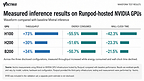
On commercially available NVIDIA H100, H200 and B200 GPUs in third-party RunPod infrastructure, Waveform increased productive GPU capacity on Mistral workloads while reducing both energy consumption and wall-clock time. No model retraining, model-weight changes or GPU-kernel modifications were required.

At the conservative +30% low end of the measured NVIDIA throughput range, a 10,000-GPU fleet operating at the same uplift would produce baseline-equivalent throughput comparable to 13,000 GPUs – the equivalent of 3,000 GPUs of additional productive capacity without expanding the physical fleet. This is an illustrative extrapolation, not a measured 10,000-GPU deployment.

Measured inference results on Runpod-hosted NVIDIA GPUs*
Waveform compared with baseline Mistral inference

GPU / Workload

Throughput

Energy Consumed

Wall-Clock

H100 / Mistral

+73 %

-55.5 %

-42.3 %

H200 / Mistral

+30 %

-51.6 %

-23.3 %

B200 / Mistral

+34 %

-50.7 %

-21.5 %

*Validation Note: Performance figures are Vectris-measured Mistral results on commercially available NVIDIA H100, H200 and B200 GPUs in RunPod infrastructure and are workload- and configuration-specific. They have not yet been independently reproduced in customer production. 

ARCHITECTURE-AGNOSTIC VALIDATION
On third-party Intel silicon, Waveform demonstrated 67% energy savings and a 32% reduction in time-to-result using the MLPerf LoadGen benchmark. Waveform has also been tested on third-party AMD silicon.

For operators, the evidence translates directly into capacity, cost and time: more useful AI output from installed infrastructure, less energy required to produce the work, and faster release of infrastructure for additional workloads.

WHAT WAVEFORM DOES
Waveform turns the discovery into an operational control point for AI infrastructure. It does not replace the optimized inference stack; it adds a control layer between serving infrastructure and the GPU, continuously identifying structural waste and reorganizing inference execution in real time.

The result is intended to complement existing inference infrastructure while targeting recoverable computational capacity that remains after conventional optimization. The objective is straightforward: more useful AI output from the infrastructure already deployed.

COMPUTE YIELD™
Vectris defines Compute Yield™ as the amount of quality-equivalent accepted AI output produced from existing compute infrastructure. It captures how efficiently installed infrastructure turns GPU capacity, energy and time into accepted AI output.

The company believes Compute Yield™ can become a new control point for AI infrastructure economics as operators increasingly balance compute availability, power constraints, capital investment and workload demand.

Vectris has completed technical demonstrations with AI-infrastructure and channel leaders and engaged a data-center advisory network representing approximately 300 MW of capacity.

COMMERCIAL AVAILABILITY
Waveform will launch October 1, 2026, with initial availability to a limited number of design partners. The company is moving from real-GPU proof toward commercial deployment.

THE BROADER AI INFRASTRUCTURE OPPORTUNITY
Vectris sees GPU inference as the first commercial application of its framework, not its endpoint. With Waveform now tested across NVIDIA, AMD and Intel silicon, the next frontier is to determine how far the same control principles extend across the broader AI infrastructure stack—including memory, data movement, networking, distributed compute, power and thermal systems. If validated across those domains, Waveform could become a broader control layer for the AI factory.

“The next phase of American leadership in artificial intelligence will depend not only on how much infrastructure we can build, but on how much more productive we can make the infrastructure already in place”, said Innovate Alabama Chairman Bill Poole, “The constraints around power, capital and compute are structural, and meeting exponential AI demand will require extracting greater value from every deployed system. Vectris is tackling that challenge from Birmingham with technology designed to increase the productive capacity of existing AI infrastructure—a powerful example of how consequential innovation from Alabama can address a problem of national economic and strategic importance.”

ABOUT VECTRIS LABS
Vectris Labs, Inc. is a Birmingham, Alabama-based AI infrastructure company behind Waveform, a control plane for Compute Yield™ in AI inference.

The Vectris team brings deep experience across GPU systems, AI infrastructure, cloud computing, performance engineering and large-scale computing environments, with backgrounds spanning AMD, Graphcore, Oracle Cloud Infrastructure, ByteDance, Mercedes-Benz, the U.S. Department of Energy and Oak Ridge National Laboratory.

That experience in understanding how computation behaves at the hardware and systems level led directly to Vectris’ discovery of deterministic structural patterns in AI inference—and to the development of Waveform as a way to measure, govern and capture the productive GPU capacity those patterns reveal.

Vectris was conceived and incubated in Birmingham by Thumos Capital. For additional information visit vectrislabs.ai. Book a Demo here.

MEDIA CONTACT
Melanie McCraney 
melanie@mccraneypr.com 

*VALIDATION AND DISCLOSURE
Performance figures are Vectris-measured Mistral results on commercially available NVIDIA H100, H200 and B200 GPUs in RunPod infrastructure and are workload- and configuration-specific. They have not yet been independently reproduced in customer production. The 10,000/13,000-GPU example is illustrative, not a measured fleet deployment. Third-party names do not imply endorsement. Quotes, titles and public references remain subject to approval before publication.

View original content to download multimedia:https://www.prnewswire.com/news-releases/vectris-discovers-recoverable-ai-compute-capacity-inside-deployed-gpus-demonstrating-up-to-73-more-productive-capacity-302855697.html

SOURCE Vectris Labs

Continue Reading

Technology

Kasm Technologies and Everfox Announce Strategic Partnership to Deliver Secure Cross Domain Workspace Access for Government and Defense

Published

on

By

McLEAN, Va., Aug. 20, 2026 /PRNewswire/ — Kasm Technologies, the platform for secure, containerized desktop and application delivery, and Everfox, a leader in cross domain solutions for classified and high-assurance environments, today announced a strategic technology partnership. The joint solution enables government, defense, and intelligence agencies to securely access applications and desktops across multiple classification levels from a single device – without endpoint sprawl, local data persistence, or mission disruption.

The partnership pairs Kasm Workspaces’ container-native, ephemeral workspace platform with Everfox’s Trusted Thin Client, a purpose-built zero-trust endpoint for secure cross domain access. Together, they replace the multi-endpoint, multi-VDI-stack approaches that have long driven up cost and operational complexity in classified environments. Sessions are policy-enforced, centrally managed, and fully wiped at termination – ensuring no data is left behind regardless of classification level.

For agencies looking to modernize cross domain infrastructure, the joint solution eliminates the requirement for a full rip-and-replace. Kasm Workspaces integrates with existing hypervisors, cloud environments, and identity providers, while Everfox’s Trusted Thin Client enables secure domain bridging on validated hardware – together allowing agencies to adopt modern workspace delivery on top of current infrastructure and transition at a pace that does not put critical missions at risk.

“Everfox and Kasm work together to securely connect users across domains while modernizing the desktop experience. Everfox enables trusted cross-domain access, and Kasm replaces rigid legacy VDI with a flexible, on-premise platform that lets customers evolve their infrastructure without vendor lock-in.”
Daniel Ben-Chitrit, Chief Product Officer, Kasm Technologies

The joint solution is available now. For more information, visit kasm.com/alliance-partnership/everfox or contact Everfox at everfox.com.

About Kasm Technologies

Kasm Technologies delivers a modern platform for secure, containerized desktop and application access. Kasm Workspaces streams browsers, desktops, and applications directly to users through ephemeral, policy-controlled sessions, eliminating the cost, rigidity, and risk of traditional VDI. Learn more at kasm.com.

About Everfox

Everfox is a leader in cross domain solutions, providing trusted access and secure data transfer across networks operating at different classification levels or security controls. Designed for high-assurance and classified environments, Everfox solutions are purpose-built for government, defense, and intelligence organizations. Learn more at everfox.com.

View original content to download multimedia:https://www.prnewswire.com/news-releases/kasm-technologies-and-everfox-announce-strategic-partnership-to-deliver-secure-cross-domain-workspace-access-for-government-and-defense-302852306.html

SOURCE Kasm Technologies

Continue Reading

Trending