Connect with us

Technology

AI Agents Are Influencing Product Decisions Without Explicit Human Authorization, Warns Info-Tech Research Group

Published

on

Product-centric delivery helps organizations sustain value beyond individual projects by maintaining ownership, direction, and accountability across the product lifecycle. New insights from Info-Tech Research Group show that AI agents are adding new governance challenges as they increasingly make decisions and execute within product workflows, sometimes without explicit human authorization. The firm’s Make the Case for Product Delivery blueprint offers a five-step approach to help leaders define product for their context, map human and agent decision authority, and build a stakeholder-ready roadmap for the transition.

ARLINGTON, Va., Sept. 18, 2026 /PRNewswire/ — Many IT organizations are still structured to deliver initiatives within defined periods, even though the products and services those initiatives support must continue to evolve and deliver value long after a project ends. Recent findings from Info-Tech Research Group show that moving toward product-centric delivery requires organizations to establish a shared definition of product, clear ownership, decision authority, and stakeholder support. The global research and advisory firm’s Make the Case for Product Delivery blueprint brings these elements together while addressing an emerging governance challenge as AI agents increasingly participate in product decisions.

Info-Tech’s research emphasizes that projects can continue to fund and implement defined changes within a product-centric model, while ongoing product ownership preserves direction, prioritization, and accountability across the full lifecycle. As AI agents become more involved in product workflows, that accountability must also extend to the decisions agents make or influence, including who authorized the decision, who can override it, and who remains accountable for the outcome.

“Projects deliver change. Product ownership sustains the value,” says Hans Eckman, research fellow at Info-Tech Research Group. “In today’s agent-enabled environments, clear ownership is even more critical. Teams need to know what an agent is authorized to do, when a human needs to approve or intervene, and who remains accountable for the result.”

Key Insights for Product Delivery Leaders
Info-Tech’s resource identifies several key considerations for leaders when building the case for product-centric delivery:

Product delivery connects temporary change to continuous value: Projects can continue to fund and deliver product changes, while ongoing product ownership maintains direction, prioritization, and accountability as products evolve over time.

Product ownership establishes accountability for value: Clear ownership helps keep product decisions and tradeoffs aligned with organizational goals. In agent-enabled environments, that accountability extends to decisions AI agents make or influence on the team’s behalf.

Silent delegation can hide AI-influenced product decisions: As agents participate in discovery, prioritization, experimentation, delivery, and support, decisions can occur without explicit human authorization or intervention. Leaders need visibility into where agents make recommendations or execute and who has authority to approve, override, or remain accountable for the outcome.

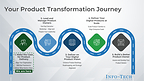
Info-Tech’s Five-Step Approach to Building the Case for Product Delivery
The Make the Case for Product Delivery blueprint guides product owners, product managers, development team leads, portfolio managers, and business analysts through five steps, with data, platform, and AI/ML stakeholders involved where agent participation and governance need to be assessed:

Define product by establishing a shared definition across the organization and distinguishing product delivery from project delivery. Where AI agents are involved, leaders also determine whether an agent is part of a product, a product itself, or a delivery mechanism, as each classification carries different accountability implications.

Define drivers and goals by connecting pain points and root causes in the current delivery model to the outcomes the transition should achieve. For agent-enabled product work, this includes establishing explicit goals for governing AI-influenced decisions.

Recognize AI and agent participation in product decisions by mapping where AI tools and agents make recommendations or execute across product workflows. Teams flag decision points where human approval, a known authorization ownership, override paths, or outcome accountability are unclear.

Communicate what comes next by identifying the critical steps required to advance product-centric delivery and organizing them into a now-next-later roadmap. Where agents participate in product workflows, the roadmap can also sequence actions such as mapping agent decision points, defining delegation boundaries, and integrating agent governance into the product operating model.

Make the case to stakeholders by clarifying each stakeholder’s role in the transition, defining what the product team needs from them, and translating the findings into a stakeholder-ready proposal. In agent-enabled environments, this can include stakeholders such as data owners, platform teams, and AI/ML teams responsible for configuring and operating agents.

The blueprint includes a supporting workbook and presentation template as well as practical outputs such as a Human-Agent Decision Map and a now-next-later roadmap. Together, these resources help leaders define how product-centric delivery will operate within their organization, surface gaps in agent decision governance, establish clear accountability, and build a practical case for moving forward.

For exclusive and timely commentary from Info-Tech’s experts, including Hans Eckman, and access to the complete Make the Case for Product Delivery blueprint, please contact pr@infotech.com.

About Info-Tech Research Group
Info-Tech Research Group is the “get things done” partner for over 30,000 IT, HR, and marketing leaders worldwide. The fastest growing research and advisory firm, Info-Tech enables leaders to make well-informed decisions and transform their organizations through AI, strategic foresight, step-by-step methodologies, practical tools, industry-leading advisory, and training programs. For nearly 30 years, tens of thousands of private and public organizations have trusted Info-Tech to lead their most important initiatives through periods of change and deliver outcomes that truly matter.

To learn more about Info-Tech’s HR research and advisory services, visit McLean & Company, and for data-driven software buying insights and vendor evaluations, visit the firm’s SoftwareReviews platform.

Media professionals can register for unrestricted access to research across IT, HR, and software, and hundreds of industry analysts through the firm’s Media Insiders program. To gain access, contact pr@infotech.com.

For information about Info-Tech Research Group or to access the latest research, visit infotech.com and connect via LinkedIn and X.

View original content to download multimedia:https://www.prnewswire.com/news-releases/ai-agents-are-influencing-product-decisions-without-explicit-human-authorization-warns-info-tech-research-group-302883560.html

SOURCE Info-Tech Research Group

Continue Reading

Technology

Saturday, September 19, 2026

Published

on

By

OTTAWA, ON, Sept. 18, 2026 /CNW/ —

Note: All times local

National Capital Region, Canada

10:00 a.m.

The Prime Minister will attend the National Caucus retreat.

Closed to media

This document is also available at https://pm.gc.ca

SOURCE Prime Minister’s Office

Continue Reading

Technology

4Humanity Introduces the National Positivity Portal, Using AI to Make the Good Happening Across America Easier to See

Published

on

By

AI-powered platform discovers and organizes real stories of nonprofit impact into a growing, searchable archive of America’s goodness

BOSTON, Sept. 18, 2026 /PRNewswire/ — Today, 4Humanity announced the National Positivity Portal, an AI-powered platform designed to discover, organize, and amplify real stories of positive impact happening across America.

The idea behind the Portal is simple: use artificial intelligence not to tell people what to think, but to help people see more of what is already happening. Its larger mission is to help lift humanity by building trust in human potential.

The National Positivity Portal continuously discovers publicly available stories from nonprofits and organizations across the country and organizes them into one searchable experience. Visitors can explore organizations and stories by cause, location, and mission, watch short daily stories of hope, compassion, service, and positive change, and find opportunities to learn more, support, volunteer, donate, or get involved.

“The problem isn’t that good things aren’t happening. It’s that we rarely see them,” said Glenn Court, Founder of 4Humanity. “Every day across America, nonprofits, foundations, civic organizations, and individuals are feeding families, supporting young people, strengthening communities, protecting the vulnerable, and helping people in countless other ways. But those stories are scattered across thousands of websites, social feeds, and local news outlets, making the full picture difficult to see. 4Humanity is working to change that.”

What AI Makes Possible
For the first time, artificial intelligence makes it possible to discover, organize, and connect positive impact stories at a scale and speed no human team could sustain.

The Portal can continuously search publicly available information, identify stories of service and positive impact, categorize them, and make them accessible through one platform. Each story contributes to a growing archive searchable by cause, location, and organization.

Rather than using AI to generate another stream of outrage or division, 4Humanity is asking a different question: What if AI could help make humanity’s best qualities more visible?

The result is intended to become a daily proof of goodness, a place where people can regularly see real examples of service, compassion, responsibility, and positive change.

An Invitation to Organizations Across America

4Humanity is inviting nonprofits across the country to opt in, with each becoming an affirming organization of the National Positivity Portal.

Organizations are affirming that their work is part of a larger national pattern of positive virtue and helping make that pattern visible.

For participating organizations, the Portal offers another way for people to discover their mission, learn about their impact, and connect with opportunities to support, volunteer, donate, or get involved.

For more information, visit 4Humanity.net to learn, explore the Portal, and opt in to help connect the good happening across America.

About the National Positivity Portal – 4Humanity.net
The National Positivity Portal is a nonpartisan, nonreligious, AI-driven platform that showcases, connects, and organizes the work of America’s nonprofits and civic organizations under one shared umbrella of demonstrated positive virtue. Its mission is to help lift humanity by building back trust in human potential. For more information, visit: 4Humanity.net.

View original content to download multimedia:https://www.prnewswire.com/news-releases/4humanity-introduces-the-national-positivity-portal-using-ai-to-make-the-good-happening-across-america-easier-to-see-302883582.html

SOURCE 4Humanity

Continue Reading

Technology

iScreen Expands iOS 27 Customization With New Extra-Large Widget Experiences, iPhone Duo Theme Support and AI-Powered Home Screen Design

Published

on

By

The latest update introduces interactive extra-large widget hubs, adaptive layouts for iPhone Duo, and AI-assisted Home Screen personalization.

LOS ANGELES, Sept. 18, 2026 /PRNewswire/ — iScreen, a mobile customization app for iOS and Android, today announced a new round of features and content designed around iOS 27, expanding the ways users can personalize their Home Screens with widgets, themes and emerging display formats.

The update highlights new experiences built around iOS 27’s extra-large widget format, theme layouts optimized for iPhone Duo, and a new collection of iOS 27-inspired visual styles. iScreen is also expanding its exploration of AI-assisted personalization through AI Home Screen Designer, offering a more intuitive way to create coordinated screen setups.

Extra-Large Widgets Unlock New Home Screen Experiences

With the expanded widget dimensions available in iOS 27, iScreen is introducing new experiences designed specifically for the larger canvas, going beyond simply scaling up existing widget formats.

The new collection features a variety of extra-large widgets, including Photo, Album, Music, Calendar, Interactive Refrigerator and Quick Launch widgets, giving users new ways to display content, interact with their Home Screen and access frequently used functions. iScreen also supports customizable extra-large widgets, allowing users to personalize content, layouts and visual styles to create more functional and expressive Home Screen experiences.

Theme Layouts Optimized for iPhone Duo

To accommodate the new screen proportions and display dimensions of iPhone Duo, iScreen has optimized selected theme resources for the device’s current screen format.

Wallpapers, widgets, icons and overall Home Screen layouts have been adjusted to better fit the new proportions while maintaining a balanced and cohesive visual experience.

Looking ahead, iScreen plans to further explore layout behavior, widget adaptation and visual continuity across different display states as new device formats create additional possibilities for mobile personalization.

iOS 27-Inspired Themes for a Cohesive New Look

Alongside its widget and device-format updates, iScreen has introduced a new collection of iOS 27-inspired themes reflecting the latest visual trends in iPhone customization.

The collection brings together coordinated wallpapers, transparent-style widgets, icons and other visual elements. By combining these assets into complete setups, users can create a polished and consistent Home Screen without having to manually search for and match individual elements.

AI-Assisted Home Screen Design

iScreen is also exploring how AI can make Home Screen personalization faster and more intuitive. AI Home Screen Designer can generate coordinated design suggestions based on a user’s preferences for style, color and visual elements, combining wallpapers, widgets and icons into a unified setup.

The feature is currently available to a limited group of users for testing. iScreen will continue refining the generation experience based on user feedback and plans to gradually expand availability.

“Personalization is shifting from static aesthetics to dynamic, context-aware experiences,” said the iScreen creative team. “With iOS 27’s larger widgets and iPhone Duo’s dual-display format, this update delivers deeper visual immersion and automated tools that simplify creating a cohesive Home Screen setup.”

About iScreen

iScreen is a mobile customization app providing widgets, wallpapers and themed layouts for iOS and Android devices. Ranking among the top home screen customization platforms worldwide, iScreen has more than 100 million users and has been featured by Apple Editorial in 128 countries for five consecutive days. With interactive and decorative options, iScreen enables users to personalize both Home Screens and Lock Screens for a more immersive mobile experience.

Official Website: iScreen – Phone Style, iScreen it!

iOS Download: ‎‎iScreen – Widgets & Wallpaper App – App Store ‎

Android Download: iScreen Google Play

View original content to download multimedia:https://www.prnewswire.com/news-releases/iscreen-expands-ios-27-customization-with-new-extra-large-widget-experiences-iphone-duo-theme-support-and-ai-powered-home-screen-design-302881925.html

SOURCE iScreen

Continue Reading

Trending