Connect with us

Technology

Meshy Details Mora, a Research Architecture for AI-Generated Interactive Worlds, and Launches Meshy 7.1

Published

on

Publicly playable at mora.fun, Mora combines coding agents, 3D generation and real-time video; Meshy also introduces finer geometric detail with Meshy 7.1

SILICON VALLEY, Calif., Sept. 21, 2026 /PRNewswire/ — Meshy, the AI-powered 3D generation platform, recently detailed Mora (Multimodal Open-world Real-time Architecture), its answer to one of the most ambitious goals in AI: generating complete worlds that people can explore, play and interact with in real time. Mora 1, an early demonstration available at mora.fun, features playable experiences ranging from spatial puzzles and multiplayer platforming to building, racing and sports, with switchable visual styles.

Much of the industry has approached this goal by asking a single video model to simulate an entire world end to end — an approach that continues to struggle with consistent spaces and complex interaction. Mora is built on a different conviction: a world should be constructed, and only then rendered. The architecture assigns each part of world generation to the layer best equipped for it: coding agents write the logic and mechanics that make a world run; Meshy’s 3D generation builds its spatial structure and assets; and a real-time video model turns that structure into final imagery and audio.

The result is a foundation on which game rules hold, spaces persist, and visual quality rises with every generation of video models. Because the layers advance independently, progress anywhere in AI — stronger coding agents, richer 3D generation, faster video models — compounds inside Mora.

For creators, the longer-term opportunity is to bring the elements of an interactive world into a more connected creative process. A change to how a game works could be developed alongside changes to how it looks, with agents helping to build and refine both. Because Mora separates these functions, advances in coding agents, 3D generation and video models can contribute to the architecture’s development individually.

Mora 1 is an early research demonstration focused on validating this architecture. Its public demos let visitors experience the approach through gameplay; a general-purpose world creation tool is a longer-term goal. Development of Mora 2 is underway as Meshy continues its research into richer AI-generated interactive experiences.

Meshy 7.1: the first generative 3D model to reach 4096³ geometric resolution

Alongside its research into interactive worlds, Meshy continues to advance the 3D generation models at the core of its platform. On September 16, the company launched Meshy 7.1, the new version of its flagship image-to-3D model, now available to all registered users. Meshy 7.1 introduces two high-detail generation modes, Ultra 2K and Ultra 4K.

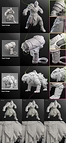
At its Ultra 4K setting, Meshy 7.1 generates geometry at 4096³ voxel resolution, with raw meshes reaching up to 80 million triangles before simplification. This makes Meshy 7.1 the first generative 3D model to reach 4096³ geometric resolution. Fine features such as stitching, woven fabric and individual scales can be generated as part of the mesh itself. These geometric details matter in workflows such as 3D printing and digital sculpting, where surface structure must be carried by the model.

In internal evaluations using Meshy’s newly developed Detail Richness Benchmark, Meshy 7.1 ranked first among five tested image-to-3D models across all three evaluated rendering resolutions. The benchmark measures geometric surface detail, providing a focused assessment of this aspect of model quality. Methodology and results are available in Meshy’s technical report, and the company plans to release the benchmark as a standalone tool.

Ultra 2K and Ultra 4K modes, along with downloads of models generated by Meshy 7.1, require a paid subscription. Ultra 2K supports single-view and multi-view generation; Ultra 4K currently supports single-view generation.

FAQ:

What is Mora?

Mora (Multimodal Open-world Real-time Architecture) is a research architecture developed by Meshy for creating AI-generated interactive worlds that people can explore, play and interact with in real time. Mora 1 is an early, publicly playable research demonstration, while a general-purpose world creation tool remains a longer-term goal. Development of Mora 2 is underway as Meshy continues its research into richer AI-generated interactive experiences.

How does Mora generate interactive worlds?

Mora assigns different parts of world generation to specialized layers. Coding agents generate game logic and mechanics, Meshy’s 3D generation provides assets and spatial structure, and a real-time video model generates the final imagery and audio.

What is the purpose of Mora’s layered architecture?

The architecture gives game rules and spatial relationships an explicit foundation in code and 3D graphics, allowing the video model to focus on visual presentation. The approach is designed to address challenges in maintaining consistent spaces and supporting complex interactions.

Where is Mora 1 available?

Mora 1’s playable research demonstrations are available at mora.fun. Current experiences include spatial puzzles, multiplayer platforming, building, racing and sports, with switchable visual styles.

What is Ultra 4K?

Ultra 4K is one of two high-detail generation modes introduced in Meshy 7.1, alongside Ultra 2K. It generates geometry at 4096³ voxel resolution, the highest setting available, so fine features such as stitching, woven fabric and individual scales are built into the mesh itself rather than painted on as textures. Ultra 4K currently supports single-view generation and requires a paid subscription.
 

About Meshy

Meshy builds foundation models for AI-powered 3D generation, helping people turn text and images into 3D assets for games, film, design and 3D printing. Founded by Ethan Hu, who holds a Ph.D. from MIT, Meshy serves more than 12 million registered users worldwide. In July 2026, the company announced nearly $400 million in Series B funding at a $1.5 billion valuation. Learn more at meshy.ai.

View original content to download multimedia:https://www.prnewswire.co.uk/news-releases/meshy-details-mora-a-research-architecture-for-ai-generated-interactive-worlds-and-launches-meshy-7-1–302884874.html

Continue Reading

Technology

Unanet Named a 2026 Top Remote Workplace

Published

on

By

Employee-driven recognition highlights Unanet’s commitment to flexibility, connection and a people-first workplace

DULLES, Va., Sept. 21, 2026 /PRNewswire/ — Unanet, the leader in AI-first ERP and growth software for government contractors and architecture, engineering and construction (AEC) firms, has been recognized as a 2026 Top Workplace for Remote Work by Energage, the technology company behind the Top Workplaces employer recognition program. This achievement demonstrates Unanet’s commitment to giving employees the flexibility of remote work while still creating opportunities to connect, collaborate, grow, and have fun together. The honor marks the fifth workplace award in the last two years Unanet has earned for its employee-first culture.

“This recognition reflects what our employees experience every day at Unanet: remote work isn’t simply about where we work, it’s about creating an environment where people can do their best work,” said Stacy Critzer, Chief Human Resources Officer at Unanet. “We’ve been intentional about building a culture where employees have the flexibility and support to be successful while staying connected to their colleagues and to the broader Unanet community, no matter where they’re located. That sense of connection and belonging makes us stronger as a team and ultimately helps us deliver better for our customers.”

The Top Workplaces for Remote Work award is based on employee feedback. In the past several years, Unanet’s employee base has grown substantially, and while Unanet continues to innovate in its AI-enabled solutions, intuitive customer interface, and industry-leading customer support, the company also continues to invest in its people and work culture. By keeping remote employees connected and supported through employee resource groups, recognition programs, virtual events, wellness programming, opportunities to build relationships across teams and mentorship, Unanet has proven time and again that its people are the cornerstone of success.

Top Workplaces national and regional employer awards highlight organizations that listen to employee feedback and drive people-first cultures. The Top Workplaces award is based on the confidential, research-backed Energage Workplace Survey. Participating companies are evaluated against the industry’s most robust benchmarks based on two decades of workplace culture research.

“Top Workplaces awards are a celebration of good news,” said Eric Rubino, CEO of Energage. “They exemplify the significance of a people-first workplace experience, reminding us that employees are the heart of any thriving organization.”

To learn more about Unanet’s culture and career opportunities, please visit https://unanet.com/about/careers.

About Energage
Energage is an HR technology company on a mission to help organizations build and brand exceptional workplace cultures. We power the Top Workplaces employer recognition program and deliver actionable, research-backed employee survey insights that fuel professional growth and elevate employer brands. Our comprehensive talent experience platform combines cutting-edge tools, expert guidance, and built-in personalization to cultivate cultures that boost engagement, improve retention, attract top talent, and drive better business results. Learn more at energage.com or topworkplaces.com.

About Unanet
Unanet is the leader in AI-first ERP and growth software for project-based businesses. Trusted by more than 4,200 government contractor, architecture, engineering, and construction firms, Unanet unifies pursuits, projects, people, and financials with built-in automation and compliance features—all supported by a dedicated customer success team. This empowers leaders to make confident, real-time decisions that drive growth from pursuit to profit. Learn more at unanet.com.

View original content:https://www.prnewswire.com/news-releases/unanet-named-a-2026-top-remote-workplace-302884919.html

SOURCE Unanet

Continue Reading

Technology

Transflo Wins 2026 National Remote Work Award from Top Workplaces

Published

on

By

TAMPA, Fla., Sept. 21, 2026 /PRNewswire/ — Transflo has been named a top employer for Remote Work in the national Top Workplaces 2026 recognition program. The accolade is based on employee feedback gathered through a third-party survey administered by employee engagement technology partner Energage LLC. The confidential survey uniquely measures the employee experience across various professional attributes.

This marks Transflo’s second consecutive year earning national recognition for Remote Work from Top Workplaces, following the same honor in 2025. The award reflects Transflo’s ongoing commitment to a productive and collaborative distributed workplace where employees thrive regardless of location.

“What makes Transflo special is our people,” said Renee Krug, Chief Executive Officer of Transflo. “We have an incredibly talented team that works hard, supports one another, and is deeply committed to our customers and our success. This recognition belongs to them.”

“Our distributed model proves that remote work thrives when you lead with trust and back it up with the right tools,” said Bill Vitti, President and Chief Revenue Officer of Transflo. “That’s the environment we’ve been intentional about building, and it shows in how our teams perform every day.”

“Earning a Top Workplaces award is a badge of honor for companies, especially because it comes authentically from their employees,” said Eric Rubino, Energage CEO. “That’s something to be proud of. In today’s market, leaders must ensure they’re allowing employees to have a voice and be heard. That’s paramount. Top Workplaces do this, and it pays dividends.”

About Transflo
Transflo is the leading provider of AI-powered mobile, telematics, and workflow automation solutions for the transportation industry in North America. Transflo’s cab to cash platform delivers real-time connectivity for fleets, brokers, factors, shippers, and commercial vehicle drivers, digitizing more than 800 million shipping documents annually and supporting approximately $115 billion in freight bills. 

Company Contact
Belinda Rueffer, SVP of Marketing
Belinda.Rueffer@transflo.com

About Energage
Making the world a better place to work together.™
Energage is a purpose-driven company that helps organizations turn employee feedback into useful business intelligence and credible employer recognition through Top Workplaces. Built on 20 years of culture research and the results from 30 million employees surveyed across more than 80,000 organizations, Energage delivers the most accurate benchmark available. For more information, visit energage.com or topworkplaces.com.

View original content to download multimedia:https://www.prnewswire.com/news-releases/transflo-wins-2026-national-remote-work-award-from-top-workplaces-302883567.html

SOURCE Transflo

Continue Reading

Technology

INSEAD AI Forum Americas debates AI’s impact across industry, careers and society

Published

on

By

FONTAINEBLEAU, France and SINGAPORE and SAN FRANCISCO, Sept. 21, 2026 /PRNewswire/ — Every industry is now being asked the same question: not whether to adopt AI, but how to do so in a way that strengthens rather than hollows out the organisations and people building them. That question sat at the centre of INSEAD’s AI Forum Americas 2026, which brought together business leaders, scientists, founders and policymakers in San Francisco this week for two days of debate on how artificial intelligence is reshaping industry, work and society. 

Across keynotes, panels and workshops spanning healthcare, robotics, organisational design and the future of careers, a consistent thread emerged: AI’s promise is inseparable from the discipline of implementation. Capturing its value responsibly means building the right frameworks, exercising sharper judgment about what to automate and what to protect, and investing in the human partnerships that make transformation durable rather than disruptive. 

Day One: Launching the INSEAD Future Council 

Day one started with the official launch of the INSEAD Future Council. This new initiative looks to bring together a network of communities, including enterprises, start-ups, investors, global innovation corridors, think tanks and academics, to work alongside INSEAD.  

The Council aims to deliver practical value across five pillars, starting by giving industry access to INSEAD’s MBA and EMBA talent through student projects and hiring opportunities. It will also foster knowledge by bringing real-world challenges and data into academic research, and improve learning by designing education programmes around current priorities. The Council will also create a connected network between industry and INSEAD’s global alumni community, and generate impact through shared research and events. 

“The Council is a two-way partnership: INSEAD brings a global platform, faculty, talent and an alumni network, and Council members bring the strategic challenges we all face as we roll out AI at the fastest possible pace,” said Victoria Woo, Senior Director of the INSEAD San Francisco Hub of Business Innovation. 

Dean of Research & Innovation Lily Fang used the Forum as an opportunity to give more details on the launch of the INSEAD Human and Machine Intelligence Institute (HUMII), made possible by a five-year, 15-million-euro gift from an alum. HUMII’s mission is to research and teach how AI can amplify human intelligence and expand human agency rather than focus on the technology itself. HUMII’s five founding principles, Fang explained, are modelled on INSEAD’s own entrepreneurial roots – open and interdisciplinary, entrepreneurial and courageous, faculty-led and independent, focused on quality over hype, and deeply connected to the outside world – positioning the institute to earn further funding by proving its impact, much like a startup hitting milestones. 

“We have a very strong voice, perhaps increasingly needed by this world, to think about how this technology will impact human society and business,” Lily Fang, Dean of Research & Innovation and Academic Director of HUMII. 

Learning, innovation, organisational challenges and the real-world impact of AI were recurring themes throughout the forum. This included the day’s opening panel, which explored the growing impact of AI in healthcare with Marc Tessier-Lavigne, co-founder, Chairman and CEO of Xaira Therapeutics. He explained how AI is reshaping how new medicines get discovered, from target identification to clinical trial design, and compressing timelines that used to take a decade into a fraction of the time. 

Josh Cohen of Apple University then took the stage to explain why companies need to consider a “4A” framework to better integrate AI into work. 

“The design idea is to avoid falling into either the language or the practice of knee-jerk automation, which does potentially great human damage. We avoid it by designing with a framework of alternatives in mind: automation when we can, augmentation when we can, addition when it’s needed, and avoidance when excessive reliance undermines learning or erodes relationships.” 

Day one also featured panels, organised by the INSEAD Future Council, focusing on the potential geopolitical tensions arising from AI development, and a session emphasising the value of diversity and emotional intelligence when it came to sparking innovation and entrepreneurship. Other sessions touched on the role of robots in the operating theatre, how much we should hand over to AI in the workplace, and why boards need to better understand AI to lead their organisations through this transformative moment. 

Day Two: From the Research Lab to the Factory Floor 

Day two opened with Yossi Matias, Vice President at Google and head of Google Research, who showed just how far AI has already reached into the real world, from satellites that spot wildfires before they spread, to LearnLM and NotebookLM tools built to support teachers rather than replace them, to MedGemma, an open-source medical model already downloaded millions of times. Matias’s own team is even putting AI to work as a co-scientist, generating hypotheses and combing research literature across disciplines. 

The sessions that followed dug into what it actually takes to make AI work inside an organisation, from building AI-ready teams and rethinking incentive structures, to the operational realities of agentic AI, physical AI and robotics on the factory floor and city streets, to hard data on how automation is reshaping careers and long-term earning potential. 

The day closed with a keynote talk from Vivienne Ming, Chief Scientist at Possibility Sciences and author of the new book Robot Proof: When Machines Have All the Answers, Build Better People. She argued that AI’s real power lies not in giving us answers but in pushing us to think harder.  

“Challenging people makes them better. Invest in better people by investing in technology that challenges us to be better,” said Ming. 

The AI Forum Americas marked the second stop in INSEAD’s 2026 AI Forum series. The global series began with the Europe Forum, held in Paris and Fontainebleau in June, and will continue in Singapore on 30-31 October. The AI Forums are part of IN:AI – The INSEAD Initiative on Responsible AI Leadership, which brings together education, research and engagement to advance responsible AI leadership.

Learn more about the INSEAD AI Forums.

About INSEAD, The Business School for the World

As one of the world’s leading and largest graduate business schools, INSEAD brings together people, cultures and ideas to develop responsible leaders who transform business and society. Our research, teaching and partnerships reflect this global perspective and cultural diversity. Our global perspective and unparalleled cultural diversity are reflected in our research, teaching, partnerships; as well as in our alumni network of over 73,000 members representing 176 nationalities across 183 countries.

With locations in Europe (France), Asia (Singapore), the Middle East (Abu Dhabi), and North America (San Francisco), INSEAD’s business education and research spans four regions. Our 162 renowned Faculty members from 40 countries inspire more than 1,700 degree participants annually in our Master in ManagementMBAGlobal Executive MBA, Specialised Master’s degrees (Executive Master in Finance and Executive Master in Change) and PhD programmes. In addition, more than 21,000 executives participate in INSEAD Executive Education programmes each year.

INSEAD continues to conduct cutting-edge research and innovate across all our programmes. We provide business leaders with the knowledge and awareness to operate anywhere. Our core values drive academic excellence and serve the global community as The Business School for the World.

CONTACT: news@insead.edu

View original content to download multimedia:https://www.prnewswire.com/news-releases/insead-ai-forum-americas-debates-ais-impact-across-industry-careers-and-society-302884760.html

SOURCE INSEAD

Continue Reading

Trending