Connect with us

Technology

FULCRUM LAUNCHES CERTIFICATE AUTOMATION, DOUBLING THE TIME ITS PLATFORM GIVES BACK TO ACCOUNT MANAGERS

Published

on

Workflow verifies coverage and pulls endorsement forms directly from the policy, extending automation Fulcrum already runs for policy checking and proposals.

SAN FRANCISCO, Sept. 28, 2026 /PRNewswire/ — Fulcrum today launched a certificate workflow that returns a complete, endorsement-ready certificate from an emailed request in under a minute, built on the same policy data the platform already uses for policy checking and proposal generation.

Fulcrum automates the underwriting context the document depends on, reading the policy rather than filling a form the way most certificate tools do. The workflow reads the inbound request and any attached contract, compares what is being demanded against the coverage the client actually carries, and flags requests the policy cannot satisfy before an account manager commits to anything. It locates the supporting endorsement forms inside the policy, pulls them, sorts them by the situation they apply to, and attaches them. Description of operations language comes from wording the agency has already approved, shaped to each client’s preferences. Account managers review and approve every certificate before it issues.

“When you track the lifecycle of a policy, from policy checking to proposals to servicing, certificates are such a major, tedious piece of that,” said Albert Hu, Product Lead for certificates at Fulcrum. “They’re also extremely hard to automate, because they require so much context about where a policy stands. We’d always wanted to build it, and once we’d proven ourselves with other workflows, we knew it was time.”

Certificates are the latest, and most demanding, of the major workflow areas Fulcrum has taken on, following policy checking and proposal generation. The sequence was deliberate: both of those required the platform to read and reconcile policy data across carriers, forms, and lines of business, and certificates inherit that same foundation.

Renewals compound the gain: because each certificate is built from current policy data rather than a stored template, an entire account can be reissued in a single batch, work that can otherwise take agencies days or weeks each year. It is the largest single gain Fulcrum has delivered to date, doubling the time the platform returns to account managers. Endorsement handling drew the most scrutiny from early users but has been fully tested and proven.

“I am confident, based on what Fulcrum has built, that this new workflow is going to be a game changer for all of Foundation Risk Partners (FRP) We’re really excited about the deployment of COIs,” said Daniel Greene, Midwest Regional Vice President of P&C Operations at FRP.

“Certificate requests are one of the most repetitive, time-consuming parts of an account manager’s day, not because the work is unimportant, but because it eats up hours that should go to higher-value client conversations,” said Arjun Mangla, CEO and Co-founder at Fulcrum. “Getting that time back without losing turnaround is what changes for these teams.”

Fulcrum is used by nearly half of the top 50 U.S. insurance brokerages and executes more than 2,500 hours of servicing work each day. The certificate workflow joins the company’s agents for policy checking, coverage analysis, proposal preparation, and sales preparation.

About Fulcrum

Fulcrum is the leading AI platform for insurance brokerages, helping teams modernize workflows like policy checking, proposal generation, and certificate issuance. Trusted by top U.S. brokerages, Fulcrum’s AI agents integrate directly with existing systems to deliver faster, more accurate service without adding headcount. Learn more at www.withfulcrum.com

Media Contact: Colleen O’Hara | press@withfulcrum.com

View original content to download multimedia:https://www.prnewswire.com/news-releases/fulcrum-launches-certificate-automation-doubling-the-time-its-platform-gives-back-to-account-managers-302891611.html

SOURCE Fulcrum

Continue Reading

Technology

Florida Tutoring Advantage selects Lumen, by Littera, to support statewide implementation

Published

on

By

NEW YORK, Sept. 28, 2026 /PRNewswire/ — After its 2025-2026 program implementation, the Florida Tutoring Advantage program has selected Littera to support its data layer to enhance program implementation and monitoring. With the goal of improving K-5 student outcomes in literacy and mathematics, Florida Tutoring Advantage aims to understand which tutoring programs are working well. Littera was one of twenty-five tutoring service and support providers in the launch year of Florida Tutor Advantage, and the program has chosen Littera to support its data layer for the 2026-2027 school year.

“We appreciate Littera’s commitment and investment in the success of program implementation for participating districts. We are grateful for the work of all our partners and Littera’s ability to meet the challenge of collecting data across our more than 15 different tutoring providers. Littera has shown their expertise and technical infrastructure to collect and clean data, offering an opportunity to provide timely support for program implementation,” said Nico Mora, Data and Reporting Manager, Florida Tutoring Advantage.

Littera’s data and visualization platform, Lumen, provides the insight Florida Tutoring Advantage needs to administer a statewide tutoring program. Lumen’s data and high-impact tutoring team works with Florida Tutoring Advantage leadership to identify data objectives and implementation strategy, managing the challenging integration across its providers. Lumen’s centralized, live data layer systematically collects standardized data and aggregates the data while scrubbing multiple data types and normalizes tutoring data so it can be utilized across data sets. Through Lumen, Florida Tutoring Advantage has the ability to access real-time data to enhance their team’s ability to monitor and visualize program execution, engagement, and effectiveness.

“With Lumen, we are applying years of in-the-trenches tutoring experience to solve the data problem that has prevented large-scale programs from regularly gathering consistent data that can drive improved implementation and outcomes,” said Littera’s founder and CEO Justin Serrano. “We are excited to partner with the program to improve Florida’s K-5 student outcomes in literacy and mathematics and to ensure state funds support strong implementation practices, continuous improvement, and positive outcomes for students.”

About Littera Education
Littera Education partners with K-12 educational organizations to lead full-service, High-Impact Tutoring and management systems in math, reading, and English language acquisition driving student progress and Academic-ROI. Littera’s standards-aligned HIT programs are led by experienced, consistent tutors who connect with students while Littera’s technology and knowledgeable team guide integration and data-driven continuous program improvement. Littera’s Lumen data and visualization platform collects, cleans, and compares data across providers, schools, and programs. For information, visit www.litteraeducation.com.

About Florida Tutoring Advantage
The Florida Tutoring Advantage, established by House Bill 1361 (2024) and administered by the UF Lastinger Center, provides in-person and virtual tutoring options, automated learning support software, and AI-enhanced learning support for Florida students who need extra help in reading or mathematics. Florida Tutoring Advantage also assists school districts who are developing district-led high-impact tutoring programs. To learn more, visit floridatutoringadvantage.com.

Contact Person:
Susan Kaplan
Susan.kaplan@litteraeducation.com

View original content to download multimedia:https://www.prnewswire.com/news-releases/florida-tutoring-advantage-selects-lumen-by-littera-to-support-statewide-implementation-302891721.html

SOURCE Littera Education

Continue Reading

Technology

PSignite’s CPGvision Platform Earned Six Best-in-Class Category Distinctions in the 2026 POI Enterprise Planning and Retail Execution Vendor Panorama

Published

on

By

NEW YORK, Sept. 28, 2026 /PRNewswire/ — PSignite, the company behind CPGvision, AI-driven trade and revenue management software for the consumer goods industry, today announced that its platform has earned six Best-in-Class Category Distinctions in the Promotion Optimization Institute’s (POI) 2026 Consumer Goods Enterprise Planning and Retail Execution Vendor Panorama.

The distinctions span the full commercial planning cycle, from setting the annual operating plan and headquarter strategy through account execution, deductions resolution, and post-event analysis. Together, they reflect CPGvision’s role as a single platform where sales, finance, and supply teams plan and act on the same numbers.

“Trade is one of the biggest lines on a CPG P&L, and our clients need to plan it, fund it, and settle it without leaking margin along the way,” said Jon Flaherty, CEO of PSignite. “Being recognized in six categories tells us our investment in CPGvision is showing up where clients feel it most: more efficient plans, faster deduction resolution, and one version of the truth that every function can work from.”

PSignite earned Best-in-Class Distinctions in the following six categories for 2026:

Annual Operating Plan (AOP)Headquarter PlanningInternal CollaborationTPMx Analytics, Dashboarding & ReportingTPMx Deductions ManagementTPMx for Tier 2 & 3 / International

About PSignite

PSignite is a leading AI solutions provider for the consumer packaged goods industry. With a focus on artificial intelligence and machine learning to help companies optimize their trade promotion funds and grow revenue profitably, and agentic AI for user productivity, PSignite offers an innovative platform designed to streamline processes and deliver actionable insights. For more information, visit cpgvision.com.

View original content to download multimedia:https://www.prnewswire.com/news-releases/psignites-cpgvision-platform-earned-six-best-in-class-category-distinctions-in-the-2026-poi-enterprise-planning-and-retail-execution-vendor-panorama-302891724.html

SOURCE PSignite

Continue Reading

Technology

AutoTrust AI Releases JEV-27B, an Open Decision Model for Self-Hosted AI Agents

Published

on

By

Trained in about 9.2 hours on one NVIDIA B200, JEV-27B adds fast, calibrated System 1 decisions to a frozen Qwen3.8-27B backbone while preserving its System 2 generation path.

SINGAPORE, Sept. 29, 2026 /PRNewswire/ — AutoTrust AI today released JEV-27B, an Apache-2.0 open-weights model designed to handle frequent, structured decisions inside AI agent workflows while retaining the underlying model’s full generation and reasoning path.

JEV-27B answers yes/no, multiple-choice and 0–5 rating questions in a single forward pass and returns a calibrated probability for every option. It runs on one NVIDIA B200 inside a customer’s own infrastructure and serves both fast System 1 decisions and deliberate System 2 generation from a single set of weights.

The model trains a 108.9-million-parameter decision block—about 0.4% of the full model—on top of a frozen Qwen3.8-27B backbone. AutoTrust reports that training took approximately 9.2 B200-hours. With the decision block switched off, all 164 HumanEval completions were byte-identical to those produced by the base model.

“Jev proved there is real demand for models that decide rather than write,” said Daniel Tang, AutoTrust AI’s chief executive and co-founder. “JEV-27B shows that this capability can run on one GPU inside a customer’s own infrastructure, next to a reasoning model. For companies that cannot send every decision to a third-party API, that changes both the cost and the risk.”

Evaluation and evidence

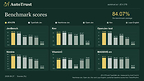
AutoTrust AI evaluated JEV-27B across six public text-decision benchmark groups. It reported scores of 88.70% on JevBench, 83.75% on Kev, 73.89% on OpenJev text, 92.91% on Nimble, 77.46% on VitaminC and 87.71% on MASSIVE-en, for an equal-weight six-group mean of 84.07%.

For additional context, AutoTrust AI also ran the hosted TypeSafe Jev 1.13 API on the same benchmark groups and reported a six-group mean of 83.85%, with JEV-27B scoring higher on four groups and lower on two. Because AutoTrust conducted this comparison itself, the figures should be read as internal comparative evidence—not as an independent third-party validation or a claim of across-the-board superiority.

For public baseline context, AutoTrust reproduced the scores published by TokenRhythm for NeoHorse-Jev, Open-Jev, Kev and Laya English. AutoTrust did not rerun those four external baselines. The pinned source table is available at https://huggingface.co/TokenRhythm/NeoHorse-Jev-4B/blob/b50e043e22e0e41e7fc0c244e4daa707b8124930/README.md. These figures are included as published benchmark context rather than as a new same-environment comparison by AutoTrust.

JEV-27B was also evaluated for fidelity to its distillation target. On 25,376 held-out questions labeled with Jev 1.13 probability distributions, JEV-27B reported a mean KL divergence of 0.017, where zero means identical distributions. On decision-models-under-pressure, an independent benchmark scored against human labels, JEV-27B reached 96% of Jev 1.13’s accuracy with 16 answer options. In that independent test, JEV-27B approached—but did not exceed—Jev 1.13.

AutoTrust AI measured a median decision latency of 137 milliseconds and sustained throughput of about 130 decisions per second on one B200. The model card also cites third-party measurements of 238 to 301 milliseconds and 23 decisions per second for Jev’s hosted API. These are not controlled, like-for-like results: the hosted API measurements include network time, while AutoTrust AI’s local measurements do not, and the hardware, serving and concurrency conditions differ.

How it works

AutoTrust AI uses the terms System 1 for fast, typed decisions and System 2 for deliberate generation and reasoning. JEV-27B serves both from one set of weights. It follows JEV-9B as the company’s second integrated System 1 and System 2 open model.

The model is built with AutoTrust AI’s Blocks of Experts recipe. A strong pretrained model, Alibaba’s open-weights Qwen3.8-27B, stays frozen as one expert block. A small, detachable block is trained for a single skill, and a router sends each request either to the fast decision block or to the deliberate generation block.

The decision block holds 108.9 million trained parameters, 0.4% of the model, and took about 9.2 hours to train on one NVIDIA B200. The reasoning path was left untouched. With the decision block switched off, JEV-27B scores 78.0% on the HumanEval coding test, and all 164 of its completions are byte-identical to the base model’s.

In a demonstration reel released with the model, a self-hosted JEV-27B served as the decision engine for 10 tasks. It played Doom, making 64 decisions in a target-practice scenario, and steered a simulated drone through a MuJoCo obstacle course. It ran a live Google Flights search from Zurich to London and verified 21 results, navigated Wikipedia to Gödel’s incompleteness theorems, flagged four regression risks in a sample change to authorization code and routed a billing-refund ticket to support.

“Every AI agent is really a long chain of small decisions—which button to press, which file to open, which queue a ticket belongs in,” said Josh Liu, AutoTrust AI’s chairman and co-founder. “Make each one fast, private and cheap, and you change the economics of the whole chain.”

AutoTrust AI said JEV-27B inherits Jev 1.13’s blind spots, including multi-hop reasoning, arithmetic, dates and adversarial inputs, and that its training data is English-centric. The company says the model is not meant for high-stakes decisions and recommends gating its answers on confidence.

Benchmark context and source notes

Scores are in percent. JEV-27B and the hosted TypeSafe Jev 1.13 API were measured by AutoTrust AI; this is not third-party validation. NeoHorse-Jev, Open-Jev, Kev and Laya English are published baselines reproduced from TokenRhythm and were not rerun by AutoTrust. TokenRhythm source (pinned revision): https://huggingface.co/TokenRhythm/NeoHorse-Jev-4B/blob/b50e043e22e0e41e7fc0c244e4daa707b8124930/README.md. Full AutoTrust methodology and source notes: https://huggingface.co/autotrust/JEV-27B.

Availability

JEV-27B is available under the Apache-2.0 license at huggingface.co/autotrust/JEV-27B. The release includes the weights, decision adapter, training and serving code, vLLM support and full evaluation reports. A demonstration reel is available at https://huggingface.co/spaces/autotrust/JEV-27B-Demo.

AutoTrust AI plans to build the JEV decision block into future models in its Guru family, which powers the ScienceGuru research platform. ScienceGuru is available for Windows and macOS at https://scienceguru.ai/. AutoTrust AI also offers customized sovereign deployments for enterprises.

JEV-27B was trained on SargeDev/jev-distill-corpus-v3, a public, Apache-2.0-licensed corpus of Jev 1.13’s outputs. It shares no weights or code with, and is not affiliated with or endorsed by, TypeSafe AI. Jev and TypeSafe are trademarks of their respective owners.

About AutoTrust AI

AutoTrust AI Pte. Ltd. is a Singapore-incorporated AI research company building the Guru family of foundation models and ScienceGuru, an AI research platform for scientists and research teams. Its Blocks of Experts architecture combines pretrained expert blocks with small trained adapters to build frontier-capable and sovereign models efficiently. Learn more at autotrust.ai.

View original content to download multimedia:https://www.prnewswire.com/apac/news-releases/autotrust-ai-releases-jev-27b-an-open-decision-model-for-self-hosted-ai-agents-302891725.html

SOURCE AutoTrust AI

Continue Reading

Trending