Connect with us

Technology

Micro-Electro-Mechanical System (MEMS) Market worth $25.03 billion by 2032 – Exclusive Report by MarketsandMarkets™

Published

on

DELRAY BEACH, Fla., Sept. 28, 2026 /PRNewswire/ — According to MarketsandMarkets™, the micro-electro-mechanical system (MEMS) market is projected to reach USD 19.06 billion in 2026 and USD 25.03 billion by 2032, registering a CAGR of 4.6% during the forecast period.

Browse 150 market data Tables and 105 Figures spread through 310 Pages and in-depth TOC on ” Micro-Electro-Mechanical System (MEMS) Market – Global Forecast to 2032″

Micro-Electro-Mechanical System (MEMS) Market Size & Forecast:

Market Size Available for Years: 2021–20322026 Market Size: USD 19.06 billion2032 Projected Market Size: USD 25.03 billionCAGR (2026–2032): 4.6%

Micro-Electro-Mechanical System (MEMS) Market Trends & Insights:

The micro-electro-mechanical system (MEMS) market is expected to grow significantly as industries increase investments in miniaturized sensing and actuation technologies across automotive, consumer electronics, healthcare, industrial, aerospace, defense, and telecom applications. Market growth is further supported by increasing demand for accurate motion sensing, pressure measurement, audio sensing, environmental monitoring, optical sensing, and RF functionality. These factors are driving the adoption of inertial sensors, pressure sensors, microphones, microspeakers, environmental sensors, optical sensors, optical actuators, microfluidics, inkjet heads, and RF MEMS devices. Product innovations and strategic developments by key players such as Robert Bosch, Broadcom, Qorvo, STMicroelectronics, Texas Instruments, Knowles Electronics, TDK Corporation, Infineon Technologies, Honeywell International, and Analog Devices are supporting market growth through advancements in MEMS sensing, actuation, miniaturization, integration, and packaging.By sensor type, the microspeakers segment is expected to record a CAGR of 18.4% between 2026 and 2032.By actuator type, the radio frequency segment is likely to exhibit ~6.3% growth rate during the forecast period.By vertical, the telecom segment is expected to register a CAGR of ~12.2% from 2026 to 2032.By region, Asia Pacific is expected to dominate the micro-electro-mechanical system (MEMS) market with ~46.8% share in 2026.

Download PDF Brochure: https://www.marketsandmarkets.com/pdfdownloadNew.asp?id=13689179

The key factor propelling the micro-electro-mechanical system (MEMS) market is the increasing adoption of miniaturized sensing and actuation technologies across automotive, consumer electronics, healthcare, industrial, aerospace & defense, and telecommunications applications. MEMS devices combine small form factors, low power consumption, high sensitivity, and fast response, making them suitable for applications such as smartphones, wearables, vehicle safety systems, navigation, medical devices, industrial equipment, and communication systems. Furthermore, the growing integration of MEMS sensors into ADAS, smartphones, hearables, smartwatches, IoT devices, and connected vehicles is increasing the demand for accelerometers, gyroscopes, pressure sensors, microphones, environmental sensors, and other MEMS components. The increasing adoption of sensor fusion and multi-sensor systems is further supporting the demand as manufacturers seek to combine motion, pressure, environmental, and other sensing capabilities within compact devices. In addition, advances in MEMS fabrication, wafer-level packaging, advanced materials, and semiconductor integration are improving device performance, reliability, and scalability, while the growing use of optical and RF MEMS is creating additional applications in AR/VR, telecommunications, and advanced sensing systems.

“Inertial sensors segment to hold the largest share of the micro-electro-mechanical system (MEMS) market in 2032″

By sensor type, the inertial sensors segment is expected to hold the largest market share in 2032, primarily due to the widespread use in smartphones, wearables, automotive systems, industrial equipment, navigation systems, and other electronic devices. Accelerometers and gyroscopes enable precise measurement of motion, orientation, vibration, and acceleration, making them essential for applications such as vehicle stability and safety systems, navigation, image stabilization, activity tracking, and motion control. Increasing adoption of ADAS, autonomous and connected vehicles, smartphones, smartwatches, hearables, and industrial automation is further expanding the demand for MEMS-based inertial sensors. In addition, advancements in low-power designs, higher sensing accuracy, sensor fusion, miniaturization, and advanced packaging are improving MEMS inertial sensor performance and enabling their integration into increasingly compact and multifunctional devices, supporting wider adoption across consumer, automotive, industrial, healthcare, aerospace, and defense applications.

“Microfluidics segment to exhibit a significant CAGR in the micro-electro-mechanical system (MEMS) market between 2026 and 2032″

By actuator type, the microfluids segment is anticipated to be the second-fastest-growing during the forecast period, driven by the mounting adoption of compact, automated, and high-throughput analytical platforms across healthcare, life sciences, and industrial applications. Rising demand for point-of-care diagnostics, lab-on-a-chip systems, and portable medical devices is accelerating the integration of MEMS-based microfluidic components that enable precise fluid handling, mixing, pumping, and sensing within miniaturized platforms. Increasing emphasis on rapid diagnostics and decentralized testing is further supporting adoption by reducing sample volumes, processing time, and system footprint. In parallel, advancements in MEMS fabrication, microfluidic channel design, and sensor integration are improving device performance and enabling greater functional integration. The expansion of precision medicine, molecular diagnostics, drug discovery, and cell analysis is also creating opportunities for microfluidic MEMS solutions, while continued miniaturization and automation are strengthening their value proposition for next-generation analytical systems.

Inquiry Before Buying: https://www.marketsandmarkets.com/Enquiry_Before_BuyingNew.asp?id=13689179

“Asia Pacific to be the fastest-growing in the micro-electro-mechanical system (MEMS) industry from 2026 to 2032″

By region, Asia Pacific is expected to witness the highest CAGR during the forecast period, driven by the strong presence of consumer electronics, semiconductor manufacturing, automotive production, telecommunications, and industrial automation across major economies including China, Japan, South Korea, Taiwan, and India. Increasing adoption of smartphones, wearables, connected vehicles, ADAS, IoT devices, and advanced industrial equipment is augmenting the demand for MEMS accelerometers, gyroscopes, pressure sensors, microphones, environmental sensors, and other MEMS devices. Expanding semiconductor and electronics manufacturing capabilities, investments in advanced packaging and sensor technologies, and growing localization of component production are further supporting regional demand. In addition, increasing deployment of 5G infrastructure, automotive sensing, robotics, medical devices, and smart industrial systems, together with the presence of major MEMS and semiconductor manufacturers and established electronics supply chains, is accelerating the adoption of MEMS technologies across the region.

Key Players

The micro-electro-mechanical system (MEMS) companies includes several major players, including Robert Bosch GmbH (Germany), Broadcom Inc. (US), STMicroelectronics N.V. (Switzerland), Texas Instruments Incorporated (US), TDK Corporation (Japan), Infineon Technologies AG (Germany), Analog Devices, Inc. (US), Honeywell International Inc. (US), TE Connectivity Ltd. (Switzerland), and NXP Semiconductors N.V. (Netherlands), among others. These players have a strong market presence across various countries in North America, Europe, Asia Pacific, and RoW.

Get 10% Free Customization on this Report: https://www.marketsandmarkets.com/requestCustomizationNew.asp?id=13689179

Browse Adjacent Market: Semiconductor and Electronics Market Research Reports &Consulting

See More Latest Semiconductor Reports:

Industrial Hose Market by Material Type (Natural Rubber, Nitrile Rubber, Polyvinyl Chloride, Silicone, Polyurethane, Ethylene Propylene Diene Monomer, Ultra High Molecular Weight Polyethylene), Media Type, Industry and Region – Global Forecast to 2032

Precision Farming Market by Automation & Control Systems, Cloud-based Software, System Integration & Consulting Services, Guidance Technology, Variable Rate Technology, Yield Monitoring, Field Mapping, Variable Rate Application – Global Forecast to 2033

About MarketsandMarkets™  

MarketsandMarkets™ has been recognized as one of America’s Best Management Consulting Firms by Forbes, as per their recent report.

MarketsandMarkets™ is a blue ocean alternative in growth consulting and program management, leveraging a man-machine offering to drive supernormal growth for progressive organizations in the B2B space. With the widest lens on emerging technologies, we are proficient in co-creating supernormal growth for clients across the globe.

Today, 80% of Fortune 2000 companies rely on MarketsandMarkets, and 90 of the top 100 companies in each sector trust us to accelerate their revenue growth. With a global clientele of over 13,000 organizations, we help businesses thrive in a disruptive ecosystem.

The B2B economy is witnessing the emergence of $25 trillion in new revenue streams that are replacing existing ones within this decade. We work with clients on growth programs, helping them monetize this $25 trillion opportunity through our service lines – TAM Expansion, Go-to-Market (GTM) Strategy to Execution, Market Share Gain, Account Enablement, and Thought Leadership Marketing.

Built on the ‘GIVE Growth’ principle, we collaborate with several Forbes Global 2000 B2B companies to keep them future-ready. Our insights and strategies are powered by industry experts, cutting-edge AI, and our Market Intelligence Cloud, KnowledgeStore™, which integrates research and provides ecosystem-wide visibility into revenue shifts.

MarketsandMarkets™ SalesPlay is an AI-driven Revenue Intelligence Co-Pilot designed to help revenue teams prioritize the right accounts, identify critical changes early, and surface opportunities ahead of demand, so pipeline builds naturally and deals close with greater consistency.

To find out more, visit www.MarketsandMarkets™.com or follow us on Twitter, LinkedIn and Facebook.

Contact:
Mr. Rohan Salgarkar
MarketsandMarkets™ INC.
1615 South Congress Ave.
Suite 103, Delray Beach, FL 33445
USA: +1-888-600-6441
Email: sales@marketsandmarkets.com
Visit Our Website: https://www.marketsandmarkets.com/
Research Insight: https://www.marketsandmarkets.com/ResearchInsight/mems-market.asp
Content Source: https://www.marketsandmarkets.com/PressReleases/mems.asp

View original content to download multimedia:https://www.prnewswire.com/news-releases/micro-electro-mechanical-system-mems-market-worth-25-03-billion-by-2032—exclusive-report-by-marketsandmarkets-302891270.html

SOURCE MarketsandMarkets

Continue Reading

Technology

Florida Tutoring Advantage selects Lumen, by Littera, to support statewide implementation

Published

on

By

NEW YORK, Sept. 28, 2026 /PRNewswire/ — After its 2025-2026 program implementation, the Florida Tutoring Advantage program has selected Littera to support its data layer to enhance program implementation and monitoring. With the goal of improving K-5 student outcomes in literacy and mathematics, Florida Tutoring Advantage aims to understand which tutoring programs are working well. Littera was one of twenty-five tutoring service and support providers in the launch year of Florida Tutor Advantage, and the program has chosen Littera to support its data layer for the 2026-2027 school year.

“We appreciate Littera’s commitment and investment in the success of program implementation for participating districts. We are grateful for the work of all our partners and Littera’s ability to meet the challenge of collecting data across our more than 15 different tutoring providers. Littera has shown their expertise and technical infrastructure to collect and clean data, offering an opportunity to provide timely support for program implementation,” said Nico Mora, Data and Reporting Manager, Florida Tutoring Advantage.

Littera’s data and visualization platform, Lumen, provides the insight Florida Tutoring Advantage needs to administer a statewide tutoring program. Lumen’s data and high-impact tutoring team works with Florida Tutoring Advantage leadership to identify data objectives and implementation strategy, managing the challenging integration across its providers. Lumen’s centralized, live data layer systematically collects standardized data and aggregates the data while scrubbing multiple data types and normalizes tutoring data so it can be utilized across data sets. Through Lumen, Florida Tutoring Advantage has the ability to access real-time data to enhance their team’s ability to monitor and visualize program execution, engagement, and effectiveness.

“With Lumen, we are applying years of in-the-trenches tutoring experience to solve the data problem that has prevented large-scale programs from regularly gathering consistent data that can drive improved implementation and outcomes,” said Littera’s founder and CEO Justin Serrano. “We are excited to partner with the program to improve Florida’s K-5 student outcomes in literacy and mathematics and to ensure state funds support strong implementation practices, continuous improvement, and positive outcomes for students.”

About Littera Education
Littera Education partners with K-12 educational organizations to lead full-service, High-Impact Tutoring and management systems in math, reading, and English language acquisition driving student progress and Academic-ROI. Littera’s standards-aligned HIT programs are led by experienced, consistent tutors who connect with students while Littera’s technology and knowledgeable team guide integration and data-driven continuous program improvement. Littera’s Lumen data and visualization platform collects, cleans, and compares data across providers, schools, and programs. For information, visit www.litteraeducation.com.

About Florida Tutoring Advantage
The Florida Tutoring Advantage, established by House Bill 1361 (2024) and administered by the UF Lastinger Center, provides in-person and virtual tutoring options, automated learning support software, and AI-enhanced learning support for Florida students who need extra help in reading or mathematics. Florida Tutoring Advantage also assists school districts who are developing district-led high-impact tutoring programs. To learn more, visit floridatutoringadvantage.com.

Contact Person:
Susan Kaplan
Susan.kaplan@litteraeducation.com

View original content to download multimedia:https://www.prnewswire.com/news-releases/florida-tutoring-advantage-selects-lumen-by-littera-to-support-statewide-implementation-302891721.html

SOURCE Littera Education

Continue Reading

Technology

PSignite’s CPGvision Platform Earned Six Best-in-Class Category Distinctions in the 2026 POI Enterprise Planning and Retail Execution Vendor Panorama

Published

on

By

NEW YORK, Sept. 28, 2026 /PRNewswire/ — PSignite, the company behind CPGvision, AI-driven trade and revenue management software for the consumer goods industry, today announced that its platform has earned six Best-in-Class Category Distinctions in the Promotion Optimization Institute’s (POI) 2026 Consumer Goods Enterprise Planning and Retail Execution Vendor Panorama.

The distinctions span the full commercial planning cycle, from setting the annual operating plan and headquarter strategy through account execution, deductions resolution, and post-event analysis. Together, they reflect CPGvision’s role as a single platform where sales, finance, and supply teams plan and act on the same numbers.

“Trade is one of the biggest lines on a CPG P&L, and our clients need to plan it, fund it, and settle it without leaking margin along the way,” said Jon Flaherty, CEO of PSignite. “Being recognized in six categories tells us our investment in CPGvision is showing up where clients feel it most: more efficient plans, faster deduction resolution, and one version of the truth that every function can work from.”

PSignite earned Best-in-Class Distinctions in the following six categories for 2026:

Annual Operating Plan (AOP)Headquarter PlanningInternal CollaborationTPMx Analytics, Dashboarding & ReportingTPMx Deductions ManagementTPMx for Tier 2 & 3 / International

About PSignite

PSignite is a leading AI solutions provider for the consumer packaged goods industry. With a focus on artificial intelligence and machine learning to help companies optimize their trade promotion funds and grow revenue profitably, and agentic AI for user productivity, PSignite offers an innovative platform designed to streamline processes and deliver actionable insights. For more information, visit cpgvision.com.

View original content to download multimedia:https://www.prnewswire.com/news-releases/psignites-cpgvision-platform-earned-six-best-in-class-category-distinctions-in-the-2026-poi-enterprise-planning-and-retail-execution-vendor-panorama-302891724.html

SOURCE PSignite

Continue Reading

Technology

AutoTrust AI Releases JEV-27B, an Open Decision Model for Self-Hosted AI Agents

Published

on

By

Trained in about 9.2 hours on one NVIDIA B200, JEV-27B adds fast, calibrated System 1 decisions to a frozen Qwen3.8-27B backbone while preserving its System 2 generation path.

SINGAPORE, Sept. 29, 2026 /PRNewswire/ — AutoTrust AI today released JEV-27B, an Apache-2.0 open-weights model designed to handle frequent, structured decisions inside AI agent workflows while retaining the underlying model’s full generation and reasoning path.

JEV-27B answers yes/no, multiple-choice and 0–5 rating questions in a single forward pass and returns a calibrated probability for every option. It runs on one NVIDIA B200 inside a customer’s own infrastructure and serves both fast System 1 decisions and deliberate System 2 generation from a single set of weights.

The model trains a 108.9-million-parameter decision block—about 0.4% of the full model—on top of a frozen Qwen3.8-27B backbone. AutoTrust reports that training took approximately 9.2 B200-hours. With the decision block switched off, all 164 HumanEval completions were byte-identical to those produced by the base model.

“Jev proved there is real demand for models that decide rather than write,” said Daniel Tang, AutoTrust AI’s chief executive and co-founder. “JEV-27B shows that this capability can run on one GPU inside a customer’s own infrastructure, next to a reasoning model. For companies that cannot send every decision to a third-party API, that changes both the cost and the risk.”

Evaluation and evidence

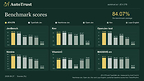
AutoTrust AI evaluated JEV-27B across six public text-decision benchmark groups. It reported scores of 88.70% on JevBench, 83.75% on Kev, 73.89% on OpenJev text, 92.91% on Nimble, 77.46% on VitaminC and 87.71% on MASSIVE-en, for an equal-weight six-group mean of 84.07%.

For additional context, AutoTrust AI also ran the hosted TypeSafe Jev 1.13 API on the same benchmark groups and reported a six-group mean of 83.85%, with JEV-27B scoring higher on four groups and lower on two. Because AutoTrust conducted this comparison itself, the figures should be read as internal comparative evidence—not as an independent third-party validation or a claim of across-the-board superiority.

For public baseline context, AutoTrust reproduced the scores published by TokenRhythm for NeoHorse-Jev, Open-Jev, Kev and Laya English. AutoTrust did not rerun those four external baselines. The pinned source table is available at https://huggingface.co/TokenRhythm/NeoHorse-Jev-4B/blob/b50e043e22e0e41e7fc0c244e4daa707b8124930/README.md. These figures are included as published benchmark context rather than as a new same-environment comparison by AutoTrust.

JEV-27B was also evaluated for fidelity to its distillation target. On 25,376 held-out questions labeled with Jev 1.13 probability distributions, JEV-27B reported a mean KL divergence of 0.017, where zero means identical distributions. On decision-models-under-pressure, an independent benchmark scored against human labels, JEV-27B reached 96% of Jev 1.13’s accuracy with 16 answer options. In that independent test, JEV-27B approached—but did not exceed—Jev 1.13.

AutoTrust AI measured a median decision latency of 137 milliseconds and sustained throughput of about 130 decisions per second on one B200. The model card also cites third-party measurements of 238 to 301 milliseconds and 23 decisions per second for Jev’s hosted API. These are not controlled, like-for-like results: the hosted API measurements include network time, while AutoTrust AI’s local measurements do not, and the hardware, serving and concurrency conditions differ.

How it works

AutoTrust AI uses the terms System 1 for fast, typed decisions and System 2 for deliberate generation and reasoning. JEV-27B serves both from one set of weights. It follows JEV-9B as the company’s second integrated System 1 and System 2 open model.

The model is built with AutoTrust AI’s Blocks of Experts recipe. A strong pretrained model, Alibaba’s open-weights Qwen3.8-27B, stays frozen as one expert block. A small, detachable block is trained for a single skill, and a router sends each request either to the fast decision block or to the deliberate generation block.

The decision block holds 108.9 million trained parameters, 0.4% of the model, and took about 9.2 hours to train on one NVIDIA B200. The reasoning path was left untouched. With the decision block switched off, JEV-27B scores 78.0% on the HumanEval coding test, and all 164 of its completions are byte-identical to the base model’s.

In a demonstration reel released with the model, a self-hosted JEV-27B served as the decision engine for 10 tasks. It played Doom, making 64 decisions in a target-practice scenario, and steered a simulated drone through a MuJoCo obstacle course. It ran a live Google Flights search from Zurich to London and verified 21 results, navigated Wikipedia to Gödel’s incompleteness theorems, flagged four regression risks in a sample change to authorization code and routed a billing-refund ticket to support.

“Every AI agent is really a long chain of small decisions—which button to press, which file to open, which queue a ticket belongs in,” said Josh Liu, AutoTrust AI’s chairman and co-founder. “Make each one fast, private and cheap, and you change the economics of the whole chain.”

AutoTrust AI said JEV-27B inherits Jev 1.13’s blind spots, including multi-hop reasoning, arithmetic, dates and adversarial inputs, and that its training data is English-centric. The company says the model is not meant for high-stakes decisions and recommends gating its answers on confidence.

Benchmark context and source notes

Scores are in percent. JEV-27B and the hosted TypeSafe Jev 1.13 API were measured by AutoTrust AI; this is not third-party validation. NeoHorse-Jev, Open-Jev, Kev and Laya English are published baselines reproduced from TokenRhythm and were not rerun by AutoTrust. TokenRhythm source (pinned revision): https://huggingface.co/TokenRhythm/NeoHorse-Jev-4B/blob/b50e043e22e0e41e7fc0c244e4daa707b8124930/README.md. Full AutoTrust methodology and source notes: https://huggingface.co/autotrust/JEV-27B.

Availability

JEV-27B is available under the Apache-2.0 license at huggingface.co/autotrust/JEV-27B. The release includes the weights, decision adapter, training and serving code, vLLM support and full evaluation reports. A demonstration reel is available at https://huggingface.co/spaces/autotrust/JEV-27B-Demo.

AutoTrust AI plans to build the JEV decision block into future models in its Guru family, which powers the ScienceGuru research platform. ScienceGuru is available for Windows and macOS at https://scienceguru.ai/. AutoTrust AI also offers customized sovereign deployments for enterprises.

JEV-27B was trained on SargeDev/jev-distill-corpus-v3, a public, Apache-2.0-licensed corpus of Jev 1.13’s outputs. It shares no weights or code with, and is not affiliated with or endorsed by, TypeSafe AI. Jev and TypeSafe are trademarks of their respective owners.

About AutoTrust AI

AutoTrust AI Pte. Ltd. is a Singapore-incorporated AI research company building the Guru family of foundation models and ScienceGuru, an AI research platform for scientists and research teams. Its Blocks of Experts architecture combines pretrained expert blocks with small trained adapters to build frontier-capable and sovereign models efficiently. Learn more at autotrust.ai.

View original content to download multimedia:https://www.prnewswire.com/apac/news-releases/autotrust-ai-releases-jev-27b-an-open-decision-model-for-self-hosted-ai-agents-302891725.html

SOURCE AutoTrust AI

Continue Reading

Trending