Connect with us

Technology

Intento Publishes The State of Translation Automation 2026, an Interactive Benchmark of 229 AI Translation Solutions in 100 Languages

Published

on

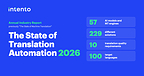
The interactive report compares translation quality, cost and translation time across 100 languages. It evaluates 229 solutions built from 57 AI models and machine translation engines, showing which solutions meet different translation requirements.

SAN FRANCISCO, Oct. 16, 2026 /PRNewswire/ — Intento has published The State of Translation Automation 2026 (inten.to/state-of-translation-automation), an interactive report on AI translation solutions in 100 languages. Readers choose their translation requirements, a target language and what to optimize for (quality, cost or translation time), and see which solutions meet those requirements in that language and how they compare.

Language engineers at Intento evaluated 229 solutions built from 57 AI models and machine translation (MT) engines, translating from English into 100 languages. They assessed 10 requirements across three levels of translation quality:

Basic: general translation quality.

Standard: Basic plus terminology, tone of voice and six formatting requirements, such as tag handling, valid JSON and Unicode support.

Advanced: Standard plus gender neutrality.

Each solution combines a model with a harness: prompts, glossaries and other context, and pre- and post-processing. For each language, the team started with an off-the-shelf model and added steps only when a simpler solution could not meet the requirements. This is the same approach Intento uses for clients.

“Automating translation used to mean choosing the ‘less wrong’ machine translation model for your content and language pair,” said Konstantin Savenkov, CEO & Co-founder of Intento. “Now it means building a harness around the models that meets your translation requirements, and you can’t build one without evaluations that check each requirement. In the report we build solutions the way we do for our clients, starting with the simplest one and adding steps only where it falls short, and show for each language what it takes in quality, cost and translation time.”

The 57 models come from 37 vendors, including Alibaba, Amazon, Anthropic, Cohere, DeepL, DeepSeek, Google, Microsoft, Mistral, OpenAI, Tencent, and xAI, and include neural machine translation models, MT systems based on large language models (LLMs), and commercial and open-weight LLMs.

The team evaluated off-the-shelf models and models adjusted with glossaries, tone of voice instructions and tag handling. It also tested two-step solutions that translate and then post-edit with an LLM, three-step solutions that translate, assess quality and repair errors, and multi-agent systems for advanced translation requirements.

AI translation quality depends on the language, the requirements and the workflow around the model

More demanding requirements leave fewer languages with a one-step solution plus a qualifying backup. For Basic translation quality, 54 of the 100 languages have this combination. That number falls to 38 languages for Standard quality and 12 for Advanced quality. The backup may require additional steps. In 18 languages, automated checks are not reliable enough to assess every requirement.

Additional steps help LLM solutions meet the general translation quality requirement. Among the evaluated LLM solutions that initially fall short, 24% meet it after translation and post-editing, and 60% after translation, quality assessment and repair.

Real-time translation comes with a quality trade-off. None of the real-time one-step solutions assessed in 84 languages meets every Standard requirement. Across the 38 languages where a one-step solution does meet those requirements, the fastest qualifying solution takes a median of about 65 seconds per 1,000 source words.

Methodology

Between June and September 2026, language engineers at Intento translated four English business texts totaling 2,978 words into 100 languages: an editorial article, a legal privacy notice, an institutional mission statement and planning guide, and a travel-safety alert.

Two automated quality-estimation metrics were used to shortlist 10 to 13 solutions per language. Intento LQA then assessed the shortlisted translations against the 10 requirements. Three LLM judges from three vendors identified errors by type and severity, and a fourth LLM combined their anonymized findings. The team accepted a result only where the three judges agreed on at least 90% of sentences. The six formatting requirements were checked in code.

Costs use August 2026 list prices in US dollars per million characters of the English source. The same language engineers configure AI workflows for more than 60 enterprise customers across hundreds of language pairs.

The State of Translation Automation 2026 is open to read, with no registration, at inten.to/state-of-translation-automation

Journalists and analysts can request a briefing on the findings at marketing@inten.to.

ABOUT INTENTO

Intento (inten.to) automates translation for global enterprises using AI agents. The Intento Enterprise Language Hub is a multilingual AI harness built on patent-based AI routing technology. It covers every touchpoint — websites, apps, help centers, support, and internal tools — in 650 languages. The agents, built from 50+ specialized LLMs, produce, validate, and repair translations against the requirements of each company: terminology, tone of voice, formatting, compliance. Intento Language engineers implement everything end-to-end — identifying requirements, configuring translation and quality workflows, integrating with existing systems — so no in-house AI expertise is needed. The result: a scalable, automated translation program trusted by 60+ global enterprises, including Indeed, Hexagon, Strava, and Agilent.

MEDIA CONTACT

marketing@inten.to

View original content to download multimedia:https://www.prnewswire.com/news-releases/intento-publishes-the-state-of-translation-automation-2026-an-interactive-benchmark-of-229-ai-translation-solutions-in-100-languages-302911475.html

SOURCE Intento

Continue Reading

Technology

PhotonPay Secures UK EMI Licence, Advancing Its Global Payment Operating System

Published

on

By

HONG KONG, Oct. 16, 2026 /PRNewswire/ — PhotonPay, a next-generation payment operating system, today announced that it has secured an Electronic Money Institution (EMI) licence from the UK Financial Conduct Authority (FCA).

The licence enables PhotonPay to issue electronic money and provide regulated payment services in the UK within the scope of its authorisation. It further strengthens PhotonPay’s local capabilities in the market and supports the company in delivering broader payment and treasury solutions for businesses operating globally.

The UK is one of the world’s leading financial and commercial hubs, and an important gateway for businesses operating across Europe and international markets. As companies expand into more countries and regions, their financial needs are evolving beyond individual cross-border transactions toward more integrated management of accounts, collections, payouts, foreign exchange, cards and treasury operations.

For PhotonPay, entering a market means more than making products and services available. It requires building a local financial foundation that meets regulatory requirements and can support businesses over the long term. The EMI licence further strengthens PhotonPay’s position in the UK and provides an important foundation for deeper connectivity with local banks, payment networks and the broader financial ecosystem.

JP, Global Head of Compliance at PhotonPay, said:

“Securing our UK EMI licence marks an important milestone in the continued expansion of PhotonPay’s global regulatory footprint. Building a global payment operating system requires strong local regulatory foundations. This authorisation strengthens our ability to build for the long term in the UK, while supporting our continued expansion across more markets, currencies and payment networks. Ultimately, it enables us to deliver a more complete and efficient payment and treasury experience for businesses operating globally.”

As businesses expand internationally, the financial infrastructure behind their operations remains highly fragmented. Different markets operate across distinct account structures, payment networks, currencies and regulatory frameworks, often requiring businesses to manage multiple financial institutions, payment providers and systems at the same time.

PhotonPay is building its next-generation payment operating system around this complexity. Through a unified technology platform, the company connects local financial capabilities across markets, enabling businesses to manage global accounts, collections, payouts, foreign exchange, cards and embedded finance more centrally while reducing the operational complexity created by multiple markets, currencies and systems.

Real commerce is the foundation of this operating system. By continuously expanding its regulatory coverage, banking relationships, payment networks and underlying technology infrastructure, PhotonPay aims to ensure that financial infrastructure can scale alongside a business as it enters new markets and grows internationally.

Since its founding, PhotonPay has continued to expand its global regulatory and local market capabilities through entities across major financial markets. Today, PhotonPay has secured nearly 30 payment licences and related regulatory authorisations worldwide, supporting capabilities across global accounts, collections, payouts, foreign exchange, cards and embedded finance.

The UK EMI licence represents another step in the continued development of PhotonPay’s global regulatory network. Looking ahead, PhotonPay will continue to deepen its local regulatory and financial capabilities in key markets, connect more markets, currencies and payment networks, and advance the development of its next-generation global payment operating system.

About PhotonPay
PhotonPay is a next-generation payment operating system designed for businesses operating globally. Across global accounts, collections, payouts, foreign exchange, cards and embedded finance, PhotonPay connects banks, payment networks and local financial infrastructure to help businesses manage global money movement more efficiently and expand into new markets with greater operational simplicity.

View original content to download multimedia:https://www.prnewswire.co.uk/news-releases/photonpay-secures-uk-emi-licence-advancing-its-global-payment-operating-system-302911509.html

Continue Reading

Technology

Payment Processing Expert Eric Miltner Explains How eCheck Payments Improve Efficiency for Small Businesses in HelloNation


Published

on

By

The article outlines how eCheck payments enable faster collections, recurring payments, and modern digital payments.

MANCHESTER, N.H., Oct. 16, 2026 /PRNewswire/ — How can eCheck payments help small businesses in New Hampshire reduce delays and improve payment tracking?

HelloNation has published an article featuring insights from Eric Miltner of PayPact in Manchester, New Hampshire, explaining how eCheck payments can improve efficiency and simplify payment processing for local businesses.

The article explains that many small businesses in New Hampshire still rely on paper checks that require mailing, depositing, and manual recordkeeping. Those extra steps can slow down cash flow and increase the risk of errors. eCheck payments offer an electronic alternative that lets businesses collect funds directly from a customer’s checking or savings account.

According to the article, eCheck payments commonly move through the ACH network, which banks use to transfer funds electronically between accounts. The article notes that while people often use the terms eCheck payments and ACH payments interchangeably, they are not identical. An eCheck refers to the customer’s payment method, while ACH payments describe the network that processes the transfer.

The HelloNation article emphasizes that payment timing matters for many small businesses in New Hampshire, especially contractors, medical offices, property managers, and professional service firms. Businesses that wait for paper checks may face delays from mail delivery, manual deposits, or payment posting errors. By using electronic payment processing, companies can often receive and organize payments more efficiently.

The article also highlights how digital payment modernization supports cleaner bookkeeping. Electronic records generated through eCheck payments can make it easier to match invoices, deposits, and customer accounts. This visibility helps businesses identify completed, pending, or overdue payments without relying on handwritten notes or manual spreadsheets.

Recurring payments are another major benefit the article discusses. Businesses that bill monthly for rent, memberships, maintenance plans, tuition, or professional services may use recurring payments to reduce administrative work. Once a customer authorizes future withdrawals, businesses can process recurring payments on a schedule without repeatedly requesting payment information.

Security is another key topic the article addresses. The HelloNation article explains that eCheck payments can be safe for online payments when businesses use secure systems with authorization procedures, encryption, and account verification tools. The article advises businesses to avoid collecting sensitive bank details via unsecured email or handwritten forms, as these methods may expose customer information.

Compared with paper checks, electronic payment processing may also reduce the risk of lost, delayed, or mishandled checks. The article explains that digital systems can provide transaction records and approval procedures that improve oversight and consistency. For businesses handling larger invoices, ACH payments and eCheck payments may also offer more predictable processing costs than certain card transactions.

The article further explains that online payments have become increasingly important for customers who expect convenient billing options. Many customers prefer paying invoices digitally rather than mailing paper checks or reading payment information over the phone. By supporting online payments, small businesses in New Hampshire may improve the customer experience while reducing administrative delays.

The HelloNation article concludes that digital payment modernization does not require businesses to replace every existing process immediately. Instead, the article describes digital payment modernization as a gradual effort to reduce manual work, improve accuracy, and simplify payment collection. Payment Processing Expert Eric Miltner explains that businesses should understand settlement timing, authorization requirements, and recordkeeping practices before integrating eCheck and ACH payments into daily operations.

How eCheck Payments Improve Efficiency for Small Businesses in New Hampshire features insights from Eric Miltner, a payment processing expert in Manchester, New Hampshire, in HelloNation.

About HelloNation

HelloNation is America’s Good News Network, a premier media platform built on the idea that good news travels faster when real people tell real stories. Through its community-focused publications and innovative “edvertising” approach, HelloNation delivers content that informs, inspires, and spotlights the leaders making a meaningful impact in their communities.

View original content to download multimedia:https://www.prnewswire.com/news-releases/payment-processing-expert-eric-miltner-explains-how-echeck-payments-improve-efficiency-for-small-businesses-in-hellonation-302903914.html

SOURCE HelloNation

Continue Reading

Technology

Beong-Soo Kim Installed as the University of Southern California’s 13th President

Published

on

By

Marking a new era for USC, President Kim announced plans for the university’s first comprehensive redesign of its undergraduate general education program in decades

LOS ANGELES, Oct. 16, 2026 /PRNewswire/ — The University of Southern California installed Beong-Soo Kim as its 13th president today during a ceremony at its University Park campus, where he outlined an ambitious vision for USC to reinvigorate its educational programs, deepen its interdisciplinary research impact, and strengthen ties with industry and community partners.

Addressing thousands of students, faculty, staff, alumni, and friends, Kim called on the Trojan community to build on USC’s pioneering history and distinctive strengths to help shape the future of higher education and society.

“The measure of a great university is not simply what we achieve, but what we make possible for others,” said Kim. “I am deeply grateful to our Board of Trustees and the entire Trojan community for entrusting me with the leadership of this extraordinary institution. USC has always been a place where people challenge conventional thinking, move the horizon, and turn bold ideas into meaningful change. Together, we will build on that spirit—to create a university that not only anticipates the future, but helps define it, opening new possibilities for generations to come.”

Kim was unanimously elected as the university’s 13th president on February 4, 2026 by the USC Board of Trustees, after serving as Interim President since July 1, 2025. Having joined USC senior leadership in 2020, Kim now holds the Robert C. Packard President’s Chair.

“Beong has proven himself a leader who moves with both conviction and care,” said Suzanne Nora Johnson, chair of the USC Board of Trustees. “In a moment of unprecedented change for higher education, he is setting a bold course for USC, one grounded in innovation, open dialogue, and a deep belief in our Trojan Family. His vision is already strengthening USC as a force of good for our students, faculty and staff, and the communities we serve.”

Drawing on USC’s pioneering history, interdisciplinary strengths, and deep ties to Los Angeles, Kim challenged the Trojan community to look beyond the immediate challenges facing higher education and embrace a larger ambition: not simply to adapt to a changing world, but to help shape what comes next.

His vision centered on three priorities: reimagining education to prepare students for a rapidly changing world; bringing together USC’s academic and research strengths to tackle society’s greatest challenges; and deepening partnerships with industry and communities to expand the university’s impact. Underlying these priorities is a commitment to advancing human flourishing and developing graduates with the creativity, compassion, courage, and judgment to lead.

Kim announced that USC will begin its first bottom-up redesign of undergraduate general education in decades. He also called for more experiential learning and immersive experiences, greater interdisciplinary collaboration, and stronger connections with the industries and communities that make Los Angeles a global center of innovation.

Acknowledging declining public trust in higher education, Kim emphasized that universities must earn that trust through listening, a willingness to change, and meaningful action. He called for responsible stewardship, strategic focus, and a renewed commitment to demonstrating the value of higher education through its impact on students and society.

Looking toward USC’s 150th anniversary in 2030, Kim challenged the university to build on its founding spirit of innovation and expand the boundaries of what is possible—for its students, Los Angeles, and the world.

Kim’s connection to USC spans generations. The son of Korean immigrants who both attended graduate school at the university, he was born and raised in the Los Angeles area and attended local public schools. He graduated Phi Beta Kappa and magna cum laude from Harvard College, earned a master’s degree from the London School of Economics, and received his law degree from Harvard Law School.

Additional images from today’s events will be published online here.

About USC
Founded in 1880, the University of Southern California is one of the world’s leading academic research institutions with 23 schools, a multi-billion-dollar health enterprise, and a vast research and development engine. The university enrolls 46,000 highly accomplished undergraduate and graduate students and employs 4,600 faculty who are members of major national academies, and MacArthur, Academy Award, and Pulitzer Prize winners, among many others. USC has a nationally recognized athletic program and a passionate global network of 500,000 alumni – the Trojan Family. Located in the heart of Los Angeles, USC is a powerhouse of innovation and impact with a global reach.

Media: uscnews@usc.edu 

View original content to download multimedia:https://www.prnewswire.com/news-releases/beong-soo-kim-installed-as-the-university-of-southern-californias-13th-president-302910822.html

SOURCE University of Southern California

Continue Reading

Trending