Connect with us

Technology

BAE Systems selected as a mission-enabling space technologies partner for NASA PRIMA astrophysics program

Published

on

NASA Jet Propulsion Laboratory mission to survey the history and evolution of the universe and bridge current scientific gaps

BROOMFIELD, Colo., Nov. 13, 2026 /PRNewswire/ — BAE Systems (LON: BA) announced today that its Jet Propulsion Laboratory (JPL)-led PRIMA (PRobe far-Infrared Mission for Astrophysics) team has been selected by NASA for the next phase of development in NASA’s new class of “Probe Explorers” astrophysics missions.   

BAE Systems will provide its Evolve+ spacecraft bus for the mission, lead the observatory assembly, integration and test process, and serve as the operations and ground lead for NASA’s JPL, the manager of the mission.   

“We are excited to continue our decades-long partnership with JPL through the PRIMA mission that will enable NASA to make significant discoveries on the history of the universe,” said Bonnie Patterson, vice president and general manager of civil space for BAE Systems. “The PRIMA mission will also help fill observation gaps with other NASA astrophysics missions, including the James Webb Space Telescope and other observatories, also supported by BAE Systems.”  

NASA’s PRIMA mission will use a highly sensitive, far-infrared space telescope that is designed to see parts of the universe that are hidden by dust. Using a 1.8-meter diameter telescope, it will observe the cosmos in far-infrared light, bridging the critical observation gap between the James Webb Space Telescope and ground-based radio observatories.

The mission will help scientists learn how stars, planets, galaxies and even water formed over time. It will reveal how these cosmic structures grow and change, providing a clearer picture of how our universe developed and evolved from its formation to the present.  

The PRIMA mission is currently advancing through Phase B development and is targeted for launch in 2033 for a five-year mission. Following a NASA confirmation review, the project will move toward full implementation.

BAE Systems will join numerous international space industry providers to support the PRIMA mission, including those from France, Italy, Canada, South Korea, Japan and the UK.

Through the PRIMA mission, BAE Systems continues its longstanding support of NASA’s astrophysics programs. This includes work on the Hubble Space Telescope, Chandra X-ray Observatory, James Webb Space Telescope and the Nancy Grace Roman Space Telescope, among others.

For more information, please contact: 

Brian Rantala, BAE Systems 
Mobile: 720-995-8253 
brian.rantala@baesystems.us 

www.baesystems.com/en-us   
@BAESystemsInc  

View original content to download multimedia:https://www.prnewswire.com/news-releases/bae-systems-selected-as-a-mission-enabling-space-technologies-partner-for-nasa-prima-astrophysics-program-302938998.html

SOURCE BAE Systems, Inc.

Continue Reading

Technology

TIMEX DECLARES TODAY ANALOG LIFE DAY

Published

on

By

A National Invitation to Get Off the Clock and Into Life

An unexpected opening in your calendar? Don’t fill it. Live it.

SHELTON, Conn., Nov. 13, 2026 /PRNewswire/ — Timex, the Official Timekeeper of Analog Life, is declaring today, Friday, November 13, Analog Life Day, and giving everyone a reason to do something increasingly refreshing: spend time actually living it. 

In a world that never stops scrolling, refreshing or asking for more of our attention, Timex is inviting people to take some of it back.

Take the long lunch. Call the friend you keep meaning to see. Leave your headphones behind. Wander somewhere without a plan. Say yes to something spontaneous. Make a memory that doesn’t need to be posted to count.  No productivity hacks. No screen time challenge. No perfectly planned itinerary.  Just a reminder that the best moments in life rarely happen between notifications. 

For more than 170 years, Timex has helped people keep time. Today, we’re reminding everyone what it’s for.

No registration. No download. No algorithm.

Just one day. Your time. Your way.

Make Time Yours.

Civic PR for Timex – timex@civic-us.com

View original content to download multimedia:https://www.prnewswire.com/news-releases/timex-declares-today-analog-life-day-302939026.html

SOURCE Timex

Continue Reading

Technology

Why a Pocket Projector Could Be the Right Gift for Gamers and Sewists: Aurzen ZIP Pro

Published

on

By

IRVINE, Calif., Nov. 13, 2026 /PRNewswire/ — The friend who hosts game night and the maker who dreads taping sewing patterns together might appreciate the same unexpected gift: a pocket projector. Aurzen ZIP Pro, a CES Innovation Awards 2027 Honoree, brings shared fun and sewing pattern projection together in one foldable projector.

Unlike a fixed TV, ZIP Pro is a gaming projector that moves with the gathering. Its larger shared image brings everyone into the adventure, whether you’re sharing maps during tabletop RPG sessions or cruising through neon-lit city streets in the upcoming AAA open-world titles. Direct USB-C support for Nintendo Switch makes it a convenient dock-free projector, letting friends play together instead of crowding around a handheld screen. Wired Game Mode offers 20–40ms response times for casual co-op and party games.

Beyond game nights, ZIP Pro brings the same flexibility to your sewing table. As a sewing projector, it lets you skip printing, taping and storing paper patterns, leaving more time for working with fabric. Native 1080p DLP and ToF autofocus help keep fine outlines clear, while adjustable support and four-point correction help align the image with your cutting surface. With less setup between an idea and the first cut, this compact sewing pattern projector helps you turn your ideas into a finished piece with greater confidence.

The ZIP Pro Basquiat Special Edition Bundle pairs the same hardware with artwork from the Basquiat estate. It includes the projector, two custom art shells, a custom GoPlay portable case and a mounting suite with MagPlay Pro and Z-Stand in a special-edition gift box. The interchangeable shells offer two different looks, making it a personal choice for Basquiat fans.

During the promotion from Nov.19-30, ZIP Pro is $579.99 (regularly $629.99); ZIP Pro Basquiat Special Edition Bundle is $649.99 (regularly $679.99). Buyers can choose a complimentary GoPlay Carry Bag or Z-Stand, limited to 50 gifts in total, first-come, first-served. A sitewide prize draw offers shoppers a chance to get their order for free.

About Aurzen

Aurzen is a global innovator in smart projection technology. By combining advanced optical engineering with intuitive software and user-focused design, Aurzen delivers products that bring big-screen experiences to any space. The company pioneered the world’s first Tri-Fold Truly Portable Projector, ZIP, and its designs have been recognized with multiple international awards, including the iF Design Award, Red Dot Award, G-Mark Award, and IDEA Award. For more information, visit www.aurzen.com.

View original content to download multimedia:https://www.prnewswire.com/news-releases/why-a-pocket-projector-could-be-the-right-gift-for-gamers-and-sewists-aurzen-zip-pro-302938816.html

SOURCE Aurzen

Continue Reading

Technology

Same Prompt, More Complete Prints: Meshy.ai Publishes Printability Benchmark for AI-Generated 3D Models

Published

on

By

In an FDM print test, Meshy.ai’s Make Printable feature cut prints with major missing features or holes from 44% (11 of 25) to 8% (2 of 25).

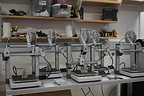
SILICON VALLEY, Calif., Nov. 13, 2026 /PRNewswire/ — Meshy.ai today published the results of a printability benchmark for AI-generated 3D models, carried out in collaboration with the Advanced Digital Design and Fabrication facility (ADDFab) at the University of Massachusetts Amherst. Meshy.ai commissioned and funded the study and supplied six Bambu Lab A1 printers and consumables. Facility participation does not constitute endorsement of Meshy.ai products.

AI-generated 3D models are usually judged by how they look on screen. Once they reach a printer, many fall short: thin wings, fins and panels fail to form or snap off when supports are removed. Meshy.ai built its Make Printable feature to close that gap. Make Printable is Meshy.ai’s print-preparation feature. It repairs mesh defects and reinforces thin features for the selected size and process, and it works on models generated in Meshy.ai and on uploaded models alike.

To see how that holds up on real hardware, Meshy.ai generated models for 25 hard-to-print prompts, and the lab sliced and printed 125 parts on brand-new Bambu Lab A1 printers: the same 25 prompts from five workflows (Meshy 7, Meshy 7 with Make Printable and three other AI 3D generators), using the same settings and filament for every workflow. Engine identities were concealed throughout file preparation, printing and grading. Three experienced 3D printing users scored each part against the lab’s five-criterion rubric, and 17 volunteers ranked the anonymous prints.

“Many AI platforms can generate 3D models that appear impressive on screen, but producing a printable part requires more than just visual fidelity. The next consideration is design for additive manufacturing, which cannot be reliably assessed from a rendered image alone. The purpose of this study was to evaluate these platforms in practice — by actually 3D printing each part on a consumer FDM printer — and to determine whether they can produce real parts that are both visually convincing and manufacturable,” said Dave Follette, Director, ADDFab, UMass Amherst.

With Meshy 7 alone, 11 of 25 prints (44%) had major missing features or holes. With Meshy 7 with Make Printable, that dropped to 2 of 25 (8%). In the same test, 23 of 25 Meshy 7 with Make Printable prints (92%) had no major missing features or holes, compared with 21 of 25 (84%), 15 of 25 (60%) and 14 of 25 (56%) for three other AI 3D generators. Other defects may remain.

Meshy.ai also ran a larger software assessment of model geometry across 100 prompts. Models with complete, connected surfaces rose from 33.4% for raw Meshy 7 output to 98.8% after Make Printable, averaged across the 100 prompts. This surface check measures detected openings and invalid connections, not physical print success.

“People use Meshy because they want to bring an idea to life, not spend hours repairing a model before they can print it,” said Jessie Bergau, 3D Printing Product and Partnerships Manager at Meshy.ai. “Make Printable helps close that gap. Working with UMass Amherst’s ADDFab Lab gave us a way to test the results beyond the screen, with physical prints evaluated without knowing which tool produced them.”

The study has several limitations. The 25 prompts were deliberately selected to challenge the models’ ability to reproduce delicate features, with priority given to prompts for which competing models were predicted to be too thin to print. The findings therefore should not be interpreted as representative of performance across all prompts. Two Meshy 7 with Make Printable prints, a six-legged insect and a long-finned tropical fish, still had major missing features or holes. The physical test covered FDM printing only. Future testing could extend to SLA, SLS and Full-Color printing.

The full printability study, including methodology, limitations and photos of the misses, is available on the Meshy.ai blog, where readers can also download the complete whitepaper. Make Printable is available now as part of Print Check in Meshy.ai.

Frequently asked questions

How does Meshy 7 with Make Printable change the geometry?

Meshy 7 with Make Printable repairs surface errors and reinforces selected thin regions for the intended print size, rather than enlarging the whole model. Inspect the prepared result before exporting.

Does it guarantee a successful print?

Geometry preparation addresses only part of the process. Material, orientation, support strategy, printer calibration and settings still matter.

Which printing processes can I prepare for?

FDM, SLA and Full-Color presets guide geometry preparation. The benchmark’s physical tests used FDM.

Can I repair a model made in another tool?

Yes. Upload it to Meshy.ai, choose the intended size and printing process, and use Meshy 7 with Make Printable before exporting to your slicer.

Can I use Meshy 7 with Make Printable through the API?

Yes. The Repair Printability API repairs model topology and can reinforce thin walls for a specified size and printing process. It accepts external model files as well as supported Meshy.ai task outputs.

About the study

Meshy.ai commissioned and funded the study and supplied six Bambu Lab A1 printers and consumables. The Advanced Digital Design and Fabrication facility (ADDFab) at the University of Massachusetts Amherst performed file preparation and slicing, printing, support removal and objective grading. Facility participation does not constitute endorsement of Meshy.ai products or an audit of Meshy.ai’s software.

About Meshy.ai

Meshy.ai is an AI 3D multimodal model company. Founded by Ethan Hu, who holds a Ph.D. from MIT, Meshy.ai builds foundation models for AI-powered 3D generation, turning text and images into 3D models for everything from games and film to 3D printing. Meshy.ai serves more than 15 million registered users and over 3,000 companies and educational institutions worldwide. In July 2026, the company raised nearly $400 million in a Series B round at a $1.5 billion valuation, the largest round to date in AI 3D. In September 2026, Meshy.ai became the first AI 3D company to surpass $100 million in annual recurring revenue (ARR). In October 2026, it was the only AI 3D company in a16z’s first ranking of the top 50 consumer AI apps by monthly revenue. Learn more at meshy.ai.

View original content to download multimedia:https://www.prnewswire.com/news-releases/same-prompt-more-complete-prints-meshyai-publishes-printability-benchmark-for-ai-generated-3d-models-302938840.html

SOURCE Meshy.ai

Continue Reading

Trending