BEIJING, March 6, 2024 /PRNewswire/ – By China Report ASEAN
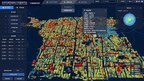
A vivid three-dimensional rendering of a bridge appeared on the intelligent monitor and evaluation platform at Beijing Yunlu Technology Co., Ltd., pointing to key factors of bridge health. Real-time status, events, transportation navigation, and traffic conditions were all tracked on the screen.
Numerous sensors installed on bridge track every minor dynamic change on the bridge surface and perform digital analysis, according to Gao Fengyong, a regional chief with the tech firm. When a large vehicle approaches, the system checks its weight and produces an early warning if the vehicle and its load is heavier than the bridge was designed to support. The vehicle is then immediately intercepted from crossing the bridge as an emergency response. The screen of the monitor platform shows a digital twin replica of the bridge.
A key method to realize bidirectional mapping and dynamic interaction between virtual and reality, the digital twin (DT) technology provides another effective approach for observing, understanding, controlling, and transforming the physical world. It was originally designed to improve local public services, but has since been more widely used to develop tailored applications for different scenarios involving urban planning and management, demonstrating enormous potential for solving problems in urban governance.
Lifecycle Management
A digital twin is a digital representation of a physical object, person, or system powered by utilizing physical models, sensor updates, operating history, and other data, which reflects the whole life cycle of the corresponding physical entities in the virtual space.
The earliest application of DT technology was in the 1970s when NASA engineers used simulations of a space vehicle to monitor and predict the performance of the real vehicle and assist ground command to make the best decisions to ensure safe flight and prolonged operational life of the vehicle. In 2003, Professor Michael Grieves at the University of Michigan first introduced the concept of DT by proposing an “Information Mirroring Model,” a vision in the context of product lifecycle management consisting of three components: real space, virtual space, and data flow connection between the two. Since then, DT technology has been developed and applied in aerospace, industrial manufacturing, and other fields.
“Simply put, a digital twin is a virtual replica of a physical entity,” said Yang Tao, an associate professor at the School of Architecture at Tsinghua University. “Supported by constantly-updated algorithms using real-time information from the virtual model synchronized with the corresponding physical system, more accurate predictions and decisions can be delivered for future operation and improvement of the physical entity.”
DT technology covers every link of the entire product life cycle from design to development, manufacturing, maintenance, and even recycling, enabling product information to remain consistent even when changes occur in any of the links. Not only can it help companies develop better products, it can also help users use the product in an optimal way.
In recent years, the rise of the meta-universe and emergence of the Internet of Things, cloud computing, and artificial intelligence (AI) have fueled the DT market, with the technology widely available in areas such as urban management, industrial manufacturing, water conservancy, and security and emergency response.
Statistics from the China Academy of Information and Communications Technology (CAICT) showed that the global digital twin market size was valued at US$7.7 billion in 2022, year-on-year growth of 57.1 percent, and is expected to reach US$30.5 billion by 2025. The figure in China was 10.4 billion yuan (US$1.45 billion) in 2022, year-on-year growth of 35 percent, and is poised to soar to 37.5 billion yuan (US$5.2 billion) by 2025.
More and more businesses, investors, and governmental agencies are considering how to leverage the emerging technology to address public service challenges and improve urban governance. Qiu Baoxing, IEAS (International Eurasian Academy of Sciences) Academician and former vice minister of China’s Ministry of Housing and Urban-Rural Development, remarked at the 12th World Geospatial Developers Conference (WGDC 2023) that the explosion of the meta-universe in 2022 propelled the transition of DT from local adoption to applications in urban scenarios.
Also at WGDC 2023, Li Deren, an academician with the Chinese Academy of Sciences and the Chinese Academy of Engineering and a professor at Wuhan University, said that compared to the product life cycle in industrial manufacturing, a digital city has an extended and more beneficial life cycle thanks to its deep learning capabilities, virtual-reality integration, and iterative evolution. The pinnacle of digital city development is smart cities based on digital twins, he asserted.
Virtual-Reality Mapping to Virtual-Reality Linkage
China first introduced the concept of a “digital twin city” in 2018 when a master plan for the development of Xiongan New Area was formulated that required synchronized planning and construction of both a digital and physical New Area with an aim for a world-class digital city with deep learning capabilities.
As project leader for Xiongan digital planning and construction based on City Information Modelling (CIM), Yang Tao considers the project an unprecedented challenge that requires trial and error. Unlike conventional model and experience-based plans, he explained, this project focuses on tackling urban issues such as urban planning, energy consumption management, waste treatment, and traffic congestion by recording and monitoring the whole process of construction of Xiongan New Area.
In transportation construction, for example, they established the world’s first large-scale regional-level digital road network to simulate real-world scenarios. The project can collect all kinds of data on the roads including pedestrians, vehicles, traffic lights, buildings, weather, and environment and detect traffic status under all kinds of weather conditions around the clock, thus providing diverse services for businesses, the government, and the public such as road operation and maintenance, emergency management, and autonomous driving tests.
Xiongan New Area’s CIM platform set the standard for subsequent digital twin city planning and construction in other parts of the country. In 2022, China rolled out a plan to facilitate development of the digital economy in the 14th Five-Year Plan period (2021-2025), calling for building digital twin cities with well-established city information modeling platforms and improved operation and management service platforms. To this end, the Ministry of Housing and Urban-Rural Development, the Ministry of Housing and Construction, the Ministry of Natural Resources, the Ministry of Water Resources, and other relevant authorities have scaled up policy support for digital twin technology development, talent, and application to promote the construction of digital twin cities.
CAICT counted 30 new enterprises involved in digital twin city construction in China every year before 2014 and between 50 and 60 from 2015 to 2018, but the number skyrocketed to over 100 from 2019 to 2021, suggesting a continuously growing market with huge potential.
DT technology is more than simply digitalizing and visualizing physical assets. The core goal is to convert data resources into data capital by linking the virtual and physical worlds while optimizing the parameters and sharing information with all parties involved in the interaction process, Yang Tao illustrated.
According to Gao Fengyong, the digital urban flood forecasting platform developed by Yunlu Technology achieved near real-time simulation of the urban flood process involving rainfall, ground water accumulation, and pipeline drainage, allowing it to provide decision-making support and flood prevention and response guidance for government authorities through simulated pre-flood analysis, real-time early warning, and post-flood summary and analysis. Last summer, the platform had already contributed to flood control in Beijing, Ningbo, Jinan, and other cities.
“Alongside visualization and simulation, a digital twin system is also intended to serve the physical entity through a digital replica to enhance the efficiency of physical production,” Gao said. By collecting real-world information on the Internet of Things for the virtual world before analysis and simulation, the system can predict risks and achieve real-time mobilization of resources, offering scientific support for decision-making in a timely manner.
However, excessive pursuit of digital technology and AI could lead to less focus on practical applications, resulting in insufficient integration of business rules and geometric models. “Application matters most, but 80 percent of digital twins are useless,” Qiu Baoxing revealed, noting that for DT technology, application scenarios including smart governance, urban construction management, general urban management, and emergency management are of paramount importance.
Yang Tao echoes that view. “A fancy model does not necessarily work well,” he said. Digital twin cities must be tailored to solve specific problems in different scenarios, he added, and optimization of urban governance cannot rely solely on technological improvements, but requires corresponding changes made in the objects and systems served or affected, so that social and technical systems will interact with each other and evolve together.
Collaborative Governance Model
CAICT’s Digital Twin City Research Report (2022) designated the period 2020-2030 as a stage of fast growth for China’s digital twin industry during which both the DT market and technology are developing in full swing.
However, cities represent a system far more complex than a space vehicle, an industrial product, or a building. They involve social, economic, environmental, and cultural factors as well as many other aspects. Humans are the main component of a city, and their different goals and behaviors can lead to various uncertainties in the process of urban governance. Application scenarios for digital twins are complex, involving multiple factors and requiring multi-sectoral collaboration. Currently, one major challenge faced by all fields is a lack of collaboration among the government, high-tech firms, and relevant entities.
In 2015, Singapore launched the “Virtual Singapore” project to build a 1:1 scale model of 3D Singapore. Alongside improving relevant policies and regulations, the city-state placed an emphasis on enhancing public participation in digital governance, encouraging citizens to transform from consumers of smart city services to creators and contributors. The government rolled out incentives for the market to provide cutting-edge technology, effective productivity, and adequate financial support to inspire all parties to collaborate while enabling their full potential. By embedding technology in policies, products, and services, Singapore’s model of collaborative digital governance reshaped the value chains for the government, businesses, and the public and improved urban governance.
In contrast, DT technology is still in its early stages of development in most other ASEAN countries. According to Shi Le from the International Logistics Division of JD Logistics, ASEAN countries vary in the development of DT technology despite the rising trend of global digitalization as well as strong domestic demand for digital management in each country. Seeking to tackle the issue, the ASEAN Plus Three (APT) Cooperation Work Plan 2023-2027 pledged to “enhance cooperation on smart and sustainable cities development in the region through ASEAN Smart Cities Network (ASCN) and ASEAN Sustainable Urbanisation Strategy (ASUS).”
DT technology represents a new model of development driving profound changes in industries. Yang Tao suggested ASEAN countries enhance collaboration, strengthen top-level design, promote institutional innovation, and gradually integrate digital twins into national overall development by starting from transportation infrastructure, green energy, and integration of industrial and supply chains.
View original content to download multimedia:https://www.prnewswire.com/apac/news-releases/digital-twins-a-new-model-for-urban-governance-302081193.html
SOURCE China Report ASEAN







 Technology5 days ago
 Technology4 days ago
 Technology5 days ago
 Technology4 days ago
 Technology4 days ago
 Technology5 days ago

 Technology5 days ago