Connect with us

Technology

Medical Transcription Market size is set to grow by USD 28.63 billion from 2024-2028, Increase in need for automated transcripts to boost the market growth, Technavio

Published

on

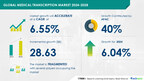
NEW YORK, July 1, 2024 /PRNewswire/ — The global medical transcription market size is estimated to grow by USD 28.63 billion from 2024-2028, according to Technavio. The market is estimated to grow at a CAGR of over 6.55% during the forecast period. Increase in need for automated transcripts is driving market growth, with a trend towards emergence of voice recognition technologies. However, increase in concerns for medical data privacy poses a challenge. Key market players include 3M Co., Aquity LLC, Athreon Corp., CareCloud Inc., Ditto Transcripts, Excel Transcriptions Inc., Flatworld Solutions Pvt. Ltd., Global Medical Transcription LLC, iMedX Inc., Lingual Consultancy Services Pvt. Ltd., Med Scribe Inc., Microsoft Corp., Outsource Accelerator Ventures OPC, Pacific Solutions Pty Ltd., Same Day Transcriptions Inc., Savista LLC, TransPerfect Global Inc., VIVA Transcription Corp., and World Wide Dictation Service of New York Inc..

Get a detailed analysis on regions, market segments, customer landscape, and companies – Click for the snapshot of this report

Forecast period

2024-2028

Base Year

2023

Historic Data

2018 – 2022

Segment Covered

End-user (Hospitals and Physician groups and clinics), Type (Services and Software), and Geography (North America, APAC, Europe, South America, and Middle East and Africa)

Region Covered

North America, APAC, Europe, South America, and Middle East and Africa

Key companies profiled

3M Co., Aquity LLC, Athreon Corp., CareCloud Inc., Ditto Transcripts, Excel Transcriptions Inc., Flatworld Solutions Pvt. Ltd., Global Medical Transcription LLC, iMedX Inc., Lingual Consultancy Services Pvt. Ltd., Med Scribe Inc., Microsoft Corp., Outsource Accelerator Ventures OPC, Pacific Solutions Pty Ltd., Same Day Transcriptions Inc., Savista LLC, TransPerfect Global Inc., VIVA Transcription Corp., and World Wide Dictation Service of New York Inc.

Key Market Trends Fueling Growth

Voice recognition software streamlines medical transcription processes by converting audio files to text without human intervention. Dragon Medical Speech Recognition software by Nuance Communications is an advanced solution, offering increased accuracy and vast vocabulary. Integration with EMR systems facilitates easy data incorporation and sharing among healthcare professionals. The market for medical transcription is anticipated to expand due to this technology’s benefits, including time savings and language adaptability. 

The Medical Transcription market is experiencing significant growth, driven by the increasing demand for efficient and accurate healthcare services. The use of advanced technologies like speech recognition and natural language processing is transforming the industry, making transcription faster and more precise. Clinics and hospitals are investing in these solutions to improve patient care and reduce operational costs. The adoption of electronic health records (EHRs) is also fueling the market, as transcribing data from these records is a crucial part of the healthcare process. Additionally, the remote work trend is gaining traction, allowing medical transcriptionists to work from anywhere, providing flexibility and convenience. Overall, the Medical Transcription market is poised for continued growth, with a focus on innovation and efficiency. 

Research report provides comprehensive data on impact of trend. For more details- Download a Sample Report

Market Challenges

The medical transcription market faces growing concerns over data privacy with the adoption of advanced technology and outsourcing. Regulations such as Australia’s Privacy Principles, France’s Data Protection Act, and the US’s HIPAA outline requirements for maintaining personal information confidentiality. However, potential data breaches due to inadequate authentication and unsecured resources pose risks, which may hinder market growth.The Medical Transcription market faces several challenges in delivering accurate and timely results. Technology, such as speech recognition, is a significant factor in this industry. While it has streamlined the process, it still requires human intervention for accuracy. Data security is another challenge, as sensitive patient information must be protected. Additionally, regulatory requirements, such as HIPAA, add complexity to the transcription process. Artificially intelligent systems and natural language processing are being used to improve efficiency and reduce errors. However, these technologies must be integrated seamlessly to ensure smooth workflows. Overall, the Medical Transcription market requires a balance between technology and human expertise to meet the demands of accuracy, security, and efficiency.

For more insights on driver and challenges – Download a Sample Report

Segment Overview 

This medical transcription market report extensively covers market segmentation by

End-user 1.1 Hospitals1.2 Physician groups and clinicsType 2.1 Services2.2 SoftwareGeography 3.1 North America3.2 APAC3.3 Europe3.4 South America3.5 Middle East and Africa

1.1 Hospitals- Hospitals are modernizing their IT systems to manage patient medical records effectively and securely. Automated technology, such as cloud-based systems and speech recognition software, streamlines record access for physicians, boosting productivity. Government regulations ensure data privacy and security. Investments in healthcare and IT continue to fuel market expansion for medical transcription services.

For more information on market segmentation with geographical analysis including forecast (2024-2028) and historic data (2018 – 2022) – Download a Sample Report

Learn and explore more about Technavio’s in-depth research reports

The global Predictive Analytics Market is experiencing robust growth, driven by advancements in artificial intelligence and big data technologies. This market offers significant opportunities for businesses to leverage data-driven insights for strategic decision-making and enhanced operational efficiency. Concurrently, the global Legal Process Outsourcing (LPO) Services Market is also expanding rapidly, fueled by the need for cost-effective legal services and the growing complexity of legal processes. Both markets are poised for substantial expansion, providing innovative solutions to their respective industries and creating new avenues for strategic investment and development.

Research Analysis

The Medical Transcription (MT) market plays a crucial role in the healthcare industry, particularly in hospitals, healthcare facilities, clinics, and physicians’ offices. MT involves the conversion of spoken words from medical recordings into written documents, including chronic illnesses such as Melanoma and Cardiovascular problems, Diabetes problems, and treatment plans. MT also includes ADT normalization, audio identification, and encryption technologies to ensure patient information security. Urbanization has led to an increase in demand for MT services due to the growing number of healthcare providers and staff burden. Telemedicine services and telehealth have also expanded the scope of MT, enabling remote medical examination findings and treatment plans to be documented. Artificial intelligence (AI) and machine learning technologies are increasingly being integrated into MT processes to improve accuracy and efficiency. Patient forms and discharge summaries are essential documents that require MT services to ensure comprehensive and accurate medical records. Over-the-counter drugs and other patient information must also be accurately documented to ensure effective treatment and follow-up care.

Market Research Overview

The Medical Transcription Market encompasses the conversion of spoken words from various healthcare sources into written documents. This process is essential for effective patient care and billing purposes. The market is driven by factors such as increasing healthcare expenditures, the need for efficient and accurate documentation, and the adoption of digital health technologies. The market also faces challenges like data security concerns and the need for high-quality transcription services. Clinics, hospitals, diagnostic centers, and research institutions are significant consumers of medical transcription services. The market is segmented based on the type of transcription services, end-users, and regions. The future of medical transcription lies in the integration of artificial intelligence and machine learning technologies to enhance accuracy and efficiency.

Table of Contents:

1 Executive Summary
2 Market Landscape
3 Market Sizing
4 Historic Market Size
5 Five Forces Analysis
6 Market Segmentation

End-userHospitalsPhysician Groups And ClinicsTypeServicesSoftwareGeographyNorth AmericaAPACEuropeSouth AmericaMiddle East And Africa

7 Customer Landscape
8 Geographic Landscape
9 Drivers, Challenges, and Trends
10 Company Landscape
11 Company Analysis
12 Appendix

About Technavio

Technavio is a leading global technology research and advisory company. Their research and analysis focuses on emerging market trends and provides actionable insights to help businesses identify market opportunities and develop effective strategies to optimize their market positions.

With over 500 specialized analysts, Technavio’s report library consists of more than 17,000 reports and counting, covering 800 technologies, spanning across 50 countries. Their client base consists of enterprises of all sizes, including more than 100 Fortune 500 companies. This growing client base relies on Technavio’s comprehensive coverage, extensive research, and actionable market insights to identify opportunities in existing and potential markets and assess their competitive positions within changing market scenarios.

Contacts

Technavio Research
Jesse Maida
Media & Marketing Executive
US: +1 844 364 1100
UK: +44 203 893 3200
Email: media@technavio.com
Website: www.technavio.com/

View original content to download multimedia:https://www.prnewswire.com/news-releases/medical-transcription-market-size-is-set-to-grow-by-usd-28-63-billion-from-2024-2028–increase-in-need-for-automated-transcripts-to-boost-the-market-growth-technavio-302186506.html

SOURCE Technavio

Continue Reading
Click to comment

Leave a Reply

Your email address will not be published. Required fields are marked *

Technology

SK hynix Begins Mass Production of 192GB SOCAMM2 ‘Setting a New Standard for AI Server Memory Performance’

Published

on

By

–     Mass production of 192GB high capacity products designed for the NVIDIA Vera Rubin platform
–     Maximizes power efficiency by featuring high density DRAM based on the latest 1cnm process
–     Company to closely collaborate with NVIDIA to solve bottlenecks in AI infrastructure and provide optimal performance

SEOUL, South Korea, April 19, 2026 /PRNewswire/ — SK hynix Inc. (or “the company”, www.skhynix.com) announced today that it has begun mass production of the 192GB SOCAMM2, a next-generation memory module standard based on the 1cnm process (sixth-generation of the 10-nanometer technology) LPDDR5X low-power DRAM.

SOCAMM2[1] is a module that adapts low-power memory – which was previously used mainly in mobile products like smartphones – for server environments. It is designed to be a primary memory solution for next-generation AI servers.

[1]SOCAMM2 (Small Outline Compression Attached Memory Module 2): An AI server–optimized memory module based on LPDDR. It offers a slim form factor and high scalability, while its compression connector enhances signal integrity and allows for easy module replacement

SK hynix emphasized that the 1cnm based SOCAMM2 product that is now in mass production delivers more than double the bandwidth with over 75% improved power efficiency compared to conventional RDIMM[2], providing an optimized solution for high performance AI operations.

[2]RDIMM (Registered Dual In-Line Memory Module): DRAM module for server/workstation that includes a register or buffer chip to relay address and command signals between the memory controller and DRAM chip in a memory module

In particular, the company noted that its SOCAMM2 products are designed for NVIDIA Vera Rubin platform.

SK hynix expects the new SOCAMM2 product will fundamentally resolve the memory bottlenecks encountered during the training and inference of large language model (LLM) with hundreds of billions of parameters, thereby playing a pivotal role in dramatically accelerating the processing speed of the overall system.

The company stated that with the AI market shifting focus from inference to training, SOCAMM2 is gaining significant attention as a next-generation memory solution capable of operating LLMs with low power consumption. To meet the demands of its global Cloud Service Provider (CSP) customers, SK hynix has not only been providing a supply portfolio, but also stabilized its mass production system early on.

“By supplying the 192GB SOCAMM2, SK hynix has established a new standard for AI memory performance,” Justin Kim, President & Head of AI Infra (CMO, Chief Marketing Officer) at SK hynix said. “We will solidify our position as the most trusted AI memory solution provider, through close collaboration with our global AI customers.”

About SK hynix Inc.

SK hynix Inc., headquartered in Korea, is the world’s top-tier semiconductor supplier offering Dynamic Random Access Memory chips (“DRAM”) and flash memory chips (“NAND flash”) for a wide range of distinguished customers globally. The Company’s shares are traded on the Korea Exchange, and the Global Depository shares are listed on the Luxembourg Stock Exchange. Further information about SK hynix is available at www.skhynix.com, news.skhynix.com.

View original content:https://www.prnewswire.com/news-releases/sk-hynix-begins-mass-production-of-192gb-socamm2–setting-a-new-standard-for-ai-server-memory-performance-302746711.html

SOURCE SK hynix Inc.

Continue Reading

Technology

EBANX announces expansion into four Southeast Asian countries and Turkey, unlocking a USD 610 billion digital market

Published

on

By

Following the inauguration of its Asia-Pacific Headquarters in Singapore, EBANX brings its payments infrastructure to Thailand, Indonesia, Malaysia, Vietnam, and Turkey, opening access to more than 380 million consumers for global merchants

SINGAPORE, April 20, 2026 /PRNewswire/ — EBANX, a global technology company specializing in cross-border payment services for emerging markets, today announced it will begin operating in five new countries: Thailand, Indonesia, Malaysia, Vietnam, and Turkey. With this expansion, EBANX will have integrated payment methods across seven economies in Asia, including India and the Philippines. Combined, they represent a USD 610 billion opportunity in digital commerce and more than 1.1 billion consumers, according to data from Payments and Commerce Market Intelligence (PCMI) and World Data Lab (WDL) analyzed by EBANX. The five new markets alone account for 57% of that volume and 386 million of those consumers — whose spending is projected to grow 97% over the next decade, faster than regions like Europe, the US, and Canada, per WDL data featured in EBANX’s Beyond Borders 2026 study.

EBANX’s announcement follows a series of milestones in the region: the inauguration of its Asia-Pacific Headquarters in Singapore, a Major Payment Institution (MPI) license from the Monetary Authority of Singapore (MAS), and the appointment of Eduardo de Abreu as Chief Product Officer (CPO) and regional CEO of EBANX Singapore.

“Asia is where the world’s fastest-growing consumer base is, and also where some of the most ambitious digital companies are headquartered,” said João Del Valle, Co-founder and CEO of EBANX. “Our investment in the region allows us to be closer to both. Global companies need local payment infrastructure to reach Asian consumers, and Asian companies need that same expertise to sell internationally. The opportunity runs in both directions.”

Among the five new EBANX’s additions, Vietnam is the fastest-growing digital commerce market, with a 22% compound annual rate through 2027, according to PCMI projections — rising from USD 36 billion to USD 44 billion. The others are not far behind. Indonesia will expand 19% over the same period, from USD 106 billion to USD 125 billion. Turkey’s 15% growth takes it from USD 123 billion to USD 142 billion. Malaysia and Thailand round out the group at 16% and 15%, respectively.

As global merchants look to diversify beyond established markets like the U.S., Europe, Brazil, and Mexico, cross-border demand in these economies is already waiting for them: international transactions account for 30% of e-commerce volume in Thailand and Malaysia, and 28% in the Philippines.

EBANX’s operations in Indonesia, Thailand, and Turkey are already available to merchants, with Malaysia and Vietnam set to follow in the next quarter. These operations will be fully supported by EBANX’s APAC HQ in Singapore.

A region that skipped the card era

Southeast Asia’s payment landscape is structurally distinct from other emerging markets. EBANX’s new countries of payment operations largely bypassed card infrastructure entirely, going from cash straight to e-wallets and account-to-account (A2A) transfers. Combined, those two methods account for 65% of e-commerce in Thailand, 61% in Indonesia, 50% in the Philippines, 35% in Malaysia, and 21% in Vietnam, according to PCMI.

“This did not happen by accident,” explained Eduardo de Abreu, Chief Product Officer and regional CEO of EBANX Singapore. “Southeast Asia has one of the youngest, most digitally fluent consumer populations in the world. Many of them got their first smartphone before they ever had a bank account, and certainly before they had a credit card. Digital wallets and instant transfers solved a real problem for a generation that was already living online.”

According to WDL data analysed by EBANX, Southeast Asia and India are the only regions where Generation Z holds the largest share of online spending across all verticals, at 27%. Elsewhere in Asia, Generation X leads at 30% — nearly double Gen Z’s 18% share.

How to reach local consumers

That payment landscape has become a barrier for global companies looking to scale in the region. According to an EBANX survey with its merchants, its fragmentation and low card usage often lead to performance issues that prevent them from reaching local consumers.

“The global companies we talk to about Southeast Asia are no longer asking about the region’s potential; they are asking how to unlock that potential and achieve high conversion rates,” said Abreu. “Our APAC Headquarters in Singapore gives us the regulatory anchor and the operational proximity to build country-by-country solutions that actually convert. We have been working toward this expansion for years, and the infrastructure is ready.”

Considering the seven Asian countries in EBANX’s portfolio, the company will have integrated more than 20 payment methods across the region. Among them are some of the most widely used alternative payment methods in each market, such as digital wallets and account-to-account (A2A) transactions—like bank transfers and QR-based paymentsas well as credit and debit cards.

ABOUT EBANX

EBANX is the leading technology platform connecting global businesses to the world’s fastest-growing digital markets. Founded in 2012 in Brazil, EBANX was built with a mission to expand access to international digital commerce. Leveraging proprietary technology, deep market expertise, and robust infrastructure, the platform enables global businesses to offer hundreds of local payment methods and streamline cross-border payments across Latin America, Africa, and Asia. With a global footprint, it established a technology and regulatory headquarters in Singapore in 2026. More than just payments, EBANX drives growth, enhances sales, and delivers seamless purchase experiences for businesses and end users alike.

For further information, please visit:
Website: https://www.ebanx.com/en/
LinkedIn: https://www.linkedin.com/company/ebanx

Media Contact:
Shan Huang
shan.huang@ahgstrategies.com 

View original content to download multimedia:https://www.prnewswire.com/apac/news-releases/ebanx-announces-expansion-into-four-southeast-asian-countries-and-turkey-unlocking-a-usd-610-billion-digital-market-302745701.html

SOURCE EBANX

Continue Reading

Technology

Agoda Report Highlights Opportunities for Japanese Hoteliers to Capture Asia’s Travelers as Only 34% Reach Advanced Localization

Published

on

By

Insights from Agoda’s latest report highlight how moving beyond basic localization can drive stronger revenue outcomes as Japan sees rising intra-Asia travel demand

SINGAPORE, April 20, 2026 /PRNewswire/ — Digital travel platform Agoda, in its latest deep dive report “Tailored to Win: Mastering Localization to Capture Asia’s Travelers in Japan“, reveals opportunities for Japanese hotels to capture more value from Asia’s fast-growing travel demand, with only 34% of properties having progressed beyond basic localization strategies.

Among surveyed properties, 71% of hotels at early stages of localization report positive revenue outcomes, compared to all hotels that have implemented more advanced localization, showing that while early efforts are delivering results, a more holistic approach maximizes commercial outcomes.

According to the Japan National Tourism Organization (JNTO), the market welcomed over 42 million international visitors in 2025, a 16% year-on-year increase, with Asian travelers accounting for over 80% of all arrivals.[1]  With such a high concentration of regional travelers, tailored strategies are becoming essential for hotels looking to better capture Japan’s Asian visitor market.

Agoda’s report highlights that with around 7 in 10 visitors coming from just five key Asian markets (South Korea, China, Taiwan, Hong Kong, and Thailand), hotels need to move beyond one-size-fits-all strategies and tailor their offerings to the distinct preferences of each market, whether through localized digital payment options, language support or culturally relevant on-site experiences. Hotels that adopt this more integrated approach are already seeing results, with around 80% of surveyed hoteliers reporting improvements in bookings.

“Only 34% of hotels have reached advanced stages of localization today with real opportunity lying in accelerating these efforts across the guest experience,” said Tadashi Ikai, Senior Country Director for Japan at Agoda. “By closing gaps across payments, language, and cultural understanding, hotels can better connect with Japan’s highly concentrated Asian traveler base and turn this into a sustained competitive advantage.”

Despite the potential results, Japanese hotels face several challenges in advancing localization efforts. According to the report, hoteliers cite limitations in payment integrations and marketing resources (each at 51%) as key barriers, alongside gaps in foreign language capabilities and awareness of cultural norms (each at 49%). These constraints continue to slow the adoption of more advanced, market-specific strategies.

As Japan’s tourism landscape becomes increasingly shaped by regional travel, the ability to deliver culturally attuned and localized guest experiences is becoming a key differentiator. To help partners navigate these challenges, Agoda’s report includes targeted “Quick Wins” based on traveler motivations:

South Korean Travelers: Seeks cultural exploration and unique local experiencesChinese Travelers: Spends more on experiences such as dining and activities rather than accommodationTaiwanese Travelers: Strongly motivated by culinary exploration and wellness experiencesHong Kong Travelers: Frequent, tech-savvy repeat visitors who value flexibility and convenienceThai Travelers: Often travel in families and favor budget-conscious, short-haul getaways

Agoda’s digital suite for localization draws on a global network of over 6 million diverse accommodations across markets, enabling partners to better align their offerings with the preferences of different traveler segments. With support for 39 languages, multi-currency payment options, and 24/7 customer support, Agoda helps hotels deliver more seamless and locally relevant experiences. Dedicated programs such as the Agoda Growth Program for visibility in priority markets, country-specific promotions and Agoda Media Solutions for native-language campaigns further support partners in localizing effectively. Through Agoda’s platform and expertise, hotels can overcome barriers, reach new segments and optimize their returns from international demand.

To explore how practical localization tips and actionable insights can help hotels capture more value from Asia’s diverse traveler base, download the full report at https://ago-da.co/4bAITjm.

[1] Japan National Tourism Organization (JNTO) (2025), “Tourism Statistics Database – Inbound Travel to Japan (Annual Data 2025).”
Available at: https://www.tourism.jp/en/tourism-database/stats/inbound/


View original content to download multimedia:https://www.prnewswire.com/apac/news-releases/agoda-report-highlights-opportunities-for-japanese-hoteliers-to-capture-asias-travelers-as-only-34-reach-advanced-localization-302739301.html

SOURCE Agoda

Continue Reading

Trending