Connect with us

Technology

Robotics End-Of-Arm Tooling (EoAT) Market to Grow by USD 1.05 Billion (2024-2028) Driven by Demand for Modular Solutions and AI Innovations

Published

on

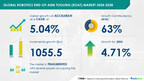
NEW YORK, Oct. 15, 2024 /PRNewswire/ — Report on how AI is redefining market landscape- The global robotics end-of-arm tooling (eoat) market size is estimated to grow by USD 1.05 billion from 2024-2028, according to Technavio. The market is estimated to grow at a CAGR of 5.04% during the forecast period. Rise in demand for modular end-of-arm-tooling is driving market growth, with a trend towards use of fdm and additive manufacturing in end-of-arm-tooling manufacturing. However, high cost of deployment of industrial robots limiting demand for robotics end-of-arm-tooling poses a challenge. Key market players include ASS Maschinenbau GmbH, Barnes Group Inc., Coval Vaccum Technology Inc., Dover Corp., Effecto Group S.p.A., EMI Corp., Festo SE and Co. KG, FIPA GmbH, IPR GmbH, Novanta Inc., OnRobot AS, Piab AB, Robotiq Inc., RoboTool Inc., SCHUNK GmbH and Co. KG, Soft Robotics Inc., Toyota Industries Corp., and Zimmer Group GmbH.

AI-Powered Market Evolution Insights. Our comprehensive market report ready with the latest trends, growth opportunities, and strategic analysis- View your snapshot now

Forecast period

2024-2028

Base Year

2023

Historic Data

2018 – 2022

Segment Covered

Application (Material handling, Assembly line, Welding and soldering, Surface treatment and finishing, and Others), End-user (Automotive, Semiconductor and electronics, Food and beverage, Industrial machinery, and Others), and Geography (APAC, Europe, North America, South America, and Middle East and Africa)

Region Covered

APAC, Europe, North America, South America, and Middle East and Africa

Key companies profiled

ASS Maschinenbau GmbH, Barnes Group Inc., Coval Vaccum Technology Inc., Dover Corp., Effecto Group S.p.A., EMI Corp., Festo SE and Co. KG, FIPA GmbH, IPR GmbH, Novanta Inc., OnRobot AS, Piab AB, Robotiq Inc., RoboTool Inc., SCHUNK GmbH and Co. KG, Soft Robotics Inc., Toyota Industries Corp., and Zimmer Group GmbH

Key Market Trends Fueling Growth

During the forecast period, the robotics end-of-arm tooling market is anticipated to witness significant growth due to the increasing adoption of advanced manufacturing technologies like Fused Deposition Modeling (FDM) and additive manufacturing. FDM technology offers faster customization and the ability to incorporate complex components using durable and lightweight plastics, making it more advanced than traditional manufacturing methodologies. Additive manufacturing, on the other hand, ensures complex geometries and consolidated design features. Both FDM and additive manufacturing have undergone advancements, enabling customization and fast design cycles. Robai, a leading robotics manufacturer, and Stratasys, a prominent additive manufacturing solutions provider, have adopted these technologies to produce components tailored to end-user requirements. Compared to Computer Numerical Control (CNC) machines, these technologies are more efficient and offer cost savings and reduced delivery times. These advantages are expected to fuel the growth of the robotics end-of-arm tooling market during the forecast period. 

The Robotics End-Of-Arm Tooling (EOAT) market is experiencing significant growth due to increasing automation in various industries. Industrial robots, including robotic arms and manipulators, require EOAT to grasp, move, lift, weld, cut, and perform other tasks. Semiconductor, automotive, and aerospace industries are major consumers of EOAT. Trends include application insights for surface treatment, customised EOAT solutions, and collaboration with robots (cobots). New sectors like agriculture, healthcare, e-commerce, and logistics are adopting EOAT for precision gripping, vacuum and pneumatic suction, and welding applications. Robotics technology continues to evolve, with electric grippers, vision systems, and non-traditional sectors driving demand. EOAT includes grippers (vacuum, suction, precision, soft hand, and welding torches), sensors, and end effectors (suction cups, welding wands, screwdrivers). The market is expected to grow further with advancements in robotics technology and increasing demand from e-commerce and personalised medicine sectors. 

Insights on how AI is driving innovation, efficiency, and market growth- Request Sample!

Market Challenges

Industrial robots require additional investments in end-of-arm tooling (EoAT), including special-end effectors and enclosures, pushing up the average cost per implementation to approximately USD85,000. Beyond the initial investment, ongoing expenses such as preventive maintenance, safety measures, operator training, and complementary equipment add to the overall cost. These high switching costs have historically deterred some industrial players from automating their palletizing processes. Despite the short-term ROI, the commitment to long-term contracts with vendors for robot maintenance and replacement poses operational challenges. In extreme cases, replacing a robot could necessitate production line shutdowns, impacting product delivery and revenue. Consequently, high customer switching costs pose a significant obstacle to the growth of the robotic palletizing market.The Robotics End-Of-Arm Tooling (Eoat) market is experiencing significant growth due to the increasing automation in various industries. One of the main challenges in this field is ensuring real-time monitoring and data collection for optimal performance. In food processing, for instance, precise Eoat is essential to maintain product shapes and consistency. Advanced materials, such as stainless steel, aluminum, ceramics, carbon fibers, and composites, are commonly used to create durable, lightweight, and high-strength Eoat for robotics. Manufacturing sectors face challenges like precision welding, plasma cutting, and inspection, which require advanced Eoat solutions. Deburring tools, welding guns, sprayers, nozzles, cutters, grinders, drilling tools, and other Eoat are crucial for material handling and assembly lines. The use of collaborative robots (cobots) and sensor technologies enables adaptive gripping and object recognition, enhancing productivity and reducing manual labor and human errors. The market also includes modular and custom Eoat solutions for specific applications, such as welding torches and material removal torches, as well as tool changers. Overall, the Eoat market continues to evolve, addressing the needs of various industries and driving innovation in robotics technology.

Insights into how AI is reshaping industries and driving growth- Download a Sample Report

Segment Overview 

This robotics end-of-arm tooling (eoat) market report extensively covers market segmentation by

Application 1.1 Material handling1.2 Assembly line1.3 Welding and soldering1.4 Surface treatment and finishing1.5 OthersEnd-user 2.1 Automotive2.2 Semiconductor and electronics2.3 Food and beverage2.4 Industrial machinery2.5 OthersGeography 3.1 APAC3.2 Europe3.3 North America3.4 South America3.5 Middle East and Africa

1.1 Material handling- The Robotics End-Of-Arm Tooling (EoAT) market refers to the production and sale of devices that attach to robotic arms to enhance functionality. These tools include grippers, sensors, and effectors, enabling robots to perform various tasks such as assembly, welding, and material handling. Companies in this sector focus on innovation and customization to meet diverse industry requirements, ensuring increased productivity and efficiency for businesses adopting automation solutions.

Download complimentary Sample Report to gain insights into AI’s impact on market dynamics, emerging trends, and future opportunities- including forecast (2024-2028) and historic data (2018 – 2022) 

Research Analysis

Robotic end-of-arm tooling (EOAT) refers to the specialized components that attach to the end of a robot arm or manipulator in industrial automation applications. These tools enable robots to perform various tasks such as grasping, moving, lifting, welding, cutting, and more. EOAT includes a wide range of tools like grippers, vacuum cups, suction cups, mechanical grippers, deburring tools, welding guns, sprayers, nozzles, cutters, grinders, welding torches, screwdrivers, and more. These tools are essential for industrial robots to effectively and efficiently execute tasks in manufacturing, assembly, packaging, and other industries. Customized EOAT solutions cater to specific application requirements, while collaborative robots (cobots) use EOAT to work safely alongside human operators.

Market Research Overview

Robotics End-Of-Arm Tooling (Eoat) refers to the devices that attach to the end of a robot arm or manipulator to enable it to perform specific tasks in industrial automation. These tools include grippers, suction cups, vacuum cups, welders, sensors, and various cutting, drilling, and grinding tools. Eoat is essential for industries requiring precision, material handling, and automated processes, such as food processing, material removal, surface treatment, and welding. Advanced materials like stainless steel, aluminum, ceramics, carbon fibers, and composites are commonly used to manufacture Eoat due to their durability, lightweight, and high-strength properties. Eoat enables robots to grasp, move, lift, and manipulate objects with precision, reducing manual labor, human errors, material wastage, and logistics costs. In non-traditional sectors like agriculture, healthcare, e-commerce, and electronics, customized Eoat solutions are increasingly being adopted for tasks ranging from precision welding and plasma cutting to inspection, surgical assistance, and material removal. Collaborative robots (cobots) and modular robotics Eoat are also gaining popularity for their adaptive gripping, object recognition, and application insights capabilities.

Table of Contents:

1 Executive Summary
2 Market Landscape
3 Market Sizing
4 Historic Market Size
5 Five Forces Analysis
6 Market Segmentation

ApplicationMaterial HandlingAssembly LineWelding And SolderingSurface Treatment And FinishingOthersEnd-userAutomotiveSemiconductor And ElectronicsFood And BeverageIndustrial MachineryOthersGeographyAPACEuropeNorth AmericaSouth AmericaMiddle East And Africa

7 Customer Landscape
8 Geographic Landscape
9 Drivers, Challenges, and Trends
10 Company Landscape
11 Company Analysis
12 Appendix

About Technavio

Technavio is a leading global technology research and advisory company. Their research and analysis focuses on emerging market trends and provides actionable insights to help businesses identify market opportunities and develop effective strategies to optimize their market positions.

With over 500 specialized analysts, Technavio’s report library consists of more than 17,000 reports and counting, covering 800 technologies, spanning across 50 countries. Their client base consists of enterprises of all sizes, including more than 100 Fortune 500 companies. This growing client base relies on Technavio’s comprehensive coverage, extensive research, and actionable market insights to identify opportunities in existing and potential markets and assess their competitive positions within changing market scenarios.

Contacts
Technavio Research
Jesse Maida
Media & Marketing Executive
US: +1 844 364 1100
UK: +44 203 893 3200
Email: media@technavio.com
Website: www.technavio.com/

View original content to download multimedia:https://www.prnewswire.com/news-releases/robotics-end-of-arm-tooling-eoat-market-to-grow-by-usd-1-05-billion-2024-2028-driven-by-demand-for-modular-solutions-and-ai-innovations-302275393.html

SOURCE Technavio

Continue Reading
Click to comment

Leave a Reply

Your email address will not be published. Required fields are marked *

Technology

Agog Strengthens Field of Immersive Media for Good with $6.5M in Early Grants and New Open Call for Climate-Impact Projects

Published

on

By

New call for proposals offers up to $1M in grants to support creators and nonprofits using immersive media to drive climate action and civic engagement

LOS ANGELES, May 12, 2026 /PRNewswire/ — Agog: The Immersive Media Institute, a philanthropic organization focused on extended reality (XR) for social good, announced today that it has distributed nearly $6.5 million in grants to date, supporting creators, nonprofits, and field-building efforts that use immersive media to deepen public understanding of urgent social and environmental challenges. Agog is now opening its support to a wider pool of creators through its first public open call, offering up to $1 million for climate-focused immersive storytelling and projects.

Since publicly launching in 2024, Agog has worked to strengthen the ecosystem for immersive storytelling by funding projects, supporting creator labs and development programs, partnering with nonprofits, and bringing together artists, technologists, and cultural leaders. The open call reflects a deepening of Agog’s investment in exploring how immersive media can bring climate stories to life in more immediate, experiential ways.

“After more than three decades working as a journalist focused on climate change, I believe immersive storytelling is a powerful way to help people connect with what’s happening now — and imagine and build what a better future could be,” said Chip Giller, co-founder and executive director of Agog and founder of climate news organization Grist. “Immersive media represents a step change in communications. These technologies put you in the story itself, allowing you to experience it viscerally as a participant. Using them, you can travel to Greenland to experience melting ice sheets, visit low-lying islands in the Pacific threatened by sea-level rise, or even embody a tree growing from a seed to a towering old growth. It’s wild — and the changes in these media are happening fast. We hope this open call encourages more people to learn about immersive media and put it to use in the fight for a livable climate.”

“Climate change is a challenge so immense that it can be hard to grasp, even as it affects every one of us,” said Wendy Schmidt, co-founder of Agog. “Immersive storytelling has the ability to bring the effects of climate change — whether it’s melting glaciers, raging storms, or disappearing coastlines — not only before our eyes but all around us, reaching all of our senses. As Agog deepens its focus on climate storytelling, we hope that this powerful technology can, by helping us all experience these changes, spur us to action for our communities and our planet.”

Agog’s grantmaking supports immersive impact storytelling across climate change, racial equity, Indigenous knowledge, and journalism, alongside broader ecosystem investments. Climate-focused projects include “Out of the Ashes,” a virtual reconstruction of communities impacted by the Los Angeles wildfires. Work in racial equity includes support for wider distribution of “The Book of Distance,” a critically acclaimed virtual reality (VR) documentary exploring memory, migration, and state-sanctioned racism. Agog has also invested in Indigenous-led storytelling through projects like “OurWorlds” and a funding initiative with the Indigenous Screen Office, supporting community-led narratives, language revitalization, and land-based knowledge. In journalism, Agog has supported efforts like the Experiential Journalism Lab at the Investigative Reporting Program at UC Berkeley Journalism, training emerging reporters to develop immersive, experience-driven forms of storytelling grounded in rigorous reporting.

Beyond individual projects, Agog has invested in the infrastructure that allows this work to grow — from creator labs and residencies with partners like PHI, Black Public Media, and Electric South to incubators such as WORLDING and Reality Hack at MIT, in addition to wider distribution initiatives. Together, these efforts support projects from concept to audience engagement and impact.

“Immersive media has the power to have a generational impact on our society, the land, and humanity,” said idris brewster, founder of Agog grantee Kinfolk Tech. “Agog has recognized the power of and need for this technology, and its support has made this kind of storytelling possible for Kinfolk Tech and many other creators and organizations.”
 

A New Phase: Climate Futures + Immersive Media Open Call

Agog’s 2026 open call, Climate Futures + Immersive Media, supports projects that use immersive media to engage people more deeply in climate issues and expand pathways for participation and action.

The initiative invites proposals from XR creators and mission-driven organizations new to immersive media, with a focus on projects that move audiences from awareness to action. The review committee will consist of Agog leadership and climate and XR experts, including Myriam Achard, chief of new media partnerships and PR at PHI; Jerome Foster II, sustainability and social impact consultant; Anthony Leiserowitz, Ph.D., director of the Yale Program on Climate Change Communication; and Jacqueline Patterson, founder and executive director of The Chisholm Legacy Project.

Areas of interest for the open call include:

Climate storytelling and civic participationCommunity power and resilienceAccess, equity, and climate justicePlanetary connection and well-beingFuture-building and world design

The open call will support projects across a range of stages and formats, from early concept to more developed work. Agog is particularly interested in projects that use smart glasses, augmented reality, spatial sound, and mixed reality to help people experience climate challenges and solutions in more immediate, embodied ways. Agog will award grants in denominations ranging from $25,000 to $200,000. In addition to funding, selected projects may receive mentorship and opportunities for partnership and distribution.

Applications close June 12. agog.org/opencall2026/ 

Agog: The Immersive Media Institute

Agog: The Immersive Media Institute is a philanthropic organization founded by Chip Giller and Wendy Schmidt that is dedicated to helping creators and nonprofit leaders use extended reality — including virtual, augmented, and mixed reality — to imagine and build a more connected, just, and compassionate world. Agog operates as a field builder and creative partner, supporting immersive storytellers whose work addresses urgent social and environmental challenges.

CONTACT: Alex Capriotti
alex@agog.org

View original content:https://www.prnewswire.com/news-releases/agog-strengthens-field-of-immersive-media-for-good-with-6-5m-in-early-grants-and-new-open-call-for-climate-impact-projects-302769688.html

SOURCE Agog: The Immersive Media Institute

Continue Reading

Technology

Seerist Caps Banner Q1 with Doubled New Customer Wins and 85% Growth in New Logo ARR

Published

on

By

AI-powered product advances fuel broad-based momentum across Commercial and International Government markets

RESTON, Va., May 12, 2026 /PRNewswire-PRWeb/ — Seerist, the AI-powered risk intelligence platform trusted by security and intelligence teams around the world, today reported strong first quarter 2026 results. New logo wins doubled year-over-year, and Annual Recurring Revenue (ARR) from new logos surged 85% compared to the same period in 2025, reflecting the convergence of product innovation meeting market demand.

Our customers are operating at a level that simply wasn’t possible before, and the market is responding accordingly. — Alex Berry, Chief Executive Officer, Seerist

The breadth of the quarter’s performance was just as notable. Total company ARR grew 15% from Q1 2025, while Seerist’s Commercial and International Government markets, the two fastest-moving areas of the business, posted a combined 19% ARR increase from the prior year period. Net Expansion in those markets rose 15%, and Gross Retention improved by 5%, signaling that customers are not only renewing but deepening their reliance on Seerist.

“The AI capabilities we’ve built into the platform, automating workflows that used to consume analyst hours, are genuinely force-multiplying what our customers can accomplish. Security and intelligence teams are extending their reach without adding headcount, and the outcomes are speaking for themselves. This quarter’s numbers are a direct reflection of that.”

— Barry Saadatmand, Chief Revenue Officer, Seerist

At the core of this product evolution is AskAnna, Seerist’s AI intelligence assistant. Built to synthesize vast quantities of structured and unstructured data into clear, actionable outputs, AskAnna has emerged as one of the most significant drivers of platform adoption and expansion and is transforming the speed and scale at which customers can act on global risk.

“AskAnna now puts 50,000 analyst hours fused with millions of open source signals all at the fingertips of a query that generates actionable insights in seconds. This is a categorically different way of understanding and responding to risk. Our customers are operating at a level that simply wasn’t possible before, and the market is responding accordingly.”

— Alex Berry, Chief Executive Officer, Seerist

As Seerist heads into the second quarter, the company expects to sustain this trajectory through continued investment in its AI capabilities, expansion of its go-to-market reach, and the deepening of strategic partnerships across Commercial, Federal Government, and International Government sectors.

About Seerist

Seerist, Inc. enables global corporations, governments, and organizations to navigate a volatile and uncertain world by preparing them for potential events that could disrupt operations. Trusted by more than 400 organizations, including over 20% of the Fortune 100, and over 50 government agencies, Seerist combines cutting-edge artificial intelligence (AI) and machine learning (ML)—parsing millions of data points—with expert human analysis built on decades of insight. With 10 global offices and a strategic partnership with Control Risks, Seerist delivers the foresight and clarity needed to make rapid, strategic, and reliable decisions when it matters most. To learn more, visit www.seerist.com

Media Contact

Jen Dillon, Seerist, 1 1 800 674 8398 748, jen.dillon@seerist.com, www.seerist.com

View original content to download multimedia:https://www.prweb.com/releases/seerist-caps-banner-q1-with-doubled-new-customer-wins-and-85-growth-in-new-logo-arr-302766629.html

SOURCE Seerist

Continue Reading

Technology

Replit Announces vibecon, its First Creative Conference where Code meets Culture in New York, June 17-18

Published

on

By

Oscar-winning filmmaker Spike Jonze, media artist Refik Anadol, advocate Reshma Saujani, AR creator Paige Piskin, digital artist GMUNK, Emmy-winning motion designer Gryun Kim, and the legendary Rhizome’s 7×7 among the names confirmed

FOSTER CITY, Calif., May 12, 2026 /PRNewswire/ — Replit, the AI software creation platform used by more than 50 million people, today announced a first-of-its kind AI conference  where code, creativity and culture intersect. The event brings together artists, filmmakers, designers, founders, technologists and curious newcomers to a playground to explore code as the next creative medium.

Taking place June 17–18 at Canyon on Manhattan’s Lower East Side, the inaugural vibecon will bring together an eclectic group of pioneering creators turning software into apps, installations, films, tools, performances, visual systems and interactive experiences that would have been out of reach for most a year ago. For two days, vibecon will be alive with people who no longer draw a line between code and craft. The conference will feature live talks, interactive installations, hands-on workshops, art exhibits and performances designed to show what becomes possible when creators can move from idea to output without losing momentum.

Oscar-winning filmmaker Spike Jonze, the creative brain behind Her, Being John Malkovich, and iconic music videos for everyone from Beastie Boys to Björk. A boundary dissolving storyteller who’s spent decades making machines feel human and humans feel surreal. Spike will be in conversation with Replit CEO, Amjad Masad, on June 17.

Turkish-American media artist Refik Anadol, a pioneer at the intersection of AI, data and architecture, will also take the stage with Replit President and Head of AI Michele Catasta. Anadol is also the co-founder of Dataland, the world’s first museum dedicated to AI art, opening in Los Angeles.

“When we founded Replit 10 years ago, I wanted it to be the platform where creatives could build anything they wanted without learning to code,” said Haya Odeh, co-founder and head of design at Replit.  “This summer’s vibecon is the culmination of that idea we had so many years ago – a space where creativity meets code building moments that inspire you, leave you in awe, and make your imagination go wild. Code truly is the new Creative”

Jonze and Anadol are joined by a host of creators on stage and around the event including.

Reshma Saujani Founder of Girls Who Code and Moms First, executive producer of No Country for Mothers, and TIME’s Women of the Year 2026. Her TED talk “Teach girls bravery, not perfection” has 54 million views and her decade-long fight for women’s economic empowerment from childcare, to paid leave, to equal pay, has made her one of the defining activist voices of her generation.

Paige Piskin, one of today’s most prolific AR creators, who has generated more than 400 billion impressions through effects and campaigns for Netflix, Coldplay and major beauty brands. Named a “legend” by VICE and an artistic “master” by Meta, Piskin will talk about how AR has changed what audiences feel when they look at a screen.

GMUNK, digital artist and director, whose psychedelic and atmospheric work spans installations, music videos, title sequences, immersive film and the iconic Windows 10 wallpaper seen by billions of people, will take over the main stage for a talk on switching artistic media in pursuit of creative discomfort.

vibecon will also bring Rhizome’s 7×7 to the stage. The long-running art and technology series pairs artists and technologists to create new work together. It is also the program through which Kevin McCoy developed Quantum, widely regarded as the first NFT artwork.

Vibecon will also feature Lucas Gelfond, the software engineer and writer reimagining the full stack of storytelling at A24 Labs; Karyn Nakamura, the Tokyo-born, MIT-trained artist and engineer probing the hidden infrastructures of perception; Debit, the composer, producer and DJ whose research-driven records and site-specific works have reached the Whitney and the Venice Biennale; and Saarim Zaman, the Dhaka-raised creative technologist and co-founder of ITM, building at the edges of culture and code.

Beyond the stage, vibecon’s installations and workshops will immerse attendees into new worlds they never thought possible.Tigris Li, artist, creative technologist and co-founder of consumer electronics company LYCHEE, is curating a real-time perfume experience that turns memories and AI conversations into a bespoke fragrance on site. LA-born new media artist Nate Mohler, founder of Projekt Blank, will lead a workshop and installation blending AI, memory and urban landscape. Artist Kyle McDonald, who works across machine learning, computer vision and social technology, will debut a new interactive installation that invites attendees to get weird with code.

Focusing on craft, create and connect, the event will feature four distinct zones of engagement:

Main Stage: A main platform for high-velocity talks, keynotes, and performances.The Forum + The Lab: An intimate space for hands-on sessions, live demos, and deep-dive discussion.Installations: Across the entire floor, AI powered art exhibits available for viewing.Event Details Dates: June 17–18, 2026Time: June 17: 11:00 AM – 7pm PM + June 18 11:00 AM – 8:00 PM
Location:  Canyon, 145 Delancy St, NYCTickets: vibecon.ai.

For more information, contact press@replit.com


View original content to download multimedia:https://www.prnewswire.com/news-releases/replit-announces-vibecon-its-first-creative-conference-where-code-meets-culture-in-new-york-june-17-18-302769318.html

SOURCE Replit

Continue Reading

Trending