Connect with us

Technology

IT Market in Germany to Grow by USD 31.1 Billion (2024-2028), Driven by IT Adoption Among SMEs, Report Highlights How AI is Driving Market Transformation – Technavio

Published

on

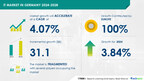
NEW YORK, Jan. 23, 2025 /PRNewswire/ — Report with the AI impact on market trends – The IT market in Germany size is estimated to grow by USD 31.1 billion from 2024-2028, according to Technavio. The market is estimated to grow at a CAGR of almost 4.07%  during the forecast period. Increased adoption of it solutions among german smes is driving market growth, with a trend towards increasing adoption of big data solutions by enterprises. However, shortage of skilled it professionals  poses a challenge. Key market players include badenIT GmbH, Broadcom Inc., Capgemini Service SAS, Cisco Systems Inc., Dell Technologies Inc., Fortinet Inc., Fujitsu Ltd., Hewlett Packard Enterprise Co., Hitachi Ltd., HUNARI Arik and Hunneck GbR, Infosys Ltd., International Business Machines Corp., Juniper Networks Inc., Lenovo Group Ltd., nextevolution GmbH, Oracle Corp., Siemens AG, Tata Consultancy Services Ltd., Toshiba Corp., and VACE Systemtechnik GmbH.

Key insights into market evolution with AI-powered analysis. Explore trends, segmentation, and growth drivers- View Free Sample PDF

IT Market In Germany Scope

Report Coverage

Details

Base year

2023

Historic period

2017 – 2021

Forecast period

2024-2028

Growth momentum & CAGR

Accelerate at a CAGR of 4.07%

Market growth 2024-2028

USD 31.1 billion

Market structure

Fragmented

YoY growth 2022-2023 (%)

3.84

Regional analysis

Germany

Performing market contribution

Europe at 100%

Key countries

Germany and Europe

Key companies profiled

badenIT GmbH, Broadcom Inc., Capgemini Service SAS, Cisco Systems Inc., Dell Technologies Inc., Fortinet Inc., Fujitsu Ltd., Hewlett Packard Enterprise Co., Hitachi Ltd., HUNARI Arik and Hunneck GbR, Infosys Ltd., International Business Machines Corp., Juniper Networks Inc., Lenovo Group Ltd., nextevolution GmbH, Oracle Corp., Siemens AG, Tata Consultancy Services Ltd., Toshiba Corp., and VACE Systemtechnik GmbH

Market Driver

In today’s business landscape, the utilization of accurate and timely business data is essential for German enterprises to reach their objectives and mitigate risks. While the Internet, retail, and advertising industries were early adopters of Big Data solutions in Germany, their application has since expanded to various end-user sectors, including manufacturing, healthcare, utilities, and transportation. Insights derived from Big Data solutions play a crucial role in enabling German enterprises to introduce new products and services to the market. Export-oriented German firms are expanding their operations overseas by optimizing production, logistics, and sales processes through Big Data tools. Some applications of Big Data solutions in Germany include: Mercedes-Benz, a division of Daimler, employs SAP HANA in its engine testing department to process and visualize vast amounts of data in seconds. This allows for the detection of minor deviations and immediate corrective actions, enhancing the efficiency of the test system. Beiersdorf, a consumer goods manufacturer, has developed a product demand management platform that utilizes SAP HANA for data aggregation. This platform offers analytics on product performance and identifies the primary causes of market share fluctuations for their brands versus competitors, empowering informed decision-making. The German government is promoting a Big Data ecosystem by investing in research projects, such as the smart data innovation lab, the German research center for AI, and the Berlin Big Data Center. This investment is expected to boost the adoption of Big Data solutions and contribute to market growth during the forecast period. 

The IT industry is thriving with trends such as Integrated Systems and Digital Factories leading the way. The National AI Strategy is a priority for Artificial Intelligence market growth, with software AI and automation transforming various sectors like hospitals, banks, shops, prisons, hotels, airports, and train stations. IT Security remains crucial as IT employees face increasing Security threats. Government support is essential for the growth of IT companies in the ICT market, including IT-Services, IT-Hardware, and Software subsector. Digital Agenda priorities include Cybersecurity, E-privacy Regulation, and the Internet of Things. Big Data and Health IT are driving Data Analytics, while Cloud computing services are essential for Internet access and penetration. ERP and Data centers are key IT infrastructure components. Skilled IT workforce is in high demand, and IT consultation services offer valuable expertise. IT hardware and hardware systems continue to innovate, shaping the future of the industry. 

Request Sample of our comprehensive report now to stay ahead in the AI-driven market evolution!

 Market Challenges

•         German enterprises are experiencing a significant challenge in recruiting and retaining skilled IT professionals due to a shortage of qualified candidates. The recruitment process is predominantly digital, with job vacancies being published on company websites and career portals. However, the lack of professionals with the necessary qualifications, experience, and skillsets in areas such as cloud, AI, Big Data, and IoT has led to over 1.3 million IT-related vacancies remaining unfilled for nearly five months in 2020. This shortage can negatively impact the digital transformation initiatives of German enterprises, potentially hindering their ability to meet client demands and adversely affecting the IT market during the forecast period. The German government is addressing this issue by simplifying immigration laws to attract foreign professionals to fill these vacancies.

•         The IT industry faces several challenges in today’s business landscape. Integrated systems require seamless compatibility among various hardware and software components. The Digital Factory revolution demands advanced automation and AI software in manufacturing. National AI Strategies call for investment in AI technologies and skilled IT workforce. IT Security remains a top concern with increasing cyber threats. The AI market grows, bringing opportunities for software AI and data analytics. Hospitals, banks, shops, prisons, hotels, airports, and train stations require IT solutions for efficient operations. Government support is crucial for IT companies in the ICT market. Computers and internet access are essential, with internet penetration driving demand for Cloud computing services. The IT industry must address the challenges of database management, libraries, and IT employees’ training. Security threats necessitate IT consultation services and IT hardware upgrades. ERP systems and data centers require robust cybersecurity and e-privacy regulations. The Internet of Things and Big Data bring new opportunities in Health IT and Cloud computing. In conclusion, the IT industry must adapt to these challenges to remain competitive. Investments in AI, automation, cybersecurity, and skilled workforce are key to success. The Digital Agenda and E-privacy Regulation will shape the future of IT-Services, IT-Hardware, and the Software subsector.

Discover how AI is revolutionizing market trends- Get your access now!

Segment Overview 

This IT market in Germany report extensively covers market segmentation by  

End-user 1.1 Manufacturing1.2 Government1.3 BFSI1.4 ICT1.5 OthersApplication 2.1 Large enterprise2.2 SMEsGeography 3.1 Europe

1.1 Manufacturing-  The German manufacturing sector, home to global leaders in automotive and engineering, is undergoing a digital transformation. IT is playing a pivotal role in converting traditional factories into smart digital ones, with automated procurement, manufacturing, and distribution processes. Industry 4.0 technologies like Big Data, analytics, AI, IoT, and cybersecurity are being deployed to optimize production and enhance flexibility and quality. In 2021, Industry 5.0 emerged, focusing on human-machine collaboration. Manufacturers are utilizing Big Data and analytics for data management from production equipment, enterprise systems, and customer management. Cloud-based software is being adopted for enterprise applications and Big Data analytics, reducing data processing time and enabling a data-driven production environment. Autonomous robots are being integrated for utility purposes, improving cost efficiency. Manufacturing intelligence allows for close speculation on mechanical and procedural challenges, driving IT market growth in Germany.

Download a Sample of our comprehensive report today to discover how AI-driven innovations are reshaping competitive dynamics

Research Analysis

The ICT market is a dynamic and ever-evolving industry, encompassing various subsectors including IT-Services, IT-Hardware, and the Software sector. The Digital Agenda drives innovation in areas like Cybersecurity, E-privacy Regulation, Internet of Things, and Artificial Intelligence (AI). Automation and Data Analytics are transforming businesses across industries, from libraries and hospitals to banks and shops. The IT industry relies on a skilled workforce to address Security threats and provide IT consultation services. Cloud computing services and the Internet are essential infrastructure, while IT employees continue to be in high demand. Database management remains a critical function for organizations, and IT hardware continues to advance with new technologies.

Market Research Overview

The ICT market is a dynamic and ever-evolving industry, encompassing various subsectors including IT-Services, IT-Hardware, and the Software sector. The Digital Agenda is a key driver, pushing for advancements in Cybersecurity, E-privacy Regulation, Internet of Things, Big Data, Health IT, Cloud computing, ERP, Data centers, Integrated systems, and Digital factory. The Artificial Intelligence market is a significant growth area, with software AI, automation, and Data Analytics leading the charge. The IT industry serves various sectors such as hospitals, banks, shops, prisons, hotels, airports, and train stations, with government support playing a crucial role. The IT industry requires a skilled workforce to address Security threats and provide IT consultation services. IT hardware, including computers and hardware systems, are essential components of the industry, enabling internet access and internet penetration for businesses and individuals alike. Cloud computing services and the Internet are fundamental to the industry’s success, with IT employees working to ensure the security and efficiency of these systems.

Table of Contents:

1 Executive Summary
2 Market Landscape
3 Market Sizing
4 Historic Market Size
5 Five Forces Analysis
6 Market Segmentation

End-userManufacturingGovernmentBFSIICTOthersApplicationLarge EnterpriseSMEsGeographyEurope

7 Customer Landscape
8 Geographic Landscape
9 Drivers, Challenges, and Trends
10 Company Landscape
11 Company Analysis
12 Appendix

About Technavio

Technavio is a leading global technology research and advisory company. Their research and analysis focuses on emerging market trends and provides actionable insights to help businesses identify market opportunities and develop effective strategies to optimize their market positions.

With over 500 specialized analysts, Technavio’s report library consists of more than 17,000 reports and counting, covering 800 technologies, spanning across 50 countries. Their client base consists of enterprises of all sizes, including more than 100 Fortune 500 companies. This growing client base relies on Technavio’s comprehensive coverage, extensive research, and actionable market insights to identify opportunities in existing and potential markets and assess their competitive positions within changing market scenarios.

Contacts

Technavio Research
Jesse Maida
Media & Marketing Executive
US: +1 844 364 1100
UK: +44 203 893 3200
Email: media@technavio.com
Website: www.technavio.com/

View original content to download multimedia:https://www.prnewswire.com/news-releases/it-market-in-germany-to-grow-by-usd-31-1-billion-2024-2028-driven-by-it-adoption-among-smes-report-highlights-how-ai-is-driving-market-transformation—technavio-302357258.html

SOURCE Technavio

Continue Reading

Technology

Axon Announces Body 5: Next-Generation Camera Built for the AI Era

Published

on

By

Axon Body 5 delivers 25x the AI processing power of earlier-generation cameras, with upgraded connectivity, audio and battery life to support real-time situational awareness in the field

SCOTTSDALE, Ariz., Oct. 24, 2026 /PRNewswire/ — Axon (Nasdaq: AXON), the global leader in public safety technology, today announced Axon Body 5, its newest body-worn camera designed to bring more powerful intelligence, connectivity and real-time support directly to officers in the field.

For years, Axon body cameras have helped agencies capture critical evidence and create greater transparency. Body 5 is built to help officers during the call, with information, assistance and backup on the spot.

“Officers shouldn’t have to choose between getting information and watching the scene. With Axon Body 5, they don’t,” said Rick Smith, Axon Founder and CEO. “They capture a license or document with the camera, keep their hands free and eyes up, and get information faster than writing it down and calling it in by radio. An officer fully engaged with the person in front of them, not down at a notepad, is a safer officer and a better-served community.”

Axon Body 5: Built for the AI Era

Built from the ground up for the AI era, Axon Body 5 delivers 25x the AI processing power than earlier generation Axon body cameras, alongside advancements in connectivity, audio, video and battery life. Together, these upgrades give the camera the physical power to run smarter AI features — both today and as new AI tools are developed in the future — while also making it more dependable for officers to use every day. 

For the first time, Axon is also introducing two versions of its latest flagship camera: Axon Body 5 and Axon Body 5 Pro.

Both models feature several key advancements, including:

25x more processing power for AI: A powerful new computing architecture creates the capacity to support current and future AI features directly on the body camera.Enhanced video: Improved video captures clearer evidence across challenging environments, including better low-light performance.Improved connectivity: Seamless connectivity in urban and remote environments – and more precise location capability – helps officers, cameras and remote support teams stay connected when timely information matters most.Longer battery life: 20% more battery life than the previous generation helps keep the camera ready and connected throughout an officer’s shift.

The Axon Body 5 Pro will continue to gain new AI capabilities as they become available, growing along with the AI Era Plan. Additionally, new hardware features include:

A near-focus camera: An additional dedicated camera lens lets officers scan driver’s licenses to check status and search for wants or warrants in seconds, without returning to the patrol vehicle, with relevant information sent to Axon Fusus to support real-time operations.Front-facing speakers: Four additional speakers project even more powerful audio toward the person an officer is speaking with, helping real-time translations from Axon Assistant carry more clearly over heavy traffic or crowd noise. Additional memory: Extra space lets the camera run several AI tools at once, helping officers stay better informed and work faster.

Bringing More of Axon’s AI Era Into the Field

Axon Body 5 helps officers get more out of the Axon AI Era Plan by bringing smart tools right to the scene. Axon’s portfolio already supports public safety professionals across a growing range of tasks. For example, Draft One helps officers turn body-camera audio into high-quality report drafts and Axon Assistant provides voice-based information access and real-time translation.

Increasingly, Axon is also bringing AI into real-time operations.

Axon Guardian is a new category of AI features within the AI Era Plan that was specifically created to work with an officer’s field-based devices – starting with body cameras and in-car cameras – to improve safety. Guardian is designed to flag potential risks as situations unfold and create alerts when additional attention may be needed. Two of the first features include:

Escalation Detection: When an Axon Body 4 or Axon Body 5 camera is activated and recording, Guardian has the ability to detect potential conflicts in real time and create an alert in Axon Fusus. A human reviews the livestream and decides if additional support or action is needed.Approach Alert: When active on Axon Fleet 3, Guardian can detect if the door of a stopped vehicle opens and alert the officer through the in-car display and their body-worn camera.

Combined, Axon Body 5 and the expanding AI Era portfolio demonstrate the importance of AI as a critical resource to assist public safety professionals before, during and after an incident — reducing administrative burden, improving situational awareness and helping protect more lives.

Innovating Responsibly

Axon’s Responsible Innovation framework guides the development of all of its products. Designed with this in mind, Axon Body 5 and Guardian prioritize human oversight and maintain agency control over data. As a key part of the responsible innovation process, Axon’s independent Ethics and Equity Advisory Council was created to help responsibly develop and deploy new technologies with transparency, while aligning with community expectations.

General availability dates for Axon Body 5 and Axon Guardian will be announced soon. Product features and capabilities vary by configuration. For more information on Axon’s current products and services: Axon Product Catalog – Axon.com.

About Axon
Axon (Nasdaq: AXON) is the global leader in public safety technology supporting state, local, federal and international public safety agencies with technology designed to Protect Life. Complementing its mission, Axon’s growing Enterprise market focuses on protecting critical infrastructure and frontline workers across multiple industries including corporate security, hospitality, retail and healthcare. Founder-led since 1993, Axon builds products with transparency and responsibility. From TASER energy devices to today’s connected network of hardware – including cameras, drones, and robotics – cloud software, sensors, and AI-tools, the Axon ecosystem helps seamlessly protect people and places when it matters most. To ensure these technologies align with community expectations, Axon’s independent Ethics & Equity Advisory Council guides the ethical, inclusive, and accountable design of its products and services. Learn more about the EEAC and Axon’s Responsible Innovation framework at Axon Responsibility. 

Non-Axon trademarks are the property of their respective owners. Axon, TASER and the Delta Logo are trademarks of Axon Enterprise, Inc., some of which are registered in the US and other countries. For more information, visit www.axon.com/legal. All rights reserved.

Please visit https://investor.axon.com and https://www.axon.com/newsroom for more information.

Media Contact:
Kate MacKinnon
Vice President, Communications
press@axon.com

View original content to download multimedia:https://www.prnewswire.com/news-releases/axon-announces-body-5-next-generation-camera-built-for-the-ai-era-302918553.html

SOURCE Axon

Continue Reading

Technology

In HelloNation, Custom Fabrication Expert Mark Coyle Explains a Common Mistake in Custom Aluminum Design

Published

on

By

The article explains why smart geometry, not thicker walls, creates stronger, more efficient aluminum components.

ROCHESTER, N.Y., Oct. 24, 2026 /PRNewswire/ — What early design choice causes many custom aluminum projects to become heavier, costlier, or harder to manufacture? That question is addressed in a HelloNation article featuring insights from Custom Fabrication Expert Mark Coyle of American Custom Metals, Inc. in Rochester, New York, that outlines how misunderstanding aluminum behavior leads designers to rely on thick walls instead of stronger geometry.

The article begins by explaining that many people assume thicker walls automatically make aluminum parts stronger. It notes that aluminum does not respond to wall thickness the way steel does. Instead, its performance is shaped by how the metal flows through the extrusion die. The article states that custom aluminum design is more effective when profiles use ribs, chambers, and flanges to create stiffness without adding unnecessary weight. This guidance helps readers understand why adding material often increases cost without improving strength.

The article also highlights that thicker walls change how aluminum moves during extrusion. When heavy areas fill more slowly, the metal cools unevenly and can develop stress that only appears later. The HelloNation piece explains that well-balanced geometry keeps extrusion smooth and predictable. This consistency makes it easier to maintain dimensional accuracy across long production runs. By focusing on geometry, custom aluminum design avoids the problems that come with slow extrusion speeds and uneven cooling.

Another insight in the article centers on how ribs and internal supports influence stability. It describes how a thin wall supported by a properly placed rib often performs better than a thick wall with no reinforcement. This happens because the rib helps distribute load, improve stiffness, and guide the aluminum as it cools. The article explains that this structural approach makes custom aluminum design more efficient and gives designers more control over how the final part behaves under pressure.

The article also shows why early collaboration between designer and fabricator prevents costly changes. It states that a fabricator familiar with extrusion can catch potential issues before a die is built. Small adjustments to corners or transitions can remove weak points or improve metal flow. The article notes that this teamwork keeps the design aligned with real-world production. By working together early, both sides reduce the risk of redesigning the die after the first test run.

Machining is another area where the article explains how wall thickness affects performance. Features such as deep pockets or sharp internal angles may require slow feed rates or special tooling. When walls are thicker than needed, those areas can become difficult to machine cleanly. The article states that thoughtful custom aluminum design makes machining more predictable. Small changes, such as adding radiused edges or sizing features to match standard tools, help shorten cycle times and prevent tool wear.

Thermal behavior receives detailed attention as well. The article explains that aluminum retains heat differently depending on the mass of each section. Thicker walls hold heat longer, which increases the chance of distortion during extrusion, machining, or finishing. When a design uses geometry to create strength, the material cools more evenly. This reduces warping and helps long profiles stay aligned. The article notes that stable cooling is important for components that require a precise fit and consistent shape throughout an entire production run.

Cost is also a key topic in the article. It states that heavier profiles increase material use, extrusion time, and tooling needs. A custom aluminum design that relies on geometry instead of mass lowers material consumption and keeps the fabrication process efficient. The article explains that lighter parts are easier to handle, ship, and assemble. This saves money across multiple stages of production and supports long-term manufacturing efficiency.

The article also notes that smart custom aluminum design creates profiles that behave predictably during extrusion and machining. Smooth transitions, balanced wall dimensions, and structural features help reduce the chance of distortion or dimensional drift. These elements also lower scrap rates and support reliable performance. By using geometry instead of excess material, designers build parts that maintain strength without compromising manufacturability.

As the article concludes, it emphasizes that avoiding thick walls is one of the best ways to improve performance and lower cost. It states that the most dependable custom aluminum components come from designs that use structural features to strengthen the profile. When designers understand how aluminum behaves at each stage of extrusion and machining, they create parts that are strong, efficient, and consistent from batch to batch. This approach turns custom aluminum design into a predictable process rather than a series of uncertain adjustments.

A Common Mistake in Custom Aluminum Design features insights from Mark Coyle, Custom Fabrication Expert of Rochester, NY, in HelloNation.

About HelloNation
HelloNation is America’s Good News Network, a premier media platform built on the idea that good news travels faster when real people tell real stories. Through its community-focused publications and innovative “edvertising” approach, HelloNation delivers content that informs, inspires, and spotlights the leaders making a meaningful impact in their communities.

View original content to download multimedia:https://www.prnewswire.com/news-releases/in-hellonation-custom-fabrication-expert-mark-coyle-explains-a-common-mistake-in-custom-aluminum-design-302918282.html

SOURCE HelloNation

Continue Reading

Technology

World Young Scientist Summit 2026 Opens in Wenzhou, Zhejiang

Published

on

By

WENZHOU, China, Oct. 24, 2026 /PRNewswire/ — This is a report by China Daily:

On October 24, the World Young Scientist Summit 2026 opened in Wenzhou, Zhejiang. The event is hosted by the China Association for Science and Technology (CAST), the Zhejiang Provincial People’s Government, and the World Association of Young Scientists. Nearly 800 representatives, including scientists, educators, and entrepreneurs from more than 60 countries and regions, are attending the summit.

He Junke, Vice President of CAST in charge of daily work and First Secretary of its Secretariat; Lian Yimin, Chairman and Party Group Secretary of the Zhejiang Provincial Committee of the Chinese People’s Political Consultative Conference; Marcelo Knobel, Executive Director of The World Academy of Sciences; and Zhang Zhenfeng, Member of the Standing Committee of the CPC Zhejiang Provincial Committee and Secretary of the CPC Wenzhou Municipal Committee, attended the summit and delivered remarks. Yao Gaoyuan, Vice Governor of the Zhejiang Provincial People’s Government, presided over the first segment of the plenary session.

With the theme “Gathering Talents Worldwide to Create a Better Future,” the summit’s annual agenda is “Global Youth Action in the AI Era: Building a Sustainable Future.” It aims to draw on the insights of young people around the world, deepen international sci-tech cooperation, and jointly address questions about young people, science, the world and the future.

Efim Zelmanov, Fields Medalist and Foreign Member of the Chinese Academy of Sciences; Chen Yunji, Deputy Director of the Institute of Computing Technology, CAS, and Director of the National Key Laboratory of Processor Chips; Mary Garson, President of the International Union of Pure and Applied Chemistry; and Lu Chaoyang, Member of the Standing Committee of CAST, Executive Dean of the Shanghai Institute of Advanced Study, University of Science and Technology of China, and Chairman of the Council of the World Association of Young Scientists, delivered keynote speeches respectively on education reform in the AI era, AI and processor chips, young women scientists’ participation in science, and quantum computing. They explored new opportunities for scientific research, talent cultivation, and international cooperation in the AI era.

This year’s summit placed greater emphasis on the growth needs of young scientists, with young talents under the age of 45 accounting for 88 percent of participants. It aimed to build a cluster of international journals, bring together young scientific talent, facilitate a batch of international collaborative projects and advance the application and commercialization of scientific and technological achievements. The summit released the Report on the Distribution and Mobility of Young Scientists in the Field of Embodied Intelligence, launched the World Young Scientist Summit Partner Journal Program and the 2026 World Young Scientist Innovation and Entrepreneurship Growth Support Program. It also published the “Young Scientist Pioneers 2035” list and announced the 2026 Sustainable Development Young Scientist Award. The awards were presented to four Chinese and foreign scientists.

Chen Tianrun, Founder of Hangzhou Moxin Technology Co., Ltd.; Yuan Yang, Assistant to the Dean of the Institute for Interdisciplinary Information Sciences at Tsinghua University; and two of the 2026 Sustainable Development Young Scientist Award winners, César de la Fuente and Nicola Segata, among other Chinese and foreign young scientist representatives, spoke at the flash-talk session to share their research practices and reflections.

In addition, the conference focused on fields such as future manufacturing, quantum information, embodied intelligence, brain-computer intelligence, environmental science, deep-sea resources, and life and health, and held 12 parallel forums. It also included the “Gravitation π” Future Technology and Concept Products Exhibition and Exchange, local thematic side events, and sci-tech and humanities study visits, further building an interdisciplinary, cross-regional and cross-sector platform for youth sci-tech exchange and cooperation.

View original content to download multimedia:https://www.prnewswire.com/news-releases/world-young-scientist-summit-2026-opens-in-wenzhou-zhejiang-302918664.html

SOURCE China Daily

Continue Reading

Trending