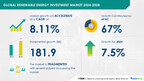
NEW YORK, Jan. 29, 2025 /PRNewswire/ — Report on how AI is redefining market landscape – The global renewable energy investment market size is estimated to grow by USD 181.9 billion from 2024-2028, according to Technavio. The market is estimated to grow at a CAGR of 8.11% during the forecast period. Supportive government policies is driving market growth, with a trend towards increased spending on utility-scale renewable energy projects . However, competition from fossil fuels poses a challenge. Key market players include AZORA CAPITAL SL, Bank of America Corp., Berkeley Partners LLP, BlackRock Inc., BNP Paribas SA, Capital Dynamics Holding AG, Centerbridge Partners LP, CHN ENERGY Investment Group Co. Ltd., Citigroup Inc., Deloitte Touche Tohmatsu Ltd., EKF, ESFC Investment Group, General Electric Co., KfW Bankengruppe, Macquarie Group Ltd., Mitsubishi UFJ Financial Group Inc., Nebras Power, Positive Energy Ltd., State Power Investment Corp., TerraForm Power Operating LLC, and The Goldman Sachs Group Inc..
Key insights into market evolution with AI-powered analysis. Explore trends, segmentation, and growth drivers- View Free Sample PDF
Renewable Energy Investment Market Scope
Report Coverage
Details
Base year
2023
Historic period
2018 – 2022
Forecast period
2024-2028
Growth momentum & CAGR
Accelerate at a CAGR of 8.11%
Market growth 2024-2028
USD 181.9 billion
Market structure
Fragmented
YoY growth 2022-2023 (%)
7.5
Regional analysis
APAC, North America, Europe, South America, and Middle East and Africa
Performing market contribution
APAC at 67%
Key countries
China, US, Japan, Germany, and Brazil
Key companies profiled
AZORA CAPITAL SL, Bank of America Corp., Berkeley Partners LLP, BlackRock Inc., BNP Paribas SA, Capital Dynamics Holding AG, Centerbridge Partners LP, CHN ENERGY Investment Group Co. Ltd., Citigroup Inc., Deloitte Touche Tohmatsu Ltd., EKF, ESFC Investment Group, General Electric Co., KfW Bankengruppe, Macquarie Group Ltd., Mitsubishi UFJ Financial Group Inc., Nebras Power, Positive Energy Ltd., State Power Investment Corp., TerraForm Power Operating LLC, and The Goldman Sachs Group Inc.
Market Driver
The renewable energy investment market is experiencing significant growth due to the energy crisis and increasing affordability concerns. The EU is leading the way in deployment with solar technology and wind technology seeing record capacity additions. Biofuels are also in demand due to energy security concerns and decarbonization efforts. Policy developments, such as renewable portfolio standards and clean energy laws, are driving investment in utility-scale solar and wind projects. However, challenges like labor costs, capital costs, interconnection and permitting delays, transmission limitations, and regulatory hurdles persist. Renewable energy sources, including hydrogen, are becoming more competitive as fossil fuel alternatives. Rising interest rates and electricity prices are impacting project economics, but federal investments and infrastructure spending offer opportunities for growth. Offshore wind is experiencing a rebound, but delayed projects and onshore wind growth remain strong. Workforce reskilling and regulatory boosts are essential for continued progress. Generative artificial intelligence is playing a role in optimizing renewable energy systems and reducing greenhouse gas emissions. The tax-credit transfer market and grid resilience are also key areas of focus. Overall, the market is facing numerous challenges and opportunities as it transitions to a clean energy future.
Utility-scale renewable energy projects, those with a capacity exceeding 10 MW, are significant investments in the energy sector. These projects benefit from favorable state and local policies and initiatives worldwide. These measures aim to facilitate the implementation of renewable energy projects by addressing potential obstacles. Utility-scale renewable energy projects are customized undertakings, with effective states linking their renewable portfolio standards to financial incentives like tax breaks and clean energy incentives. However, determining the most cost-effective and efficient electricity supply source between renewable energy options and traditional electricity generation can be challenging for stakeholders, regulatory bodies, and investors alike.
Request Sample of our comprehensive report now to stay ahead in the AI-driven market evolution!
Market Challenges
The renewable energy investment market is facing several challenges in 2023. The energy crisis caused by fossil fuel price volatility and supply disruptions is pushing businesses and governments to invest in renewable energy for energy affordability and security. EU deployment of renewable energy is on the rise, with solar technology and wind technology leading the way. However, challenges persist in the form of biofuel demand outpacing supply, policy developments, and labor and capital costs. Wind technology faces challenges such as interconnection and permitting delays, transmission limitations, and rising interest rates. Renewable portfolio standards, clean energy laws, and carbon reduction targets are driving capacity additions in electricity generation. Generative artificial intelligence and tax-credit transfer markets are providing regulatory boosts and policy support. Hydrogen deployment and workforce reskilling are also key areas of focus. Despite these challenges, renewable energy remains a competitive fossil fuel alternative, with utility-scale solar, wind, and distributed systems driving growth in residential, commercial, and industrial sectors. However, delayed projects and offshore wind growth are causing capacity rebound and electricity price concerns. Infrastructure investments and federal support are essential to address these challenges and ensure a smooth transition to a decarbonized energy system.Renewable energy has seen consistent growth in the global electricity market, yet fossil fuels remain preferred in some countries due to their abundant availability and lower production costs. Establishing renewable energy facilities comes with a significant initial investment, and the power output from sources like solar and wind is intermittent, leading to variable electricity volumes. Solar Photovoltaic (PV) installations, for instance, require substantial capital expenditure despite a decline in material costs. The need to install solar PV panels over expansive areas to generate substantial electricity volumes further increases investment and costs.
Discover how AI is revolutionizing market trends- Get your access now!
Segment Overview
This renewable energy investment market report extensively covers market segmentation by
Type 1.1 Asset finance1.2 Small distributed capacityGeography 2.1 APAC2.2 North America2.3 Europe2.4 South America2.5 Middle East and Africa
1.1 Asset finance- Renewable energy investment market witnesses significant contributions from financial service vendors, such as the Clean Energy Finance Corporation, which provides investments for small-scale clean energy projects in Australia. This assists businesses, manufacturers, commercial property owners, and farmers in implementing clean energy solutions for a sustainable future. Solar thermal projects, including concentrated solar power and solar heating systems, have seen a decline in investments, currently holding a 3% share. Offshore wind projects, accounting for 7% of investments, have surpassed solar thermal in terms of market share since 2014. Hydropower projects account for 4% of investments. Over the past decade, India’s energy policy has focused on market entry and cost reduction of renewable energy technologies. Asset financing, the largest segment, involves off-balance-sheet capital from power utility companies and a mix of equity and debt from infrastructure investors and banks. The International Energy Agency emphasizes the need for governments worldwide to accelerate their transition to sustainable energy to mitigate climate change risks and ensure access to clean and affordable energy for all. These factors are expected to fuel the growth of the asset finance segment in the global renewable energy investment market.
Download a Sample of our comprehensive report today to discover how AI-driven innovations are reshaping competitive dynamics
Research Analysis
The renewable energy investment market is experiencing significant growth as the world grapples with an energy crisis and the need to transition to cleaner sources. The EU has been at the forefront of deployment, with affordability and energy security driving the shift towards renewables. Solar technology and wind technology continue to lead the charge, with biofuels also playing a role in the energy mix. The IEA assesses that renewables will account for 95% of new electricity capacity additions by 2025. Policy developments, including the Paris Agreement, UN Climate Change, and the Energy Transitions Stocktake, are driving clean energy laws and renewable portfolio standards. Utility-scale solar, offshore wind, and electricity generation from renewables are all seeing capacity additions, contributing to decarbonization efforts. Federal investments and infrastructure investments are crucial for the expansion of renewable energy, with tax-credit transfer markets providing additional incentives. Generative artificial intelligence is also playing a role in optimizing renewable energy production, and grid resilience is a key consideration as the share of renewables in the energy mix increases. Greenhouse gas emissions are reducing as a result, helping to meet carbon reduction targets. Biofuel demand is also increasing as the transportation sector seeks to decarbonize.
Market Research Overview
The renewable energy investment market is experiencing significant growth as the world grapples with an energy crisis and the need to transition away from fossil fuels. The EU is leading the way in deployment, with a focus on energy affordability and security. Solar technology and wind technology are at the forefront of this transition, with biofuels also playing a role. Policy developments, including renewable portfolio standards and clean energy laws, are driving capacity additions in utility-scale solar, wind, and hydrogen deployment. However, challenges such as labor costs, capital costs, interconnection and permitting delays, transmission limitations, and regulatory hurdles continue to impact project inputs. The demand for biofuels is also increasing, driven by carbon reduction targets and the need for fossil fuel alternatives. Decarbonization efforts are receiving federal investments and infrastructure boosts, with offshore wind and utility-scale systems seeing significant growth. The rebound in renewable energy is expected to continue, despite delayed projects and rising interest rates. Generative artificial intelligence is playing a role in optimizing energy production and grid resilience, while regulatory support and workforce reskilling are essential for competitiveness. The tax-credit transfer market is also providing policy support for renewable energy projects. Overall, the renewable energy market is facing numerous challenges and opportunities as it strives to meet electricity generation demands and reduce greenhouse gas emissions.
Table of Contents:
1 Executive Summary
2 Market Landscape
3 Market Sizing
4 Historic Market Size
5 Five Forces Analysis
6 Market Segmentation
TypeAsset FinanceSmall Distributed CapacityGeographyAPACNorth AmericaEuropeSouth AmericaMiddle East And Africa
7 Customer Landscape
8 Geographic Landscape
9 Drivers, Challenges, and Trends
10 Company Landscape
11 Company Analysis
12 Appendix
About Technavio
Technavio is a leading global technology research and advisory company. Their research and analysis focuses on emerging market trends and provides actionable insights to help businesses identify market opportunities and develop effective strategies to optimize their market positions.
With over 500 specialized analysts, Technavio’s report library consists of more than 17,000 reports and counting, covering 800 technologies, spanning across 50 countries. Their client base consists of enterprises of all sizes, including more than 100 Fortune 500 companies. This growing client base relies on Technavio’s comprehensive coverage, extensive research, and actionable market insights to identify opportunities in existing and potential markets and assess their competitive positions within changing market scenarios.
Contacts
Technavio Research
Jesse Maida
Media & Marketing Executive
US: +1 844 364 1100
UK: +44 203 893 3200
Email: media@technavio.com
Website: www.technavio.com/
View original content to download multimedia:https://www.prnewswire.com/news-releases/renewable-energy-investment-market-to-grow-by-usd-181-9-billion-2024-2028-driven-by-supportive-government-policies-report-with-the-ai-impact-on-market-trends—technavio-302363179.html
SOURCE Technavio










 Coin Market5 days ago
 Technology5 days ago
 Coin Market5 days ago
 Technology5 days ago
 Coin Market5 days ago
 Coin Market5 days ago
 Technology5 days ago
 Technology5 days ago