Connect with us

Technology

Cultural Tourism Market to Grow by USD 6.67 Billion by 2028, Rising Stress-Related Cases Boost Market, Report on AI-Powered Market Evolution – Technavio

Published

on

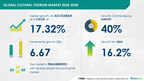
NEW YORK, Feb. 5, 2025 /PRNewswire/ — Report on how AI is driving market transformation – The global cultural tourism market size is estimated to grow by USD 6.67 billion from 2024-2028, according to Technavio. The market is estimated to grow at a CAGR of  17.32%  during the forecast period. Growing instances of stress-related cases is driving market growth, with a trend towards increasing demand for ar and vr technology in cultural tourism. However, concerns related to overtourism  poses a challenge. Key market players include ACE Cultural Tours Ltd, Aracari Travel, Envoy Tours, Exodus Travels Limited, G Adventures, Geographic Expeditions Inc., Greaves Travel Ltd, Indigenous Tourism BC, JPMorgan Chase and Co., Kudu Travel Ltd., Lindblad Expeditions Holdings Inc., Martin Randall Travel Ltd, Odyssey World, Responsible Travel, Tandem Travel, Tauck Inc., Travel Leaders Group Holdings LLC, Travelogy India Pvt. Ltd, Wilderness Travel, and Intrepid Group Pty Ltd..

Key insights into market evolution with AI-powered analysis. Explore trends, segmentation, and growth drivers- View Free Sample PDF

Cultural Tourism Market Scope

Report Coverage

Details

Base year

2023

Historic period

2018 – 2022

Forecast period

2024-2028

Growth momentum & CAGR

Accelerate at a CAGR of 17.32%

Market growth 2024-2028

USD 6.67 billion

Market structure

Fragmented

YoY growth 2022-2023 (%)

16.2

Regional analysis

Europe, APAC, North America, South America, and Middle East and Africa

Performing market contribution

Europe at 40%

Key countries

China, Japan, Italy, France, and Spain

Key companies profiled

ACE Cultural Tours Ltd, Aracari Travel, Envoy Tours, Exodus Travels Limited, G Adventures, Geographic Expeditions Inc., Greaves Travel Ltd, Indigenous Tourism BC, JPMorgan Chase and Co., Kudu Travel Ltd., Lindblad Expeditions Holdings Inc., Martin Randall Travel Ltd, Odyssey World, Responsible Travel, Tandem Travel, Tauck Inc., Travel Leaders Group Holdings LLC, Travelogy India Pvt. Ltd, Wilderness Travel, and Intrepid Group Pty Ltd.

Market Driver

In today’s tourism market, cultural experiences are a major trend. Customers seek unique and genuine interactions with local traditions and histories. Traditional tourist attractions like historic sites, art galleries, and museums continue to draw crowds. However, off-the-beaten-path destinations and experiential travel are gaining popularity. Sustainable travel practices, including eco-friendly initiatives and conservation efforts, are important to both customers and B2C enterprises. The global market scenario is driven by affordability, employment opportunities, and stress-relief. Middle class consumers are fueling outbound tourism, with budget airlines making travel more accessible. Hotels, vacation rentals, cruises, package holidays, camping, business events, conferences, and exhibitions cater to various travel preferences. Aracari Travel, Classic Journeys LLC, and Wilderness Travel are some B2C enterprises offering cultural tourism experiences. These companies focus on diverse cultures, rich histories, and local customs, often including festivals, cooking classes, and food tours. Social media and online platforms help travelers research and book these experiences. However, travel restrictions and social isolation policies due to the current global situation have impacted the industry. The tourism sector remains resilient, adapting to new challenges and continuing to appreciate and promote cultural diversity. 

The cultural tourism market is experiencing a significant shift due to the rising popularity of AR and VR technologies. These innovative technologies offer tourists engaging and interactive experiences with cultural attractions, heritage sites, and museums. AR technology, accessible through smartphones and tablets, provides virtual reconstructions, 3D models, and multimedia content of historical sites and artifacts, enhancing visitors’ understanding of cultural landmarks. VR headsets transport users to immersive virtual environments, enabling exploration of ancient ruins, historical sites, and cultural landscapes from the convenience of homes or tourist centers. AR and VR technologies are revolutionizing cultural tourism by bringing history to life in a unique and interactive way. 

Request Sample of our comprehensive report now to stay ahead in the AI-driven market evolution!

 Market Challenges

The cultural tourism market is thriving as customers seek unique experiences and interactions with local cultures. Traditional tourist attractions like historic sites, art galleries, and museums continue to draw crowds, but there’s a growing demand for off-the-beaten-path destinations and experiential travel. Sustainable travel practices, such as eco-friendly initiatives and conservation efforts, are important to both budget-conscious middle class travelers and B2C enterprises. Challenges include travel restrictions and social isolation policies, which have impacted outbound tourism. Affordability remains a key driver, with budget airlines, vacation rentals, and package holidays offering solutions. Business events, conferences, and exhibitions also contribute to the global market scenario. Diverse cultures and rich histories are at the heart of this sector, with culinary tourism, cooking classes, and food tours adding flavor. Social media and online platforms are essential tools for marketing and booking hotels, cruises, camping, and more. The driving forces behind cultural tourism are genuine experiences, diversity appreciation, and the international community’s desire to learn and connect.Overtourism poses a substantial challenge to the cultural tourism industry. Popular cultural destinations face negative consequences when the number of visitors exceeds the carrying capacity of the location. This results in overcrowding, environmental degradation, and cultural commodification, putting strain on local resources. Notably, cultural heritage sites and landmarks are at risk of degradation due to excessive foot traffic. Monuments, archaeological sites, and culturally significant areas can suffer from wear and tear, compromising their authenticity and integrity. Overcrowding also negatively impacts the visitor experience, with long queues, restricted access, and limited space detracting from the enjoyment of cultural attractions.

Discover how AI is revolutionizing market trends- Get your access now!

Segment Overview 

This cultural tourism market report extensively covers market segmentation by  

TypeDomestic Cultural TourismInternational Cultural TourismServiceCultural Eco-tourismIndigenous Cultural TourismSocio-cultural TourismGeographyEuropeAPACNorth AmericaSouth AmericaMiddle East And Africa

1.1 Domestic cultural tourism-  In the domestic cultural tourism market, there is a flourishing trend driven by factors such as the demand for genuine experiences, technological innovations, and government support for local heritage promotion. Mobile apps are a significant catalyst, offering travelers easy access to detailed guides, maps, and cultural information. Virtual Reality (VR) and Augmented Reality (AR) applications have gained popularity, providing immersive experiences for exploring cultural sites virtually. Social media platforms and online communities serve as essential resources for discovering, sharing, and engaging with cultural experiences. Sustainable and responsible travel practices, niche experiences like culinary tours and artisanal workshops, and global government initiatives are current trends. These initiatives foster economic growth, preserve cultural heritage sites, and promote local festivals and events, ultimately increasing domestic cultural tourism demand and expanding the global cultural tourism market.

Download a Sample of our comprehensive report today to discover how AI-driven innovations are reshaping competitive dynamics

Research Analysis

Cultural tourism is a thriving market that offers unique experiences for travelers seeking authentic connections with local traditions and histories. Customer preferences have shifted from traditional tourist attractions to off-the-beaten-path destinations, leading to a surge in experiential travel. Interactions with locals, sustainable travel practices, and eco-friendly travel are becoming essential elements of cultural tourism. The global market scenario for cultural tourism is growing, with an increasing number of travelers seeking immersive experiences. Cultural tourism encompasses historic sites, art galleries, museums, and regional customs. Festivals, heritage tourism, and culinary tourism are popular sub-sectors, offering opportunities for cooking classes, food tours, and festival tourism. Affordability and employment are key considerations for many travelers, making sustainable eco-tourism initiatives increasingly important. Companies like Aracari Travel, Classic Journeys LLC, and Wilderness Travel offer curated cultural experiences, showcasing the best of each destination while promoting responsible travel practices.

Market Research Overview

Cultural tourism is a growing market that offers unique experiences for travelers seeking authentic connections with diverse cultures and rich histories. Customer preferences shift towards experiential travel, interactions with locals, and off-the-beaten-path destinations. Traditional tourist attractions like historic sites, art galleries, museums, and festivals continue to be popular, but eco-friendly travel and sustainable practices gain traction. Budget airlines and outbound tourism from the middle class fuel the market’s growth. B2C enterprises, including hotels, vacation rentals, cruises, and package holidays, cater to various budgets and preferences. Eco-tourism initiatives, conservation efforts, and business events like conferences and exhibitions also contribute to the global market scenario. Affordability, employment opportunities, and stress-related cases drive demand. Aracari Travel, Classic Journeys LLC, and Wilderness Travel are among the enterprises offering cultural experiences. Diverse cultures, regional customs, arts, and customs engage the international community. Travel restrictions and social isolation policies challenge the industry, but social media and online platforms provide opportunities for virtual experiences. Lack of infrastructure in some destinations remains a concern.

Table of Contents:

1 Executive Summary
2 Market Landscape
3 Market Sizing
4 Historic Market Size
5 Five Forces Analysis
6 Market Segmentation

TypeDomestic Cultural TourismInternational Cultural TourismServiceCultural Eco-tourismIndigenous Cultural TourismSocio-cultural TourismGeographyEuropeAPACNorth AmericaSouth AmericaMiddle East And Africa

7 Customer Landscape
8 Geographic Landscape
9 Drivers, Challenges, and Trends
10 Company Landscape
11 Company Analysis
12 Appendix

About Technavio

Technavio is a leading global technology research and advisory company. Their research and analysis focuses on emerging market trends and provides actionable insights to help businesses identify market opportunities and develop effective strategies to optimize their market positions.

With over 500 specialized analysts, Technavio’s report library consists of more than 17,000 reports and counting, covering 800 technologies, spanning across 50 countries. Their client base consists of enterprises of all sizes, including more than 100 Fortune 500 companies. This growing client base relies on Technavio’s comprehensive coverage, extensive research, and actionable market insights to identify opportunities in existing and potential markets and assess their competitive positions within changing market scenarios.

Contacts

Technavio Research
Jesse Maida
Media & Marketing Executive
US: +1 844 364 1100
UK: +44 203 893 3200
Email: media@technavio.com
Website: www.technavio.com/

View original content to download multimedia:https://www.prnewswire.com/news-releases/cultural-tourism-market-to-grow-by-usd-6-67-billion-by-2028–rising-stress-related-cases-boost-market-report-on-ai-powered-market-evolution—technavio-302368481.html

SOURCE Technavio

Continue Reading

Technology

Cognizant and Google Cloud Expand Alliance to Accelerate Agentic Enterprise Transformation

Published

on

By

Initiative establishes new Gemini Frontier Capability Group, dedicating more than 18,000 engineers to help drive AI adoption for global enterprises.More than 55,000 associates completed Build with Gemini, the largest Gemini partner workshop held to date, part of a shared commitment to scale client execution through Cognizant’s Frontier Certified Engineers.

TEANECK, N.J. and SUNNYVALE, Calif., Oct. 19, 2026 /PRNewswire/ — Cognizant (Nasdaq: CTSH) and Google Cloud today announced a significant expansion of their partnership to accelerate the adoption of agentic AI, including a new Gemini Frontier Capability Group. The group brings together a dedicated global workforce that pairs Google’s full-stack, enterprise-ready AI platform with Cognizant’s domain, industry and engineering expertise as an AI Builder.

Backed by more than 18,000 dedicated Cognizant associates, the new group represents a substantial joint investment and builds on the momentum created by Cognizant’s dedicated Gemini practice launched in April 2026. The new group is designed to bridge the path from pilot to production, equipping enterprises with the ability to safely deploy resilient, enterprise-grade agents that can help drive measurable business value.

“Establishing our dedicated Gemini Frontier Capability Group lets our best frontier engineering talent focus entirely on getting frontier AI into production for clients,” said Ravi Kumar S, CEO of Cognizant. “Our Build with Gemini workshop gave over 55,000 associates that experience directly, earning them tangible skills on one of the world’s most advanced AI platforms, and this new group is where that experience goes to work every day.”

“Deploying AI agents at scale requires trusted partners with deep architectural and integration expertise,” said Thomas Kurian, chief executive officer, Google Cloud. “Cognizant’s dedicated Frontier Capability Group and their skilling initiative for tens of thousands of engineers on Gemini will help our joint customers accelerate the adoption of autonomous agents throughout the enterprise.”

Introducing the Gemini Frontier Capability Group

Designed to meet surging enterprise demand for scaled AI execution, the group aims to deliver production-grade, AI solutions designed to drive business outcomes for global enterprises by leveraging Gemini, Google Cloud’s AI platform for building, governing, and deploying agents. The group will initially concentrate its engineering capabilities across legacy modernization, developer experience, autonomous business process agentification and frontier cyber defense.

To operationalize these capabilities, the group plans to deploy standardized, security-first agentic architecture built on the Model Context Protocol (MCP) and fortified by Google Cloud’s Model Armor. These trusted frameworks are expected to power a new suite of collaborative, production-ready enterprise solutions, including Cognizant’s Catalog Support Agent (CSA) for retail, the Neuro® San-orchestrated Healthcare Agentic Marketplace, and multi-agent Order-to-Cash (O2C) workflows for manufacturing.

Scaling outcomes with Frontier Certified Engineers

Underpinning the group is a shared commitment by Google Cloud and Cognizant to scale client execution through Frontier Certified Engineers. One early proof point shows what this looks like in practice: by integrating Gemini AI models across its software development lifecycle, Cognizant helped a leading retailer achieve a 40% increase in developer productivity, reduce time-to-market by 30%, and realize a 35% cost savings, underscoring the transformative potential of AI-driven software engineering.

As part of Cognizant’s frontier certification skills drive, the company recently concluded the Build with Gemini workshop with Google Cloud, where Cognizant associates built AI agents and applications while earning Gemini skills credentials. Completed by more than 55,000 Cognizant associates, it is the largest single Gemini partner workshop held to date, representing a meaningful step in building Cognizant’s frontier-certified workforce.

Cognizant is also applying Gemini internally at scale. As announced in July, the company is deploying Gemini to 100,000 associates this year, with plans to scale up to 200,000, and continues to increase its certification commitment for professionals on the platform.

About Cognizant
Cognizant (Nasdaq: CTSH) is an AI Builder and technology services provider, bridging the gap between AI investment and enterprise value by building full-stack AI solutions for our clients. Our deep industry, process and engineering expertise enables us to build an organization’s unique context into technology systems that amplify human potential, drive tangible outcomes and keep global enterprises ahead in a fast-changing world. See how at www.cognizant.ai or @cognizant. 

About Google Cloud
Google Cloud offers a powerful, optimized AI stack — including AI infrastructure, leading models like Gemini, data management capabilities, multicloud security solutions, developer tools and platform, as well as agents and applications — that enables organizations to transform their business for the Agentic Era. Customers in more than 200 countries and territories turn to Google Cloud as their trusted technology partner.

Cognizant media contacts:

U.S.

Name Ben Gorelick

Email benjamin.gorelick@cognizant.com 

Europe / APAC

Name Sarah Douglas

Email sarah.douglas@cognizant.com 

India

Name Vipin Nair

Email Vipin.nair@cognizant.com 

Google Cloud media contact:

   Josh Gunter

   jmgunter@google.com

View original content to download multimedia:https://www.prnewswire.com/news-releases/cognizant-and-google-cloud-expand-alliance-to-accelerate-agentic-enterprise-transformation-302912036.html

SOURCE Cognizant Technology Solutions

Continue Reading

Technology

Eczema Awareness Month 2026: What Is the State of Eczema Today?

Published

on

By

NEA pairs findings from its State of AD report with video stories from the community to highlight the data and daily realities of living with eczema

For Eczema Awareness Month 2026, NEA asks what living with eczema looks like today, drawing on the State of AD to bring national data and personal stories together.

The State of Atopic Dermatitis Indicator Report and 51 state-level briefs, published Oct. 1, are available at StateofAD.org.

Video stories from people with eczema and their caregivers share what daily life with the condition is like. Join the conversation with #UnhideEczema.

NOVATO, Calif., Oct. 19, 2026 /PRNewswire/ — Eczema Awareness Month 2026 is underway, and this year’s theme is the State of Eczema. Since Oct. 1, the National Eczema Association (NEA) has been inviting the community to see, share and talk about what living with eczema is like. Throughout October, NEA is asking a question for the more than 31 million Americans living with eczema, and those who care for them: what is it like to live with eczema, and what does it take to get good care?

The theme builds on the State of AD, NEA’s four-year initiative on atopic dermatitis (AD), funded by the Centers for Disease Control and Prevention (CDC). It brings together two kinds of evidence, national data and the experiences of people with eczema, to offer a more complete view of the condition.

The State of AD: data that backs up the experience

On Oct. 1, NEA published its State of Atopic Dermatitis Indicator Report, along with 51 state-level briefs covering all 50 states and Washington, D.C. AD is the most common form of eczema. The report is the first comprehensive national and state-level baseline on AD diagnosis and care, and it points to gaps across the country. The complete report and all state briefs are available at StateofAD.org.

“Eczema Awareness Month is about making sure people feel seen. The State of AD gives us the evidence to show that eczema deserves attention in every state, and the stories our community is sharing show why it matters. Together, they tell the whole story,” said Kristin Belleson, president and CEO of NEA.

Video stories: eczema in their own words

Alongside the data, NEA is sharing video testimonials from people living with eczema and the caregivers who support them. The data shows the scale of the need, and the stories show the people behind it. Watch the stories at EczemaMonth.org.

Ways to take part this October

NEA invites people with eczema, caregivers, health care professionals and partners to join the conversation:

Watch and share the video stories from the eczema community.

Explore the State of AD report and your state’s brief at StateofAD.org.

Use #UnhideEczema on social media to share your own experience.

Visit EczemaMonth.org for resources, events and more ways to get involved.

NEA thanks all the sponsors and partners who make Eczema Awareness Month possible, including our Platinum Sponsors: AbbVie, all® free clear, LEO Pharma, and Sanofi and Regeneron.

Frequently Asked Questions (FAQ)

Q: What is Eczema Awareness Month?
A: Eczema Awareness Month takes place every October. In 2026, it is centered on the State of Eczema, bringing together national data and personal stories from the eczema community.

Q: What is the State of AD?
A: The State of AD is a four-year initiative funded by the CDC. Its foundation is the State of Atopic Dermatitis Indicator Report and 51 state-level briefs, published Oct. 1, which set a national and state reference baseline on AD care and diagnosed prevalence.

Q: Where can I find the State of AD report?
A: The full report and all state briefs are available at StateofAD.org.

Q: How can I take part in Eczema Awareness Month?
A: Watch and share the stories, explore the report and use #UnhideEczema on social media.

The State of AD project was supported by the Grant or Cooperative Agreement Number 1 NU58DP007726-01-00, funded by the Centers for Disease Control and Prevention (CDC). Its contents are solely the responsibility of the authors and do not necessarily represent the official views of the Centers for Disease Control and Prevention or the U.S. Department of Health and Human Services.

About the National Eczema Association

Founded in 1988, the National Eczema Association (NEA) is a 501(c)(3) nonprofit and the largest patient advocacy organization serving the more than 31 million Americans living with eczema and those who care for them. NEA provides programs and resources to elevate the diverse lived experience of eczema, helping patients and caregivers understand their condition, actively engage in their care, find strength in one another and improve their lives. NEA also advances critical eczema research and partners with key stakeholders to ensure the patient voice is represented and valued in education, care and treatment decision-making. Learn more: NationalEczema.org

View original content to download multimedia:https://www.prnewswire.com/news-releases/eczema-awareness-month-2026-what-is-the-state-of-eczema-today-302912799.html

SOURCE National Eczema Association

Continue Reading

Technology

In HelloNation, Electrical Expert Brennan Coffey Explains Why a Circuit Breaker Keeps Tripping

Published

on

By

The Article Explains Common Reasons a Circuit Breaker Trips and When the Pattern Signals a Bigger Problem.

SCHENECTADY, N.Y., Oct. 19, 2026 /PRNewswire/ — Why does a circuit breaker keep tripping? A HelloNation article answers that question and breaks down the most common reasons behind the problem.

The article explains that every circuit is built to carry a set amount of power safely. A circuit breaker cuts power once that limit is crossed, protecting the wiring from overheating before real damage occurs.

Each breaker in the panel protects one specific circuit, the article notes. An overloaded circuit will usually trip only its own breaker, not the entire panel. Homeowners often notice the pattern happens at predictable moments, like running a microwave and a toaster together.

According to the article, an overloaded circuit is one of the most common reasons a breaker trips. This often happens when several appliances draw power from the same outlets at once.

The article notes that kitchens are frequent trouble spots, since they run several high draw appliances from a limited number of outlets. Spreading large appliances across different circuits often solves the problem on its own.

A short circuit or a ground fault can also cause a circuit breaker to trip, the article explains, and both tend to act faster than a simple overload. A short circuit happens when a hot wire unexpectedly touches another wire.

A ground fault usually involves contact with a grounded surface, often because of moisture nearby. The article points out that GFCI outlets add protection in bathrooms and kitchens, though a standard breaker can still trip when a fault occurs elsewhere on the same circuit.

Newer homes may also have arc fault breakers, which sense the electrical pattern of an arc rather than a simple overload. These devices catch a hazard tied closely to house fires.

The article adds that an aging breaker can be the source of trouble in its own right, especially in a panel older than twenty years. Electrical Expert Brennan Coffey leads Coffey Electric & Generator, serving homeowners throughout the Schenectady area.

Homeowners should never open a panel cover or inspect breakers beyond resetting a switch, the article warns, since the panel carries live current even when a breaker has tripped. Forcing a stubborn breaker back on can let dangerous heat build inside the wall.

A breaker box that feels warm or shows scorch marks needs more urgency than routine tripping. That kind of heat points to trouble well beyond a simple overload, the article cautions.

The article suggests tracking when and where trips happen to spot a pattern before calling for help. Noting which appliances were running, and how often the issue repeats, gives a professional a useful starting point.

Waiting too long to address repeated trips can let a small issue grow into a larger and costlier one, the article explains. Addressing the pattern early tends to save both time and money down the road.

Electrical Expert Brennan Coffey is featured in the article, which advises against repeatedly resetting a breaker that keeps tripping without a clear cause. A licensed electrician can identify the underlying issue and determine what the repair actually requires.

Why Does a Circuit Breaker Keep Tripping? features insights from Brennan Coffey, Electrical Expert of Schenectady, New York, in HelloNation.

About HelloNation

HelloNation is America’s Good News Network, a premier media platform built on the idea that good news travels faster when real people tell real stories. Through its community-focused digital publications and innovative “edvertising” approach, HelloNation delivers expert-driven, good-news content that informs, inspires, and spotlights the leaders making a meaningful impact in their communities.

View original content to download multimedia:https://www.prnewswire.com/news-releases/in-hellonation-electrical-expert-brennan-coffey-explains-why-a-circuit-breaker-keeps-tripping-302912791.html

SOURCE HelloNation

Continue Reading

Trending