Connect with us

Technology

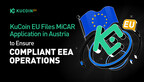
KuCoin EU Files MiCAR Application in Austria to Ensure Compliant EEA Operations

Published

on

Key Takeaways:

KuCoin EU Exchange GmbH (“KuCoin EU”) is applying for a Markets in Crypto-Assets Regulation (“MiCAR”) license in Austria to operate as a fully compliant crypto-asset service provider in the EU/EEA.After receiving the license, KuCoin EU will be leveraging KuCoin’s cutting-edge technology and fostering the well-respected KuCoin brand to offer secure and innovative crypto products and services to KuCoin EU’s customers in EU/EEA.Vienna emerges as a strategic European crypto hub with its progressive regulatory framework and access to exceptional talent.Crypto industry leaders Oliver Stauber (CEO) and Christian Niedermüller (COO) will ensure operational excellence and full compliance with European Regulatory Standards as Managing Directors of KuCoin EU.

VIENNA, Feb. 20, 2025 /PRNewswire/ — KuCoin, a leading global cryptocurrency exchange, has announced that KuCoin EU Exchange GmbH is in the midst of filing an application for a MiCAR license in Austria. This application underscores KuCoin’s commitment to meeting the highest standards of regulatory compliance while solidifying its presence in the EU/EEA region.

The MiCAR license will enable KuCoin EU to serve its customers across all 30 EU and EEA member countries, ensuring consistent access to crypto products and services under a robust regulatory framework. This initiative aligns with KuCoin’s vision of fostering transparency, trust, and accountability in administering best-in-class digital asset services, offering users a secure and compliant trading platform.

KuCoin EU will set up its headquarters in Vienna, Austria, marking the city a strategic hub for all European activities and is actively hiring talents for its operations. The decision to choose Austria was primarily driven by the timely implementation of the MiCAR accompanying laws, stable and foreseeable regulatory environment as well as the huge talent pool. KuCoin EU acknowledges Austria’s efforts, e.g. driven by the City of Vienna, in creating a transparent, efficient, and best-in-class framework for crypto businesses to operate while safeguarding investors interests and fostering innovation in the financial sector.

Commenting on the establishment of the EU hub, KuCoin’s CEO BC Wong said “As a globally leading crypto exchange, we place compliance and user experience at the forefront of our mission. Today, I am proud to announce the establishment of our new EU hub in Vienna and that KuCoin EU intends to file for a MiCAR application in Austria. This marks a significant milestone in our steadfast commitment to executing a global, compliant strategy. Upon receiving a MiCAR license, we will enter the EEA market, which we deem strategically important. By advancing our compliance efforts, we are poised to better serve local users with more convenient, secure, and seamlessly localized products and experiences. We remain dedicated to fostering a transparent, responsible, and sustainable global digital asset ecosystem.”

Oliver Stauber, former General Counsel and Managing Director at Bitpanda, and Christian Niedermueller, former CEO of another European digital asset exchange, both veterans of the European crypto industry and seasoned financial executives with legal background, have been appointed as the Managing Directors of KuCoin EU Exchange GmbH. Stauber and Niedermueller bring extensive expertise in financial market regulation and crypto exchange management, strengthening KuCoin’s leading position as it navigates the complexities of Europe’s evolving crypto regulations while ensuring a successful and regulatory compliant business operation in the EU and EEA.

“I am absolutely thrilled to embark on this journey as the CEO of KuCoin EU, where we are set to revolutionize the crypto landscape across the EU and EEA with innovative products and services. At KuCoin EU, our mission is clear: to create Europe’s premier, regulatory-compliant crypto asset service provider. We are excited to announce that we will apply for a MiCAR license in Austria. Upon receiving the MiCAR license we are committed to delivering secure, compliant, and cutting-edge crypto solutions that will redefine trust and innovation in the EU’s fintech arena. Get ready for a new era in crypto!”

–       Oliver Stauber, CEO of KuCoin EU

“After having scaled up another European exchange and having my toes in the digital asset industry now for more than 9 years, I am very happy to help bringing KuCoin to the next level in Europe. We aim to build a fantastic local team, have a sophisticated localized operational & product setup and also strengthen brand awareness massively in the years to come. Being a KuCoin customer myself since the very beginning in 2017, I couldn’t be prouder to support KuCoin now at this stage.”

–       Christian Niedermueller, COO of KuCoin EU

Once KuCoin EU has been granted its MiCAR license, KuCoin EU will be well-positioned to provide services for European users, offering access to a wide range of digital assets while ensuring compliance with EU regulations. The company’s long-term vision includes contributing to the broader adoption of blockchain technology and strengthening the EU’s position as a leader in the global crypto ecosystem.

As KuCoin takes this step forward, the exchange remains focused on fostering innovation and trust in the digital asset space while aligning its operations with regulatory frameworks worldwide.

About KuCoin EU

KuCoin EU Exchange GmbH, based in Vienna, Austria, is committed to establishing a fully compliant digital asset brokerage under the MiCAR framework. By leveraging KuCoin’s advanced technology and nurturing the respected KuCoin brand, KuCoin EU aims to deliver secure and innovative crypto products and services to its customers within the European Economic Area (EEA).

KuCoin EU Exchange GmbH currently does not offer any services in the EU/EEA and will only commence operation upon receiving appropriate licensing.

About KuCoin

Founded in 2017, KuCoin is one of the pioneering and most globally recognized technology platforms supporting digital economies, built on a robust foundation of cutting-edge blockchain infrastructure, liquidity solutions, and an exceptional user experience. With a connected user base exceeding 39 million worldwide, KuCoin offers comprehensive digital asset solutions across wallets, trading, wealth management, payments, research, ventures, and AI-powered bots.

KuCoin has garnered accolades such as “Best Crypto Apps & Exchanges” by Forbes and has been recognized among the “Top 50 Global Unicorns” by Hurun in 2024. This recognition reflects its commitment to user-centric principles and core values, which include integrity, accountability, collaboration, and a relentless pursuit of excellence.

KuCoin is not licensed in the EU/EEA and does not actively offer any services in the EU/EEA.

Photo – https://mma.prnewswire.com/media/2624175/image_5002362_22605912.jpg
Logo – https://mma.prnewswire.com/media/2356857/KuCoin_Horizontal_Green_LOGO_Logo.jpg

View original content:https://www.prnewswire.co.uk/news-releases/kucoin-eu-files-micar-application-in-austria-to-ensure-compliant-eea-operations-302381210.html

Continue Reading
Click to comment

Leave a Reply

Your email address will not be published. Required fields are marked *

Technology

DMALL Gains Momentum in Southeast Asia with AI-Driven Retail Platform

Published

on

By

SINGAPORE, May 4, 2026 /PRNewswire/ — As retailers across Southeast Asia face rising operational complexity, shifting consumer expectations and margin pressure, demand is growing for integrated, real-time retail operating systems.

Dmall Inc. (02586.HK) is supporting this shift with a unified retail operating platform that connects core retail functions, improves execution efficiency and enhances visibility across stores, supply chains and customer touchpoints.

As one of China’s largest retail digital solutions providers by revenue and gross merchandise volume, Dmall serves nearly 600 retail clients across 11 countries and regions. Its platform has been shaped by large-scale deployments in complex retail environments, including long-standing work with Wumart Group, Metro, Lawson, 7-Eleven South China and SM Group in Southeast Asia.

Dmall’s recent collaboration with Cold Storage Singapore marks a milestone in supporting retail digital transformation across Southeast Asia. Completed within seven months, the project covered 87 stores across supermarket, hypermarket and express formats, consolidating multiple systems into a single platform across supply chain, merchandising and store operations.

“The transition was completed with minimal disruption to our operations,” said Mr. Lim Boon Chiong, Managing Director of Cold Storage Singapore. “We are seeing early improvements in product availability and replenishment, supported by better visibility across our supply chain and store network.”

The platform has also contributed to more consistent store execution and a more reliable customer experience. The first phase provides a foundation for the next stage of development, including AI-driven capabilities to further support product availability, freshness management and operational efficiency.

Dmall and Cold Storage Singapore plan to extend their cooperation to the fuel and convenience store format in June 2026, reflecting a deepening partnership and a shared commitment to creating greater operational value across retail formats.

“Southeast Asia is one of the world’s most dynamic retail markets, but also one of the most operationally complex,” said Mr. Zhongwei Ren, Partner and Chief Strategy Officer of Dmall. “By combining operational integration with AI-driven capabilities, Dmall aims to help retailers build more adaptive, scalable and efficient operations.”

About Dmall 

Founded in 2015, Dmall (02586.HK) is committed to advancing retail through technology. As one of Asia’s leading providers of digital retail solutions, Dmall delivers integrated, AI-driven innovations that help retailers improve efficiency, optimize decisions and create greater value.

View original content to download multimedia:https://www.prnewswire.com/apac/news-releases/dmall-gains-momentum-in-southeast-asia-with-ai-driven-retail-platform-302761046.html

SOURCE Dmall Inc.

Continue Reading

Technology

Germany’s PDF/UA Mandate Raises the Bar for HTML to PDF C# Workflows

Published

on

By

Enterprise .NET teams generating PDFs at scale face new compliance pressure. Most aren’t ready.

CHICAGO, May 4, 2026 /PRNewswire/ — The German government’s Deutschland Stack has standardized on PDF/UA as the required format for final-form digital documents. For .NET teams building HTML to PDF C# workflows, the mandate forces a question many have deferred: does the library you depend on actually produce compliant output, or just output that looks right?

Iron Software’s IronPDF, a commercial .NET library used in regulated industries across logistics, healthcare, and finance, generates PDF/UA-1 compliant documents directly from HTML in C#. That’s the same conformance level the Deutschland Stack now requires.

“Accessibility compliance has shifted from important to mandatory,” said Cameron Rimington, CEO of Iron Software. “Government rules like this set a floor that enterprise teams are expected to meet, not aspire to. The question is whether their tooling can clear that bar without bolt-on remediation.”

From recommendation to requirement

PDF/UA (ISO 14289) defines what makes a PDF universally accessible: correct tag structure, logical reading order, and metadata that lets assistive technologies parse the document reliably. The standard has existed since 2012, but adoption has been patchy.

Germany’s decision to embed PDF/UA into its national digital stack moves it from best practice to enforceable baseline. Combined with the European Accessibility Act, which extends similar requirements to digital products serving EU markets, the compliance window for document-heavy .NET applications is closing fast.

Most HTML to PDF C# workflows aren’t compliant yet

Despite the regulatory pressure, PDF/UA compliance is still the exception across enterprise .NET. Many teams generating PDFs at volume, particularly those running HTML to PDF C# pipelines, are using libraries that produce visually correct files but miss the structural and metadata requirements accessibility standards actually demand.

As mandates harden, that gap is harder to defer.

“Germany just standardized on PDF/UA. In our experience, most development teams aren’t compliant yet, and they know it,” said Rimington. “That gap is why they’re coming to us.”

What this means for .NET developers

Teams generating PDFs in .NET, for government portals, financial statements, healthcare records, or legal filings, are increasingly being asked to prove their output meets accessibility standards, not just that it renders.

IronPDF gives developers a direct path from HTML to PDF in C# with two methods that cover the common cases:

RenderHtmlAsPdfUa generates PDF/UA-1 compliant documents directly from HTMLSaveAsPdfUa converts existing PDFs to PDF/UA-1

When source HTML is semantic and well-structured, compliant output can be produced in a single call with no remediation step required. For less structured input, additional tagging may be needed to reach full compliance.

The library also supports PDF/A (conformance levels 1 through 3, both b and a) and PDF versions 1.2 through 1.7, covering archival and compliance requirements common in public sector and enterprise deployments.

In production: serving Germany’s regulated industries

The compliance pressure IronPDF is built for is already shaping decisions on the ground. ThreeB IT, a software engineering firm based in Ibbenbüren, has standardized on IronPDF for document generation across logistics and healthcare platforms, including systems serving Kuehne + Nagel and nationwide COVID-19 testing infrastructure.

Operating under strict GDPR and healthcare data rules made the library choice a compliance decision as much as a technical one.

“Because Iron Software doesn’t store any data, GDPR compliance is simple. That’s critical for every project we build,” said Thimo Buchheister, CEO of ThreeB IT.

Deployment speed mattered just as much.

“IronPDF made it possible to build a nationwide COVID testing system in two weeks. The key part was ready within hours,” said Buchheister.

The firm now treats Iron Software libraries as a default in its stack.

“We’ll integrate at least one Iron Software product in every future project. It’s become part of our standard stack,” Buchheister added.

View original content:https://www.prnewswire.com/news-releases/germanys-pdfua-mandate-raises-the-bar-for-html-to-pdf-c-workflows-302761055.html

SOURCE Iron Software

Continue Reading

Technology

Cregis Showcases at Money20/20 Asia 2026, Exploring a New Paradigm for Financial Infrastructure Powered by Stablecoins and On-Chain Payments

Published

on

By

HONG KONG, DUBAI, UAE and SINGAPORE, May 4, 2026 /PRNewswire/ — From April 21 to 23, 2026, at Money20/20 Asia 2026—one of the most influential fintech events in the Asia-Pacific region—Cregis participated as an exhibitor at Booth 6001. The conference brought together industry leaders to discuss key themes such as payment innovation, cross-border settlement, digital assets, and regulatory developments. During the event, Cregis presented its comprehensive digital asset infrastructure solutions tailored for enterprises and financial institutions, while engaging in in-depth conversations with participants from banks, payment providers, fintech companies, and Web3 organizations.

Advancing Payment Infrastructure

Throughout the event, the Cregis team highlighted its end-to-end capabilities in on-chain payments and digital asset management, with a focus on enterprise payment and treasury needs. As stablecoins and blockchain technologies increasingly move into real-world applications, enterprise priorities are shifting from simply supporting crypto assets to enabling efficient, secure, and controllable fund flows.

Cregis offers a unified infrastructure that supports multi-chain and multi-asset management, adaptable to a wide range of use cases including cross-border trade settlement, merchant payments, and corporate treasury operations. By ensuring both security and compliance, the platform enables more efficient global fund movement and greater transparency in settlement processes.

Richard, Co-Founder of Cregis, commented during the event: “Today, the key challenge for enterprises is no longer whether to enter the digital asset space, but how to build a fund management system that balances efficiency, security, and compliance. Through our infrastructure, we aim to help businesses operate more effectively in an increasingly complex global payments landscape.”

A New Cross-Border Payment Paradigm Driven by Stablecoins

Stablecoins and on-chain payments emerged as central topics at this year’s conference. As more financial institutions and payment providers explore the use of digital assets in cross-border settlement, stablecoins are becoming a critical bridge between traditional finance and the crypto economy.

During the event, Cregis engaged with various industry partners to discuss practical applications of stablecoins in cross-border trade, enterprise settlement, and treasury management. Compared to traditional cross-border payment rails, stablecoin-based settlement offers clear advantages in efficiency, cost, and transparency. At the same time, it raises higher requirements for underlying infrastructure, particularly in areas such as secure custody, fund monitoring, and regulatory compliance.

Engaging Industry Leaders: Exploring the Future Evolution of Finance in Asia

Beyond its presence on the exhibition floor, Cregis co-hosted a side event titled The Reserved Table: Redefining Asia’s Future of Settlements alongside WIDTH, StraitsX, and PlatON. The event brought together key players across payments, stablecoins, and cross-border settlement to explore the future trajectory of financial infrastructure in Asia.

At the event, Tannie, Head of Southeast Asia at Cregis, joined a panel discussion themed “A New Standard of Value: Stablecoins, Settlement & the New Money Stack”, where he shared insights from frontline enterprise use cases.

Tannie noted that the market still tends to view stablecoins primarily as a “product”, such as a yield-generating tool or trading instrument. However, in real-world business scenarios, stablecoins are increasingly evolving into foundational infrastructure. For exchanges, payment providers, and cross-border enterprises, the focus is no longer on yield, but on critical operational questions: how to enable real-time global settlement, how to manage liquidity across regions, and how to reduce reliance on traditional banking systems.

Looking ahead, Tannie emphasized that the deeper significance of stablecoins lies in their ability to fundamentally reshape how enterprises manage capital. Within an infrastructure-driven stablecoin framework, businesses can achieve:

Policy-based approval and signing mechanisms for fund movementsReal-time on-chain reconciliation and automated settlementA unified liquidity view across multiple chains and wallets24/7 uninterrupted treasury operations

This shift signals that stablecoins are not merely replacing traditional payment rails—they are driving enterprises to transition from conventional financial workflows toward a more programmable, automated “next-generation operating system for capital.”

From Payment Capabilities to Global Financial Connectivity

As stablecoins, on-chain payments, and enterprise-grade asset management systems continue to mature, a more efficient, transparent, and globally connected financial network is taking shape.

Richard noted: “In the coming years, as the convergence between traditional finance and Web3 accelerates, demand for robust digital asset infrastructure will continue to grow. Cregis aims to be a key enabler in this transition, providing enterprises with secure, scalable, and reliable foundational capabilities.”

Looking ahead, Cregis will continue to enhance its product offerings across custody, payments, and asset management. By focusing on real-world business needs, the company is committed to building a more comprehensive digital asset infrastructure, empowering global enterprises to improve efficiency, manage risks, and achieve sustainable growth in the next generation of financial systems.

View original content to download multimedia:https://www.prnewswire.com/apac/news-releases/cregis-showcases-at-money2020-asia-2026-exploring-a-new-paradigm-for-financial-infrastructure-powered-by-stablecoins-and-on-chain-payments-302761060.html

SOURCE Cregis

Continue Reading

Trending