Connect with us

Technology

Global Terrorism Index 2025: Terrorism Spreads as Lone Wolf Attacks Dominate the West

Published

on

LONDON, March 5, 2025 /PRNewswire/ — The number of countries recording a terrorist attack increased from 58 to 66, according to the 12th annual Global Terrorism Index (GTI) released today. This reverses nearly a decade of improvements, with 45 countries deteriorating and 34 improving. The four deadliest terrorist groups intensified their violence in 2024, driving an 11% rise in fatalities. In the West, lone wolf attacks now dominate, accounting for 93% of fatal attacks over the past five years.

Key Findings:

The Sahel region remains terrorism’s epicentre, accounting for over half of all global terrorism deathsIslamic State (IS) expands its operations to 22 countries and remains the deadliest organisation, causing 1,805 deaths, with 71% of its activity being in Syria and DRCTehrik-e-Taliban (TTP) emerged as fastest-growing terrorist group, with 90% increase in attributed deathsDeaths in sub-Saharan Africa (excluding the Sahel) are now at their lowest since 2016, dropping by 10%Terrorist attacks jumped by 63% in the West, Europe was most affected where attacks doubled to 67In 2024, several Western countries reported one in five terror suspects as under 18, with teenagers accounting for most IS-linked arrests in EuropeSeven Western countries are in the first 50 most impacted countries on the GTIAntisemitic and Islamophobic hate surged globally, with the US seeing a 200% rise in antisemitic incidents in 2024

The Gaza conflict has intensified instability in the Middle East and is fuelling hate crimes in the West, while terrorism deaths surged in Iran. Global terrorism deaths remained constant in 2024, after allowing for the October 7 attack. The four deadliest terrorist groups escalated their violence, causing an 11% rise in terrorism fatalities. The most deaths from terrorism were in Burkina Faso, Pakistan and Syria. Burkina Faso is responsible for one fifth of all deaths globally.

Islamic State (IS) remains the deadliest organisation, causing 1,805 deaths across 22 countries in 2024, one more than the prior year. IS was most active in Syria and the DRC. IS Khorasan Province (ISK) has emerged into one of the most active jihadist groups worldwide, conducting major attacks in Iran and Russia. Since 2020, ISK has expanded from one country to five, producing propaganda in nine languages. Tehrik-e-Taliban Pakistan (TTP) is the fastest-growing terrorist organisation, with deaths rising 90% to 558.

The GTI is produced by international think tank the Institute for Economics & Peace (IEP) and has been published annually for the last 12 years. It is the most comprehensive resource on global terrorism trends and uses multiple factors to calculate its score, including the number of incidences, fatalities, injuries and hostage numbers, before combining these with conflict and socioeconomic data to provide a holistic picture of terrorism.

Steve Killelea, Founder & Executive Chairman, IEP: “This year’s Global Terrorism Index highlights two key concerns; firstly, 98% of all terrorist deaths occurred in conflict zones, with 2024 recording the highest number of conflicts since the end of the WWII. Secondly, social tensions and dissatisfaction within the West are fuelling lone actor terrorism. 93% of all fatal terrorist attacks were caused by lone actors. The best way to control terrorism is to stop or reduce the number of conflicts. In addition, the Gaza conflict has been, and still is, a catalyst for antisemitism and Islamophobia.”

Western nations face new terror landscape

The majority of Western attacks are now carried out by individuals without formal group affiliations, who radicalise through social media, gaming platforms and encrypted messaging apps. The shift towards online radicalisation has enabled potential terrorists to access extremist content, and organise with minimal physical contact. Algorithmic radicalisation on popular social media sites can drive users toward progressively more extreme content over time.

The West saw its first major rise in terrorist incidents since 2017, with attacks increasing from 32 to 52. Sweden, Australia, Finland, the Netherlands, Denmark and Switzerland registered their first attacks in more than five years. Germany was Europe’s worst-performing nation, placing 27th globally following the Magdeburg Christmas market attack.

In the UK, under-18s accounted for 42% of 219 terror arrests last year[1], reflecting a broader Western trend where youths account for one in five terror suspects. They typically lack ties to established groups and can combine contradictory extremist ideologies.

Sahel remains global terrorism epicentre

Terrorism in the Sahel has increased significantly, with deaths rising nearly tenfold since 2009. Weak governance, ethnic tensions, and ecological degradation have created a conducive environment in which terrorism can flourish. The Sahel accounts for 51% of 2024’s terrorism deaths, with Burkina Faso, while improving overall, remained the most affected nation for a second year. Six of the ten countries in the region recorded at least one fatality. Togo recorded its worst year for terrorism since the inception of the Index, reflecting the spread of terrorist activity beyond the Sahel.

Competition over the region’s mineral resources has contributed to ongoing instability. Gold is a major flashpoint in Mali, Burkina Faso, and Niger. Niger supplies more than 25% of European uranium. Russian presence has grown significantly in the region while France is withdrawing.

Niger illustrates the fragility of progress in the region. After achieving the second-largest improvement in 2022, it experienced a reversal in the last two years, recording a 94% increase in terrorism deaths to 930 fatalities in 2024, the largest surge globally. 

Terrorism in the Middle East

Although the Middle East recorded a 7% reduction in terrorist attacks in 2024 to 618, the resurgence of violence between Israel and Palestine continues to destabilise the region. Both Israel and Syria ranked among the ten most impacted countries globally.

Since 2020, traditional foreign influence in Syria has diminished, with Russia, China, and Iran reducing their roles while Turkey emerges as a dominant regional power. The Kurdish-led Syrian Democratic Forces (SDF), once a key partner of the US in the fight against IS, now faces mounting challenges. Turkey’s opposition to a strengthened SDF, coupled with the potential scaling back of US support, has created conditions that IS could exploit to regain influence. The new US administration’s position on the SDF is still unclear.

Hate speech and the US

Hate crimes escalated sharply for both the Jewish and Muslim communities in the US following the Gaza war, with FBI-recorded incidents targeting the Jewish community rising by 270% in just two months. Anti-Muslim hate increased at a similar rate, with reported incidents of Islamophobia rising by 300% in the same period. Similar patterns emerged in Europe and Australia, with 31% of all Western attacks motivated by antisemitic or anti-Israel sentiment. 

While the US bucked the trend of other Western countries in 2024, with only one death from three attacks, 2025 will be a worse year. The January attack in New Orleans where an IS-pledged individual killed 15 people highlights that concerns remain about a resurgence of terrorist activity. Globally there were a total of 24 foiled plots linked to IS or affiliated groups, including a high-profile plot targeting Taylor Swift concerts in Vienna, but it is likely that many more were prevented.

Terror groups exploit technology surge

Terrorist organisations are rapidly adapting to emerging technologies, transforming their operations through artificial intelligence and encrypted communications. Intelligence agencies report that ISK has markedly expanded its digital arsenal, producing AI-enhanced video content and sophisticated online magazines in multiple languages.

The group deploys encrypted messaging platforms and cryptocurrency for fundraising, whilst using AI to create localised propaganda aimed at foreign targets. Their reach now spans from Central Asia to North America, demonstrating how digital platforms have reshaped terrorist recruitment and operations.

This technological evolution poses new challenges for security services, as extremists increasingly exploit encrypted apps and dark web forums for radicalisation and operational planning. AI also creates opportunities for intelligence services to analyse larger amounts of information, and detect radicalisation earlier.

Contacts

GTI2025@bcw-global.com

Notes to Editors

The full GTI 2025 report and interactive map are available at: visionofhumanity.org

X: @GlobPeaceIndex

Facebook: facebook.com/globalpeaceindex

Global Terrorism Index (GTI)

The GTI by the Institute for Economics & Peace provides a comprehensive summary of the key global trends and patterns in terrorism over the last 17 years. The report ranks 163 countries (99.7 per cent of the world’s population) according to the impact of terrorism. The indicators include the number of terrorist incidents, fatalities, injuries and hostages.

The GTI report is produced using data from TerrorismTracker and other sources. TerrorismTracker provides event records on terrorist attacks since 1 January 2007. The dataset contains over 73,000 terrorist incidents for the period 2007 to 2024.

Institute for Economics & Peace

The Institute for Economics & Peace (IEP) is the world’s leading think tank dedicated to developing metrics to analyse peace and to quantify its economic value. It does this by developing global and national indices, including the annual Global Peace Index, calculating the economic cost of violence and understanding Positive Peace which is the attitudes, institutions and structures that create and sustain peaceful societies.

[1] Counter Terrorism Policing, UK, 2024 – https://www.counterterrorism.police.uk/number-of-young-people-arrested-for-terrorism-offences-hits-record-high/ 

View original content:https://www.prnewswire.co.uk/news-releases/global-terrorism-index-2025-terrorism-spreads-as-lone-wolf-attacks-dominate-the-west-302389884.html

Continue Reading

Technology

Alethios Unveils a Comprehensive Decentralized Data Collection Suite for Human Health Research

Published

on

By

Live, no-code integrations let researchers combine participant-reported outcomes, wearables and sensors, AI-powered digital biomarkers, and at-home lab tests in a single study at a fraction of the cost of traditional research.

SAN FRANCISCO, Oct. 22, 2026 /PRNewswire/ — Alethios, the software platform delivering research infrastructure for human health, today launched a comprehensive suite of decentralized data collection tools. Researchers can now combine participant-reported outcomes, wearable and sensor data, digital biomarkers, and at-home biomarker testing in a single study, without writing code, managing multiple vendors, or requiring clinic visits.

Alethios powers studies across nutraceuticals, functional foods, academia, consumer health, medical devices, biotech, and the life sciences. Study designs range from consumer perception studies to pivotal, randomized, double-blind, placebo-controlled trials all run on the same software platform. Customers  including Givaudan, Thorne, PLT Health Solutions, Applied Food Sciences, Hofseth BioCare, Helaina, Samphire Neuroscience, and Sonoran University use the platform to generate rigorous evidence from participants’ homes. The new integrations build on the company’s founding belief that rigorous, multimodal research should be within reach for teams of every size and budget, across the human health ecosystem.

The suite spans four layers of data, each available as a no-code integration within the Alethios Study Planner and Study Operator:

Reported data: participant-submitted photo, video, audio, and text, plus a library of clinically validated instruments, both publicly available and licensed.Generated health data: personal wearables and health platforms including Apple Watch, Google Health, Garmin, Oura, Whoop, and Fitbit, and sensors including Abbott’s continuous glucose monitors and Withings and InBody bioimpedance scales.Digital biomarkers: validated cognitive batteries powered by BrainHQ, skin health selfies for dermatology and cosmetic studies powered by Haut.ai, and 3D body composition scans powered by Prism Labs.At-home biomarker testing: dried blood spot cards, Tasso blood collection devices, and at-home microbiome kits. Standard panels, including male and female hormones, cardiovascular, metabolic, inflammation, vitamin D, and hydration, run through Choose Health. Next-generation tests include epigenetic clocks from Muhdo and TruDiagnostic, and gut and vaginal microbiome sequencing from GutID and other shotgun metagenomic sequencing partners.

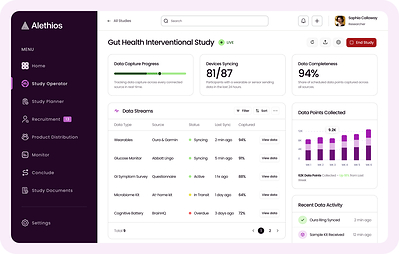
Adding a data type takes a few clicks. In the Study Planner, researchers select the data types their study needs and place each one on the participant schedule. For at-home kits, Alethios can handle ordering, shipping, and unique ID verification to keep every sample matched with the right participant, and results flow back into the platform. Once a study is live, the Study Operator brings every data stream into one real-time monitoring dashboard.

Compliant Data Collection by Default

Every integration runs on the platform’s existing infrastructure, where validation and data integrity assurances are built in and each one is designed to encourage participant adherence without compromising data quality. Researchers can:

Schedule each integration on the study timeline, so every data point is accurately time-stamped.Tie completion and compliance to milestone-based tracking and compensation, for example releasing a $50 gift card once a participant’s kit is accessioned at the lab.Monitor adherence across multiple data types in real-time from the Study Operator, so missed wearable syncs, late surveys, or unreturned kits are caught before they turn into missing data.

Every data point is cleaned and aligned to its participant automatically, so research teams receive one analysis-ready dataset rather than stitching together exports from multiple vendors.

“We built Alethios for researchers across human health,” said Zeenia Framroze, Founder and CEO of Alethios. “There are so many new ways to collect data at home, and we want to give research teams the best of them, wherever they sit. Whether someone is designing a claims substantiation study for a supplement or running post-marketing surveillance for a drug, we want to make it easy to collect robust subjective and objective data from Alethiad participants around the nation. The better and more accessible data collection is, the more we move the needle on our understanding of all of human health.”

A Home for Next-Generation Health Measurement

“So many novel devices and at-home tests are being developed today,” said Gurpreet Atwal, CTO of Alethios. “We want Alethios to be the tool scientists and innovators use to rapidly develop and validate new methods of data collection, and the home for the newest, best-in-class technologies for measuring human health. With rapid recruitment through the Alethiad Participant Community, those technologies can be tested with diverse, representative participants from day one.”

Companies developing novel devices, tests, or digital biomarkers can apply to integrate with Alethios here.

About Alethios

Alethios is a software platform delivering research infrastructure for human health. Its AI-powered, full-stack software delivers the capabilities of a study team without the overhead. The platform unifies protocol design, IRB coordination, recruitment, participant management, multimodal data collection, and reporting for decentralized clinical trials. Principal investigators, sponsors, and CROs rely on Alethios to generate rigorous real-world evidence across human health industries, setting up a study in minutes with plans starting at $100 per month. Through the Study Planner, Study Operator, and the Alethiad Participant Community, research teams can use the software in a self-service, hybrid, or fully turn-key model, at a fraction of the cost of traditional research.Alethios is a 2026 Nutra Healthspan Innovator Award winner, a 2026 Vitafoods Europe Startup Challenge finalist, and a 2025 NutraIngredients-USA Startup Award finalist. Get started at Alethios.com.

View original content to download multimedia:https://www.prnewswire.com/news-releases/alethios-unveils-a-comprehensive-decentralized-data-collection-suite-for-human-health-research-302916518.html

SOURCE Alethios, Inc.

Continue Reading

Technology

7 out of 10 Individuals Hit by Data Breaches Via Third Party, Kroll Finds

Published

on

By

Breaches at technology and insurance firms affected the most individuals
in Kroll cases, highlighting the wider damage a single incident can cause

NEW YORK, Oct. 22, 2026 /PRNewswire/ — Kroll, the leading independent provider of financial and risk advisory solutions, today revealed that two-thirds of organizations surveyed (69%) suffered a data breach in the past year. More than a third (34%) were breached more than once, according to its 2026 annual Data Breach Outlook.

Further analysis showed that financial services accounted for the largest share of organizations breached in Kroll’s cases, at 20%, but a single breach at a technology provider can expose data belonging to customers of hundreds of businesses that use its services.

Of the incidents handled by Kroll in the twelve months between June 2025 and June 2026, 69% of affected individuals were impacted by a third-party breach. 79% of those individuals were affected by a breach from the technology sector, which is significantly higher compared to the finance (9%), insurance (6%) or healthcare (5%) sectors.

Breaches at technology firms accounted for the largest number of affected individuals, followed by insurers, despite ranking seventh and ninth respectively for the total number of organizations breached.

Data and Trends from the Kroll Data Breach Outlook 2026

Repeated breaches are common. Of the 250 leaders surveyed by Kroll, 69% said their organization had suffered a breach in the previous 12 months, while 34% reported experiencing more than one.IT teams are far more concerned about third parties than senior leaders. More than half (54%) of IT and technology leaders identified vendor and third-party breaches as their biggest compliance risk, compared with 40% of C-suite executives and 30% of risk and compliance leaders.Third-party relationships complicate the response. Dependence on vendors was among the top four challenges leaders faced when making breach-response decisions, cited by 41% of respondents.A small number of breaches can have a wide impact. Technology ranked seventh for the number of organizations breached but first for the total number of individuals affected. Insurance ranked ninth for the number of organizations breached but second for the total number of individuals affected.

Denyl Green, Global Head of Breach Notification at Kroll says, “Kroll handles thousands of incidents every year. Across most of the major incidents we handled over the past year, a vendor, software supplier or service provider was the link between the initial breach and the organizations affected. One incident can reach businesses and individuals who have never dealt directly with the company where the compromise began.”

“As AI agents are given more access to systems and sensitive data, breach risk rises across both human on non-human identities. Data and identity governance are becoming even more complex, and we expect AI to feature more prominently in Kroll’s Data Breach Outlook next year, both as a tool used by attackers and as a source of exposure for businesses adopting it.”

“When a supplier is breached, every client needs to determine whose data was affected and whether customers and regulators need to be notified. The businesses that respond most effectively have already mapped their third-party relationships and the subsequent domino effect, with an agreed plan in place before an incident happens. That preparation can reduce both the complexity and the cost of managing a breach, as well as give greater peace of mind.”

Katherine Keefe, Global Cyber Insurance Industry Lead at Kroll says, “Kroll’s breach data shows a single supplier breach can trigger dozens or even hundreds of cyber insurance claims from businesses whose only connection is that they use the same provider. These scenarios exponentially increase potential cyber insurance losses compared to breaches affecting a single business.”

“Cyber underwriters are already responding, not only by more closely scrutinizing how businesses manage their suppliers, but also by identifying potential single points of failure which may be caused by vendors and suppliers serving wide swaths of industry. Cyber insurance claims teams managing aggregated losses are also impacted and require efficient incident response and breach notification best practices when multiple policyholders are affected by the same event.”

“Cyber insurers now know that identifying dependencies on common vendors is critical to assessing and minimizing the risk that one breach will impact many policyholders.”

Kroll’s Cyber and Data Resilience (CDR) practice guides organizations through cyber crises, from incident response and cyber risk strategy to process and software controls and managed security operations. Within CDR, the Data Breach team handles some of the largest and most complex notification programs in the world. Often serving as part of a broader cyber incident response, Kroll’s data breach notification services help organizations rapidly navigate multi-jurisdictional requirements, including call center and credit monitoring services, to meet regulatory obligations and protect their reputation. Learn more: https://www.kroll.com/en/services/cyber/breach-notification.

About the Data Breach Outlook 2026 report

The Data Breach Outlook 2026, launched in October 2026, draws on two sources: an analysis of data breach incidents handled by Kroll’s Cyber and Data Resilience practice between June 2025 and June 2026, and a companion survey of 250 risk and compliance leaders and C-suite executives and board members, conducted by Kroll in 2026, examining how organizations experience and respond to breach events, including the role of vendor and third-party relationships.

About Kroll

As the leading independent provider of financial and risk advisory solutions, Kroll leverages our unique insights, data and technology to help clients stay ahead of complex valuation demands. Kroll’s team of more than 6,500 professionals worldwide continues the firm’s nearly 100-year history of trusted expertise spanning risk, governance, transactions and valuation. Our advanced solutions and intelligence provide clients the foresight they need to create an enduring competitive advantage. At Kroll, our values define who we are and how we partner with clients and communities. Learn more at kroll.com.

View original content to download multimedia:https://www.prnewswire.com/news-releases/7-out-of-10-individuals-hit-by-data-breaches-via-third-party-kroll-finds-302916280.html

SOURCE Kroll Associates

Continue Reading

Technology

Innodisk Launches All-in-One GMSL2™ Camera Starter Kit to Accelerate Edge AI Vision Deployment

Published

on

By

TAIPEI, Oct. 22, 2026 /PRNewswire/ — Innodisk, a leading global AI solution provider, today announced the Innodisk GMSL2™ Camera Starter Kit, an all-in-one vision solution that bundles four 3MP GMSL2™ camera modules, a capture card, FAKRA cables, and other necessary accessories.

A milestone in Innodisk’s edge AI vision strategy, the kit lets customers set up a multi-camera system and begin validation right out of the box, shortening the path from proof of concept (PoC) to deployment. Full camera source code is included, giving customers flexibility throughout development and maintenance.

As AI vision moves toward multi-camera perception in robotics and intelligent vehicles, integrating cameras, capture cards, drivers, and host platforms has become increasingly complex, often taking six months or more before validation. The starter kit’s pre-integrated hardware and software driver enable system integrators to speed up time-to-market.

All-in-One Multi-Camera Integration for Faster Setup and Validation

GMSL2™ is a high-speed video transmission technology that originated in automotive applications and offers long-distance connectivity. Unlike plug-and-play USB cameras, it requires a dedicated capture card and platform-specific drivers. The starter kit includes four 3MP fixed-focus GMSL2™ camera modules, a capture card, four FAKRA cables, a power adapter, power cords, and a quick start guide. It also provides camera source code for the widely adopted NVIDIA Jetson Orin Nano Super Developer Kit, so users can bypass component sourcing, system-level integration, driver debugging, and tuning.

“The biggest challenge in a multi-camera AI vision project is often not the AI application itself, but the camera integration and system tuning that come before it,” said CK Hsu, Senior Manager of the Camera Product Business Department at Innodisk. “With the GMSL2™ Camera Starter Kit, Innodisk takes on the complexity of early-stage integration so customers can focus on development and move into PoC sooner.”

Source Code Included for Seamless Customization

With the camera source code in hand, engineering teams can independently adapt the software driver to their own requirements and use the kit as a working foundation for further development. Innodisk also provides comprehensive customization services from hardware fine-tuning to application deployment, helping customers move smoothly into design-in and mass production.

Expanding GMSL2™ Portfolio for Diverse Edge AI Scenarios

The kit supports edge AI scenarios including blind spot detection and advanced driver assistance systems (ADAS) for heavy-duty vehicles, object recognition and environmental perception for humanoid robots and AMRs.

View original content to download multimedia:https://www.prnewswire.com/apac/news-releases/innodisk-launches-all-in-one-gmsl2-camera-starter-kit-to-accelerate-edge-ai-vision-deployment-302916771.html

SOURCE Innodisk Corporation

Continue Reading

Trending