Technology
A Global Insurer Just Bought This Canadian Company’s Quantum-Risk Toolkit, and the Timing Is No Accident
Published
2 hours agoon
By
Issued on behalf of QSE – Quantum Secure Encryption Corp.
QSE – Quantum Secure Encryption Corp. (CSE: QSE) (OTCQB: QSEGF) (FSE: VN80) has secured its first major financial-services purchase order for its Quantum Preparedness Assessment platform, from the Malaysian operations of a leading global insurance and asset-management group, a validation milestone as regulated industries begin preparing for a threat that has not fully arrived yet.
Equity Insider News Commentary
VANCOUVER, BC, July 14, 2026 /PRNewswire/ — Some of the most consequential decisions in business are made years before the risk they address actually materializes. A driller commits capital to a deepwater project that will not produce for a decade. An insurer prices policies against events that may never happen. And now, a growing set of regulated enterprises are spending money today to defend against a computer that does not yet exist in usable form: a quantum machine powerful enough to break the encryption that protects the modern financial system. QSE – Quantum Secure Encryption Corp. (CSE: QSE) (OTCQB: QSEGF) (FSE: VN80) just booked a notable data point in that shift.
Key Takeaways
A financial-services first. QSE secured a purchase order for its Quantum Preparedness Assessment (QPA) platform from the Malaysian operations of a leading global insurance and asset-management group, its first major financial-services adoption of QPA.A high-bar customer. The buyer operates in one of the world’s most heavily regulated industries, where cybersecurity, vendor-risk, privacy, and operational-resilience requirements face rigorous review, a signal that QPA cleared a demanding procurement process.A regulatory tailwind. Malaysia’s Cyber Security Act 2024 names banking and finance as critical information infrastructure, and NIST has finalized its first post-quantum cryptography standards, moving migration from a technical discussion to an operational requirement.A repeatable model. QSE believes assessment-led adoption can be repeated across insurance, banking, asset management, fintech, healthcare, and public-sector customers that need to move from awareness to a migration plan.A pattern the market already rewards. Across sectors, from offshore energy to cybersecurity, some of this year’s stronger-performing companies share one trait: they are positioned ahead of a long-horizon demand shift rather than chasing it.
The Threat That Arrives Before the Machine Does
The core idea behind post-quantum security is counterintuitive: the danger is here even though the quantum computer capable of causing it is not. The reason is a threat commonly called harvest now, decrypt later. Sensitive encrypted data, customer records, identity information, policy and claims files, payment and investment data, can be collected and stored today, then decrypted years from now once quantum capabilities mature. For a financial institution whose records must remain confidential for decades, that turns a future problem into a present one.
QSE’s Quantum Preparedness Assessment platform is designed to address exactly that gap. QPA helps an organization understand where its current encryption may be exposed to future quantum risk, identifying which systems, data, and digital assets may need to be upgraded before quantum computers become powerful enough to weaken widely used encryption. Rather than forcing an immediate rip-and-replace of core infrastructure, the platform helps enterprises build a structured view of cryptographic assets and dependencies, prioritize risk, develop migration roadmaps, and produce reporting for security, risk, audit, compliance, and executive stakeholders.
“This purchase order is an important milestone for QSE because it demonstrates that our QPA platform is being adopted by the type of customer that faces some of the highest security and compliance expectations in the market,” said Ted Carefoot, Chief Executive Officer of QSE. “Large financial-services organizations do not move forward with cybersecurity vendors unless there is a real operational need and a rigorous review process.”
Why Malaysia, and Why Now
The location matters. Malaysia’s Cyber Security Act 2024, known as Act 854, has introduced a stronger national framework for cybersecurity, including obligations tied to national critical information infrastructure, cyber threat and incident management, and regulated cybersecurity services. Banking and finance is one of Malaysia’s identified critical information infrastructure sectors, alongside government, healthcare, energy, and other essential sectors. That regulatory backdrop turns quantum readiness from an optional exercise into part of a compliance conversation, and QSE believes the order strengthens its commercial positioning across Malaysia and Southeast Asia.
The timing is global as well. NIST has released its first finalized post-quantum cryptography standards and has stated that organizations should begin migrating systems to quantum-resistant cryptography. Governments in the United States and Europe have moved toward formal transition timelines for public-sector systems, critical infrastructure, and other high-risk environments. In other words, the demand curve QSE is selling into is being shaped not only by technology but by regulation, which tends to make it more durable.
“QPA gives enterprises a lower-friction way to start,” added Mr. Carefoot. “It allows a board, executive team, security team or compliance function to see what needs to be addressed, what should be prioritized first, and how a practical migration plan can be developed. That is why we believe assessment-led adoption can become a repeatable model across banks, insurers, asset managers, healthcare organizations, government entities and other regulated sectors.”
The Market’s Tell: Positioning Ahead of the Curve
QSE is a small, early-stage company, and the names below are far larger and are referenced here only as market and thematic context, not as peers, competitors, or financial comparables to QSE. What ties them together is a single idea the market has been rewarding in 2026: companies that position themselves ahead of a long-horizon demand shift, and build the tools or assets to meet it, tend to attract investor attention. Each of the companies below has been among the stronger performers in its corner of the market this year.
Palo Alto Networks (Nasdaq: PANW) is the closest thematic reference point, because it operates in the same broad arena QSE does: enterprise cybersecurity. The company posted a record fiscal third quarter in 2026 with revenue up 31% year over year to roughly $3 billion and next-generation security annual recurring revenue climbing about 60%, and its shares have risen sharply year to date. Palo Alto’s momentum reflects the same secular force underneath QSE’s purchase order: regulated enterprises are increasing spending on next-generation security, and post-quantum readiness is becoming part of that budget. The scale differs enormously, but the demand driver is shared.
Transocean (NYSE: RIG) offers the long-horizon-commitment parallel from a completely different industry. The offshore driller has been one of the energy sector’s stronger performers this year, supported by a contract backlog exceeding $7 billion and new harsh-environment awards that extend its utilization into 2027 and 2028. Transocean’s business is built on committing enormous capital today against demand that will not fully materialize for years, the same structural logic behind buying quantum-readiness tools now for a threat that arrives later. The market has rewarded that forward positioning with a strong year-to-date advance.
Talos Energy (NYSE: TALO) reinforces the point that disciplined preparation for a long-dated payoff can be a winning strategy. The Gulf of America-focused operator has posted a year-to-date share-price gain in the low-to-mid twenties percent, backed by first-quarter 2026 adjusted EBITDA of roughly $293 million and a disciplined approach to developing assets that pay off over multi-year horizons. Talos illustrates the investor appetite for companies executing methodically toward future value, which is precisely the discipline QSE is applying as it converts early adoption into what it hopes becomes a repeatable enterprise model.
Crescent Energy (NYSE: CRGY) rounds out the picture as another operator that has outperformed its sector year to date, with a gain in the low-to-mid twenties percent supported by record first-quarter 2026 production and captured operating synergies. Crescent’s appeal to investors rests on steady execution and capital discipline rather than a single catalyst, a profile that maps onto QSE’s assessment-led, land-and-expand approach: prove value on a first engagement, then
build a repeatable pipeline across regulated industries.
From One Order to a Repeatable Model
The strategic significance of the Malaysian order is less about its size and more about what it may represent. QSE believes the engagement can serve as a template for additional opportunities across insurance, banking, asset management, fintech, public-sector, and other regulated industries where long-term data confidentiality and cryptographic resilience are becoming strategic priorities. The assessment-led model is designed to be a practical first step: a lower-friction entry point that lets an enterprise move from awareness to planning without immediately replacing core infrastructure, and one that can naturally lead to deeper engagements as migration work begins.
For a company of QSE’s size, landing a demanding financial-services customer is the kind of proof point that can matter more than its dollar value suggests. It shows the platform can clear a rigorous enterprise procurement process, and it gives the company a reference case in exactly the sector where quantum risk is most acute. Whether that translates into the repeatable pipeline QSE envisions will depend on execution, the pace of regulatory adoption, and the company’s ability to keep converting assessments into longer-term relationships. But the direction of travel, from awareness toward operational planning, is now clearly underway.
CONTINUED… Stay ahead of QSE’s expansion across regulated industries and get the full story and updates here.
About QSE – Quantum Secure Encryption Corp.
QSE – Quantum Secure Encryption Corp. is a Canadian technology company specializing in post-quantum data security, encryption, and secure data infrastructure. Built around quantum-delivered entropy and zero-knowledge architecture, QSE’s solutions help protect sensitive data from current cyber threats and future quantum-enabled attacks. QSE serves organizations across commercial, enterprise, and public-sector environments requiring long-term data confidentiality and resilience. For more information, visit www.qse-corp.com or contact sales@qse-corp.com.
The best positioning happens before the crowd catches on. Eagle Eye is a real-time investor signal-intelligence platform that surfaces sentiment shifts, news flow, and trending tickers as they form, so you see attention building instead of chasing it. Watch it live at eagle-eye.dev.
Article Source
Equity Insider
editor@equity-insider.com
DISCLAIMER
Nothing in this publication should be considered as personalized financial advice. We are not licensed under securities laws to address your particular financial situation. No communication by our employees to you should be deemed as personalized financial advice. Please consult a licensed financial advisor before making any investment decision. This is a paid advertisement and is neither an offer nor recommendation to buy or sell any security. We hold no investment licenses and are thus neither licensed nor qualified to provide investment advice. The content in this report or email is not provided to any individual with a view toward their individual circumstances. Equity-Insider.com is wholly owned and operated by Market Equities Limited (“MEL”). MEL and/or it’s affiliate, officers, directors, associates have previously been paid a fee directly by QSE — Quantum Secure Encryption Corp. for advertising and digital media (compensation term expired); MEL expects future compensation for ongoing digital media services. MEL, together with its owners, officers, directors, and affiliates, owns shares of QSE — Quantum Secure Encryption Corp. acquired both through private placement and through the open market, and MEL and its owners, officers, directors, and affiliates reserve the right to buy, sell, or hold shares at any time without further notice commencing immediately and ongoing. This article is being distributed for MEL. There may also be 3rd parties who may have shares of QSE — Quantum Secure Encryption Corp. and may liquidate their shares which could have a negative effect on the price of the stock. Previous and expected compensation constitutes a conflict of interest as to our ability to remain objective in our communication regarding the profiled company. Because of this conflict, individuals are strongly encouraged to not use this publication as the basis for any investment decision. While all information is believed to be reliable, it is not guaranteed by us to be accurate. Individuals should assume that all information contained in our newsletter is not trustworthy unless verified by their own independent research. Also, because events and circumstances frequently do not occur as expected, there will likely be differences between any predictions and actual results. Always consult a licensed investment professional before making any investment decision. Be extremely careful, investing in securities carries a high degree of risk; you may likely lose some or all of the investment.
The comparable companies referenced (PANW, RIG, TALO, CRGY) are provided solely as market and thematic context and are not peers, competitors, or comparables of QSE — Quantum Secure Encryption Corp. All third-party stock performance figures are approximate, measured year to date as of mid-July 2026, and are subject to change.
View original content to download multimedia:https://www.prnewswire.com/news-releases/a-global-insurer-just-bought-this-canadian-companys-quantum-risk-toolkit-and-the-timing-is-no-accident-302824821.html
SOURCE Equity Insider
You may like
Technology
Ramp Launches Ramp for Construction to Help Companies Catch Job Overruns Before Month-End
Published
16 minutes agoon
July 14, 2026By
New capabilities automate job coding for field crews and give finance real-time visibility and control across every project
NEW YORK, July 14, 2026 /PRNewswire/ — Ramp today launched Ramp for Construction, a suite of construction-specific capabilities across Ramp’s financial operations platform to help general contractors, builders, and subcontractors control spend at the job level, protect margins, and catch overruns before they happen.
For many construction firms, overruns surface at month-end, after card charges, invoices, approvals, and job codes have finally been reconciled—and after the margin is already gone. The problem is fragmentation: cards in one place, AP in another, approvals over email, and job coding in spreadsheets. In a nearly $2.2 trillion U.S. industry built around tight job-level margins, disconnected systems make it harder for contractors to see and control spend in real time.
Ramp for Construction connects the field and back office at the point of spend. Field crews get a simpler way to make purchases, capture receipts, and confirm job details without sorting through irrelevant codes or chasing paperwork weeks later. Finance teams get cleaner project data from the start, managed centrally and synced with the systems they already use.
“I drop the invoice in and Ramp pulls all the amounts, retainage included, and matches it against what’s committed on the PO,” said David Anderson, Accountant at Dick Anderson Construction. “It updates in real time as I enter invoices and change orders, so when it’s time to release, I just check the balance in Ramp and release it, no separate report needed.”
Ramp for Construction adds construction-specific capabilities across Ramp’s cards, expense, and accounts payable platform:
Less admin for field crews: Ramp AI pre-fills the job, phase, and cost code based on the field worker and expense, so crews simply one-click review and confirm. Mobile and SMS receipt capture keeps submissions quick.Project-based approvals: Route expenses and bills to the project manager accountable for each job, giving construction firms a first line of defense to review spend, catch issues, and maintain control before costs are approved.Real-time project visibility: Ramp tracks card, bill, and purchase order activity to show actuals vs budget as spend happens on each project.Automated retainage tracking: Ramp tracks retainage from purchase order through release, helping general contractors enforce holdbacks, reduce manual spreadsheet work, and protect against financial risk.Compliant subcontractor payments: Ramp checks that lien waivers, W-9s, and certificates of insurance meet company policy before payment, helping teams reduce risk without adding manual review to every payout.
“Construction firms should have the visibility they need to manage project profitability in real time,” said Geoff Charles, Chief Product Officer at Ramp. “Every card swipe and invoice should hit the right job, cost code, and budget the moment money moves. Ramp for Construction gives finance teams the controls to enforce compliance, protect margins, and act with confidence as projects evolve.”
Ramp for Construction is already helping firms improve operations. More than 70% of receipts are matched within 24 hours, field teams submit 2.7x more transactions with accurate cost coding at the time of submission, and teams save more than 15 hours each month through automated retainage tracking and compliance document reviews.
Ramp for Construction supports Viewpoint Vista, Viewpoint Spectrum, Sage 100 Contractor, Sage 300 CRE, Sage Intacct, Sage Intacct Construction, CMiC, Acumatica, NetSuite, and QuickBooks Online.
Ramp for Construction is available now. Learn more at ramp.com/construction.
About Ramp
Ramp is how companies save time and money on every dollar they spend. It’s the smart financial infrastructure behind every card swipe, invoice, and reimbursement – streamlining approvals, processing payments, and closing the books automatically. More than 70,000 organizations, from family farms and space startups to the Fortune 100, have saved over $12 billion and 27 million hours with Ramp. For the median customer, that translates to 5% savings on expenses and 16% revenue growth in their first year. Founded in 2019, Ramp powers over $200 billion in purchases annually. Learn more at www.ramp.com.
* Ramp does not include bank transfers or non-monetized payments when calculating Total Purchase Volume.
View original content to download multimedia:https://www.prnewswire.com/news-releases/ramp-launches-ramp-for-construction-to-help-companies-catch-job-overruns-before-month-end-302824818.html
SOURCE Ramp
Technology
Eagle Hill Retention Index: Employee Retention Outlook Softens as Workers Reassess Their Options
Published
16 minutes agoon
July 14, 2026By
Declining Compensation Sentiment and Renewed Confidence in Job Opportunities Signal Growing Attrition Risk—Especially Among Millennials
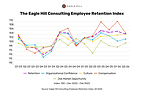
ARLINGTON, Va., July 14, 2026 /PRNewswire/ — The latest Eagle Hill Consulting Employee Retention Index declined 1.3 points in the second quarter of 2026 to 104.2, marking its lowest level in the past year and signaling that U.S. workers will be less likely to remain in their current roles over the next six months. While retention remains relatively strong by historical standards, the latest data suggest employers may be entering a period of increased workforce mobility.
The decline comes as employees grow less satisfied with their compensation while simultaneously growing more optimistic about opportunities in the external job market. Notably, these shifts occurred even as employees’ confidence in organizations and satisfaction with workplace culture improved.
“Today’s workforce is sending employers a nuanced message,” said Melissa Jezior, president and chief executive officer of Eagle Hill Consulting. “Employees generally feel good about their organizations and workplace culture, but many are questioning whether their compensation and long-term growth opportunities are keeping pace with the market. When workers begin to believe they have better options elsewhere, retention risks increase, even inside organizations with strong cultures.”
The findings come as the broader labor market sends mixed signals. The latest Job Openings and Labor Turnover Survey (JOLTS) showed job openings holding steady at 7.6 million, exceeding expectations and suggesting opportunities remain available for workers considering a move. At the same time, the June jobs report showed hiring slowed considerably, highlighting a labor market that is cooling but continues to offer opportunities for skilled talent.
“Employers shouldn’t interpret a slower hiring market as a reason to become complacent,” Jezior added. “Workers are evaluating the entire employee experience, not just whether they have a job, but whether they see a future with their employer. Organizations that invest in career development, leadership, culture, and meaningful rewards will be in the strongest position to retain critical talent as mobility begins to increase.”
Key Retention Index Indicators
Compensation Indicator: Declined 5.6 points, representing the only indicator to weaken this quarter.Job Market Opportunity Indicator: Increased 1.9 points, reflecting growing optimism about external job opportunities.Organizational Confidence Indicator: Increased 0.9 points, rebounding after two consecutive quarters of decline.Culture Indicator: Increased 0.3 points, continuing its steady upward trend for a fourth consecutive quarter.
Millennials Emerge as the Biggest Retention Risk
Although overall retention outlook declined modestly, the largest shift occurred among Millennials. Millennials experienced a 6.1-point decline in the Retention Index, signaling that they pose an attrition risk. They were the only generation to report declines across organizational confidence, compensation, and culture while simultaneously expressing greater confidence in outside job opportunities.
As Millennials increasingly occupy management, leadership, and specialized professional roles, this shift could have outsized implications for organizations.
“Millennials now represent the backbone of leadership pipelines across many organizations,” said Jezior. “When this generation begins questioning whether to stay, employers risk losing institutional knowledge, leadership continuity, and future executives. The findings underscore why retaining high-potential talent must be a core business and workforce planning priority, not just an HR initiative.”
Generational Gap Begins to Narrow
Unlike previous quarters, retention outlooks across generations became more closely aligned.
Gen Z reported a modest decline.Millennials experienced the sharpest drop.Gen X became more likely to stay.Baby Boomers also showed improved retention sentiment.
Compensation Increasingly Drives Retention Decisions
The Compensation Indicator experienced its sharpest decline in recent quarters, suggesting employees are placing greater emphasis on total rewards, future earning potential, and advancement opportunities.
Combined with improving perceptions of external job opportunities, the findings indicate workers may increasingly compare what they receive today against what they believe they could earn elsewhere.
The Eagle Hill Employee Retention Index is a first-of-a-kind market indicator that tracks worker sentiment across four proven drivers of retention: organizational confidence, culture, compensation, and job market opportunity.
The Organizational Confidence Indicator measures how confident employees are in their organization’s future and leadership.The Culture Indicator looks at employee sentiment about their workplace culture, connections, and whether they feel valued and recognized.The Compensation Indicator measures how employees view their compensation, benefits, and ability to grow their compensation at their organization.The Job Market Opportunity Indicator measures how employees perceive external prospects for employment and job security in the near term.
Each month, the Eagle Hill Consulting Employee Retention Index measure shifts in workforce retention based upon ongoing employee opinion surveys on factors related to worker intentions to change jobs. As the Employee Retention Index increases, it signals an increase in retention in the next six months. As the Employee Retention Index decreases, it signals to employers that workers are more likely to leave their jobs, and organizations can expect more turnover in the next six months.
The Eagle Hill Consulting Employee Retention Index is based on a monthly omnibus survey conducted by IPSOS of a nationally representative sample of U.S. adults employed full- or part-time. Quarterly indices and reports are issued based on a minimum of 1,200 aggregated responses per quarter. Respondents are polled on a range of workforce topics including organizational confidence, culture, compensation, and job market opportunity.
The survey commenced in December 2022, and the most recent data was collected from April and June 2026.
Eagle Hill Consulting LLC is an award-winning business that provides unconventional management consulting services in the areas of Organizational Performance, Business Intelligence, Technology Enablement, Talent, and Change Management. The company’s expertise in delivering innovative solutions to unique challenges spans across Fortune 500 companies, government agencies, and global nonprofits. Eagle Hill has offices in the Washington, D.C. metropolitan area, Boston, MA, and Seattle, WA. More information is available at www.eaglehillconsulting.com.
View original content to download multimedia:https://www.prnewswire.com/news-releases/eagle-hill-retention-index-employee-retention-outlook-softens-as-workers-reassess-their-options-302825245.html
SOURCE Eagle Hill Consulting LLC
Technology
New Flywheel Report Shows How Brands Can Turn Fragmentation into a Competitive Advantage
Published
16 minutes agoon
July 14, 2026By
The Big Shift outlines how a Total Commerce approach can connect media, retail, trade and consumer engagement as shopping journeys become increasingly complex.
BALTIMORE, July 14, 2026 /PRNewswire/ — Flywheel, a leader in commerce and technology solutions and part of the Omnicom (NYSE: OMC) Integrated Media offering, today released The Big Shift: From Managing to Mastering Fragmentation, a new white paper examining how AI-powered search, social commerce, retail media and organizational silos are reshaping the way brands drive growth.
While 80% of consumers (OM Research, Connected Commerce 2024) now take a non-linear path to purchase, many brands still manage media, retail, trade, and shopper marketing through separate teams, budgets, and performance metrics. According to Flywheel, that disconnect leads to wasted media investment, missed sales opportunities, unmeasured promotional impact, and reduced organizational agility.
The report argues that brands must adopt a Total Commerce approach, a business model that unifies consumer discovery, retail activation, media investment, trade planning, and measurement into one operating system focused on business outcomes rather than channel performance.
“The way consumers discover and buy products has fundamentally changed,” said Mike Feldman, SVP Commerce at Flywheel. “A shopper might discover a product through a creator, research it through an AI assistant, purchase it through a retailer marketplace and pick it up in-store, all within a few hours. The brands winning today are not treating those moments as separate channels. They are organizing around one connected consumer journey.”
The report notes that TikTok generated $33.1 billion in gross merchandise volume in Q1 2026, surpassing eBay and demonstrating how quickly discovery and purchase are converging on a single platform.
The report identifies three forces accelerating the fragmentation challenge:
Consumer discovery has fundamentally changed. Social platforms have become primary discovery engines, with 73% of Gen Z and 67% of Millennials (Salsify, 2025) citing social media as their main source for learning about new products. Nearly half of social media users have also used influencers in their purchase journey.AI is becoming a new discovery channel. Thirty-six percent of consumers, including 45% of Gen Z and 51% of Millennials (OM Research – GEO Update April 2026) say they have shifted most of their searches from traditional search engines to generative AI platforms.Retailers have become media companies. Retailers now operate advertising businesses, premium content platforms and closed-loop measurement capabilities that increasingly connect media exposure to purchase behavior.
The report arrives as marketers grapple with many of the same trends that dominated conversations at this year’s Cannes Lions Festival of Creativity, including creator commerce, retail media, and AI-powered discovery. Against that backdrop, The Big Shift emphasizes the continued importance of physical retail, arguing that while discovery increasingly happens across creators, AI, retail media and connected TV, the shelf remains one of the most critical moments in the consumer journey.
“The physical shelf is still one of the most important moments in commerce, but it is no longer where the consumer journey begins,” said Phil Camarota, Chief Creative Officer at Flywheel and President of the Cannes Lions Creative Commerce Jury. “By the time a shopper reaches a store or product page, they have already been influenced by creators, retail media, reviews, AI recommendations and countless other touchpoints. The brands that succeed are creating one connected experience, across all those moments.”
The report also highlights Flywheel client Danone’s “Become a Home’Rista” campaign as an example of Total Commerce in action. Built around the insight that many consumers believed barista-quality coffee required professional expertise, the program connected influencer content, retail media, digital shelf activation and in-store experiences across multiple retailers. The campaign generated 641 million impressions and multi-brand halo sales across Danone’s portfolio.
Ariel Dalton, Head of Strategic Insights, Planning & Connected Commerce at Danone shared: “We uncovered what we call the ‘barista gap’ and built a campaign that inspires consumers to recreate and elevate the coffeehouse experience at home. The success of this campaign demonstrated the power of pairing a compelling consumer insight with the strength of Danone’s portfolio, to deliver a daily ritual that feels both elevated and unique to the consumer. What began as a pilot in 2025 has evolved into one of our flagship programs, scaling across multiple retail activation nationwide.
“Fragmentation leaves brands with a simple choice: manage it or master it,” Feldman said. “Brands that own consumer journeys across channels, orchestrate with retailers around shared outcomes and align internally around one set of goals will create competitive advantage. The brands that master fragmentation will define the next era of commerce.”
About Flywheel:
Flywheel, a leader in commerce and technology solutions and part of the Omnicom (NYSE: OMC) Integrated Media offering, provides best-in-class service that combines tailored expertise with advanced software solutions to help clients drive incremental sales, market share, profitability, and measurable commerce growth.
A leader across major marketplace platforms, Flywheel combines global scale and influence with a customized, client-centric approach designed to deliver impactful business outcomes. Client success remains at the center of the company’s mission.
With operations across the Americas, Europe, APAC, and China, Flywheel is widely recognized for the scale of its retail media capabilities, while delivering value across the entire commerce ecosystem. The company helps brands navigate the evolving commerce landscape through integrated solutions built to accelerate growth and performance.
View original content to download multimedia:https://www.prnewswire.com/news-releases/new-flywheel-report-shows-how-brands-can-turn-fragmentation-into-a-competitive-advantage-302822256.html
SOURCE Flywheel Digital
Ramp Launches Ramp for Construction to Help Companies Catch Job Overruns Before Month-End
Eagle Hill Retention Index: Employee Retention Outlook Softens as Workers Reassess Their Options
New Flywheel Report Shows How Brands Can Turn Fragmentation into a Competitive Advantage
Send Rakhi to UK swiftly with UK Gifts Portal
Whiteboard Series with NEAR | Ep: 45 Joel Thorstensson from ceramic.network
New Gooseneck Omni Antennas Offer Enhanced Signals in a Durable Package
Why You Should Build on #NEAR – Co-founder Illia Polosukhin at CV Labs
Whiteboard Series with NEAR | Ep: 45 Joel Thorstensson from ceramic.network
NEAR End of Year Town Hall 2021: The Open Web World, MetaBUILD 2 Hackathon and 2021 recap
Trending
-
Technology4 days agoMedical AI Ecosystem Innovation Forum and iMedLoop Global Medical Imaging Data Platform Launch Held in Beijing
-
Technology4 days agoThe Original Pioneer: You & HIKMICRO – Celebrating Three Years of Leading the Digital Hunt Together
-
Coin Market3 days agoBitcoin nearing late stages of bear market: Jamie Coutts, Real Vision
-
Technology4 days agoSummary Notice of Pendency and Proposed Settlement of Stockholder Derivative Action
-
Technology4 days agoFrontier Airlines Data Breach: Edelson Lechtzin LLP Launches Investigation Into Exposure of Personal Information
-
Technology4 days agoinsureMO Congratulates its Customer Union Assurance on Winning the 2026 Celent Model Insurer Award
-
Technology4 days agoThe future takes flight: AT&T and Ericsson demonstrate drone detection outside of AT&T Stadium
-
Coin Market4 days agoUS CBDC ban to go into effect without Trump signoff on housing bill