Connect with us

Technology

TIER IV joins JST’s Next-Generation Edge AI Semiconductor R&D Program to open-source AI chip designs for autonomous driving

Published

on

TOKYO, Aug. 14, 2026 /PRNewswire/ — TIER IV, the pioneering force behind open-source software for autonomous driving, has joined the Next-Generation Edge AI Semiconductor Research and Development Program led by the Japan Science and Technology Agency (JST) to advance research and development of a software-defined system-on-chip (SoC) for Level 4 autonomous driving. Under the JST program, a research team led by Professor Yoshihiro Kawahara of Graduate School of Engineering, The University of Tokyo, will advance research into use-case-driven, functionally differentiated physical AI chip design. Meanwhile, TIER IV is developing the logic design of an AI chip designed to efficiently process inference for end-to-end (E2E) autonomous driving AI, with the goal of open-sourcing the design assets and associated toolchain.

High-performance computing technologies, including graphics processing units (GPUs), have played a central role in accelerating the rapid evolution of AI. Level 4 autonomous driving, however, requires AI models to operate continuously under real-world and real-time constraints. This calls for a new approach that complements existing high-performance computing technologies while further advancing not only power efficiency, but also adaptability, transparency, and verifiability.

Through this initiative, TIER IV will independently design an AI chip for autonomous driving that supports Autoware, the world’s leading open-source software for autonomous driving, and evaluate its effectiveness as part of an SoC. In addition to the chip’s logic design, TIER IV will open-source the compiler and related toolchain. By making these technologies available, TIER IV aims to establish an open ecosystem in which semiconductor manufacturers can leverage its platform technologies to accelerate the commercialization of SoCs for Level 4 autonomous driving.

Power efficiency

Autonomous driving AI increasingly relies on large-scale Transformer models that process sensor inputs, such as camera images and point cloud data, in an integrated manner from perception through motion planning. This initiative will focus on Transformer inference and develop a dedicated architecture that simplifies the complex control mechanisms required for general-purpose computing.

Data required for AI model execution will be efficiently placed in advance and repeatedly reused within the chip, reducing the power consumed by external memory transfers and computation control. The architecture will also incorporate dedicated compute circuits for operations frequently used in Transformers, including matrix multiplication and attention mechanisms.

Rather than optimizing only the chip’s peak performance, TIER IV will seek to improve performance per watt across the entire autonomous driving system, including Autoware. The design will support flexible deployment across a broad range of applications, from embedded devices operating at several watts to in-vehicle electronic control units operating at several tens of watts.

Adaptability

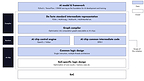
The technology landscape surrounding autonomous driving AI is evolving rapidly, making it difficult for architectures designed around a specific model or hardware configuration to adapt continuously to change. To address this challenge, TIER IV will introduce the Tensor Operator Set Architecture (TOSA), a standardized intermediate representation, between AI models and the AI chip.

Operations from AI models developed in frameworks such as PyTorch will be converted into a common TOSA representation. Optimization and code generation will then be performed through TOSA before execution on the AI chip, enabling loose coupling between AI frameworks and hardware.

As a result, changes in AI model architectures or computational methods can be accommodated primarily through software updates to components such as the compiler and runtime, without requiring the entire chip to be redesigned from scratch. TIER IV aims to realize a software-defined SoC whose performance and power efficiency can be continuously optimized through software.

Transparency

In safety-critical applications such as Level 4 autonomous driving, it is important to understand not only the AI model itself, but also the internal architecture and processing flow of the computing system on which it runs. Under this initiative, TIER IV will open-source the logic design of its autonomous driving AI chip, together with the compiler and related toolchain.

By making the design information publicly available, TIER IV will enable semiconductor manufacturers and developers to inspect the chip’s internal architecture and software behavior, and to modify, extend, and reuse the technologies according to their vehicle platforms, AI models, performance requirements, and power constraints.

Just as Autoware has enabled collaborative development of autonomous driving software, TIER IV will extend the same open-source philosophy to AI chip design and related toolchains. This will support an ecosystem in which autonomous driving AI technologies can be continuously improved and advanced without dependence on specific semiconductor products or closed development environments.

Verifiability

The process of executing an AI model on a chip involves model-format conversion, computational optimization, quantization, rounding, and other transformations. These processes are essential to improving performance and power efficiency, but they may also introduce numerical differences that affect the final computation results. A mechanism is therefore needed to assess the impact of such differences.

Using TOSA and its clearly defined operator specifications as a foundation, TIER IV will structure the compilation transformation process and introduce formal verification techniques. For selected transformations and operations, the initiative will establish mechanisms to mathematically verify numerical consistency before and after transformation, as well as compliance with predefined error tolerances.

Through this approach, TIER IV will pursue not only high processing performance, but also an execution environment in which the transformations applied to an AI model before chip execution can be traced and the correctness of the resulting processing can be verified. This will contribute to a more reliable execution environment for autonomous driving AI.

Supporting quotes

“Advances in AI have been accelerated by powerful computing platforms, including GPUs, which have enabled rapid progress across the industry,” said Shinpei Kato, founder and CEO of TIER IV. “As Level 4 autonomous driving moves toward broader deployment, we believe the next step is to complement these platforms with computing architectures designed for real-world and real-time requirements. Through this initiative, we are introducing a software-defined and open approach to AI chip design that combines power efficiency, adaptability, transparency and verifiability. In particular, the ability to understand how an AI model is transformed for execution and to verify the correctness of that processing will be increasingly important as autonomous driving systems are deployed in safety-critical environments. By extending the open-source philosophy behind Autoware from software to AI chip design and related toolchains, we aim to create an open ecosystem in which automakers, semiconductor manufacturers and developers can build upon the technology and continue advancing their own systems. This represents an important step toward a scalable, adaptable and reliable computing foundation for Level 4 autonomous driving.”

“In physical AI applications such as robotics and autonomous driving, GPU power consumption has long been a major bottleneck for deployment on battery-powered devices,” said Professor Yoshihiro Kawahara of Graduate School of Engineering, The University of Tokyo. “This project aims to fundamentally overcome this constraint through a functionally differentiated chip design backward-mapped from specific use cases. I look forward to TIER IV developing chips responsible for high-level decision-making – specifically, the high-level behavioral layer that handles the thinking process essential for end-to-end physical AI and autonomous driving. As the leading force behind Autoware, the global standard open-source software for autonomous driving, TIER IV is democratizing design, with an approach spanning application requirements to hardware. This enables applied researchers to shape their ideal semiconductors. This initiative, supported by an open ecosystem, has the potential to lay the foundations for a steady stream of Japanese startups creating high-value semiconductors.”

About TIER IV

TIER IV stands at the forefront of deep tech innovation, pioneering Autoware, open-source software for autonomous driving. With a comprehensive suite of platforms and services built around Autoware, TIER IV provides everything from software development and vehicle procurement to operational support. Through the Autoware ecosystem, TIER IV works with partners worldwide to shape the future of intelligent vehicles with open-source software, aiming to create mobility that is safer, more sustainable, and accessible to all.

Media contact
pr@tier4.jp 

The word marks and logos of TIER IV are trademarks or registered trademarks of TIER IV, Inc. in Japan and other countries. All other company names, product names, service names, and logos referenced herein are trademarks or registered trademarks of their respective owners.

Autoware is a registered trademark of the Autoware Foundation.

View original content to download multimedia:https://www.prnewswire.com/news-releases/tier-iv-joins-jsts-next-generation-edge-ai-semiconductor-rd-program-to-open-source-ai-chip-designs-for-autonomous-driving-302850781.html

SOURCE TIER IV, Inc.

Continue Reading

Technology

Altimetrik Accelerates Enterprise AI Transformation with Google Cloud’s Gemini for Healthcare

Published

on

By

BENGALURU, India, Nov. 11, 2026 /PRNewswire/ — Altimetrik, an AI engineering company, has launched new industry-specific AI capabilities built on Google Cloud’s Gemini for healthcare to automate complex enterprise workflows. As an integration partner, Altimetrik will help healthcare organizations put agentic AI to work on their most complex operational challenges.

Together, Google Cloud and Altimetrik will put these capabilities to work by integrating AI with existing enterprise data, systems, and workflows for healthcare organizations. Combining Google Cloud’s advanced AI capabilities with Altimetrik’s healthcare domain expertise and enterprise engineering, the collaboration aims to streamline administrative processes, improve access to clinical and operational information, and support more effective care coordination.

Altimetrik will build and deploy these solutions using its ALTi AIOS™ framework, complementing Google Cloud’s technology with workflow orchestration, and governance. The framework incorporates agent permissions, auditability, and human oversight into solution design, enabling healthcare organizations to adopt agentic AI responsibly.

“Pilots are easy. Scaling is the hard part, especially when AI must operate within decades of established systems, data, and processes,” said Raj Sundaresan, CEO of Altimetrik. “In healthcare, AI must earn the trust of the people delivering care. Since joining Google Cloud’s AI-native partner cohort earlier this year, our forward-deployed engineers have been helping organizations move agentic AI from pilot to production through ALTi AIOS™, ensuring every agent is permissioned, auditable, and accountable. Gemini for healthcare provides a powerful foundation for the industry, and we are proud to build on that foundation as a launch partner, while keeping care teams firmly in control.”

“Healthcare organizations need solutions that bridge cutting-edge AI with day-to-day operational realities,” said Satish Thomas, Vice President, Google Cloud. “Our collaboration with Altimetrik brings Gemini directly into mission-critical workflows, helping healthcare leaders to streamline administrative processes, improve coordination, and make data more actionable.”

Altimetrik first partnered with Google Cloud earlier this year when it became a part of the company’s cohort of AI-native partners to scale agentic AI across the global enterprise.

Learn more about how Altimetrik is building governed, agentic solutions that help healthcare teams make more confident decisions.

About Altimetrik

Altimetrik is an AI engineering company helping some of the most revered and iconic enterprises modernize systems, data, and processes at the heart of their business, so they can move faster, operate more efficiently, and innovate continuously. Through ALTi AIOS™, its AI-native operating system, Altimetrik combines the latest AI capabilities with deep engineering expertise to help clients solve complex challenges, accelerate modernization, and deliver measurable outcomes at scale.

Altimetrik’s clients get access to the latest AI innovations while maintaining flexibility to choose the right technologies for their business, through trusted relationships with OpenAI, Google Gemini, Anthropic, Databricks, and major hyperscalers.

A member of the World Economic Forum’s Centre for AI Excellence, the Forum’s global hub for shaping responsible AI, Altimetrik is also recognized in the 2025 Constellation Research ShortList™ for Global AI Services and named a Major Contender in multiple Everest Group PEAK Matrix® assessments, including Software Product Engineering Services (2026), Enterprise Quality Engineering Services (2025), and Digital Engineering Services for BFSI and Life Sciences. Learn more at altimetrik.com.

View original content to download multimedia:https://www.prnewswire.com/in/news-releases/altimetrik-accelerates-enterprise-ai-transformation-with-google-clouds-gemini-for-healthcare-302935320.html

Continue Reading

Technology

20th Global Entrepreneurship Week China 2026 Kicks off in Shanghai

Published

on

By

SHANGHAI, Nov. 11, 2026 /PRNewswire/ — On November 10, 20th Global Entrepreneurship Week China 2026 (hereinafter referred to as “Entrepreneurship Week”) kicked off in Shanghai.

Running from November 10 to 14, 2026 for five days, this edition features more than 50 entrepreneurship events, bringing together over 100 distinguished global guests, representatives from nearly 500 cutting-edge tech enterprises and professional investment institutions, and more than 1,500 entrepreneurs.

By focusing on “Learning”, “Showcase”, “Matchmaking” and “Empowerment”, Global Entrepreneurship Week China builds an all-round entrepreneurship support ecosystem and creates an international platform for in-depth exchanges among entrepreneurs.

This year’s event further elevates its international profile. Jonathan Ortmans, Founder and President, Global Entrepreneurship Network, led a delegation of more than 20 international guests, including outstanding entrepreneur representatives and seasoned entrepreneurship mentors from the Republic of Korea, the United States, Chile, Germany, Egypt, New Zealand and other countries, to Global Entrepreneurship Week China, enabling Chinese and foreign entrepreneurs to share valuable experience from diverse entrepreneurial ecosystems with zero distance.

Taking the 20th anniversary as an opportunity, this year’s Entrepreneurship Week further highlights its role in disseminating innovative ideas. It features five themed days tailored to Shanghai’s industrial tracks, catering to the growth needs of entrepreneurs across the full lifecycle. Future Intelligence Day focuses on cutting-edge areas including intelligent computing, general AI, quantum technology and humanoid robots; Future Manufacturing & Materials Day focuses on sectors such as humanoid robots, precision intelligent equipment and flexible manufacturing; Future Energy Day focuses on controllable nuclear fusion, advanced nuclear energy, long-duration energy storage, hydrogen energy, solid-state batteries and other fields; Future Health Day covers tracks of brain-computer interface, cell and gene therapy, biomanufacturing and regenerative medicine; Angel Fund & Future Space Day centers on campus entrepreneurship, early-stage startup pitching, entrepreneurship research, commercial aerospace, low-altitude economy, future mobility and other themes.

More than 50 entrepreneurship activities including startup project pitching, achievement exhibitions, sci-tech innovation community exchanges, and cultural and sports interactions will be held successively on Fuxing Island. These activities build a platform for global entrepreneurs to connect technologies, capital and industrial resources, and the event will run through November 14.

View original content:https://www.prnewswire.com/news-releases/20th-global-entrepreneurship-week-china-2026-kicks-off-in-shanghai-302936055.html

SOURCE Global Entrepreneurship Week China

Continue Reading

Technology

Dragonpass Acquires iCoupon the Leading Global Voucher Redemption Network to Build International Loyalty-as-a-Service Platform

Published

on

By

Strategic Acquisition Combines Dragonpass’ Loyalty Infrastructure, Powering 35 of the World’s 50 Largest Banks, With iCoupon’s Vouchering Technology Supporting Over One Billion Passengers

SINGAPORE, Nov. 11, 2026 /PRNewswire/ — Dragonpass, the global travel and lifestyle benefits platform serving more than 45 million members worldwide, has announced the acquisition of iCoupon, the intelligent digital vouchering technology business whose network spans over 400 airports worldwide. The transaction represents a strategic expansion of Dragonpass’ technology and distribution capabilities, combining established financial services relationships with extensive airline and retail integrations to accelerate its development of a global loyalty-as-a-service platform.

The acquisition follows almost a decade of commercial collaboration between the two businesses, initially focused on delivering digital dining benefits across airports. While Dragonpass has developed its global presence through partnerships with financial institutions, including some of the world’s largest banks and payment networks, iCoupon has built complementary infrastructure connecting 200 airlines, over 400 airports and 4,000 retail units across 56 countries. The combination creates immediate opportunities to expand dining and retail offerings, alongside access to previously untapped solutions and customer segments across both networks.

In the near term, Dragonpass will focus on extending its dining and retail propositions through iCoupon’s established network, while introducing additional Dragonpass services to iCoupon’s airline and airport partners. Longer term, the business will explore how transferable integrations can support a wider lifestyle offering beyond aviation, creating opportunities to deliver relevant benefits across more frequent customer interactions. iCoupon’s existing team will remain in place, with its open-network model continuing to operate, ensuring continuity for existing partners while supporting new opportunities across the combined business.

Dragonpass acquires iCoupon following nearly a decade of collaboration, expanding its financial services, aviation and retail capabilities.iCoupon’s network spans over 200 airlines, 400+ airports and over 4,000 retail units across 56 countries, with support already available to over one billion passengers.iCoupon issued over £100 million in digital vouchers in 2025, demonstrating the scale of its existing distribution and redemption infrastructure.Dragonpass research finds 50% of Britons consider loyalty schemes outdated, while 76% value affordable everyday treats.The deal strengthens dining and retail offerings in the near term, supporting Dragonpass’ wider ambition to build a global loyalty-as-a-service platform

Jane Zhu, CEO & Co-founder at Dragonpass, shares:

“The acquisition of iCoupon represents a significant step in our strategy to build a global loyalty-as-a-service platform. Having worked together for almost a decade, we recognise the strength of its technology and network, and the immediate opportunity to expand our dining and retail offering while exploring applications across new lifestyle markets.

“The future of loyalty lies in connecting customer intelligence with relevant benefits at scale. By bringing together complementary distribution networks and investing in more intelligent engagement technology, we’re building the infrastructure to help our partners deliver greater value to customers, precisely when they need it.”

iCoupon’s technology enables airlines and other partners to distribute vouchers, discounts and customer entitlements through existing identifiers, including boarding passes, barcodes and QR codes. Integrated directly into participating retailers’ point-of-sale systems, its platform supports real-time redemption, transaction tracking and automated reconciliation. Having issued over £100 million in digital vouchers during 2025, including 12 million food and beverage entitlements, iCoupon has expanded into 13 technology modules spanning passenger care, retail and other travel services, providing Dragonpass with additional capabilities and new commercial opportunities.

Richard Bye, CEO and Co-founder at iCoupon, shares:

“For too long, loyalty has been constrained by fragmented ecosystems, disconnected rewards and experiences that often fail to reflect what customers genuinely value. This acquisition is about helping accelerate a shift away from traditional points-based programmes towards real-time, contextual engagement that delivers meaningful benefits exactly when and where they matter most. By combining Dragonpass’ global distribution and customer intelligence capabilities with iCoupon’s powerful airline connected redemption infrastructure, we are creating the foundations for a new generation of loyalty; one that is intelligent, frictionless and seamlessly embedded into the everyday lives of consumers around the world.”

Dragonpass’ nationally representative Comfort Index finds 50% of Brits consider loyalty schemes outdated, revealing the mounting pressure on traditional loyal models to demonstrate value while 48% of Brits are more likely to switch long-term providers due to rising costs, poor support or irrelevant rewards. Meanwhile, 69% say brands that reduce everyday friction are more likely to earn their loyalty. Demand for practical benefits is also growing, with 76% valuing affordable everyday treats, despite 56% worrying about the cost of dining, drinks and experiences.

This expansion forms part of Dragonpass’ broader investment in data orchestration and customer engagement technology. By connecting a wider global benefits supply chain with more intelligent distribution and personalisation capabilities, the company aims to address a longstanding challenge for enterprise loyalty programmes: sourcing relevant benefits across markets and delivering them through a seamless customer experience. Its longer-term strategy is to enable financial institutions, airlines and other partners to move beyond static rewards catalogues, offering benefits aligned with individual customer needs, while strengthening engagement and commercial value across its network.

About Dragonpass

Established in 2005, Dragonpass is a leading global travel and lifestyle platform, providing premium benefits and experiences to more than 45 million members worldwide. Its growing ecosystem spans travel, health and wellness, lifestyle and entertainment, with a global network covering more than 140 countries and regions and partnerships with more than 800 enterprises.

About iCoupon

iCoupon is a market-leading intelligent vouchering company with a global presence, specialising in the provision of digital vouchering services within the aviation industry and beyond. Collaborating with an extensive network of more than 200 airlines, spanning over 400 airports and in excess of 4,000 retail establishments, the company’s aim is to share value and place it where it counts. iCoupon leverages its unique technology to facilitate the seamless distribution of intelligent vouchers by airlines, airports, ground handlers and retailers directly to passenger boarding passes, enhancing the value-sharing experience.

View original content to download multimedia:https://www.prnewswire.com/apac/news-releases/dragonpass-acquires-icoupon-the-leading-global-voucher-redemption-network-to-build-international-loyalty-as-a-service-platform-302936106.html

SOURCE Dragonpass

Continue Reading

Trending