Connect with us

Technology

Diagnostic Imaging Market to Reach US$ 33.2 Bn by 2031, Growing at 4.6% CAGR: New Report by Wissen Research

Published

on

Rising Demand for Early Disease Detection and AI-Enabled Imaging Drives Steady Market Expansion Through 2031

SHERIDAN, Wyo., Sept. 16, 2026 /PRNewswire/ — The global diagnostic imaging market is projected to grow from USD 26.5 billion in 2026 to USD 33.2 billion by 2031, registering a CAGR of 4.6% during the forecast period (2026–2031), according to a new study by Wissen Research.

Growth is being driven by rising chronic disease prevalence, an expanding geriatric population, and increasing demand for earlier and more precise disease detection. AI-assisted imaging, 3D/4D visualization, and portable imaging devices are improving diagnostic accuracy, streamlining radiology workflows, and extending imaging access across hospitals, outpatient clinics, emergency settings, and rural healthcare facilities.

See the Full Data Behind This Forecast — Get a Free Sample Report

Where the Technology Is Heading: AI Moves Into the Scanner Itself

The most significant shift in diagnostic imaging is not happening after the scan — it is happening during it. Major manufacturers are embedding deep learning reconstruction (DLR) algorithms directly into image acquisition pipelines, clearing signal-level noise as data is captured rather than cleaning up images afterward.

The clinical impact is measurable. GE HealthCare’s Sonic DL sequence now enables complex multi-sequence brain and joint MRI protocols to complete in under 15 minutes, allowing hospitals to increase daily throughput per scanner substantially without new capital equipment. Radiology remains the leading specialty for AI-enabled device clearances, with more than 1,100 cleared by the U.S. FDA to date.

Alongside this, cloud-native PACS and teleradiology platforms are replacing on-premise image archives, enabling remote reads across multi-site networks and reducing reporting turnaround times. Photon-counting CT and hybrid imaging systems are pushing resolution higher while lowering radiation dose, supporting earlier detection in oncology, cardiology, and neurology.

What’s Fueling Growth in the Diagnostic Imaging Market

AI-Enabled Imaging Adoption: AI-based systems are improving diagnostic precision, shortening scan-to-diagnosis time, and raising patient throughput across care settings.Cloud PACS and Teleradiology Expansion: Remote reading platforms are accelerating reporting and improving specialist access across distributed hospital networks.Photon-Counting CT Commercialization: Ultra-high-definition imaging with reduced radiation exposure is shortening replacement cycles for high-end equipment.Portable and Handheld Imaging: Point-of-care ultrasound and mobile systems are expanding diagnostic access in emergency departments, outpatient centers, and rural facilities.Safer Contrast Agents: Non-nephrotoxic imaging options are extending diagnostic access to chronic kidney disease patients.Certified Refurbished Systems: Lower capital barriers are enabling imaging infrastructure expansion across developing markets.

Need Data Specific to Your Region or Segment? Request a Custom Report

Challenges Facing the Diagnostic Imaging Market

Reimbursement compression is emerging as the sector’s most pressing operational constraint. The Centers for Medicare & Medicaid Services introduced an efficiency adjustment in the 2026 Medicare Physician Fee Schedule that permanently reduces work relative value units by 2.5% across roughly 7,700 diagnostic and procedural codes. New combined head and neck CTA codes have produced global payment reductions of up to 30.8%. The result is a growing misalignment between what providers invest in premium scanners and what public payers reimburse — pushing many networks to extend equipment life cycles rather than upgrade.

Beyond reimbursement, high acquisition and maintenance costs for MRI and CT systems remain a barrier for community hospitals and providers in developing markets. A persistent shortage of qualified radiologists is contributing to reporting backlogs, while the shift to cloud-based imaging raises data security and cybersecurity considerations for healthcare providers.

Recent Strategic Developments in the Diagnostic Imaging Market

In May 2026, GE HealthCare introduced next-generation SIGNA MRI technologies and AI-based workflow solutions at ISMRM 2026, including new 3T and helium-free MRI systems, deep learning imaging technologies, and cloud-based research tools.

Also in May 2026, Siemens Healthineers launched an integrated workflow solution for CT-guided percutaneous coronary interventions, combining CT imaging, plaque analysis, procedural planning, and cath lab guidance in a single application.

In March 2026, Samsung Medison consolidated its U.S. medical imaging divisions, NeuroLogica and Boston Imaging, under the Samsung HME America brand, expanding into AI ultrasound, digital radiography, portable CT, and photon-counting detector technologies.

In February 2026, Fujifilm Holdings launched the ARIETTA Deep Insight x ultrasound platform, applying AI and deep learning to improve image quality, with automated workflow tools and real-time virtual sonography.

Key Insights from Diagnostic Imaging Market Analysis

X-ray systems led the market by modality in 2025, supported by the highest global procedure volumes of any modality, lower installation and shielding requirements, and continued analog-to-digital replacement demand.2D imaging held the largest share by technology type in 2025, driven by faster acquisition and turnaround times, lower infrastructure needs, and the fact that most AI triage algorithms were built around standard 2D radiography and ultrasound workflows.North America held the largest regional share in 2025, supported by strong reimbursement, high per-capita imaging volumes, and large health systems with significant purchasing capacity.Asia-Pacific is the fastest-growing region, driven by healthcare infrastructure expansion, rising healthcare expenditure, and growing adoption of AI-enabled and portable imaging across urban and underserved areas.

Key Players in the Diagnostic Imaging Market

Leading companies are focused on embedding AI into imaging platforms, expanding cloud and enterprise imaging capabilities, and broadening portable and point-of-care portfolios.

Company

Key Focus Area

GE HealthCare (US)

SIGNA MRI platforms and deep learning reconstruction

Siemens Healthineers (Germany)

CT, interventional imaging, and integrated procedural workflows

Philips (Netherlands)

Enterprise imaging, cloud PACS, and AI-enabled platforms

Canon Medical Systems (Japan)

CT, MRI, and ultrasound imaging systems

Fujifilm Holdings (Japan)

AI-driven ultrasound and enterprise imaging management

Samsung Medison (South Korea)

AI ultrasound, portable CT, and photon-counting detectors

Hitachi Healthcare (Japan)

Diagnostic imaging systems portfolio

Shimadzu Corporation (Japan)

X-ray and fluoroscopy imaging systems

Hologic (US)

Mammography and breast imaging

United Imaging Healthcare (China)

Advanced imaging systems manufacturing

Butterfly Network (US)

Handheld point-of-care ultrasound

Nano-X Imaging (Israel)

Digital X-ray and imaging access technologies

Regional Analysis and Growth Opportunities

North America leads the diagnostic imaging market, underpinned by advanced healthcare infrastructure, high imaging procedure volumes, favorable reimbursement for advanced modalities, and sustained hospital investment in premium imaging technology. An aging population and the formation of large health networks and group purchasing organizations continue to support long-term equipment and service contracts.

Asia-Pacific is the fastest-growing region, propelled by healthcare infrastructure expansion, rising healthcare expenditure, and improving access to advanced diagnostics across China, India, Japan, South Korea, and Australia. Government investment in healthcare modernization and the growth of private hospitals and imaging centers are accelerating adoption, while AI-enabled and portable systems are extending diagnostic capability into underserved areas.

Europe, Latin America, and the Middle East & Africa complete the report’s regional coverage, with growth shaped by screening program expansion and imaging infrastructure investment.

Wissen Research’s healthcare technology analysts are available to walk through findings specific to your market, region, or competitive set.

Need Insights Specific to Your Business? Request a Customized Version of This Report:

Market Segmentation Snapshot

The global diagnostic imaging market is segmented across modality, technology, portability, architecture, application, end user, and region:

By Modality Type: X-RayUltrasoundComputed Tomography (CT)Magnetic Resonance Imaging (MRI)Nuclear Imaging (PET/SPECT)MammographyFluoroscopyBy Technology Type: 2D Imaging3D/4D ImagingAI-Enabled ImagingPortable/Point-of-Care ImagingCloud-Based Imaging InformaticsBy Portability Type: Fixed Imaging SystemsPortable/Mobile Imaging SystemsBy Source/Architecture Type: Standalone Imaging SystemsHybrid Imaging Systems (PET-CT, SPECT-CT, PET-MRI)By Application Type: CardiologyOncologyNeurologyOrthopedicsGynecology & ObstetricsPulmonologyGastroenterologyBy End User: HospitalsDiagnostic Imaging CentersAmbulatory Surgical CentersSpecialty ClinicsResearch & Academic InstitutesBy Region: North AmericaEuropeAsia-PacificLatin AmericaMiddle East & Africa

As AI-enabled imaging, photon-counting CT, and cloud-based radiology continue to mature, diagnostic imaging remains a cornerstone of modern healthcare infrastructure. For manufacturers and providers, the path forward lies in balancing continued technology investment against tightening reimbursement, while extending imaging access into outpatient, portable, and underserved care settings.

Get the Complete Diagnostics Imaging Market Report — Forecasts, Insights & Growth Opportunities: https://www.wissenresearch.com/market-research-reports-pricings/diagnostic-imaging-market/

Frequently Asked Questions

Q: What is the size of the diagnostic imaging market? A: The global diagnostic imaging market is estimated at USD 26.5 billion in 2026 and is projected to reach USD 33.2 billion by 2031.

Q: What is the growth rate of the diagnostic imaging market? A: The diagnostic imaging market is projected to grow at a CAGR of 4.6% between 2026 and 2031.

Q: Which modality holds the largest share of the diagnostic imaging market? A: X-ray systems held the largest share by modality in 2025, supported by the highest global procedure volumes and lower installation and infrastructure requirements compared with other modalities.

Q: Which region leads the diagnostic imaging market? A: North America held the largest share of the diagnostic imaging market in 2025, while Asia-Pacific is the fastest-growing region through 2031.

Q: Who are the key players in the diagnostic imaging market? A: Leading companies in the diagnostic imaging market include GE HealthCare, Siemens Healthineers, Philips, Canon Medical Systems, and Fujifilm Holdings.

Q: How is AI changing diagnostic imaging? A: AI is being embedded directly into image acquisition through deep learning reconstruction algorithms, reducing noise at the signal level, shortening scan times, and enabling automated lesion detection and workflow prioritization for radiologists.

Expert Profile | Mayur Jain, Wissen Research

Mayur Jain is a Research Expert at Wissen Research with multidomain expertise with more than 12+ years of experience in market research industry. 

Email: mayur@wissenresearch.com
LinkedIn:  https://www.linkedin.com/in/mayur-jain-0190542a/ 

About Wissen Research

Wissen Research is a global market intelligence and consulting firm specializing in healthcare, life sciences, technology, and emerging industries. The company provides data-driven insights, strategic market analysis, and industry forecasts to help organizations make informed business decisions and identify new growth opportunities across global markets

Company Contact:

Wissen Research LLC,
Gould St, Ste R,
Sheridan, WY 82801,
Phone: (+1) 510 240 9853
Email: info@wissenresearch.com
Website: https://www.wissenresearch.com/
Blog: https://www.wissenresearch.com/insights/
LinkedIn: https://www.linkedin.com/company/wissen-research 

View original content to download multimedia:https://www.prnewswire.co.uk/news-releases/diagnostic-imaging-market-to-reach-us-33-2-bn-by-2031–growing-at-4-6-cagr-new-report-by-wissen-research-302881093.html

Continue Reading

Technology

Accordia Bank Launches HSA+ Nationwide as New Law Expands HSA Eligibility to Millions.

Published

on

By

PLEASANT GROVE, Utah, Sept. 17, 2026 /PRNewswire/ — Accordia Bank today announced the nationwide launch of Accordia HSA+, a full-service consumer-directed healthcare platform offering Health Savings Accounts and related benefit accounts to consumers and employers throughout the United States including distribution through benefits brokers and advisors.

The launch arrives as the health savings account market undergoes its most significant eligibility expansion since HSAs were created in 2003. Under the One Big Beautiful Bill Act, Bronze and Catastrophic health plans are treated as HSA-compatible beginning January 1, 2026. 35 percent of plans offered on HealthCare.gov qualify as HSA-eligible for the 2026 plan year, compared with 4 percent a year earlier.

“Eligibility just expanded to millions of people who have never had access to a Health Savings Account, and Accordia is in the market to serve these customers with best of breed products” said Matt Field, President of Accordia Bank. ” We built Accordia HSA+ because employers and their advisors tell us two things about the incumbents: the fees are hard to justify, and nobody answers the phone. We are a bank, not an administrator that partners with a bank, so we can price the account differently and we have a long legacy of personalized customer service.”

Accordia HSA+ provides the complete consumer-directed benefits suite: health savings accounts, health FSAs, limited purpose FSAs, dependent care FSAs, Health Reimbursement Arrangements, commuter benefits, lifestyle spending accounts, and COBRA administration. Participants receive a benefits debit card, mobile and web account access, and access to an investment platform once their account reaches the investment threshold of $1,000. Employers receive a single implementation, consolidated administration across all account types, and high service standards.

One major benefit for consumers and employers is that Accordia Bank’s Health Savings Account carries no monthly administration fee.

“An advisor’s reputation is on the line every time they recommend a vendor, and the thing that damages it is not price; it is a transition that goes badly,” said Heidi Maestas, Senior Vice President of Client Experience and Growth at Accordia Bank. “So, we built HSA+ around the handoff. One implementation across every account type, published service standards an advisor can hold us to, and a U.S.-based team that knows the group.”

“Our product suite has grown over the past several years by finding places where a well-run bank can compete with much larger institutions,” said Mike Watson, Chief Executive Officer of Accordia Bank. “Health Savings Accounts are exactly that kind of place. The product is a deposit product at its core, and deposits are what banks are built to do. What HSA+ adds is access to a one-stop shop for the full suite of consumer-directed benefits and administration that brokers and employers need”

Accordia HSA+ is available now for employer groups nationwide, including January 1, 2027, effective dates. Benefits brokers and consultants interested in the Accordia HSA+ advisor program can contact Wendy Dampier, HSA Solutions Advisor, at wendy.dampier@accordia.bank; or Reggie Harwell, HSA Solutions Advisor at reggie.harwell@accordia.bank, or visit https://accordia.bank/banking/business-banking/business-hsa.

For media inquiries, please contact:

Lee Lamb, SVP Marketing & Brand | lee.lamb@accordia.bank 

 About Accordia Bank –

Founded in 1993, Accordia Bank is a financial institution headquartered in Pleasant Grove, Utah, with approximately $1.6 billion in assets. Through Accordia HSA+, the bank serves consumers, employers and benefits advisors nationwide as a Health Savings Account custodian and administrator of consumer-directed benefit accounts. Accordia Bank also provides commercial, agricultural, small business, and construction lending. Accordia Bank is a division of Quill Bank. Member FDIC | Equal Housing Lender. Online: https://accordia.bank.

View original content to download multimedia:https://www.prnewswire.com/news-releases/accordia-bank-launches-hsa-nationwide-as-new-law-expands-hsa-eligibility-to-millions-302882685.html

SOURCE Accordia Bank

Continue Reading

Technology

Lawrence Semiconductor Names Don Garrison General Manager and Chief Operating Officer

Published

on

By

Former Littelfuse semiconductor operations executive brings direct epitaxy leadership to the Tempe manufacturer of engineered silicon and germanium materials as it expands to meet growing demand

TEMPE, Ariz., Sept. 17, 2026 /PRNewswire/ — Lawrence Semiconductor, a U.S.-owned manufacturer of engineered silicon and germanium epitaxial materials, today announced that Don Garrison has joined as General Manager and Chief Operating Officer. Garrison reports to Chief Executive Officer Ali Torabi and leads manufacturing, engineering, quality and customer delivery as the company expands capacity to meet growing demand from photonics, sensing, quantum computing and defense customers.

As a merchant epitaxy foundry, Lawrence manufactures the engineered layers that customers use as starting material for advanced microelectronic, photonic and sensing devices. Its portfolio includes specialized silicon, germanium, silicon-germanium (SiGe), germanium-tin (GeSn) and isotopically enriched silicon-28 epitaxial materials for photonics, sensing, quantum computing, defense and other advanced semiconductor applications. Lawrence is the only merchant source in the United States for production GeSn and silicon-28 epitaxy and one of very few in the world.

“Lawrence makes advanced materials that very few companies in the world can produce, and our customers build their most demanding devices on them,” said Ali Torabi, chief executive officer. “Don has run semiconductor manufacturing at far larger scale, and he has run epitaxy, which is rare. With him leading operations, we can invest in capacity with confidence and scale to meet the industry’s rapidly growing need for specialty foundry services.”

Garrison brings more than 25 years of semiconductor manufacturing leadership. He most recently served as Vice President of Global Operations for the Semiconductor Business Unit at Littelfuse, directing manufacturing, engineering and supply chain across eight fabrication, assembly and test sites and an organization of more than 2,500 people.

Previously he was Director of Fab Operations at NXP Semiconductors in Chandler, Arizona, and led manufacturing excellence initiatives at GlobalFoundries during a high-growth factory startup. Earlier he spent more than a decade at Intel Corporation in technical and manufacturing roles. He has led epitaxial deposition operations directly at multiple companies and lives in the Phoenix area.

“I have run epitaxy before, and it is one of the most unforgiving processes in semiconductor manufacturing. Lawrence has been doing it well for more than 30 years,” said Garrison. “My job is to scale the operation to meet demand without compromising the quality and reliability our customers depend on.”

Lawrence operates a Class 100 cleanroom in Tempe with 14 epitaxial reactors running around the clock. The company is ISO 9001:2015 certified, is certified under the Department of Defense Joint Certification Program and is implementing IATF 16949 to support automotive and high-reliability production programs.

A high-resolution photo of Don Garrison is available on request.

About Lawrence Semiconductor

Lawrence Semiconductor Research Laboratory, Inc. is a privately held, U.S.-owned specialty semiconductor materials manufacturer headquartered in Tempe, Arizona. Founded in 1992, the company supplies custom silicon and germanium epitaxial materials to customers from early research through high-volume production. Its customers span silicon photonics, infrared sensing, power electronics, optical interconnect, quantum computing and defense. For more information, visit lawrencesemi.com.

View original content to download multimedia:https://www.prnewswire.com/news-releases/lawrence-semiconductor-names-don-garrison-general-manager-and-chief-operating-officer-302882687.html

SOURCE Lawrence Semiconductor

Continue Reading

Technology

Crypto Options Approach Half of Bitcoin Derivatives Market as Bybit Captures 28% of Tracked Volume, Glassnode Report Finds

Published

on

By

New Glassnode x Bybit research highlights structural shift toward options, with Bybit leading tracked Ether options for 143 consecutive days and tokenized gold perpetuals for 476 days

DUBAI, UAE, Sept. 18, 2026 /PRNewswire/ — Crypto derivatives markets are becoming more sophisticated as options take on a larger role in how traders manage and price risk, according to a new report from digital assets data provider Glassnode, produced in partnership with Bybit.

The State of Crypto Derivatives identifies a structural shift in the crypto-native Bitcoin derivatives market, with options increasing their share of notional open interest from roughly 25% to nearly 50% over the period studied. At the same time, dated futures have increasingly given way to perpetuals, reshaping how market participants gain and manage exposure.

The report draws on Glassnode’s venue-resolved derivatives and market data across the crypto-native market, individual venues and Bybit’s own derivatives book.

“Ether makes up about a third of Bybit’s Options Volume over the past 90 days, the highest Ether share of the four venues in the panel. The Ether options market has found a second venue of size,” said Frederik Theissen, Head of Research at Glassnode.

Options become a core part of crypto derivatives

Options have gained market share across four of the five market regimes examined since 2019, with their fastest growth occurring during the prolonged bear market.

The trend is significant because it suggests the growth of options is not simply a product of rising prices or speculative activity. Instead, market participants increasingly appear to be using options to manage downside, express views on volatility, and price specific market events.

Meanwhile, dated futures have increasingly given way to perpetual contracts, reinforcing the broader evolution of crypto derivatives toward instruments that offer more flexible and continuous exposure.

“Dated futures have all but left the crypto-native market: their volume sits about 97% below where it was in 2021. Leverage moved into perpetuals and risk pricing moved into options, whose volume runs more than three times higher than it did then,” added Frederik.

Bybit’s Bitcoin options share nearly triples

As the options market has expanded, Bybit has significantly increased its share of trading activity.

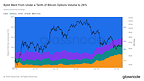
Glassnode’s data shows that Bybit’s share of the four-venue Bitcoin options volume pool rose from less than 10% to 28%, nearly tripling over the reporting period.

The growth has been driven by active turnover rather than simply the accumulation of open positions. Bybit’s options book turns over in days, compared with weeks for the largest book in the tracked panel.

This distinction highlights an important feature of a mature derivatives market: liquidity is not only about the amount of open interest held on a venue, but also how actively that liquidity is traded and recycled.

Bybit leads Ether options and tokenized gold

Bybit’s options activity extends beyond Bitcoin. The report finds that Bybit recorded the highest Ether options trading volume among the four tracked venues for 143 consecutive days. Glassnode confirmed the leadership using coin-denominated volumes as well as dollar values, reducing the impact of Ether price movements on the comparison.

Ether now accounts for approximately one-third of Bybit’s total options volume.

Bybit has also established a leading position in tokenized commodity derivatives. Measured in ounces, its tokenized-gold perpetual book has remained the largest among the crypto venues tracked by Glassnode for 476 consecutive days.

In gold options, Bybit accounted for 97.1% of open interest across the tracked venues.

Together, the figures point to a derivatives platform with growing depth across crypto-native assets and tokenized commodities, as traders increasingly use a broader range of instruments to manage risk and express market views.

Bybit’s options book grows more than fourfold

Bybit’s own options market has expanded substantially alongside the wider market.

According to the report, Bybit’s options book reached $2.33 billion, up from $529 million during its first month.

The growth has not been linear. Options initially represented a smaller share of Bybit’s derivatives activity during the rapid expansion of perpetual contracts, before rebuilding as demand for more sophisticated risk-management instruments increased.

The resulting U-shaped pattern broadly mirrors the wider market’s rotation back toward options.

“The derivatives market is becoming more sophisticated. Traders are increasingly using options not simply to take directional positions, but to express views on volatility, manage downside, and price specific events,” said Sean Ballard, Head of Derivatives and Institutional Business at Bybit.  “The data shows this is becoming a structural part of the market, and Bybit is building the liquidity, breadth, and infrastructure needed for the next stage of growth.”

“Bybit is leading the way in market evolution by aligning options with where price discovery and volume really live. By introducing options on perpetual contracts, we are bringing an industry-first innovation to the market, and we believe this should be a game changer for the growth and development of market structure,” added Sean.

Building the next generation of derivatives markets

The findings highlight a broader evolution in crypto trading. As options become a larger part of the market, competitive differentiation will increasingly depend on liquidity, breadth of instruments, and the infrastructure required to serve both professional and individual traders.

Bybit’s growing options market reflects this convergence, with expanding activity across Bitcoin and Ether and established depth in tokenized-gold derivatives.

Methodology: The State of Crypto Derivatives is based on Glassnode’s venue-resolved derivatives and market data, current as of the settled close of August 23, 2026. Venue coverage varies by metric and reflects the venues tracked by Glassnode. The options analysis covers four crypto-native venues. The futures analysis covers the offshore venues tracked by Glassnode and excludes CME, and the tokenized-gold analysis covers the crypto venues tracked by Glassnode.

The full report is available here.

#Bybit  / #NewFinancialPlatform

About Bybit

Bybit is The New Financial Platform.

We believe every person should have access to every financial opportunity on earth. That’s why we’re building the first intelligent platform that connects anyone, anywhere to the world’s finance.

Trusted by more than 80 million users worldwide, Bybit brings together investing, trading, payments, and wealth-building in a single secure and intelligent ecosystem. Through the combination of AI-powered technology, deep global liquidity, robust security, and transparent operations, Bybit makes global finance more accessible, efficient, and empowering for everyone.

Built for everyone. Powered by intelligence. Open to the world.

Learn more at Bybit.com.

For more details about Bybit, please visit Bybit Press

For media inquiries, please contact: media@bybit.com

For updates, please follow: Bybit’s Communities and Social Media

Facebook | Instagram | LinkedIn | Reddit | Telegram | TikTok | X | Youtube

View original content to download multimedia:https://www.prnewswire.com/apac/news-releases/crypto-options-approach-half-of-bitcoin-derivatives-market-as-bybit-captures-28-of-tracked-volume-glassnode-report-finds-302882692.html

SOURCE Bybit

Continue Reading

Trending