Connect with us

Technology

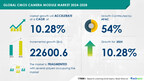
CMOs Camera Module Market size is set to grow by USD 22.60 billion from 2024-2028, Growing popularity of social media applications to boost the market growth, Technavio

Published

on

NEW YORK, June 17, 2024 /PRNewswire/ — The global CMOs camera module market size is estimated to grow by USD 22.60 billion from 2024-2028, according to Technavio. The market is estimated to grow at a CAGR of 10.28% during the forecast period. Growing popularity of social media applications is driving market growth, with a trend towards technological advances in image sensors of CMOs camera module. However, accuracy issues poses a challenge. Key market players include Balluff GmbH, e-con Systems Inc., Huiber Vision Technology Co. Ltd., IDS Imaging Development Systems Gmbh, Jenoptik AG, LG Electronics Inc., Mcnex Co. Ltd., MISUMI Electronics Corp., Nikon Corp., NXP Semiconductors NV, OmniVision Technologies Inc., ON Semiconductor Corp., Panasonic Holdings Corp., PCE Holding GmbH, Samsung Electronics Co. Ltd., Sharp Corp., SK hynix Co. Ltd., Sony Group Corp., STMicroelectronics International N.V., and Teledyne Technologies Inc..

Get a detailed analysis on regions, market segments, customer landscape, and companies – View the snapshot of this report

Forecast period

2024-2028

Base Year

2023

Historic Data

2018 – 2022

Segment Covered

Application (Consumer electronics, Automotive, Surveillance cameras, Factory automation, and Others), Type (5MP to 13MP, Above 13MP, and Below 5MP), and Geography (North America, APAC, Europe, South America, and Middle East and Africa)

Region Covered

North America, APAC, Europe, South America, and Middle East and Africa

Key companies profiled

Balluff GmbH, e-con Systems Inc., Huiber Vision Technology Co. Ltd., IDS Imaging Development Systems Gmbh, Jenoptik AG, LG Electronics Inc., Mcnex Co. Ltd., MISUMI Electronics Corp., Nikon Corp., NXP Semiconductors NV, OmniVision Technologies Inc., ON Semiconductor Corp., Panasonic Holdings Corp., PCE Holding GmbH, Samsung Electronics Co. Ltd., Sharp Corp., SK hynix Co. Ltd., Sony Group Corp., STMicroelectronics International N.V., and Teledyne Technologies Inc.

Key Market Trends Fueling Growth

The CMOS camera module market is expanding due to advancements in CMOS image sensors. Vendors are developing prototypes that combine the qualities of CCD and CMOS sensors, such as imec’s CCD-in-CMOS technology. Additionally, 3D-stacked CMOS image sensors are gaining popularity for their fast data readout and low noise. Sony’s 3-layer stacked CMOS image sensor is an example of this technology’s capabilities. These innovations enable OEMs to explore new applications and drive market growth. 

The CMOS camera module market is experiencing significant growth due to the increasing demand for high-quality imaging technology in various industries. Digital photography, surveillance systems, and automotive applications are some sectors driving this trend. The use of advanced features such as high dynamic range, low light sensitivity, and high resolution is becoming increasingly important.

Companies are investing in research and development to produce more efficient and cost-effective solutions. The market is competitive, with key players focusing on innovation and differentiation to gain a competitive edge. The future looks bright for the CMOS camera module market, with continued growth expected in the coming years. 

Research report provides comprehensive data on impact of trend. For more details- Download a Sample Report

Market Challenges

The automotive industry’s shift towards Advanced Driver-Assistance Systems (ADAS) presents both opportunities and challenges for CMOS camera module manufacturers. While these modules are crucial for ADAS applications due to their accuracy and support for critical functions, their performance in extreme temperatures and long-term usage can be a concern.This issue, compounded by the increasing reliance on autonomous vehicles, necessitates the development of high-performing, reliable CMOS camera modules to meet stringent safety regulations and prevent potential accidents. Failure to do so could hinder the growth of the global CMOS camera module market.The Cmos Camera Module market faces several challenges in the technology industry. One major challenge is keeping up with the demand for higher resolution and faster processing capabilities. Another challenge is ensuring compatibility with various devices and operating systems.Additionally, cost and power consumption are key considerations, as manufacturers strive to create affordable and energy-efficient solutions. Furthermore, security concerns, such as preventing unauthorized access and data theft, are becoming increasingly important. Lastly, the market is highly competitive, with numerous players vying for market share. To succeed, companies must continuously innovate and differentiate their offerings.

For more insights on driver and challenges – Download a Sample Report

Segment Overview

Application1.1 Consumer electronics1.2 Automotive1.3 Surveillance cameras1.4 Factory automation1.5 OthersType 2.1 5MP to 13MP2.2 Above 13MP2.3 Below 5MPGeography 3.1 North America3.2 APAC3.3 Europe3.4 South America3.5 Middle East and Africa

1.1 Consumer electronics- The consumer electronics industry experienced significant growth in 2023 due to the large consumer base for electronic products like smartphones, tablets, PCs, digital cameras, gaming consoles, and TVs, which utilize CMOS camera modules. The popularity of wearable cameras for activities such as underwater recording and extreme sports is increasing, leading to the expansion of CMOS sensor production capacities.

Notable smartphone OEMs, including Apple, Huawei, and Samsung, are integrating CMOS sensors into their offerings, driving the demand for high-resolution cameras and more pixels. This shift from CCD to CMOS sensors is fueling the expansion of the global CMOS camera module market.

For more information on market segmentation with geographical analysis including forecast (2024-2028) and historic data (2018 – 2022) – Download a Sample Report

Research Analysis

The CMOS camera module market is experiencing significant growth due to advancements in digital imaging technology. Electronic video signals from these modules are utilized in various applications, including mobile phones, tablets, and other mobile devices. The miniaturization trend in modern digital cameras has led to the development of thinner modules and smaller form factors, enabling the production of slim smartphones and compact devices.

In low-light environments, CMOS sensors have shown superior performance, making them ideal for recording videos and capturing clear digital data. The lens system in these modules plays a crucial role in image quality, while electrical signals are transmitted to displays for real-time viewing. Advanced packaging techniques have enabled multiple camera configurations, further expanding the market’s potential applications.

Market Research Overview

The Cmos Camera Module market encompasses the production and distribution of high-performance image sensors, specifically Complementary Metal-Oxide-Semiconductor (Cmos) sensors. These sensors are integral to digital cameras, smartphones, and various industrial applications. The market is driven by the increasing demand for high-resolution imaging, low power consumption, and advanced features such as autofocus and image stabilization.

Manufacturers focus on developing smaller, more efficient sensors to cater to the growing market for wearable devices and Internet of Things (IoT) applications. The market is also influenced by advancements in technology, including the integration of artificial intelligence and machine learning algorithms for improved image processing.

Table of Contents:

1 Executive Summary
2 Market Landscape
3 Market Sizing
4 Historic Market Size
5 Five Forces Analysis
6 Market Segmentation

ApplicationConsumer ElectronicsAutomotiveSurveillance CamerasFactory AutomationOthersType5MP To 13MPAbove 13MPBelow 5MPGeographyNorth AmericaAPACEuropeSouth AmericaMiddle East And Africa

7 Customer Landscape
8 Geographic Landscape
9 Drivers, Challenges, and Trends
10 Company Landscape
11 Company Analysis
12 Appendix

About Technavio

Technavio is a leading global technology research and advisory company. Their research and analysis focuses on emerging market trends and provides actionable insights to help businesses identify market opportunities and develop effective strategies to optimize their market positions.

With over 500 specialized analysts, Technavio’s report library consists of more than 17,000 reports and counting, covering 800 technologies, spanning across 50 countries. Their client base consists of enterprises of all sizes, including more than 100 Fortune 500 companies. This growing client base relies on Technavio’s comprehensive coverage, extensive research, and actionable market insights to identify opportunities in existing and potential markets and assess their competitive positions within changing market scenarios.

Contacts
Technavio Research
Jesse Maida
Media & Marketing Executive
US: +1 844 364 1100
UK: +44 203 893 3200
Email: media@technavio.com
Website: www.technavio.com/

View original content to download multimedia:https://www.prnewswire.com/news-releases/cmos-camera-module-market-size-is-set-to-grow-by-usd-22-60-billion-from-2024-2028–growing-popularity-of-social-media-applications-to-boost-the-market-growth-technavio-302173070.html

SOURCE Technavio

Continue Reading
Click to comment

Leave a Reply

Your email address will not be published. Required fields are marked *

Technology

NIX United Achieves AWS AI Competency After Rigorous Audit

Published

on

By

AI-enabled software development company NIX United has officially achieved the AWS AI Competency designation from Amazon Web Services (AWS). The recognition validates NIX’s proven expertise in architecting, securing, and deploying enterprise-grade artificial intelligence and machine learning solutions on AWS.

TAMPA, Fla., July 23, 2026 /PRNewswire-PRWeb/ — For enterprise organizations, the designation provides independent validation of NIX’s end-to-end AI capabilities across solution architecture, data security, governance, and operational excellence. It is based on successful production deployments, including a generative AI customer feedback analytics platform and an AI-powered medical education solution. The competency also provides eligible customers with access to AWS-validated frameworks, specialized technical resources, and AWS GenAI Innovation Funding programs.

“AI must be engineered for long-term production value,” said Artur Bakulin, Head of RnD and Innovation at NIX United. “Earning the AWS AI Competency reflects our commitment to building AI architectures grounded in verifiable return on investment.”

Moving Beyond AI Demos to Production Value

While AI adoption accelerates, organizations face a critical barrier: transitioning from impressive proofs of concept to production-grade applications. Building AI for the modern enterprise requires solving complex challenges around regulatory compliance and seamless system integration.

To earn the AWS AI Competency, NIX completed a comprehensive technical audit demonstrating its ability to deliver scalable AI solutions. The evaluation covered engineering practices, security controls, governance frameworks, and operational excellence, while highlighting NIX’s experience applying generative AI to complex business workflows.

Strategic Benefits for Enterprise Clients

“AI must be engineered for long-term production value,” said Artur Bakulin, Head of RnD and Innovation at NIX United. “Earning the AWS AI Competency reflects our commitment to building AI architectures grounded in verifiable return on investment.”

For NIX clients, this designation provides:

Reduced project risk through AWS-validated architectures that support data privacy, security, and regulatory compliance.Faster project execution with access to eligible AWS funding programs, including subsidized AI assessments, Proofs of Concept (PoCs), and AWS GenAI Innovation Funding.Long-term scalability with solutions engineered to move seamlessly from pilot projects to business-critical production environments.

Organizations exploring generative AI initiatives can work with NIX experts to evaluate their eligibility for the AWS GenAI Innovation Funding Program and identify opportunities to accelerate adoption.

Frequently Asked Questions

Q: What specific competency did NIX United achieve?

A: NIX achieved the AWS AI Competency, a formal designation by Amazon Web Services verifying a partner’s technical proficiency and robust customer success in delivering generative AI solutions.

Q: What criteria did AWS use to evaluate NIX United?

A: AWS conducted a comprehensive technical audit covering NIX’s solution architecture, security controls, governance frameworks, and delivery methodology.

Q: How can enterprise clients fund their AI initiatives with NIX United?

A: Through NIX’s status as an advanced AWS partner, eligible clients can access the AWS GenAI Innovation Funding Program to offset costs for AI assessments, proofs-of-concept, and full-scale implementations.

Media Contact

Yevheniia Kryvenko, NIX United, 1 7272563558, yevheniia.kryvenko@nixs.com, NIX United

View original content:https://www.prweb.com/releases/nix-united-achieves-aws-ai-competency-after-rigorous-audit-302831769.html

SOURCE NIX United

Continue Reading

Technology

Apollo and San Jose Earthquakes Announce Official Sleeve and Go-to-Market Partnership, Bringing the AI GTM System to Major League Soccer

Published

on

By

First-of-its-kind partnership to help Earthquakes capitalize on soccer’s surging popularity through AI-powered GTM transformation

SAN FRANCISCO, July 23, 2026 /PRNewswire/ — Apollo, the AI go-to-market system, announced today a multiyear Official Sleeve Partnership with Major League Soccer’s San Jose Earthquakes that entails becoming both the club’s Official Go-to-Market Partner and the first go-to-market (GTM) company to combine a professional sports sponsorship with a full-scale partnership for revenue operations transformation.

As soccer continues its unprecedented rise in popularity across the United States, with MLS seeing a 62% year-over-year increase in viewership to kick off the 2026 season, the unique partnership positions the Earthquakes to modernize their GTM, accelerate revenue and capitalize on the sport’s expanding global audience.

In the partnership, Apollo will serve as both a brand sponsor with its logo featured prominently on the right sleeve of the Earthquakes’ jersey, and as a technology partner, powering the club’s GTM strategy. The club will deploy Apollo’s system across key revenue-generating functions, including group ticket sales, sponsorship pipeline management, inbound lead routing and season ticket renewals, creating a modern GTM system designed to drive fan engagement and commercial growth.

“We see this partnership as a natural extension of Apollo’s mission to make world-class go-to-market accessible to everyone by bringing it to the world’s most popular game,” said Matt Curl, CEO of Apollo. “Soccer is entering an incredible growth phase in the U.S., creating a once-in-a-generation opportunity for clubs to deepen fan relationships and accelerate commercial growth. Every professional sports team is running a revenue business focused on finding customers, engaging fans, growing sponsorships and driving renewals. By bringing together data, intelligence and execution into one system, we’re helping the Earthquakes build a modern commercial operation that will become a model for the future of sports.”  

The partnership reflects Apollo’s broader vision that every organization can benefit from its AI GTM system. With the rise in soccer’s popularity, clubs face increasing pressure to convert fan interest into lasting relationships, ticket sales, sponsorships and recurring revenue. While sports organizations have historically relied on fragmented tools across ticketing, sponsorship sales, CRM and marketing, Apollo brings those workflows together into one connected system to help organizations capitalize on this moment.

For the Earthquakes, that means:

Modernizing group ticket sales workflowsImproving inbound lead managementGrowing sponsorship pipelineStreamlining season ticket renewal campaignsGiving sales and marketing teams a unified system

“While excitement around soccer continues to grow across the country, we’re investing in the technology and systems that will help us better engage our supporters and continue growing our commercial business,” said Earthquakes President Jared Shawlee. “I started my career in sales and have never seen the kind of technology that Apollo provides. This will transform our approach to sales and marketing by giving us one system to connect data, automate workflows and create a more connected experience for Quakes fans throughout their journey with the club.”

“We are excited to roll out the Apollo AI GTM system to revenue teams across our organization,” added Earthquakes Chief Strategy Officer Ian Anderson. “Apollo is at the forefront of AI-powered GTM and the Quakes are committed to being ahead of the technology curve for our industry.”

The Earthquakes become Apollo’s first official sports partner, laying the foundation for a broader strategy to bring modern GTM technology to sports organizations worldwide. Apollo plans to use the partnership as a blueprint for working with hundreds of professional sports organizations facing similar revenue and commercial challenges.

“This is just the beginning,” added Curl. “Professional sports organizations have the same GTM challenges as fast-growing businesses. We’re excited to demonstrate what’s possible when data, intelligence, and execution come together in a single system to help teams build stronger relationships with fans, partners, and customers.”

The partnership will officially debut ahead of the Earthquakes’ annual California Clasico match on Saturday, July 25, against the LA Galaxy at Stanford Stadium, with Apollo and the club jointly celebrating the launch through customer events, social activations and in-stadium experiences.

About Apollo
Apollo is the AI GTM System that uniquely combines data, intelligence, and execution in one loop helping every business find and win their next customer. Trusted by millions of users and over 600,000 companies worldwide, Apollo combines one of the industry’s largest B2B contact databases with a purpose built GTM intelligence engine and a full execution stack, in an all-in-one system. Learn more at apollo.io.

About San Jose Earthquakes
The San Jose Earthquakes, one of Major League Soccer’s original teams, are the epicenter for soccer in Northern California, playing at the highest professional level in the United States. The club won MLS Cups in 2001 and 2003 and took home Supporters’ Shields in 2005 and 2012. The Earthquakes are based out of PayPal Park, an 18,000-seat soccer-specific stadium that opened in 2015 and is the first cloud-enabled venue in MLS. The organization was originally founded in 1974 in the North American Soccer League, and in 2024, celebrated its 50th anniversary of positively impacting communities around Northern California. The club’s nonprofit arm, the Quakes Foundation, focuses on health and fitness initiatives for local underserved youth and fighting food insecurity. For more information about the Earthquakes, visit sjearthquakes.com.

View original content to download multimedia:https://www.prnewswire.com/news-releases/apollo-and-san-jose-earthquakes-announce-official-sleeve-and-go-to-market-partnership-bringing-the-ai-gtm-system-to-major-league-soccer-302832676.html

SOURCE Apollo.io

Continue Reading

Technology

CIQ Arms Federal Agencies and Contractors with Kernel-Level Detection and BOD 26-04-Compliant Remediation

Published

on

By

RLC Pro Hardened and Ascender Pro together give federal teams kernel exploitation detection as it happens and CVE remediation before it wipes out an entire fleet

RENO, Nev., July 23, 2026 /PRNewswire/ — CIQ, the founding commercial sponsor of Rocky Linux, today announced the launch of an RLC Pro Hardened and Ascender Pro deployment that gives federal agencies real-time kernel exploit detection, audit-ready compliance, and automated remediation in a single deployment. The pairing gives federal teams a stronger position inside the three-day remediation window Binding Operational Directive (BOD) 26-04 sets for the highest-risk vulnerabilities on federal systems.

On June 10, 2026, CISA issued BOD 26-04, and the three-day clock starts when a flaw enters the Known Exploited Vulnerabilities (KEV) catalog, not when a patch ships. For the most dangerous vulnerabilities, the exploit often arrives before the patch does, leaving agencies with a compliance deadline and no fix to apply yet. Non-compliance penalties can include a range of administrative consequences, including greater regulatory oversight and asset disconnection.

RLC Pro Hardened, CIQ’s federal-ready Enterprise Linux distribution, answers that gap. It is the first Enterprise Linux distribution to ship runtime kernel exploitation detection enabled and supported by default, giving agencies a record of what happened during the window before a fix shipped. CIQ delivered that capability well before BOD 26-04 put federal agencies on a three-day clock.

“A single critical vulnerability can impact an entire federal fleet before it’s even confirmed as a CVE,” said Gregory Kurtzer, founder and CEO of CIQ. “RLC Pro Hardened’s LKRG catches the exploit behavior at the kernel the moment it happens, patch or no patch. Once remediation is required, Ascender Pro orchestrates it across the entire fleet and proves it happened, system by system. Agencies get both sides covered without rebuilding their infrastructure.”

RLC Pro Hardened ships with Linux Kernel Runtime Guard (LKRG), which validates kernel integrity continuously and records kernel-level exploitation as it happens. The distribution also arrives audit-ready, with FIPS 140-3 validated cryptography and CIQ-engineered lockdown playbooks for DISA STIG, CIS and NIST 800-171.

Ascender Pro adds Reaqt, an event-driven engine that watches fleet logs, matches them against rule sets, and fires the right Ansible playbook automatically. Across a fleet, that closes issues faster than manual, ticket-driven review.

More About BOD 26-04

BOD 26-04 replaced the severity-score deadlines of BOD 22-01 and BOD 19-02 with a risk model. It scores each vulnerability on four factors: public exposure, presence in the KEV catalog, exploit automation and technical impact. A vulnerability that meets all four carries a three-calendar-day remediation deadline, the shortest CISA has set in a Binding Operational Directive. Agency remediation policies must support the directive by August 7, 2026.

About CIQ

CIQ is the founding support and services partner for Rocky Linux and a leading provider of enterprise Linux infrastructure. CIQ delivers commercially supported Linux offerings, high-performance computing solutions and AI infrastructure to enterprises, government agencies, research institutions and supercomputing centers worldwide. CIQ’s products include the Rocky Linux from CIQ (RLC Pro) family of operating systems, Ascender Pro for IT automation, Fuzzball job-based container orchestration, Warewulf cluster provisioning and Apptainer, the leading container system for high-performance computing. For more information, visit ciq.com.

MEDIA CONTACT:
Cristin Connelly
Cathey Communications for CIQ
cristin@cathey.co

View original content to download multimedia:https://www.prnewswire.com/news-releases/ciq-arms-federal-agencies-and-contractors-with-kernel-level-detection-and-bod-26-04-compliant-remediation-302833327.html

SOURCE CIQ

Continue Reading

Trending