Could Bimetallic ‘Supermetals’ Provide a Solution?
by Craig York, Copperweld CEO
BRENTWOOD, Tenn., June 25, 2024 /PRNewswire/ — The copper industry is driven by a complex system of supply-and-demand cycles. One cycle of particular concern, given the growing interest in decarbonization technologies, involves the relationship between global copper supply and green initiative copper demand. This co-dependency presents a zero-sum scenario where copper supply deficits threaten green initiatives, and green initiatives intensify the copper supply crisis. To avoid a stalemate, the future of green programs may depend on solutions that offer a more efficient and sustainable use of copper.
Copper Supply Shortfall
Copper prices recently reached record highs, crossing the $5/lb threshold for the first time.1 Analysts attribute much of this price explosion to soaring copper demand, mainly due to the large role copper plays in renewable energy, decarbonization efforts, and power grid investments.2
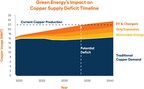
Over time, if increased copper demand is continually met with reduced supply, shortfalls are soon to follow. In 2022, copper production was about 22 million metric tons (MMT), while demand was about 26 MMT; recycled copper scrambled to make up the difference.2 Some analysts estimate the growing supply-demand gap will result in an annual copper supply shortfall of 8 million tons by 2034 — an outcome that would pose a significant hurdle for the future of green energy projects.3
How Does the Copper Shortage Threaten Green Goals?
It is estimated that the technology used in green initiatives could eliminate 2/3 of global greenhouse gas emissions by 2050. However, meeting net-zero carbon emission targets would require doubling annual copper demand to 50 MMT. With copper suppliers already struggling to increase output, that’s unlikely to happen.3
Richard Adkerson, former CEO of U.S. mining group, Freeport-McMoRan, predicts that surging copper demand will cause a supply shortfall as society rapidly adopts electric cars, renewable electricity, and power grid expansions.4
Wire and cable products are of particular interest in the usage of copper for green programs. Overall, wire and cable use related to the green energy transition could grow from 0.8 million MMT to 6.7 MMT between 2020 and 2040.3
While copper demand in conventional applications will increase only 0.5% by 2040, there will be significant increases in copper usage in some green energy sectors. This includes an 11% increase in demand from electric vehicles (EVs) and chargers, a 19% increase from grid expansion, and a 7% increase from renewable energy technologies during this time frame.3
As our society moves forward with green energy initiatives, we must conserve and reallocate copper resources. The solution is found in copper supply management through copper-alternative products in high-usage markets.
‘Supermetals’ — Bimetallic Wire Conserves Copper and Offers Enhanced Performance
A bimetallic wire is an engineered electrical conductor that is composed of two separate metals metallurgically bonded together, combining the distinct characteristics of the two metals into one ‘Supermetal’.
Copper is limited in its engineering options. To increase strength, you must use more copper. With a bimetallic wire, an engineered core of steel or aluminum can be used to provide benefits like increased strength or improved energy efficiency while conserving copper at the same time.
Unlike alloys which are a blend of metals throughout, bimetallic wire often consists of a corrosion-resistant periphery of copper with an inner core of metal chosen for its specific performance characteristics. This construction opens a wide range of engineering possibilities for leveraging the core of the wire to create an electrical conductor that goes beyond copper’s capabilities alone.
Two popular bimetallic ‘Supermetals’ have forged a significant presence in the power grid and construction markets:
Copper-Clad Steel (CCS) grounding, power, and signal conductors have been used in substations, power distribution, underground utilities, mining, and transportation applications for nearly a century.Copper-Clad Aluminum (CCA) is a bimetallic conductor that has been widely used in telecommunication, data, and building construction applications for over 50 years.
Bimetallic ‘Supermetal’ Benefits:
Reduced Copper Consumption – Bimetallic conductors optimize the use of valuable copper, in some cases using only 1/6 the copper found in solid copper wire.Improved Energy Efficiency – CCA building wire has 2.7% lower impedance, translating into energy savings and less strain on the power grid.5Enhanced Strength – CCS conductors provide up to three times more tensile strength than solid copper, allowing CCS wires to be used in power grid and utility applications where demanding conditions often lead to broken wire or loose connections that can cause power outages and safety hazards.6 Extended Service Life – CCS conductors have up to five times more flex-fatigue endurance, allowing wires to withstand the bending, jerking, and vibration experienced in applications that encounter repeated stress and impact.7 Improved Connections – CCS wire’s corrosion-resistant copper exterior and annealed steel core allow utility workers to ‘bite down’ on grounding wires, making solid connections that remain secure through decades of abuse.Reduced Incentives for Theft – As the price of copper reaches all-time highs, copper theft is an increasing issue. Bimetallic wires have conveniently low street value, making them less attractive to copper thieves.Improved Cost Stability – With lower copper content, bimetallic wires reduce exposure to volatile price fluctuations experienced with solid copper wires.
Of bimetallic wire’s many advantages, two benefits represent the potential for significant impact on decarbonization and green initiative efforts:
1) Bimetals Conserve Copper
Focusing on industries that use large amounts of copper is key to copper conservation efforts.
As the largest consumer of copper resources, the construction industry accounts for almost half (45%) of the nation’s copper supply. And, within the construction industry, building wire alone uses 20% of the total U.S. copper supply.8
Fortunately, the building construction industry already has an alternative to single-metal copper wire: Copper-Clad Aluminum (CCA). CCA building wire uses 1/6 the amount of copper when upsized two AWG sizes compared to copper conductors, as is required by the National Electric Code (NEC) for most electrical circuits. This upsizing allows CCA to provide comparable electrical performance to equivalently rated copper conductors.
Utilizing CCA instead of single-metal copper for building wire applications could have potentially saved the U.S. nearly 700 million pounds of copper in 2022! That’s equivalent to the copper required for 3.8 million EVs, enough solar farm capacity to power 13.3 million homes (77,000 MW), or 175 wind farms (approximately 175,00 wind turbines with 1.5-MW capacity). Using this 2022 potential saving model, CCA building wire would conserve 3.2 billion metric tons (7 billion pounds) of copper resources over the next decade, not even accounting for market growth.9, 10
2) Bimetals Provide Energy Savings
Whether electricity is generated by traditional energy sources or by green technologies, the efficient use of energy impacts power grid infrastructure. The more energy we require, the more electricity we must produce. The more electricity we must produce, the more power grid infrastructure we must build. Therefore, reducing the amount of electricity needed reduces strain on the power grid.
One way to more smartly use energy within a power grid network happens at the building level. CCA conductors are the most electrically efficient of the three building wire conductor materials permitted by the NEC when installed per code. Recent testing verifies that CCA conductors are 2.7% more energy efficient than copper conductors and 7% more efficient than aluminum conductors when installed per the NEC. This translates into significant kilowatt hour (kWh) energy savings in the nation’s power grid.11
In 2022, total U.S. electricity consumption was about 4.05 trillion kWh. Of that, 1.42 trillion kWh (38.9%) went to the residential sector.12 If CCA building wire’s electrical efficiency was applied to residential use alone, it would render 38.3 billion kWh of energy savings for the power grid. That’s enough annual electricity to power approximately 3.5 million homes or a residential population the size of the city of Chicago.13, 14
Efficient energy usage not only reduces strain on the power grid, it translates into dollars-and-cents savings for homeowners.
The average annual electricity consumed by a U.S. household in 2022 was 10,791 kWh (899 kWh per month).15 The resulting average annual U.S. household electric bill was $1,644 ($137 per month).16
Considering this data, if CCA’s electrical efficiencies were applied to 131.2 million U.S. households, the annual electric bill savings would translate to $5.8 billion for the replacement of copper alone.17 Savings projections are amplified once commercial and industrial buildings are included. In these applications, the replacement of aluminum wire with CCA in large circuits represents the potential for substantial energy cost savings.
Conclusion
Solid-copper wire has been the default material for electrical circuits for over a century, so presenting change of any kind is viewed as a threat. But, bimetals don’t threaten the copper industry; they sustain it. Bimetals allow copper to do what it does best. With copper supply deficits threatening decarbonization and green energy goals, finding safe and effective alternatives to copper is critical.
Bimetallic wire reduces the use of copper in many electrical applications, reserving copper for the periphery of the conductor, where electrical connections are made. Using a copper-alternative metal for the core of the wire, conductors can be engineered in numerous ways to provide highly specialized performance. The copper saved in the core of a wire can then be redirected to green technology investments.
From copper conservation to energy savings to enhanced performance, bimetallic ‘Supermetals’ put copper where it counts so that society can put copper where it’s needed most.
Want to learn more about Copperweld’s copper-saving, performance-enhancing bimetallic products? Contact Copperweld Sales today.
Read the full article here.
About Copperweld
Copperweld is the world leader in bimetallic wire and cable specializing in power, grounding, and signal conductors for building construction, power grid, utilities, communications, and transportation. For over 100 years, their mission has been to make the most reliable, sustainable, and innovative wire and cable products on the market. Copperweld’s metallurgical expertise and engineered solutions result in bimetallic products that enhance performance, extend service life, conserve copper, improve energy efficiency, and reduce incentives for theft. Their American-made products are manufactured in the heart of the USA, and the culture of excellence and innovation that inspired them over a century ago still drives them today.
Sources:
https://www.macrotrends.net/1476/copper-prices-historical-chart-datahttps://www.morningstar.co.uk/uk/news/248802/is-copper-entering-a-new-supercycle.aspxhttps://carboncredits.com/copper-and-the-need-to-meet-the-worlds-rewiring-demand-for-energy-transition/https://www.ft.com/content/d281665f-0444-4cd8-b616-5f5ddf2ab8a6https://www.americanbimetallic.org/post/important-differences-between-cca-and-aluminumwww.copperweld.com/blog/engineered-conductorswww.copperweld.com/blog/is-ccs-really-stronger-than-copperhttps://www.statista.com/statistics/254870/use-of-copper-and-copper-alloys-in-the-us-by-purpose/https://www.copper.org/publications/pub_list/pdf/A6191-ElectricVehicles-Factsheet.pdfhttps://www.copper.org/education/c-facts/home/https://www.americanbimetallic.org/post/important-differences-between-cca-and-aluminumhttps://www.eia.gov/energyexplained/electricity/use-of-electricity.phphttps://www.statista.com/statistics/205589/top-20-cities-in-the-us-with-the-highest-resident-population/https://www.census.gov/quickfacts/fact/table/chicagocityillinois,US/PST045222https://www.eia.gov/tools/faqs/faq.phphttps://www.eia.gov/todayinenergy/detail.phphttps://www.statista.com/statistics/183635/number-of-households-in-the-us/
View original content to download multimedia:https://www.prnewswire.com/news-releases/copper-crisis-threatens-green-initiatives-302179332.html
SOURCE Copperweld









 Technology5 days ago
 Technology5 days ago
 Coin Market4 days ago
 Technology5 days ago

 Technology5 days ago
 Technology5 days ago
 Technology5 days ago