Connect with us

Technology

OnLocation’s U.S. Energy Horizons to 2050 Release: Reference and Advanced Technologies Scenarios for the U.S. Energy Sector

Published

on

VIENNA, Va., June 26, 2024 /PRNewswire/ — The U.S. energy system will continue a significant transition through 2050, driven by new technologies, policies, and consumer choices. These will result in new market dynamics, industry challenges, and changes in energy-related greenhouse gas emissions. OnLocation, a KeyLogic company, produced the U.S. Energy Horizons to 2050 report to explore these issues using its enhanced version of the National Energy Modeling System (OL-NEMS). The Horizons report provides Reference and Advanced Technologies scenarios to illustrate the impacts of clean technology innovation and enabling policies that could lead to deeper decarbonization. OnLocation’s release webinar is on Thursday, June 27 at 2 p.m. (EST).

What is the OnLocation U.S. Energy Horizons to 2050 Report (OL EH)?
OL EH provides a view of the U.S. energy system through 2050 and may be used by various stakeholders to inform policy decisions. If specific actions are taken, it projects potential future effects on energy supply and demand. OL EH considers the impact of existing and potential policies and technologies affecting energy-related greenhouse gas emissions.

OL EH is a series of modeled projections under different sets of consistent input assumptions. Although many input assumptions (e.g., prices, technology development, economic growth, geopolitical developments) are uncertain long-term, OnLocation uses the best judgment of its energy experts, informed by historical trends and expected future changes, to develop quantitative central pathways for model input assumptions. These central pathways produce the OL EH Reference scenario and may be adjusted in sensitivity scenarios to illustrate the impacts of parameter uncertainty on the energy system.

The OL EH Reference scenario serves as a baseline against which policy action may be compared. It assumes current laws and regulations continue throughout the projection period, which allows proposed policy actions or technology improvements to be modeled as a sensitivity scenario. The impact of the OL EH Advanced Technologies scenario is estimated by comparing scenario results with the Reference scenario.

Why is OnLocation Releasing OL EH?
That fact that the energy system is undergoing and will continue rapid and complex change is neither a singular nor recent phenomenon. To assist policymaking in this dynamic environment, the U.S. Energy Information Administration (EIA) routinely captures the existing state of knowledge about the U.S. energy system in its Annual Energy Outlook (AEO). Citing the need for more time to incorporate new features to the underlying NEMS model to reflect recent energy system changes, EIA announced they would not release an AEO for 2024. This is the first year since the early 1980’s that EIA did not produce an AEO.

OnLocation decided to produce the OL EH this year to benefit the energy & climate modeling community. Over its 40-year history, OnLocation has worked with EIA to build and maintain parts of NEMS, the energy-economy model used to produce AEOs. OnLocation developed its own version of the model, OL-NEMS, based on AEO 2023, including new features and policy updates to address energy system issues and CO2 mitigation strategies important to OnLocation’s clients. OL EH brings together the best of OnLocation’s energy system expertise in a modeling framework familiar to users of the AEO.

How Did OnLocation Develop the OL EH?
OL-NEMS is based on AEO 2023. OnLocation updated this model with publicly available data, policy updates, and new capabilities, making OL EH markedly different from EIA’s AEO 2023. OnLocation is solely responsible for OL EH assumptions and results.

A full report will include a full list of OL-NEMS model updates and OL EH scenario assumptions. Key updates include:

Hydrogen production, storage, and trade (including low-carbon hydrogen sources).Improved representation of carbon capture and sequestration (CCS) and carbon markets.Other CO2 mitigation technologies such as direct air capture (DAC) and sustainable aviation fuel.Updated regulations including new EPA greenhouse gas standards for power plants and vehicles.Greater data center electricity demand growth in the commercial sector.Lower cost assumptions for renewables, carbon capture, and electric vehicles.

How Does OL EH Compare to AEO 2023?
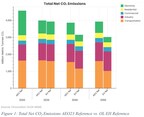
Our key modifications lead to greater CO2 reductions in most energy sectors by 2050 compared to AEO 2023, especially in the power and transportation sectors, as shown in Figure 1. These reductions are due to a more rapid phase-out of conventional fossil fuels in favor of clean energy sources such as renewable energy and electric vehicles in EH Ref compared to AEO.

What the EH Scenarios Reveal
While Reference scenario CO2 emissions decline over time, net emissions in the Advanced Tech scenario are much lower than the Reference scenario (Figure 2).

An important contributor to these reductions is that the power sector achieves net zero CO2 by 2040 with a combination of new renewables, battery storage, and CO2 capture including bioenergy with carbon capture (BECCS). Some other sectoral emissions are offset by net negative emissions from both DAC and BECCS in industry, biofuels, and hydrogen production.

Conclusion
OL EH is accessible to organizations aiming to explore potential future projections of the U.S. energy system more effectively and identify strategies for influencing its direction. Additional OnLocation reports on Data Center (AI & Cryptocurrency) Energy Demands, Employment Impacts of the U.S. Energy Transition, and Critical Materials Demands of the U.S. Energy Sector are planned for later this year.

OnLocation helps public and private groups apply quantitative tools to assess structural and regulatory challenges facing the U.S. energy system. For more information or to book a free consultation, please visit our website or email contact@onlocationinc.com.

View original content to download multimedia:https://www.prnewswire.com/news-releases/onlocations-us-energy-horizons-to-2050-release-reference-and-advanced-technologies-scenarios-for-the-us-energy-sector-302183798.html

SOURCE Keylogic

Continue Reading
Click to comment

Leave a Reply

Your email address will not be published. Required fields are marked *

Technology

Keeper Security Launches Integration With Wiz to Remediate Critical Cloud Vulnerabilities

Published

on

By

With new integration, Keeper’s identity security platform remediates vulnerabilities discovered by Wiz, enabling closed-loop protection across cloud environments.

CHICAGO, June 16, 2026 /PRNewswire/ — Keeper Security, the leading zero-trust and zero-knowledge identity security and Privileged Access Management (PAM) platform, today announces a new integration with Wiz, a leading cloud and AI security platform that is now part of Google Cloud. Joining the Wiz Integration Network establishes Keeper as a remediation engine for identity security vulnerabilities discovered by Wiz, closing the loop between cloud security detection and active risk resolution. When Wiz identifies an identity-related vulnerability, spanning human users, machine identities, AI agents and database accounts, it automatically surfaces the finding in Keeper’s Cloud Security dashboard, where security teams can review and remediate each issue directly within KeeperPAM®.

As cloud environments grow more complex, organizations face an expanding attack surface driven by the rapid proliferation of Non-Human Identities (NHIs), autonomous AI agents and over-privileged service accounts. Wiz surfaces these risks with unmatched cloud visibility and Keeper provides joint customers with an automated, trusted path from discovery to remediation.

“Finding a vulnerability is the first half of the battle,” said Craig Lurey, CTO and Co-founder of Keeper Security. “By integrating with Wiz, Keeper helps customers rotate compromised credentials, enforce privileged access management and reduce over-permissioned identities, turning Wiz’s detection power into faster, more decisive risk reduction. This is the future of cloud security – detection and remediation working as one, giving security teams a clear path from vulnerability discovery to resolution across the identities and workloads that matter most.”

“We’re happy to welcome Keeper to the Wiz Integration Network,” said Oron Noah, VP of Product, Extensibility & Partnerships at Wiz. “Together, we’re helping customers connect cloud risk findings with privileged access controls, making it easier to move from discovery to remediation. By bringing cloud visibility and access management into a unified workflow, teams can better secure both human and machine identities at scale.”

At the heart of the integration is a real-time workflow that transforms Wiz’s Issues into Keeper-driven remediation actions. When a Wiz customer enables the Keeper integration, Wiz scans the cloud environment for identity security vulnerabilities within Keeper’s remediation scope. Security teams can then select a finding and execute the appropriate remediation action through KeeperPAM:

Rotate compromised credentials and vault updated secretsBring unmanaged accounts under PAM governanceReduce excessive privileges for users, service accounts and IAM rolesMap Wiz Issues to existing PAM records or onboard new resourcesSubmit resolutions back to Wiz to close the loop on each finding

This tight integration bridges the gap between cloud security detection and identity security remediation, giving security teams a single, closed-loop workflow. Rather than manually triaging Wiz Issues and separately executing remediation steps in Keeper, KeeperPAM works alongside Wiz by automatically receiving identity-related Issues and streamlining the remediation steps. For teams, this results in accelerated Mean Time To Remediation (MTTR) and a dramatically reduced window of exposure before a vulnerability can be exploited.

The integration is especially powerful in AI-native environments, where autonomous agents and service accounts can rapidly accumulate excessive permissions across cloud infrastructure. Wiz’s AI Application Protection Platform (AI-APP) detects over-privileged AI agents, insecure service configurations and other AI-native risks. Keeper serves as a designated remediation engine, enforcing least privilege policies and enabling just-in-time access controls for AI agents in response. Together, they secure the full AI lifecycle from code to runtime, without requiring manual intervention from security teams.

Key benefits include:

Streamlined Identity Remediation: When Wiz discovers an identity security vulnerability, Keeper takes action – rotating compromised credentials, enforcing PAM controls and reducing excess privileges – streamlining the steps between detection and resolution.Closed-Loop Security Workflow: Connect Wiz’s industry-leading cloud and AI vulnerability detection directly to Keeper’s privileged access management platform for a complete detect-to-remediate pipeline that operates at cloud scale.Accelerated Mean Time to Remediation: By accelerating response to identity vulnerabilities at the moment of discovery, organizations dramatically shrink the window of exposure and reduce the risk of breach escalation.Comprehensive Identity Coverage: Remediation scope covers the full range of identity types, including human users, machine identities, AI agents and database accounts, ensuring no privileged entity goes unmanaged across cloud environments.

KeeperPAM, Keeper’s cloud-native privileged access management platform, unifies password, secrets and connections management with zero-trust network access, endpoint privilege management and remote browser isolation in a single solution. Built on a zero-trust and zero-knowledge architecture, KeeperPAM provides real-time visibility, automated credential security and AI-powered session monitoring to help organizations prevent breaches and maintain compliance across hybrid and multi-cloud environments.

By connecting detection directly to remediation, Keeper and Wiz give security teams the confidence that cloud risks are not just visible, but actively resolved. KeeperPAM’s zero-trust architecture ensures every remediation action maintains a verifiable chain of custody – from Wiz’s initial finding through to Keeper’s corrective action – supporting both continuous compliance and audit readiness.

Keeper’s integration with Wiz is available now. Review the full release notes in the Keeper documentation.

About Keeper Security
Keeper Security is the leading zero-trust and zero-knowledge identity security solution, trusted by millions of people and thousands of organizations globally. KeeperPAM® is Keeper’s privileged access management platform that unifies password and passkey management, secrets management, privileged session management and endpoint privilege management in a single cloud-native platform, protected with quantum-resistant encryption. KeeperAI delivers real-time, AI-native threat detection across every privileged session. As AI agents proliferate and identity becomes the defining attack surface, Keeper governs access for humans, machines, non-human identities and AI agents, serving as the unified control plane for access, compliance and visibility across the enterprise. For more information, visit KeeperSecurity.com.

Learn more: KeeperSecurity.com

Follow Keeper: Facebook Instagram LinkedIn X YouTube TikTok

Media Contact
Katherine Benfield
ICR for Keeper Security
keepersecurity@icrinc.com


View original content to download multimedia:https://www.prnewswire.com/news-releases/keeper-security-launches-integration-with-wiz-to-remediate-critical-cloud-vulnerabilities-302801062.html

SOURCE Keeper Security

Continue Reading

Technology

Benzinga Launches Institutional Portfolio Intelligence API for Faster Institutional Ownership Intelligence

Published

on

By

DETROIT, June 16, 2026 /PRNewswire/ — Benzinga, a leading provider of market intelligence and financial data APIs, today announced the launch of its Institutional Portfolio Intelligence API. The new dataset is designed to help brokerages, fintech platforms, quantitative researchers, and investor applications uncover signals hidden within hedge fund and institutional portfolios.

The dataset provides institutional holdings, capital flow trends, portfolio analytics, and ownership intelligence across more than 11,000 U.S. equities and ETFs. It delivers portfolio intelligence covering more than 8,000 hedge funds and institutional managers representing over $50 trillion in assets under management.

Unlike many institutional ownership datasets that refresh on quarterly reporting cycles, Benzinga’s Institutional Portfolio Intelligence API instantly incorporates newly filed 13F disclosures as they become available. Firms can use this data to identify emerging trends, monitor shifts in institutional conviction, and uncover actionable insights from large-scale portfolio activity sooner.

As investors seek deeper insights beyond traditional market data, understanding how professional money managers allocate capital has become an increasingly valuable source of intelligence.

“While institutional holdings are reported quarterly, the market doesn’t wait for quarterly data refreshes,” said Clint Rhea, Manager of Institutional and Channel Partnerships at Benzinga. “Our Institutional Portfolio Intelligence API captures new 13F disclosures as they are filed, allowing clients to identify position initiations, exits, and conviction changes from some of the world’s largest investors as quickly as possible. Whether you’re monitoring a crowded short, tracking institutional accumulation, validating an investment thesis, or understanding how professional money managers are allocating capital, speed and breadth of coverage matter. This dataset delivers on all of them.”

Key capabilities of the Institutional Portfolio Intelligence API include:

Institutional holdings and portfolio dataOwnership trends and capital flow analysisConsensus fund positioning insightsPortfolio concentration and allocation analyticsOutlier trade and conviction signal identificationHistorical coverage dating back to 2013Coverage across 11,000+ U.S. equities and ETFs (and 20,000+ delisted tickers)Fund sentiment by ticker, theme, industry or sectorFund performance and copy-traded returnsFund P/L and other fund manager metricsReal-time raw filings and insights

The dataset is designed for integration into brokerage platforms, portfolio research tools, screening applications, quantitative models, and investor-facing experiences. Available via API, WebSockets, and flat file delivery, the solution enables firms to incorporate institutional intelligence directly into their products and workflows.

The launch further expands Benzinga’s growing suite of institutional-grade market data solutions, helping clients build more informed investing experiences powered by actionable intelligence, alternative datasets, and more timely visibility into institutional portfolio activity.

About Benzinga

Benzinga is a leading financial media and data technology company that empowers investors with high-quality, real-time market intelligence. Through its news platform, APIs, and data products, Benzinga provides traders, financial institutions, and fintech platforms with the insights they need to make smarter investment decisions. From breaking news and analyst ratings to corporate events and alternative datasets, Benzinga’s tools help market participants stay ahead of the information that drives price movement.

To learn more, visit www.benzinga.com/apis/.

View original content to download multimedia:https://www.prnewswire.com/news-releases/benzinga-launches-institutional-portfolio-intelligence-api-for-faster-institutional-ownership-intelligence-302801012.html

SOURCE Benzinga

Continue Reading

Technology

Made Card and Multiply Mortgage Partner to Extend Homeowner Benefits Beyond Closing Day

Published

on

By

NEW YORK, June 16, 2026 /PRNewswire/ — Made Card, the first credit card purpose-designed for the homeowner, today announced a partnership with Multiply Mortgage, the leading provider of homeownership benefits, helping employees across 1,200+ employers finance homes with lower rates and concierge-level support through their workplace.

Made is designed for what comes after closing day. Multiply connects employees to expert loan advisors and competitive rates through a workplace benefit. Made picks up where the mortgage leaves off, turning unavoidable home costs into a measurable financial return. Through the partnership, homebuyers who finance with Multiply will receive access to a suite of exclusive benefits built for new homeowners including a sign-on bonus redeemable toward closing costs and elevated cashback on mortgage payments, utilities, maintenance, and repairs.

“This partnership is a personal one for me,” said Alex Song, Co-Founder of Made Card. “Two years ago, Multiply helped me buy my own home, and I believed in what they were building so much that I became one of their earliest investors. Today we get to build together as operators. Multiply reaches homebuyers at the exact moment they are making the largest financial decision of their lives, and they do it with a level of care I experienced firsthand. Connecting that moment to Made is exactly what this card was built for.”

“Multiply exists to make homeownership more accessible and less stressful, and Made Card extends that mission past closing day,” said Michael White, Co-Founder and CEO of Multiply Mortgage. “Our clients are navigating the biggest purchase of their lives. Pairing that with a card built around what owning actually costs is exactly the benefit our customers deserve.”

About Made Card
Made is building the first credit card purpose-designed for the homeowner’s expenses: the predictable bills, the unexpected ones, and the administrative and emotional weight that no existing financial product was built to address. Turning that unavoidable cost into a measurable financial return, Made addresses a spend category every other card ignores and is building the next-gen home ecosystem.

About Multiply Mortgage
Multiply Mortgage helps employees navigate the largest purchase of their lives: buying a home. Multiply’s financial wellness benefit offers mortgage interest rate discounts and personalized guidance throughout the home financing process, all with zero cost or administrative overhead for the company.

Media Contact
media@madecard.com
madecard.com

View original content to download multimedia:https://www.prnewswire.com/news-releases/made-card-and-multiply-mortgage-partner-to-extend-homeowner-benefits-beyond-closing-day-302800954.html

SOURCE Made Card

Continue Reading

Trending