Connect with us

Technology

IDTechEx Discusses Co-Packaged Optics (CPO) Packaging Technology Trends and Market Trajectory

Published

on

BOSTON, July 24, 2024 /PRNewswire/ — Over the past decade, the capacity of data center Ethernet switches has surged from 0.64 Tbps to 25.6 Tbps, driven by the adoption of 64×400 Gbps or 32×800 Gbps pluggable optical transceiver modules. However, these high-speed modules, within their current form factors, pose significant challenges. Issues include the required densities of electrical and optical connectors, as well as escalating power consumption.

To achieve next-generation optical engines supporting 800 Gbps and beyond per module, the communication rate must double to at least 100 Gbps per lane. This increase introduces substantial signal integrity issues across the switch socket, motherboard, and edge connector, leading to heightened power dissipation at SerDes interfaces. In future Ethernet switching, these signal integrity problems may cause I/O power consumption to exceed that of the switch core. Additionally, the integration density of standard pluggable modules is limited by the QSFP/OSFP form factor, necessitating advanced thermal management solutions not yet widely available.

Co-Packaged Optics (CPO) presents a promising solution to these challenges. Unlike traditional pluggable models, CPO integrates optical modules directly onto the switch ASIC substrate, reducing electrical reach and effectively addressing signal integrity issues. This approach has gained traction among major data centers. However, optimizing the packaging strategy for CPO remains a topic of ongoing industry discussion and development. IDTechEx’s latest report, “Co-Packaged Optics (CPO) 2025-2035: Technologies, Market, and Forecasts“, explores these advancements in CPO technology and packaging techniques enabling its adoption.

The importance of advanced semiconductor packaging technologies for Co-Packaged Optics (CPO)

The integration of CPO in data centers aims to boost I/O bandwidth and reduce energy consumption. The way photonic integrated circuits (PICs) are combined with electronic integrated circuits (EICs) and switch ICs, can significantly influence the areal and edge bandwidth density, as well as packaging parasitics. These factors directly affect the transceiver’s I/O bandwidth and energy efficiency, meaning improper integration can negate the advantages of silicon photonics.

For CPO, the integration of photonic and electronic components can be achieved through various methods, each with unique advantages and challenges. The most advanced, and still in the R&D phase, is the 3D monolithic integration. This embeds photonic components within an existing electronic process node with minimal alterations, co-locating active photonics and driving electronics within the same die. This reduces parasitics and simplifies packaging by eliminating the need for interface pads and bumps. However, monolithic integration typically uses older CMOS nodes, resulting in suboptimal photonic performance and higher energy consumption. Despite these limitations, it offers minimal impedance mismatch and simplified packaging.

Conversely, 2D integration places the PIC and EIC side by side on a PCB, connected by wire bonds or flip-chip. This method is straightforward and cost-effective, but introduces significant parasitic inductance, limiting aggregate I/O due to single-edge connections. While 2D integration is easy to package, the reliance on wire bonds constrains the transceiver bandwidth and increases energy consumption, making it less efficient for high-performance applications.

3D hybrid integration offers a more advanced solution by placing the EIC on top of the PIC, via various advanced semiconductor packaging technologies including Through-Si-Via (TSV), high density fan-out, Cu-Cu hybrid bonding, and active photonic interposer, significantly reducing parasitics. The use of advanced semiconductor packaging technologies in 3D integration allows for dense pitch capabilities, enhancing performance. However, thermal dissipation remains a challenge, as the heat generated by the EIC can impact the PIC, necessitating advanced thermal management solutions. Despite these thermal challenges, 3D hybrid integration achieves higher performance due to minimized packaging parasitics.

2.5D integration serves as a compromise, with both the EIC and PIC flip-chipped onto a passive interposer with TSVs. This approach maintains manageable parasitics and dense pitch capabilities similar to 3D integration but adds complexity with the need for interposer traces. While 2.5D integration balances performance, cost, and fabrication turnaround, it incurs higher parasitics than 3D hybrid integration.

In summary, each integration method presents trade-offs between performance, complexity, and cost, with the choice based on specific application requirements and constraints.

Co-Packaged Optics (CPO) market trajectory

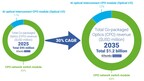
According to IDTechEx, the Co-Packaged Optics (CPO) market is projected to exceed $1.2 billion by 2035, growing at a robust CAGR of 28.9% from 2025 to 2035. CPO network switches are expected to dominate revenue generation, driven by each switch potentially incorporating up to 16 CPO PICs. Optical interconnects for AI systems will constitute approximately 20% of the market, with each AI accelerator typically utilizing one optical interconnect PIC to meet increasing demands for high-speed data processing and communication in advanced computing applications.

IDTechEx’s latest report, “Co-Packaged Optics (CPO) 2025-2035: Technologies, Market, and Forecasts”, offers extensive exploration into the latest advancements within Co-Packaged Optics technology. The report delves deep into key technical innovations and packaging trends, providing a comprehensive analysis of the entire value chain. It thoroughly evaluates the activities of major industry players and delivers detailed market forecasts, projecting how the adoption of CPO will reshape the landscape of future data center architecture.

Central to the report is the recognition of advanced semiconductor packaging as the cornerstone of Co-Packaged Optics technology. IDTechEx places significant emphasis on understanding the potential roles that various semiconductor packaging technologies may play within the realm of CPO.

Key aspects of the report include:

Market Dynamics: Examination of key players such as Nvidia, Broadcom, Cisco, Ranovus, and Intel, and the forces shaping the CPO landscape.Innovations in CPO Design: Exploration of advanced CPO designs and their implications for enhancing data center efficiency and shaping future architecture.Semiconductor Packaging Breakthroughs: Insight into the latest advancements in semiconductor packaging, including 2.5D and 3D technologies, and their role in enabling CPO innovation.Optical Engines: Analysis of the drivers behind CPO’s performance and efficiency advantages.CPO for AI Interconnects: Exploration of how optical I/O can address the limitations of copper connections in AI applications, improving efficiency, latency, and data rates.CPO for Switches: Assessment of the potential 25% efficiency gains in high-performance network switches through CPO integration.Challenges and Solutions: Critical review of obstacles to CPO adoption and strategies to overcome them.Future Analysis: Predictions and insights into the next generation of CPO and its anticipated impact on the industry.

The report is based on extensive research and interviews with industry experts and provides valuable insights for anyone interested in gaining a strategic understanding of Co-Packaged Optics’ role in advancing the future of data centers and AI technology.

Market Forecasts:10-year Data Center Population Cumulative Forecast10-year AI Accelerator Unit Shipments Forecast10-year CPO Interconnect for AI (Optical I/O) Unit Shipments Forecast10-year CPO Interconnect for AI (Optical I/O) Market Revenue Forecast10-year CPO-enabled Network Switch Unit Shipments Forecast10-year CPO-enabled Network Switch Market Revenue Forecast10-year Total CPO Market Revenue

For more information on this IDTechEx report, including downloadable sample pages, please visit www.IDTechEx.com/CPO.

For the full portfolio of related research available from IDTechEx please see www.IDTechEx.com/Research/Semiconductors.

About IDTechEx

IDTechEx provides trusted independent research on emerging technologies and their markets. Since 1999, we have been helping our clients to understand new technologies, their supply chains, market requirements, opportunities and forecasts. For more information, contact research@IDTechEx.com or visit www.IDTechEx.com

Media Contact: 
Charlotte Martin 
Subscriptions Marketing Manager
press@IDTechEx.com 
+44(0)1223 812300

Social Media Links: 
X: https://www.twitter.com/IDTechEx 
LinkedIn: https://www.linkedin.com/company/idtechex/ 

Photo: https://mma.prnewswire.com/media/2468305/Total_CPO_Market_Growth.jpg
Logo: https://mma.prnewswire.com/media/478371/IDTechEx_Logo.jpg


View original content:https://www.prnewswire.co.uk/news-releases/idtechex-discusses-co-packaged-optics-cpo-packaging-technology-trends-and-market-trajectory-302205422.html

Continue Reading
Click to comment

Leave a Reply

Your email address will not be published. Required fields are marked *

Technology

/C O R R E C T I O N — Applied Intuition, Inc./

Published

on

By

In the news release, Applied Intuition Collaborates with Heidelberg Materials to Advance Innovation in Quarry Operations with Autonomous Haulage Fleets, issued 30-Apr-2026 by Applied Intuition, Inc. over PR Newswire, we are advised by the company that changes have been made. The complete, corrected release follows, with additional details at the end:

Applied Intuition Collaborates with Heidelberg Materials to Advance Innovation in Quarry Operations with Autonomous Haulage Fleets

Deployment brings intelligent, vehicle-based autonomy to Australia, establishing a new operating model for construction and mining environments.

SUNNYVALE, Calif., April 30, 2026 /CNW/ — Applied Intuition, Inc., a leader in physical AI, today announced its collaboration with Heidelberg Materials, one of the world’s largest integrated manufacturers of building materials and solutions, to deploy autonomous haulage systems for Heidelberg Materials’ quarry operations, starting at a site in Australia.

Applied Intuition will provide its Self-Driving System (SDS) for Construction to support autonomous haulage operations within Heidelberg Materials’ fleet of construction and mining vehicles in Australia. The deployment marks the next real-world application of Applied Intuition’s autonomy platform in industrial environments. Upon successful completion, it will support the expansion of autonomous operations within Heidelberg Materials’ broader Australian network.

The collaboration also challenges the standard industry model. While autonomy solutions traditionally target the largest quarry sites, this system is designed for smaller operations, including those running just two 40-ton trucks, making it deployable across quarry sites of varying size worldwide.

“No two quarry or construction sites operate the same way, with different layouts, constraints and economics,” said Qasar Younis, co-founder and CEO of Applied Intuition. “We’ve built our platform to adapt to that reality. This partnership shows we can take the same core system used in large mining operations and apply it to smaller, infrastructure-constrained quarry sites, scaling it across hundreds of unique locations.”

For Heidelberg Materials, the partnership is aimed at enhancing safety and operational performance. It also reflects the need for an autonomy solution that can operate at large sites and smaller ones too, whereas traditional autonomous haulage systems are often too infrastructure-heavy or costly to scale. For Applied Intuition, it serves as a proof point that its autonomy platform is designed not just for one-off deployments, but for global scale across construction, quarry and mining environments of any size.

Applied Intuition’s system runs directly on the vehicle, with integrated perception, decision-making and safety systems onboard, enabling reliable operation without constant connectivity or heavy site infrastructure.

The collaboration builds on Applied Intuition’s growing presence in construction and mining autonomy and reinforces its broader physical AI strategy. The same core platform has already been deployed in other industries, including trucking and defense, with learnings from each domain contributing to continuous system improvements. Applied Intuition’s SDS platform strategy also enables the company to bring technologies proven in other domains into construction and mining, helping accelerate development and deployment.

Through this project, Applied Intuition demonstrates the range of its autonomy platform, from some of the largest mining trucks in the world to smaller quarry vehicles operating in constrained, lower-infrastructure environments. Together, these deployments highlight the company’s approach to building scalable autonomy for construction and mining from the ground up.

To learn more about how Applied Intuition is building the future of construction autonomy, visit applied.co.

About Applied Intuition
Applied Intuition, Inc. is powering the future of physical AI. Founded in 2017 and now valued at $15 billion, the Silicon Valley company is creating the digital infrastructure needed to bring intelligence to every moving machine on the planet. Applied Intuition services the automotive, defense, trucking, construction, mining and agriculture industries in three core areas: tools and infrastructure, operating systems and autonomy. Eighteen of the top 20 global automakers, as well as the United States military and its allies, trust the company’s solutions to deliver physical intelligence. Applied Intuition is headquartered in Sunnyvale, California, with offices in Washington, D.C.; San Diego; Ft. Walton Beach, Florida; Ann Arbor, Michigan; London; Stuttgart; Munich; Stockholm; Gothenburg, Sweden; Bangalore; Seoul; and Tokyo. Learn more at applied.co.

Correction: An earlier version of this release incorrectly stated the location of the site noted in the first paragraph.

View original content:https://www.prnewswire.com/news-releases/applied-intuition-collaborates-with-heidelberg-materials-to-advance-innovation-in-quarry-operations-with-autonomous-haulage-fleets-302758224.html

SOURCE Applied Intuition, Inc.

Continue Reading

Technology

MOREH Demonstrates Production-Ready LLM Inference on Tenstorrent Galaxy, Achieving DGX A100-Class Performance with Improved Cost Efficiency

Published

on

By

Reduces HBM Costs with GPU–Tenstorrent Heterogeneous Distributed Serving
First unveiled at Tenstorrent’s launch event, TT-Deploy, in San Francisco on May 1

SANTA CLARA, Calif., May 1, 2026 /PRNewswire/ — Moreh, an AI infrastructure software company, led by CEO Gangwon Jo, announced that it has successfully validated LLM inference performance on the Tenstorrent Galaxy Wormhole system using its proprietary ‘MoAI Inference Framework.’

Based on tests across leading Mixture-of-Experts (MoE) models—including GPT-OSS, Qwen, GLM, and DeepSeek—Moreh achieved LLM inference performance on Tenstorrent Galaxy Wormhole matching or surpassing NVIDIA DGX A100-class systems, demonstrating a compelling alternative to conventional GPU-centric AI infrastructure.

Moreh also improved cost efficiency by implementing a disaggregated serving architecture that combines GPUs with Tenstorrent Wormhole chips. By utilizing Tenstorrent processors as dedicated prefill accelerators, the company reduced reliance on high-cost HBM and lowered overall infrastructure costs.

The results were first unveiled at Tenstorrent’s launch event, TT-Deploy, held on May 1 in San Francisco.

As a strategic partner of Tenstorrent and a major external contributor to Metalium, Moreh showcased a live LLM inference demo at the event. Building on its experience operating AMD GPU-based production environments in real-world data centers, the company presented its latest technical achievements in ‘Production-Ready LLM Inference on Tenstorrent Galaxy.’

MoAI Inference Framework is a disaggregated inference solution that enables unified operation of heterogeneous GPUs and NPUs—including NVIDIA, AMD, and Tenstorrent—within a single cluster. This allows enterprises to build flexible AI infrastructure strategies without vendor lock-in.

Moreh CEO Gangwon Jo stated, “Achieving production-grade LLM inference performance and stability on Tenstorrent-based systems marks a significant milestone,” and added, “We will continue to enhance performance through deeper optimization across heterogeneous architectures and closer integration with Tenstorrent NPUs.”

Moreh is developing its own core AI infrastructure engine and, through its foundation LLM subsidiary Motif Technologies, is building end-to-end capabilities spanning both infrastructure and model domains. Simultaneously, the company is making its mark in the global market through collaborations with key partners such as AMD, Tenstorrent, and SGLang.

View original content to download multimedia:https://www.prnewswire.com/news-releases/moreh-demonstrates-production-ready-llm-inference-on-tenstorrent-galaxy-achieving-dgx-a100-class-performance-with-improved-cost-efficiency-302760562.html

SOURCE Moreh

Continue Reading

Technology

US Startup PerZeption Inc. Announces Collaboration with Alcon Research

Published

on

By

BOSTON, MA, May. 1, 2026 /PRNewswire/ — Advancements in vision correction evaluation require methods that offer both precision and efficiency in detecting clinically meaningful visual differences. Addressing this need, PerZeption is set to present new data validating its AIM+ CSF modeling technology at the Association of Research in Vision and Ophthalmology (ARVO) annual meeting.

Attendees are invited to learn more about this innovative approach during the poster session on May 4, 2026, from 11:15 AM to 1:00 PM, at posterboard #0941.

“We are very excited to collaborate with Alcon, one of the largest companies within the Ophthalmology sector worldwide. “, Dr. Jan Skerswetat said. “The results, presented by Dr Derek Nankivil, indicate that our technology enables rapid, repeatable, and highly sensitive assessment of contrast vision.”

The abstract, titled ‘AIM+ CSF modeling enables efficient detection of clinically meaningful visual differences,’ outlines how PerZeption’s technology supports sensitive, low-burden visual assessment for vision correction evaluation. Data indicates that with approximately six adaptive displays of stimuli and two repeats, studies show around 20 subjects can achieve 90% power to detect a 1 JND (Just Noticeable Difference) change in AULCSF (Area Under the Log Contrast Sensitivity Function). This research also demonstrates AIM+ CSF’s stable repeatability in less than 3 minutes, absence of bias, and robust performance, validating its role as an effective tool for objective visual performance evaluation.

This joint effort highlights a shared dedication to advancing ophthalmology research and developing precise tools for visual assessment. The ARVO annual meeting serves as the world’s foremost event for ophthalmology research, offering a vital platform for sharing scientific breakthroughs and fostering dialogue within the global vision science community.

“In addition to all the exciting research presentations that leverage PerZeption technology at this years’ ARVO meeting, we are also proud to be showcasing PerZeption’s battery of functional tests at our booth, #4027.” Dr. Skerswetat added and noted that there will be opportunities to try out our technology.

This presentation at ARVO represents a significant step in the validation and recognition of PerZeption’s contributions to advanced visual assessment technologies.

About PerZeption Inc
PerZeption delivers vision testing with a rapid, self-administered, and adaptive psychophysical platform delivered via cloud-based software on standard tablets or all-in-one computers. Our flagship platform, Angular Indication Measurement (AIM), enables testing of over 20 visual functions. Our novel approach equips researchers and clinicians with a comprehensive range of visual functions and introduces new tests for which there are no currently available devices. We reduce chairtime. Self-administered tests on a single device in combination with proprietary methods that rapidly assess vision, reduce user’s burden and require minimal training or space, unlike bulky, specialized single-use devices. Finally, cloud-based delivery supports secure in-clinic and remote testing, ensuring consistent, trackable results for clinicians and pharmaceutical companies. 

View original content:https://www.prnewswire.com/news-releases/us-startup-perzeption-inc-announces-collaboration-with-alcon-research-302760563.html

SOURCE PerZeption

Continue Reading

Trending