Technology
IDTechEx Discusses Co-Packaged Optics (CPO) Packaging Technology Trends and Market Trajectory
Published
2 years agoon
By
BOSTON, July 24, 2024 /PRNewswire/ — Over the past decade, the capacity of data center Ethernet switches has surged from 0.64 Tbps to 25.6 Tbps, driven by the adoption of 64×400 Gbps or 32×800 Gbps pluggable optical transceiver modules. However, these high-speed modules, within their current form factors, pose significant challenges. Issues include the required densities of electrical and optical connectors, as well as escalating power consumption.
To achieve next-generation optical engines supporting 800 Gbps and beyond per module, the communication rate must double to at least 100 Gbps per lane. This increase introduces substantial signal integrity issues across the switch socket, motherboard, and edge connector, leading to heightened power dissipation at SerDes interfaces. In future Ethernet switching, these signal integrity problems may cause I/O power consumption to exceed that of the switch core. Additionally, the integration density of standard pluggable modules is limited by the QSFP/OSFP form factor, necessitating advanced thermal management solutions not yet widely available.
Co-Packaged Optics (CPO) presents a promising solution to these challenges. Unlike traditional pluggable models, CPO integrates optical modules directly onto the switch ASIC substrate, reducing electrical reach and effectively addressing signal integrity issues. This approach has gained traction among major data centers. However, optimizing the packaging strategy for CPO remains a topic of ongoing industry discussion and development. IDTechEx’s latest report, “Co-Packaged Optics (CPO) 2025-2035: Technologies, Market, and Forecasts“, explores these advancements in CPO technology and packaging techniques enabling its adoption.
The importance of advanced semiconductor packaging technologies for Co-Packaged Optics (CPO)
The integration of CPO in data centers aims to boost I/O bandwidth and reduce energy consumption. The way photonic integrated circuits (PICs) are combined with electronic integrated circuits (EICs) and switch ICs, can significantly influence the areal and edge bandwidth density, as well as packaging parasitics. These factors directly affect the transceiver’s I/O bandwidth and energy efficiency, meaning improper integration can negate the advantages of silicon photonics.
For CPO, the integration of photonic and electronic components can be achieved through various methods, each with unique advantages and challenges. The most advanced, and still in the R&D phase, is the 3D monolithic integration. This embeds photonic components within an existing electronic process node with minimal alterations, co-locating active photonics and driving electronics within the same die. This reduces parasitics and simplifies packaging by eliminating the need for interface pads and bumps. However, monolithic integration typically uses older CMOS nodes, resulting in suboptimal photonic performance and higher energy consumption. Despite these limitations, it offers minimal impedance mismatch and simplified packaging.
Conversely, 2D integration places the PIC and EIC side by side on a PCB, connected by wire bonds or flip-chip. This method is straightforward and cost-effective, but introduces significant parasitic inductance, limiting aggregate I/O due to single-edge connections. While 2D integration is easy to package, the reliance on wire bonds constrains the transceiver bandwidth and increases energy consumption, making it less efficient for high-performance applications.
3D hybrid integration offers a more advanced solution by placing the EIC on top of the PIC, via various advanced semiconductor packaging technologies including Through-Si-Via (TSV), high density fan-out, Cu-Cu hybrid bonding, and active photonic interposer, significantly reducing parasitics. The use of advanced semiconductor packaging technologies in 3D integration allows for dense pitch capabilities, enhancing performance. However, thermal dissipation remains a challenge, as the heat generated by the EIC can impact the PIC, necessitating advanced thermal management solutions. Despite these thermal challenges, 3D hybrid integration achieves higher performance due to minimized packaging parasitics.
2.5D integration serves as a compromise, with both the EIC and PIC flip-chipped onto a passive interposer with TSVs. This approach maintains manageable parasitics and dense pitch capabilities similar to 3D integration but adds complexity with the need for interposer traces. While 2.5D integration balances performance, cost, and fabrication turnaround, it incurs higher parasitics than 3D hybrid integration.
In summary, each integration method presents trade-offs between performance, complexity, and cost, with the choice based on specific application requirements and constraints.
Co-Packaged Optics (CPO) market trajectory
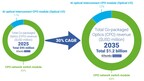
According to IDTechEx, the Co-Packaged Optics (CPO) market is projected to exceed $1.2 billion by 2035, growing at a robust CAGR of 28.9% from 2025 to 2035. CPO network switches are expected to dominate revenue generation, driven by each switch potentially incorporating up to 16 CPO PICs. Optical interconnects for AI systems will constitute approximately 20% of the market, with each AI accelerator typically utilizing one optical interconnect PIC to meet increasing demands for high-speed data processing and communication in advanced computing applications.
IDTechEx’s latest report, “Co-Packaged Optics (CPO) 2025-2035: Technologies, Market, and Forecasts”, offers extensive exploration into the latest advancements within Co-Packaged Optics technology. The report delves deep into key technical innovations and packaging trends, providing a comprehensive analysis of the entire value chain. It thoroughly evaluates the activities of major industry players and delivers detailed market forecasts, projecting how the adoption of CPO will reshape the landscape of future data center architecture.
Central to the report is the recognition of advanced semiconductor packaging as the cornerstone of Co-Packaged Optics technology. IDTechEx places significant emphasis on understanding the potential roles that various semiconductor packaging technologies may play within the realm of CPO.
Key aspects of the report include:
Market Dynamics: Examination of key players such as Nvidia, Broadcom, Cisco, Ranovus, and Intel, and the forces shaping the CPO landscape.Innovations in CPO Design: Exploration of advanced CPO designs and their implications for enhancing data center efficiency and shaping future architecture.Semiconductor Packaging Breakthroughs: Insight into the latest advancements in semiconductor packaging, including 2.5D and 3D technologies, and their role in enabling CPO innovation.Optical Engines: Analysis of the drivers behind CPO’s performance and efficiency advantages.CPO for AI Interconnects: Exploration of how optical I/O can address the limitations of copper connections in AI applications, improving efficiency, latency, and data rates.CPO for Switches: Assessment of the potential 25% efficiency gains in high-performance network switches through CPO integration.Challenges and Solutions: Critical review of obstacles to CPO adoption and strategies to overcome them.Future Analysis: Predictions and insights into the next generation of CPO and its anticipated impact on the industry.
The report is based on extensive research and interviews with industry experts and provides valuable insights for anyone interested in gaining a strategic understanding of Co-Packaged Optics’ role in advancing the future of data centers and AI technology.
Market Forecasts:10-year Data Center Population Cumulative Forecast10-year AI Accelerator Unit Shipments Forecast10-year CPO Interconnect for AI (Optical I/O) Unit Shipments Forecast10-year CPO Interconnect for AI (Optical I/O) Market Revenue Forecast10-year CPO-enabled Network Switch Unit Shipments Forecast10-year CPO-enabled Network Switch Market Revenue Forecast10-year Total CPO Market Revenue
For more information on this IDTechEx report, including downloadable sample pages, please visit www.IDTechEx.com/CPO.
For the full portfolio of related research available from IDTechEx please see www.IDTechEx.com/Research/Semiconductors.
About IDTechEx
IDTechEx provides trusted independent research on emerging technologies and their markets. Since 1999, we have been helping our clients to understand new technologies, their supply chains, market requirements, opportunities and forecasts. For more information, contact research@IDTechEx.com or visit www.IDTechEx.com.
Media Contact:
Charlotte Martin
Subscriptions Marketing Manager
press@IDTechEx.com
+44(0)1223 812300
Social Media Links:
X: https://www.twitter.com/IDTechEx
LinkedIn: https://www.linkedin.com/company/idtechex/
Photo: https://mma.prnewswire.com/media/2468305/Total_CPO_Market_Growth.jpg
Logo: https://mma.prnewswire.com/media/478371/IDTechEx_Logo.jpg
View original content:https://www.prnewswire.co.uk/news-releases/idtechex-discusses-co-packaged-optics-cpo-packaging-technology-trends-and-market-trajectory-302205422.html
You may like
Technology
Autonomous Defense Technologies Set to Ignite a Nearly $200 Billion Global Market
Published
45 minutes agoon
July 23, 2026By
AI-Powered Military Drones, Autonomous Platforms, and Next-Generation Defense Systems Are Fueling One of the Fastest-Growing Opportunities in Aerospace and Defense
NEW YORK, July 23, 2026 /PRNewswire/ — Market News Updates News Commentary – Around the globe, the defense industry is quickly adopting autonomous technologies, with governments investing significantly in artificial intelligence, unmanned systems, advanced sensors, and self-directed decision-making capabilities. Military forces are on the lookout for technologies that can swiftly gather intelligence, function in dangerous settings without risking personnel, and respond promptly to threats. Unmanned aerial vehicles (UAVs) utilizing autonomous AI are increasingly crucial in modern military operations, proficient in various tasks such as reconnaissance, surveillance, target identification, electronic warfare, logistics support, and precision strike missions with minimal human intervention. As artificial intelligence advances, these sophisticated systems are expected to improve their efficiency in managing drone swarms, sharing battlefield information, and swiftly adjusting to changing combat situations. Companies leading the Autonomous and AI technology Defense Operations boom include: VisionWave Holdings Inc. (NASDAQ: VWAV), Kratos Defense & Security Solutions, Inc. (NASDAQ: KTOS), AeroVironment, Inc. (NASDAQ: AVAV), AEVEX Corp. (NYSE: AVEX), Sidus Space, Inc. (NASDAQ: SIDU).
There is also a rapid expansion in financial opportunities. Fortune Business Insights forecasts substantial growth in the global Autonomous Defense Platforms Market, with a projected increase from approximately US$69.77 billion in 2026 to US$198.87 billion by 2034, indicating a robust compound annual growth rate of 14.0%. Additionally, the firm anticipates a surge in the global Military Drone Market from US$22.49 billion in 2026 to US$52.31 billion by 2034, showing an 11.1% compound annual growth rate. With rising defense budgets and a focus on AI-enhanced military capabilities, companies specializing in autonomous aircraft, AI software, advanced sensors, cybersecurity platforms, navigation systems, and cutting-edge battlefield technologies are well positioned to capitalize on these expanding markets.
The widespread integration of autonomous AI UAVs is revolutionizing military strategies and operations. Instead of relying on individual aircraft, armed forces are increasingly deploying coordinated fleets of intelligent drones capable of monitoring vast areas, identifying targets, transmitting secure communications, and offering real-time situational awareness to ground troops. Advancements in machine learning, computer vision, edge computing, and secure battlefield networking are empowering these systems to autonomously process large amounts of data, thereby reducing the workload on operators and increasing mission success. As global tensions rise and defense modernization remains a top priority worldwide, autonomous defense technologies are expected to be one of the fastest-growing sectors in the military industry in the coming decade.
VisionWave (NASDAQ: VWAV) and Meteor Aerospace Leadership Advance Integration Planning for AI-Enabled Multi-Domain Defense Technologies Following Previously Announced Acquisition Agreement — VisionWave Holdings Inc. (“VisionWave” or the “Company”) a defense technology company developing advanced artificial intelligence, autonomous systems and next-generation security technologies, today announced that its executive leadership team has completed a strategic technology and integration working session with the leadership of Meteor Aerospace Ltd. in Israel following the Company’s previously announced acquisition agreement to acquire a controlling interest in Meteor Aerospace. Completion of the transaction remains subject to the closing conditions described below.
The executive meetings represent an important milestone in the transaction process as both companies continue advancing technical, operational and commercial integration planning while progressing toward satisfaction of the closing conditions described below.
During the visit, VisionWave executives conducted comprehensive reviews of Meteor Aerospace’s expanding portfolio of advanced defense technologies, including tactical and strategic unmanned aerial vehicles (UAVs), unmanned ground vehicles (UGVs), unmanned surface vessels (USVs), electronic warfare (EW) and SIGINT technologies, precision strike systems, C4ISR platforms and integrated sovereign defense architectures.
The working sessions included executive strategy meetings, engineering reviews, technology demonstrations, manufacturing assessments and product roadmap discussions focused on identifying opportunities to accelerate innovation, expand international commercialization and strengthen VisionWave’s multi-domain defense technology platform.
Meteor Aerospace presented video documentation of field tests and demonstrations of its products, including flights of the Impact-700 UAV at the Bar Yehuda airfield near the Dead Sea in Israel, that were done with the regulatory monitoring and approval of the Israeli Aviation Authority.
For operational security reasons, the meetings were conducted at a confidential location, and additional details regarding attendees and facilities are not being disclosed.
Douglas Davis, Executive Chairman and Chief Executive Officer of VisionWave Holdings, stated: “Visiting Meteor Aerospace and working directly alongside its leadership and engineering teams reinforced what we recognized when we entered into the acquisition agreement. Meteor has developed a highly differentiated portfolio of autonomous systems, electronic warfare technologies, and integrated battlefield capabilities supported by a team with decades of aerospace engineering experience. Seeing these technologies firsthand further strengthened our confidence in the strategic opportunity this transaction represents.”
Mr. Davis continued: “Our integration planning, in preparation for a potential closing, is well underway. By bringing together VisionWave’s expertise in artificial intelligence, advanced sensing and computational technologies with Meteor’s capabilities across autonomous platforms, C4ISR, precision defense technologies and sovereign defense architectures, we believe we are building a next-generation defense technology platform positioned to address rapidly growing global demand for integrated battlefield solutions, autonomous systems and national security modernization.”
Throughout the visit, executives from both organizations evaluated opportunities to align technology development, manufacturing capabilities, international business development initiatives and long-term product strategies as part of VisionWave’s integration planning process.
The meetings also provided both leadership teams with the opportunity to establish integration priorities across engineering, operations, commercialization and future product development while preparing for the successful completion of the proposed transaction.
As previously announced, completion of the acquisition remains subject to a number of conditions for VisionWave’s satisfactory completion of legal, financial, operational, technical, aerospace, cybersecurity, export control, intellectual property and commercial due diligence, receipt of any applicable regulatory approvals and satisfaction of other customary closing conditions. There can be no assurance that the closing conditions will be satisfied, or that the transaction will be completed on the anticipated timeline or at all. Continued… Read this full release and additional news for VWAV by visiting: https://www.vwav.inc/newsroom/
Why Investors Are Watching the UAV / Autonomous / AI Military Operations Industries:
Autonomous AI-powered UAVs becoming standard assets for ISR and combat support missionsRising global defense spending focused on artificial intelligence and autonomous warfareGrowing adoption of autonomous drone swarms and collaborative mission capabilitiesIncreased demand for real-time intelligence, surveillance, and reconnaissance (ISR)Continued advances in machine learning, computer vision, edge computing, and autonomous navigationExpansion of electronic warfare, cybersecurity, and secure battlefield communicationsDefense modernization programs accelerating across North America, Europe, and the Indo-PacificGrowing opportunities for companies developing next-generation autonomous defense platforms
Other recent developments in the autonomous, defense/military/UAV/drone industries of note include:
Kratos Defense & Security Solutions, Inc. (NASDAQ: KTOS), a technology company in the defense, national security and global markets, recently announced it has been awarded a sole-source, single award Indefinite Delivery/Indefinite Quantity (IDIQ) contract for approximately $156 million, by the U.S. Department of Energy’s National Nuclear Security Administration (NNSA) Office of Secure Transportation (OST), in support of Project Solar Shield.
Under this new contract award, Kratos will provide mobile Counter-Unmanned Aircraft System (C-UAS) platforms designed to support OST’s critical National Security mission. The Office of Secure Transportation is responsible for the safe and secure ground and air transportation of nuclear weapons, weapon components, and special nuclear materials, as well as other missions supporting U.S. national security.
AeroVironment, Inc. (“AV”) (NASDAQ: AVAV), a global leader in intelligent, multi-domain autonomous systems, recently announced it has been awarded a $117.3 million contract by the U.S. Army for its P550™ electric vertical take-off and landing (eVTOL) unmanned aerial system in support of the Army’s Long Range Reconnaissance program, advancing the Army’s push to field scalable, adaptable capabilities for modern warfare.
The award was issued under a Basic Ordering Agreement (BOA) through a competitive Call for Solutions (C4S) under the U.S. Army’s Unmanned Aircraft Systems (UAS) Marketplace initiative, a centralized digital platform designed to accelerate the procurement of vetted drone technologies.
AEVEX Corp. (NYSE: AVEX) recently announced it has been awarded a $17.5 million follow-on contract under its Global Solutions portfolio to continue delivering critical services in support of U.S. national security objectives.
The contract reinforces the company’s role in providing mission focused, data-driven services and solutions that help decision makers act with speed and confidence. AEVEX’s Global Solutions capabilities integrate technology and multi-domain expertise to transform complex data into actionable insight for time sensitive missions.
“Our teams are trusted to support some of the nation’s most important missions,” said Roger Wells, Chief Executive Officer at AEVEX. “This award reflects continued confidence in AEVEX to deliver the specialized expertise required to advance essential national security interests.”
Sidus Space, Inc. (NASDAQ: SIDU) (“Sidus” or the “Company”), an innovative space and defense technology company, recently announced that its next LizzieSat® has successfully completed vibration testing, a key environmental qualification milestone for SpaceX’s Transporter-18 rideshare mission from Vandenberg Space Force Base in California, currently scheduled for launch no earlier than October 2026.
Vibration testing simulates the intense mechanical loads a spacecraft experiences during launch and ascent. The testing was conducted at Element U.S. Space & Defense’s facility in Orlando, Florida, an accredited independent provider of product qualification and environmental testing services. Completing this testing is designed to confirm that the satellite’s structure, components, and integrated payloads can withstand the stresses of liftoff and remain fully operational on orbit, a critical step in clearing the spacecraft for final integration and shipment to the launch site.
DISCLAIMER: MarketNewsUpdates.com (MNU) is a third party publisher and news dissemination service provider, which disseminates electronic information through multiple online media channels. MNU is NOT affiliated in any manner with any company mentioned herein. MNU and its affiliated companies are a news dissemination solutions provider and are NOT a registered broker/dealer/analyst/adviser, holds no investment licenses and may NOT sell, offer to sell or offer to buy any security. MNU’S market updates, news alerts and corporate profiles are NOT a solicitation or recommendation to buy, sell or hold securities. The material in this release is intended to be strictly informational and is NEVER to be construed or interpreted as research material. All readers are strongly urged to perform research and due diligence on their own and consult a licensed financial professional before considering any level of investing in stocks. All material included herein is republished content and details which were previously disseminated by the companies mentioned in this release. MNU is not liable for any investment decisions by its readers or subscribers. Investors are cautioned that they may lose all or a portion of their investment when investing in stocks. This press release was distributed on behalf of VisionWave Holdings, Inc. For current services performed MNU was compensated forty nine hundred dollars for news coverage of the current press releases issued by VisionWave Holdings, Inc. by the Company. MNU HOLDS NO SHARES OF ANY COMPANY NAMED IN THIS RELEASE.
This release contains “forward-looking statements” within the meaning of Section 27A of the Securities Act of 1933, as amended, and Section 21E the Securities Exchange Act of 1934, as amended and such forward-looking statements are made pursuant to the safe harbor provisions of the Private Securities Litigation Reform Act of 1995. “Forward-looking statements” describe future expectations, plans, results, or strategies and are generally preceded by words such as “may”, “future”, “plan” or “planned”, “will” or “should”, “expected,” “anticipates”, “draft”, “eventually” or “projected”. You are cautioned that such statements are subject to a multitude of risks and uncertainties that could cause future circumstances, events, or results to differ materially from those projected in the forward-looking statements, including the risks that actual results may differ materially from those projected in the forward-looking statements as a result of various factors, and other risks identified in a company’s annual report on Form 10-K or 10-KSB and other filings made by such company with the Securities and Exchange Commission. You should consider these factors in evaluating the forward-looking statements included herein, and not place undue reliance on such statements. The forward-looking statements in this release are made as of the date hereof and MNU undertakes no obligation to update such statements.
Contact Information:
Media Contact email: editor@marketnewsupdates.com – +1(561)486-1799
View original content to download multimedia:https://www.prnewswire.com/news-releases/autonomous-defense-technologies-set-to-ignite-a-nearly-200-billion-global-market-302833247.html
SOURCE Market News Updates
Technology
atQor Earns Microsoft Frontier Partner Status for AI Delivery
Published
45 minutes agoon
July 23, 2026By
The recognition validates atQor’s ability to unite Cloud & AI Platforms, AI Business Solutions and Security for customers in financial services, manufacturing, retail, healthcare and public sector.
AHMEDABAD, India, MISSISSAUGA, ON and SANTA FE SPRINGS, Calif., July 23, 2026 /PRNewswire/ — atQor, a Microsoft-focused AI and data platform company, today announced it has achieved Microsoft Frontier Partner status, with its nomination led by Microsoft India and recognition extending across Canada, the United States and India.
atQor holds all six Microsoft Solutions Partner designations, the Support Services designation, Azure Expert MSP status, Microsoft Fabric Featured Partner recognition and ten Advanced Specializations.
“Our engineers do not wait for a mandate to use AI, they build with it every day, and that is what Microsoft recognized,” said Pushkaraj Kale, CEO of atQor India. “Earlier this year, our teams built and deployed more than two hundred production AI agents in a single seventy-two-hour engineering event, and twenty-five of those are now live on Microsoft Marketplace. This nomination was led by Microsoft India, and it reflects the discipline our customers see across every industry we serve.”
“The Frontier Partner designation recognizes organizations that are helping customers move beyond AI experimentation and into business transformation. atQor has consistently invested across Microsoft’s AI, data, cloud, and security stack while building the Go-To-Market and delivery capabilities required to create measurable customer outcomes. We are pleased to see atQor join this distinguished group of partners and look forward to their continued contribution to AI adoption across industries,” said Om Batra, Channel Partner Sales Leader, India and South Asia, Microsoft.
“The most successful AI partners are those that can bridge innovation with operational excellence. atQor has built competencies spanning Microsoft Fabric, Azure AI, Security, and Copilot while maintaining a strong focus on delivery quality and governance. Their Frontier Partner recognition reflects the technical maturity and execution capability needed to help customers scale AI with confidence,” said Sanjeev Sharma, Director Tech Sales and Partner CTO, India and South Asia, Microsoft.
For customers, the recognition means fewer handoffs: one firm carrying the work from the first Microsoft Fabric workshop through the AI agent in production, instead of a customer coordinating several vendors to get there. atQor applies this across financial services, manufacturing, retail, healthcare and public sector organizations in Canada, the United States and India, continuing the relationship through managed Azure operations once systems are live.
Pushkaraj and the India team led this global recognition, according to Kartik Shah, Founder of atQor, who said Canada and U.S. teams, led by Co-Founder and Global COO Greg Kachhadiya, already hold themselves to that same standard.
About atQor: atQor is a Microsoft-focused AI and data platform company that helps enterprises move AI from pilot to production. Founded in 2002, the company operates across Canada, the United States and India, and holds CSP Direct authorization including Azure Gov Cloud in US. atQor maintains ISO 9001, ISO 20000, ISO 27001 and ISO 22301 certifications. Learn more at atQor.com.
Media Contact: Ramanuj Zawar, 419311@email4pr.com. United States: +1-844-294-5383. Canada: +1-289-290-4490. India: +91-706-904-3269.
View original content to download multimedia:https://www.prnewswire.com/news-releases/atqor-earns-microsoft-frontier-partner-status-for-ai-delivery-302832916.html
SOURCE atQor
Technology
Carrier Accelerates Intelligent Building Strategy with Acquisition of 75F
Published
45 minutes agoon
July 23, 2026By
Cloud-native building automation strengthens Carrier’s digital ecosystem to enable increasingly intelligent and autonomous buildings
PALM BEACH GARDENS, Fla., July 23, 2026 /PRNewswire/ — Carrier Global Corporation (NYSE: CARR), global leader in intelligent climate and energy solutions, today announced it has acquired 75F, a leading innovator in cloud-native, wireless, AI-enabled building automation systems. The acquisition strengthens Carrier’s intelligent building capabilities across applications — from complex applied systems and high-growth data centers to light commercial and retrofits.
“Buildings are becoming intelligent and autonomous systems that continuously learn, adapt and optimize performance,” said David Gitlin, Chairman & CEO, Carrier. “Through Carrier ClimaVision™, we have already seen firsthand the power of 75F’s cloud-native, AI-enabled platform. This acquisition accelerates our strategy to create increasingly autonomous and self-optimizing buildings by bringing together connected equipment, intelligent controls and digital solutions in a unified platform that simplifies deployment, connects building data and enables agentic AI.”
The combination of Carrier’s WebCTRL® building controls install base, Abound™ predictive analytics capability and the Nlyte® operational intelligence platform with 75F’s unified data layer and AI capabilities will create a differentiated end-to-end offering spanning equipment, controls, analytics and outcomes for buildings globally. Together, these integrated capabilities enable building operators to transition from traditional building management to fully autonomous operations that proactively identify maintenance opportunities, optimize energy consumption, intelligently manage assets and improve occupant comfort.
“75F was founded to fundamentally rethink building automation using cloud-native software, AI and wireless technologies,” said Deepinder Singh, founder and CEO, 75F. “Joining Carrier enables us to accelerate that vision on a global scale. Together, we can help make intelligent buildings simpler to deploy, easier to operate and more accessible to customers everywhere.”
75F’s platform combines wireless sensors, intuitive controls, cloud software and AI-enabled automation designed to reduce installation time and simplify commissioning while optimizing energy efficiency and indoor air quality. Carrier plans to integrate 75F’s generative and agentic AI as well as auto-commissioning capabilities into its large commercial platforms, including its Carrier QuantumLeap™ thermal management suite, improving deployment and real-time thermal performance for the rapidly growing data center market.
Paul, Weiss, Rifkind, Wharton & Garrison LLP acted as external legal counsel to Carrier in connection with the transaction. Avisen Legal, PA acted as external legal counsel to 75F in connection with the transaction.
About Carrier
Carrier Global Corporation, global leader in intelligent climate and energy solutions, is committed to creating innovations that bring comfort, safety and sustainability to life. Through cutting-edge advancements in climate solutions such as temperature control, air quality and transportation, we improve lives, empower critical industries and ensure the safe transport of food, life-saving medicines and more. Since inventing modern air conditioning in 1902, we lead with purpose: enhancing the lives we live and the world we share. We continue to lead because of our world-class, inclusive workforce that puts the customer at the center of everything we do. For more information, visit carrier.com or follow Carrier on social media at @Carrier.
Carrier. For the World We Share.
Cautionary Statement
This communication contains statements which, to the extent they are not statements of historical or present fact, constitute “forward-looking statements” under the securities laws. These forward-looking statements are intended to provide management’s current expectations or plans for Carrier’s future operating and financial performance, based on assumptions currently believed to be valid. Forward-looking statements can be identified by the use of words such as “believe,” “expect,” “expectations,” “plans,” “strategy,” “prospects,” “estimate,” “project,” “target,” “anticipate,” “will,” “should,” “see,” “guidance,” “outlook,” “confident,” “scenario” and other words of similar meaning in connection with a discussion of future operating or financial performance. Forward-looking statements may include, among other things, statements relating to the acquisition of the 75F business, the integration of such business into Carrier’s existing operations, strategies or transactions of Carrier, Carrier’s plans with respect to its indebtedness and other statements that are not historical facts. All forward-looking statements involve risks, uncertainties and other factors that may cause actual results to differ materially from those expressed or implied in the forward-looking statements. For additional information on identifying factors that may cause actual results to vary materially from those stated in forward-looking statements, see Carrier’s reports on Forms 10-K, 10-Q and 8-K filed with or furnished to the U.S. Securities and Exchange Commission from time to time. Any forward-looking statement speaks only as of the date on which it is made, and Carrier assumes no obligation to update or revise such statement, whether as a result of new information, future events or otherwise, except as required by applicable law.
CARR-IR
Contact:
Media Inquiries
Rob Six
561-281-2362
Investor Relations
Michael Rednor
561-365-2020
View original content to download multimedia:https://www.prnewswire.com/news-releases/carrier-accelerates-intelligent-building-strategy-with-acquisition-of-75f-302833332.html
SOURCE Carrier Global Corporation
Autonomous Defense Technologies Set to Ignite a Nearly $200 Billion Global Market
atQor Earns Microsoft Frontier Partner Status for AI Delivery
Carrier Accelerates Intelligent Building Strategy with Acquisition of 75F
Send Rakhi to UK swiftly with UK Gifts Portal
Whiteboard Series with NEAR | Ep: 45 Joel Thorstensson from ceramic.network
New Gooseneck Omni Antennas Offer Enhanced Signals in a Durable Package
Why You Should Build on #NEAR – Co-founder Illia Polosukhin at CV Labs
Whiteboard Series with NEAR | Ep: 45 Joel Thorstensson from ceramic.network
NEAR End of Year Town Hall 2021: The Open Web World, MetaBUILD 2 Hackathon and 2021 recap
Trending
-
Technology4 days agoEmdoor Launches “Ailyn” AI Hub at WAIC 2026: Unifying Intelligence Across Every Device
-
Technology5 days agoAI-Powered Connectivity: APAC Charts a Path to a Smarter Digital Future
-
Technology4 days agoPenetron Strengthens Global Research Collaboration at ICSHM 2026
-
Technology5 days agoLaifen Expands U.S. Retail Footprint with Costco Launch of Best-Selling SE Hair Dryer
-
Coin Market4 days agoSaylor turns up heat with ‘110 reasons’ why BIP-110 is a bad idea
-
Coin Market4 days agoWill the US get CLARITY this week? Bitcoin’s new $80K target: Hodler’s Digest, July 19
-
Technology3 days ago“Every Day CO₂ Challenge”: More Than a Game, A New Way of Learning
-
Technology4 days ago
China-Europe Youth Exchange Campaign: When Fashion Meets Football — A Green Pitch Appointment for Cross-Cultural Dialogue