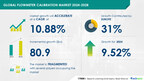
NEW YORK, Aug. 12, 2024 /PRNewswire/ — The global flowmeter calibration market size is estimated to grow by USD 80.9 million from 2024-2028, according to Technavio. The market is estimated to grow at a CAGR of almost 10.88% during the forecast period. Calibration eliminates uncertainty of flowmeters is driving market growth, with a trend towards emergence of online monitoring and self-contained field calibration. However, calibration is not always reliable poses a challenge. Key market players include ABB Ltd., Azbil Corp., Badger Meter Inc., Brooks Instrument LLC, Colorado Engineering Experiment Station Inc., Emerson Electric Co., Endress Hauser Group Services AG, Euroloop Calibrations BV, Fortive Corp., HOFFER FLOW CONTROLS INC., Honeywell International Inc., KROHNE Messtechnik GmbH, Laboratory Testing Inc., Polycontrols Technologies Inc., Schneider Electric SE, Siemens AG, Sierra Instruments Inc., TransCanada Calibrations Ltd., VSL BV, and Yokogawa Electric Corp.
Get a detailed analysis on regions, market segments, customer landscape, and companies – Click for the snapshot of this report
Forecast period
2024-2028
Base Year
2023
Historic Data
2018 – 2022
Segment Covered
End-user (Oil and gas, Water and wastewater, Mining and minerals, Chemicals, and Others), Distribution Channel (OEM service providers and Third-party service providers), and Geography (Europe, North America, APAC, Middle East and Africa, and South America)
Region Covered
Europe, North America, APAC, Middle East and Africa, and South America
Key companies profiled
ABB Ltd., Azbil Corp., Badger Meter Inc., Brooks Instrument LLC, Colorado Engineering Experiment Station Inc., Emerson Electric Co., Endress Hauser Group Services AG, Euroloop Calibrations BV, Fortive Corp., HOFFER FLOW CONTROLS INC., Honeywell International Inc., KROHNE Messtechnik GmbH, Laboratory Testing Inc., Polycontrols Technologies Inc., Schneider Electric SE, Siemens AG, Sierra Instruments Inc., TransCanada Calibrations Ltd., VSL BV, and Yokogawa Electric Corp.
Key Market Trends Fueling Growth
New technologies, such as online monitoring and self-contained field calibration, are transforming the flowmeter calibration market. These advancements necessitate robust calibration protocols for maintaining accuracy. Self-contained field calibration devices, like magmeters, thermal mass, or dual-rotor turbine meters, support online monitoring and calibration. These systems keep historical data records, reducing downtime and associated risks. Online calibration maintenance software, a cost-effective investment, stores data, displays results, and evaluates flowmeter performance and lifespan. The flowmeter’s performance, influenced by environmental and fluid conditions, determines the calibration lifespan, ensuring longer retention across various applications.
The Flowmeter Calibration Market is experiencing significant growth due to increasing demands in various industries, including chemicals, HVAC, jet engines, and wastewater treatment. Modern flowmeters, such as Coriolis, Turbine, and Magnetic, are trending, with the implementation of AI, IoT, and wireless networks for digital enablement and real-time scenarios. Precision and accuracy are crucial for industries like pharmaceuticals, agriculture, and food and drinks, driving the need for advanced calibration technology. Chemical industries, OEMs, and raw material manufacturers require frequent calibration to maintain production efficiency and reduce repair costs from device malfunctions. Laboratory calibration and in-house calibration are popular methods, with contamination control and skilled manpower essential for maintaining calibration accuracy. Industries like oil and gas, aerospace, defense, electronics, and water and wastewater treatment are investing in advanced flow calibration equipment for cost management and disruption mitigation. Sanitary applications and hygiene practices are also crucial for industries like food and drinks. The future of flowmeter calibration lies in technology implementation, machine learning, and cost-effective solutions.
Discover 360° analysis of this market. For complete information, schedule your consultation- Book Here!
Market Challenges
Flowmeter calibration is a crucial process for ensuring accurate measurement of fluid flow. End-users conduct calibration according to a scheduled plan. Calibration involves comparing the flowmeter with a standard and correcting any deviation. Flowmeters can be calibrated in certified laboratories like NIST, ensuring master meter accuracy and NIST certification. Alternatively, calibration can be done using an accurate weigh scale approved by NIST. However, calibrated conditions may lead to inaccuracies when used in specific applications. For instance, a flowmeter calibrated in clean water may not accurately measure wastewater with high suspended solids. Unexpected turbulence, pipe length, material, roughness, and incident angle can also impact performance and lead to systematic, random, and spurious errors. As a professional, it’s essential to consider these factors to maintain measurement accuracy.The Flowmeter Calibration Market faces several challenges in various industries such as chemicals, HVAC, jet engines, and water and wastewater. These challenges include the implementation of modern smart devices, AI, IoT, and wireless networks for digital enablement and machine learning. Ensuring accuracy and precision in calibration is crucial for industries dealing with raw materials and industrial activities. Cost management is a significant concern for OEMs using Coriolis, Turbine, Magnetic flow meters, and other flow measurement technologies in sanitary applications for sectors like pharmaceuticals, agriculture, food and drinks, electronics, and oil and gas. Calibration frequency, contamination, and skilled manpower are key factors impacting calibration costs and device malfunctions. Disruptions due to in-house calibration and hygiene practices in industries like aerospace, defense, and HVAC are also challenges. Real-time scenarios require efficient calibration solutions to minimize repair costs and ensure optimal performance. Calibration laboratories play a vital role in maintaining the accuracy of flow meters in various applications. However, factors like contamination and calibration frequency pose challenges to the calibration process. In conclusion, the flow meter market demands continuous innovation and cost-effective solutions to address these challenges.
For more insights on driver and challenges – Download a Sample Report
Segment Overview
This flowmeter calibration market report extensively covers market segmentation by
End-user 1.1 Oil and gas1.2 Water and wastewater1.3 Mining and minerals1.4 Chemicals1.5 OthersDistribution Channel2.1 OEM service providers2.2 Third-party service providersGeography 3.1 Europe3.2 North America3.3 APAC3.4 Middle East and Africa3.5 South America
1.1 Oil and gas- In the oil and gas sector, flowmeters play a crucial role in managing the transportation of various fluids and gases through pipelines. The velocity of the medium in these pipes can change continuously due to factors like internal diameter and roughness, necessitating calibration services using the same fluid and ideal pipework setup. Calibration is essential as flowmeters must operate accurately in the oil and gas industry’s specific conditions. Uneven velocity distribution impacts measurement values, but calibration ensures precise fiscal measurements under challenging situations and varying environmental conditions. Regular calibration services reduce maintenance and repair costs for end-users. The oil and gas industry’s reliance on flowmeters and the necessity for their accurate calibration will fuel market growth during the forecast period.
For more information on market segmentation with geographical analysis including forecast (2024-2028) and historic data (2018 – 2022) – Download a Sample Report
Market Research Overview
The Flowmeter Calibration Market encompasses various industries such as oil and gas, aerospace, defense, electronics, and more, requiring regular calibration of their flow measurement equipment for optimal performance. Real-time scenarios demand precise and accurate measurement, and calibration is crucial to prevent costly repair costs due to device malfunctions. Hygiene practices are essential in industries like pharmaceuticals, food and drinks, and chemical industries to ensure product quality and safety. Flow calibration equipment finds extensive applications in modern industries like industrial manufacturing, electrical and electronics, and HVAC systems. The integration of technology such as AI, IoT, and wireless networks enhances digital enablement and cost management. Calibration frequency is a critical factor, with laboratory calibration ensuring high accuracy and precision. Contamination and skilled manpower are significant challenges, while in-house calibration offers cost savings and disruption reduction. Raw materials and industrial activities necessitate various flow meter types like Coriolis, Turbine, Magnetic, and Sanitary applications, catering to diverse sectors like water and wastewater treatment, OEMs, and wastewater treatment. Accuracy, precision, and technology implementation are key considerations, with self-cleaning systems and calibration frequency crucial for industries like jet engines and HVAC systems.
Table of Contents:
1 Executive Summary
2 Market Landscape
3 Market Sizing
4 Historic Market Size
5 Five Forces Analysis
6 Market Segmentation
End-userOil And GasWater And WastewaterMining And MineralsChemicalsOthersDistribution ChannelOEM Service ProvidersThird-party Service ProvidersGeographyEuropeNorth AmericaAPACMiddle East And AfricaSouth America
7 Customer Landscape
8 Geographic Landscape
9 Drivers, Challenges, and Trends
10 Company Landscape
11 Company Analysis
12 Appendix
About Technavio
Technavio is a leading global technology research and advisory company. Their research and analysis focuses on emerging market trends and provides actionable insights to help businesses identify market opportunities and develop effective strategies to optimize their market positions.
With over 500 specialized analysts, Technavio’s report library consists of more than 17,000 reports and counting, covering 800 technologies, spanning across 50 countries. Their client base consists of enterprises of all sizes, including more than 100 Fortune 500 companies. This growing client base relies on Technavio’s comprehensive coverage, extensive research, and actionable market insights to identify opportunities in existing and potential markets and assess their competitive positions within changing market scenarios.
Contacts
Technavio Research
Jesse Maida
Media & Marketing Executive
US: +1 844 364 1100
UK: +44 203 893 3200
Email: media@technavio.com
Website: www.technavio.com/
View original content to download multimedia:https://www.prnewswire.com/news-releases/flowmeter-calibration-market-size-is-set-to-grow-by-usd-80-9-million-from-2024-2028–calibration-eliminates-uncertainty-of-flowmeters-to-boost-the-market-growth-technavio-302219418.html
SOURCE Technavio








 Technology4 days ago
 Coin Market5 days ago
 Coin Market4 days ago
 Technology4 days ago
 Technology4 days ago
 Technology4 days ago