Connect with us

Technology

3D Printing Medical Devices Market size is set to grow by USD 7.07 billion from 2024-2028, Increased demand for personalized or customized medical devices to boost the market growth, Technavio

Published

on

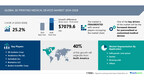
NEW YORK, Aug. 21, 2024 /PRNewswire/ — The global 3D printing medical devices market size is estimated to grow by USD 7.07 billion from 2024-2028, according to Technavio. The market is estimated to grow at a CAGR of almost 25.2% during the forecast period. Increased demand for personalized or customized medical devices is driving market growth, with a trend towards rising focus on the research for the use of 3D printing process to manufacture living organs and cell structures. However, high initial setup cost of 3d printing facility poses a challenge. Key market players include 3D Systems Corp., Anatomics Pty Ltd., Autodesk Inc., Biomerics LLC, Boston Scientific Corp., Desktop Metal Inc., EOS GmbH, Exail Technologies, Formlabs Inc., General Electric Co., INTAMSYS TECHNOLOGY CO. LTD., MATERIALISE NV, Mecuris GmbH, Medtronic Plc, Organovo Holdings Inc., Qualtech Consulting Corp., Renishaw Plc, Schultheiss GmbH, SLM Solutions Group AG, and Stratasys Ltd..

Get a detailed analysis on regions, market segments, customer landscape, and companies – Click for the snapshot of this report

Forecast period

2024-2028

Base Year

2023

Historic Data

2018 – 2022

Segment Covered

Application (Orthopedic and spinal, Dental, Hearing aids, and Others), End-user (Hospitals and clinics, Academic institutes, Pharma and biotech companies, and Others), and Geography (North America, Europe, Asia, and Rest of World (ROW))

Region Covered

North America, Europe, Asia, and Rest of World (ROW)

Key companies profiled

3D Systems Corp., Anatomics Pty Ltd., Autodesk Inc., Biomerics LLC, Boston Scientific Corp., Desktop Metal Inc., EOS GmbH, Exail Technologies, Formlabs Inc., General Electric Co., INTAMSYS TECHNOLOGY CO. LTD., MATERIALISE NV, Mecuris GmbH, Medtronic Plc, Organovo Holdings Inc., Qualtech Consulting Corp., Renishaw Plc, Schultheiss GmbH, SLM Solutions Group AG, and Stratasys Ltd.

Key Market Trends Fueling Growth

The 3D printing medical devices market is experiencing significant growth due to the advancements in 3D bioprinting technology. This process involves the precise layering of cells, biologic scaffolds, and growth factors to create bioidentical tissue, such as stem cells, skin grafts, and bone and cartilage. Unlike traditional 3D printers, 3D bioprinters use a computer-guided pipette to layer living cells, referred to as bioink, to create artificial living tissues. One of the most promising applications of 3D bioprinting is in the field of organ replacement. This technology has the potential to address the shortage of donor organs and reduce organ rejections by creating organs that better meet the requirements of the body. Companies like ORGANOVO and Allevi are leading the way in 3D bioprinting for medical applications, developing products such as the ExVive 3D Bioprinted Human Liver Tissues and the first desktop 3D bioprinter that prints living tissues out of human cells. These advancements offer several advantages over traditional regenerative methods, including highly precise cell placement and digital control of speed, resolution, cell concentration, drop volume, and diameter of printed cells. With continued research and development, 3D bioprinting technologies are expected to record widespread adoption, driving the growth of the global 3D printing medical devices market.

The 3D Printing Medical Devices market is experiencing significant growth, particularly in the production of patient-specific solutions for various medical applications. Stereolithography (SLA) and digital light processing (DLP) technologies are driving innovation in this field, enabling the creation of complex medical devices such as prosthetics implants, orthopedic implants, and wearable medical devices. Dentistry and orthodontics are major sectors benefiting from 3D printing, with applications including tissue-engineered products, customized hearing aids, and bone scaffolds. Remote patient monitoring, telemedicine, and vital signs measurement are also seeing advancements through 3D printing, with the ability to produce non-implantable medical devices like sensors and monitors. Minimally invasive surgery and drug testing are other areas where 3D printing is making an impact, with potential applications in organ and tissue production, and complex medical procedures. 3D printing laboratories are collaborating with diagnostic centers, medical institutions, and laser beam technology to deliver personalized solutions, from implantable medical devices to surgical equipment and patient-specific models. CAD images are used to create patient-specific products in a layer-wise manner, leading to improved patient outcomes and reduced healthcare costs. 

Discover 360° analysis of this market. For complete information, schedule your consultation- Book Here!

Market Challenges

The 3D printing medical devices market faces significant challenges due to high capital costs. These costs are primarily driven by the expensive equipment needed for 3D printing or outsourced print services, as well as the advanced software used for post-processing. While desktop FDM or SLA machines cost less than USD5,000, higher-end additive manufacturing printers, such as SLS, material jetting, and metal printing, can range from USD200,000 to USD850,000, and even exceed several millions of dollars. Moreover, proprietary raw materials sold by printer manufacturers at high profit margins add to the costs. Operating a clinical 3D printing laboratory requires trained ancillary staff and significant investments in personnel. The time required to produce 3D printed devices, which depends on the number of layers, ranges from hours to days. These factors limit the viability of 3D printing for mass manufacturing and may negatively impact the growth of the market during the forecast period.The 3D printing medical devices market is experiencing significant growth, with physicians increasingly turning to 3D-printed solutions for elective surgical procedures and complex prosthetic limbs. However, challenges persist, including the use of titanium alloys and biocompatible materials for cancer patients and ensuring the safety of drug contact materials. Hearing aid manufacturers are also embracing 3D printing for personalized hearing aid devices using biocompatible materials. CAD/CAM technology and desktop printers are revolutionizing dental clinics and hospitals, leading to improved surgical planning, shorter operation times, and reduced post-surgical complications. In orthopedics, 3D-printed prosthetics offer mechanical protection and improved surgical outcomes. However, concerns around biosafety, ethical issues, and regulation by authorities like the Human Tissue Authority remain. Innovations in photopolymerization and rapid prototyping continue to drive advancements in surgical instruments, personalized prosthetics, orthotics, and even tissue and organ engineering. Healthcare professionals must collaborate with medical device manufacturers to address these challenges and ensure surgeon comfort and fatigue prevention.

For more insights on driver and challenges – Download a Sample Report

Segment Overview

This 3d printing medical devices market report extensively covers market segmentation by

Application1.1 Orthopedic and spinal1.2 Dental1.3 Hearing aids1.4 OthersEnd-user2.1 Hospitals and clinics2.2 Academic institutes2.3 Pharma and biotech companies2.4 OthersGeography3.1 North America3.2 Europe3.3 Asia3.4 Rest of World (ROW)

1.1 Orthopedic and spinal- The 3D printing medical devices market encompasses the production of orthopedic implants, spinal implants, and prosthetic limbs using 3D printing technology. Orthopedic applications, including standard-sized implants, patient-matched implants, and custom implants for individuals with deformities, dominate the market due to the rising prevalence of orthopedic and spinal disorders, increasing demand for personalized implants, and the ability to create complex structures and individually matched devices. The technology’s capacity to manufacture lattice structures and porous surfaces promotes faster healing and better bone ingrowth, particularly in orthopedic and spinal implants. In the orthopedic segment, 3D printing allows for the production of titanium implants with greater porosity, improving stability and bony ingrowth. In the prosthetics sector, 3D printing significantly reduces manufacturing costs and speeds up production, making it suitable for children who quickly outgrow their limbs. The global 3D printing medical devices market is anticipated to grow due to these factors, with orthopedic and spinal applications leading the way. Vendors are also investing heavily in R&D to create technologically advanced implants, further fueling market growth.

For more information on market segmentation with geographical analysis including forecast (2024-2028) and historic data (2018 – 2022) – Download a Sample Report

Research Analysis

The 3D printing medical devices market is revolutionizing the healthcare industry by enabling the production of customized medical products using CAD images in a layer-wise manner. This technology allows for the creation of patient-specific implants, hearing aids, bone scaffolds, surgical equipment, and more. The process begins with the creation of patient CAD images, which are then used to design and manufacture implants and other medical devices. This technology offers numerous advantages, including improved patient comfort, better surgical outcomes, and the ability to produce personalized prosthetics, orthotics, and surgical instruments. The use of 3D printing in medical devices extends beyond implantable and non-implantable devices, with potential applications in drug testing, organ and tissue engineering, and even organ transplantation using biomaterials and computer-aided manufacturing. The technology is transforming the medical device manufacturing landscape, offering rapid prototyping capabilities and enabling healthcare professionals to create innovative solutions for their patients.

Market Research Overview

The 3D printing medical devices market is revolutionizing the healthcare industry by enabling the production of customized medical products using CAD images in a layer-wise manner. This technology allows for the creation of patient-specific products such as implants, hearing aids, bone scaffolds, and surgical equipment, which cater to individual patient needs. 3D printing technology is being used in various medical fields, including neurosurgery, orthopedics, and dentistry. Patient CAD images are used to create personalized models, allowing physicians to plan elective surgical procedures with greater precision. 3D-printed medical devices are made using titanium alloys and biocompatible materials, ensuring safety and compatibility with human tissues and organs. These devices are being used in cancer patients and those requiring organ transplantation, as well as in the production of complex prosthetic limbs and brain designs for neurosurgery. The use of 3D printing technology in the medical field also extends to surgical tools, surgical planning, and even wearable medical devices for remote patient monitoring and telemedicine. The technology offers numerous benefits, including reduced operation time, improved surgical outcomes, and fatigue prevention for surgeons. However, there are also concerns regarding biosafety, ethical issues, and regulation by authorities such as the Human Tissue Authority. The 3D printing medical devices market includes various technologies such as stereolithography (SLA), digital light processing, and photopolymerization, among others. The market is expected to grow significantly due to the increasing demand for personalized medical products and the advancements in CAD/CAM technology, making desktop printers accessible to dental clinics and hospitals for dental restoration and orthopedic prosthetics. The use of 3D printing technology in medical devices is transforming the healthcare industry, offering numerous benefits and challenges.

Table of Contents:

1 Executive Summary
2 Market Landscape
3 Market Sizing
4 Historic Market Size
5 Five Forces Analysis
6 Market Segmentation

ApplicationOrthopedic And SpinalDentalHearing AidsOthersEnd-userHospitals And ClinicsAcademic InstitutesPharma And Biotech CompaniesOthersGeographyNorth AmericaEuropeAsiaRest Of World (ROW)

7 Customer Landscape
8 Geographic Landscape
9 Drivers, Challenges, and Trends
10 Company Landscape
11 Company Analysis
12 Appendix

About Technavio

Technavio is a leading global technology research and advisory company. Their research and analysis focuses on emerging market trends and provides actionable insights to help businesses identify market opportunities and develop effective strategies to optimize their market positions.

With over 500 specialized analysts, Technavio’s report library consists of more than 17,000 reports and counting, covering 800 technologies, spanning across 50 countries. Their client base consists of enterprises of all sizes, including more than 100 Fortune 500 companies. This growing client base relies on Technavio’s comprehensive coverage, extensive research, and actionable market insights to identify opportunities in existing and potential markets and assess their competitive positions within changing market scenarios.

Contacts

Technavio Research
Jesse Maida
Media & Marketing Executive
US: +1 844 364 1100
UK: +44 203 893 3200
Email: media@technavio.com
Website: www.technavio.com/

View original content to download multimedia:https://www.prnewswire.com/news-releases/3d-printing-medical-devices-market-size-is-set-to-grow-by-usd-7-07-billion-from-2024-2028–increased-demand-for-personalized-or-customized-medical-devices-to-boost-the-market-growth-technavio-302226611.html

SOURCE Technavio

Continue Reading
Click to comment

Leave a Reply

Your email address will not be published. Required fields are marked *

Technology

ASUS Accelerates Enterprise AI at Scale with 6th-Gen AMD EPYC Server CPUs

Published

on

By

 ASUS leverages 6th-gen AMD EPYC Server CPUs to deliver scalable, efficient compute for enterprise AI, cloud, virtualization and business-critical workloads

SAN FRANCISCO, July 24, 2026 /PRNewswire/ — ASUS today announced its groundbreaking new server lineup powered by the AMD EPYC™ 9006 processors, engineered to deliver unmatched performance for the most demanding intensive enterprise workloads. This advanced portfolio introduces two highly optimized series with efficiency-optimized AMD EPYC SP8 server CPU, the flagship dual-socket ASUS RS700A/720A for extreme compute density and the single-socket ASUS RS500A/520A for superior space efficiency and deployment flexibility.

Both series integrate full PCIe® 6.0, leading memory support, and high-density E3.S storage, all underpinned by proprietary ASUS innovations for superior thermal management and operational efficiency to meet and exceed the rigorous demands of enterprise AI, virtualization, storage and cloud environments.

“The new ASUS server series, powered by 6th-gen AMD EPYC server CPUs, is engineered to power every enterprise workload with flexible, scalable infrastructure,” Paul Ju, Senior Vice President of ASUS, commented, “This launch marks a significant milestone for ASUS and our clients. The new series empowers businesses with a resilient foundation to achieve unprecedented computing efficiency and accelerating AI innovation with inference.”

ASUS expands 6th-gen AMD EPYC server portfolio with dual optimized series

ASUS has introduced a new server lineup segmented into two distinct series, each precisely engineered to meet diverse enterprise demands.

The flagship RS700A/720A series (dual-socket) delivers extreme compute density, making it ideal for AI inferencing, and complex simulations. It offers exceptional bandwidth with PCIe 6.0, memory leadership via 32 DIMM slots supporting ultrafast MRDIMM, and high-density storage with up to 32 E3.S bays in a compact 2U form factor.

Complementing this is the RS500A/520A series (single-socket), a highly efficient and space-optimized solution with depth under 800mm, perfect for mainstream enterprise workloads and rack-constrained environments. Featuring full PCIe 6.0 capabilities, E3.S storage support, and modular scalability through shared components with the RS700A and RS720A series, it provides uncompromised performance in a streamlined, deployment-friendly design.

ASUS elevates the AMD EPYC platform with cutting-edge proprietary innovations

ASUS has significantly advanced the AMD EPYC 9006 platform with a series of proprietary engineering breakthroughs focused on superior reliability, thermal management, and operational efficiency.

The DC-MHS modular architecture features a zone-partitioned chassis that separates I/O, HPM, fan, and storage modules to accelerate development, reduce capital costs, and enable rapid serviceability. The patented ASUS DIMM.2 Innovation repositions M.2 storage to the cooler DIMM region, eliminating thermal throttling without extra heatsinks and unlocking greater scalability. Thermal Radar 3.0 with PID Control delivers precise real-time fan regulation via advanced algorithms, reducing energy use and maintaining peak performance under heavy enterprise-level workload.

Completing the suite is the optimized tool-less operational-velocity design, which boosts maintenance efficiency, maximizing uptime and lowering TCO and sustaining peak performance even under volatile, high-load AI/HPC workloads.

AVAILABILITY & PRICING

ASUS RS700A/720A series and RS500A/520A series servers will be available soon. Please contact your local ASUS representative for further information.

View original content to download multimedia:https://www.prnewswire.co.uk/news-releases/asus-accelerates-enterprise-ai-at-scale-with-6th-gen-amd-epyc-server-cpus-302833931.html

Continue Reading

Technology

Fractal posts 20% revenue growth and 92% net income growth in Q1 FY27

Published

on

By

Adjusted EBITDA Grows at 35% YoYGross Margin up 29 bps1 to 46%; Adjusted EBITDA Margin up 189 bps to 17%

NEW YORK, July 24, 2026 /PRNewswire/ — Fractal Analytics Ltd (BSE: 544700) (NSE: FRACTAL) announced its consolidated financial results for Q1 FY27, ending June 30, 2026.

In Q1 FY27, the Company reported consolidated operating revenue of INR 9,125 m, a growth of 20% year on year (YoY). Revenue growth was led by the company’s Healthcare and Life Sciences (HLS) industry, which clocked 69% growth YoY. Strong sustained growth in HLS over the last several quarters has resulted in it becoming the second largest industry in the portfolio. Banking, Financial Services and Insurance (BFSI) also performed very well, growing 36% YoY in Q1. Fractal’s largest industry, Consumer Packaged Goods and Retail (CPGR), continued to gather momentum, growing 19% YoY. On the other hand, TMT declined 22% YoY.

Fractal’s focus on deepening customer relationships continues to yield good outcomes. Its clients collectively increased their spending with the company, as reflected in the Net Revenue Retention2 of 117% in Q1. Further, its Net Promoter Score (NPS) during the period stood at 77.

The company reported improved profit margins at all levels. Gross Margin in Q1 was at 46%, while Adjusted EBITDA Margin expanded by 189 bps YoY to 17%. Net Income grew 92% YoY to INR 723 m.

Commenting on the performance, Srikanth Velamakanni, Group CEO and Executive Vice-Chairman, said:

“Enterprises are putting real transformation budgets behind AI now and we’re seeing it directly in the size of the deals coming to us. TMT was the drag on our headline growth this quarter. Excluding TMT, our business grew 35% year on year, which is a better read on the underlying demand we’re seeing.

As data sovereignty becomes a bigger priority for governments and enterprises, and as open-weight models keep improving, clients need a partner who can work across models and infrastructure. We have invested heavily in our people, our research, and our own intellectual property to be that partner.”

1 Basis points = 1/100th of 1%
2 Net Revenue Retention in our Fractal.ai segment measures how effectively we retain and expand revenue from our existing clients over a defined period and is calculated by comparing the current period’s revenue from the clients who existed at the start of the period, with their revenue in the previous period – including the effects of upsells, cross-sells and contractions

About Fractal 

Fractal Analytics Ltd (BSE: 544700) (NSE: FRACTAL) is a globally recognized pure-play enterprise AI company trusted by Fortune 500®-sized enterprises to power decision-making through AI services, solutions, and products, anchored by Cogentiq, its flagship agentic AI platform. With over 6,000 professionals across North America, EMEA, and Asia-Pacific, Fractal partners with business leaders to drive competitive differentiation for their organizations by embedding AI into critical decisions across business functions and industry verticals.

Fractal invests more than 6% of its revenue in AI R&D, supporting foundational AI research, product development, and IP creation that address both immediate client needs and long-term technological advancement. Fractal’s track record includes developing proprietary models and products such as Cogentiq Health – Vaidya.ai and Cogentiq Data Science – PiEvolve, as well as incubating and spinning out Qure.ai, a global healthcare AI leader focused on the rapid identification and management of tuberculosis, lung cancer, and stroke (or critical health conditions). Fractal’s suite of businesses consists of Asper.ai (a Revenue Growth Management product for CPG companies) and Analytics Vidhya (an Ed-tech platform).

For more information, go to www.fractal.ai.

Logo: https://mma.prnewswire.com/media/2931510/5858548/Fractal_Logo.jpg


View original content:https://www.prnewswire.com/news-releases/fractal-posts-20-revenue-growth-and-92-net-income-growth-in-q1-fy27-302833932.html

SOURCE Fractal Analytics Limited

Continue Reading

Technology

Xryma Plc : Pre-Listing Liquidity Facility and Price Discovery Process

Published

on

By

NICOSIA, Cyprus, July 24, 2026 /PRNewswire/ — Xryma Plc (“Xryma”)  announces its intention to reapply within the next twelve months for admission to list on Euronext Paris (“Euronext”), with such admission being subject to Euronext’s approval. Before submitting its application, Xryma intends to launch a pre-listing liquidity facility and price discovery process, comprising a private placement to institutional and qualified investors alongside a secondary market offer to Xryma existing shareholders (“shareholders”) wishing to exit prior to listing.  

The admission referred to above that is subject to the approval of Euronext may also be subject to approval by relevant regulatory authorities, and no assurance can be given that approval will be granted or as to the timing of any admission.

The pre-listing liquidity facility and price discovery process is designed to:

Enable shareholders seeking an exit to participate without the need to open an EU brokerage account,Provide a clear and orderly opportunity for existing shareholders to sell all or part of their holdings ahead of any potential admission to trading on Euronext Paris,Enable shareholders to sell all or part of their holdings at the same price at which qualified and institutional investors subscribe for shares in the Company,Establish, through a bookbuild with qualified and institutional investors, a market-validated referenced price for Xryma shares ahead of any potential admission on Euronext Paris (the “Primary Market Placement Price”),Support orderly trading upon potential admission.

Individual shareholder mailouts explaining the details of the pre-listing liquidity facility scheme with instructions and necessary documentation will be conducted during August 2026.

As the Primary Market Placement Price is to be determined by the subsequent bookbuild, shareholders will be given the opportunity to set a floor price which will result in the sale of their shares if the Primary Market Placement Price is higher.  Shareholders will receive the Primary Market Placement Price minus applicable fees.

Shareholders and Investors may be scaled back to match corresponding demand from the other party, with partial fulfilment a possibility if the Company cannot match supply to demand.

Completion of the process is subject to achieving a level of institutional and qualified investor demand that the Board considers appropriate to support an orderly market should Xryma subsequently be admitted to trading on Euronext Paris.

Participation is entirely voluntary. Shareholders who do not wish to sell will simply retain their shares. Shareholders that do not intend to participate should continue to onboard with a Euronext participating broker, or a Euroclear ESES custodian, per previous communications.

The major shareholders, SCP Select All Enterprise (Monaco) and SCP Red 5 Solutions (Monaco) will not participate in the offer and will be subject to lock up arrangements.

Mr Nikogiannis (John) Karantzis, CEO of Xryma Plc comments: “Our shareholders have told us they would value a straightforward way to realise their holdings without the time and cost of opening an EU brokerage account. This process is our response to that feedback. We are structuring the placement to be large enough to establish a credible reference price whilst limiting dilution, with demand directed first towards meeting shareholder sell interest. We look forward to updating the market on the revised timetable in due course.”

Shareholders seeking a more detailed explanation of the pre-listing liquidity facility and price discovery process, should refer to the guide available at https://www.xryma.com/investors

Important Information & Disclaimers

This press release may contain inside information within the meaning of Article 7(1) of Regulation (EU) 596/2014 (Market Abuse Regulation).

This publication is not for publication or distribution or release, directly or indirectly, in or into the United States of America (including its territories and possessions, any state of the United States and the District of Columbia), Canada, Australia, South Africa, Japan or any other jurisdiction where such an announcement would be unlawful. The distribution of this publication may be restricted by law in certain jurisdictions and persons into whose possession this document or other information referred to herein comes should inform themselves about and observe any such restriction. Any failure to comply with these restrictions may constitute a violation of the securities laws of any such jurisdiction. No action has been taken that would permit an offering of the treasury shares or possession or distribution of this publication in any jurisdiction where action for that purpose is required.

This publication does not constitute or form part of an offer for sale or solicitation of an offer to purchase or subscribe for securities in the United States, Canada, Australia, South Africa, Japan or any other jurisdiction and the securities referred to herein have not been registered under the securities laws of any such jurisdiction. Any New Shares (if such are issued) will not be registered under the United States Securities Act of 1933, as amended (the “Securities Act”), or under the securities laws of any State or any other jurisdiction of the United States, and may not be offered or sold, directly or indirectly, in the United States except pursuant to an exemption from, or in a transaction not subject to, the registration requirements of, the Securities Act and in compliance with all applicable securities laws of any State or any other jurisdiction of the United States. No public offering of securities is being made in the United States or in any other jurisdiction.

The information set forth herein must not be distributed in any jurisdiction where such distribution is unlawful, and any recipients are requested to inform themselves about and to observe such restrictions.

The Offering referred to herein by Xryma Plc will only be made in accordance with all applicable corporate and securities laws. Any shares referred to herein will exclusively be offered or sold in reliance on any applicable exemptions from prospectus or registration requirements in any jurisdiction. In member states of the European Economic Area, this publication is only addressed to and directed at persons who are ‘qualified investors’ within the meaning of Article 2(e) of Regulation (EU) 2017/1129 (as amended and including any relevant delegated regulations, the “Prospectus Regulation”) or in any other circumstances falling within exemptions available in the relevant member state under Article 1(4) and/or 1(5) of the Prospectus Regulation. In the United Kingdom, this publication is only addressed to and directed at qualified investors within the meaning of the Prospectus Regulation, as it forms part of domestic law by virtue of the European Union (Withdrawal) Act 2018, as amended (“EUWA”), who are persons (i) who have professional experience in matters relating to investments falling within Article 19(5) (investment professionals) of the Financial Services and Markets Act 2000 (Financial Promotion) Order 2005 (as amended, the “Order”), (ii) falling within article 49(2)(a) to (d) (high net worth companies, incorporated associations, etc.) of the Order, or (iii) to whom it may otherwise be lawfully communicated; any other persons in the United Kingdom should not take any action on the basis of this publication and should not act on or rely on it.

This publication does not constitute a recommendation concerning the prospective Offering. This announcement does not constitute an Offer or invitation to subscribe.

This announcement includes statements that are, or may be deemed to be, ‘forward looking statements’. These forward-looking statements can be identified by the use of forward looking terminology, including the terms ‘believes’, ‘estimates’, ‘anticipates’, ‘expects’, ‘intends’, ‘may’, ‘will’, or ‘should’ or, in each case, their negative or other variations or comparable terminology, or by discussions of strategy, plans, objectives, goals, future events or intentions. By their nature, forward looking statements involve risk and uncertainty because they relate to future events and circumstances which may or may not occur. Many of these factors are beyond the control of the Company. Should one or more of these risks or uncertainties materialise, or should underlying assumptions prove incorrect, actual results and circumstances may vary materially from those described in this announcement as anticipated, believed, estimated or expected.

View original content to download multimedia:https://www.prnewswire.co.uk/news-releases/xryma-plc–pre-listing-liquidity-facility-and-price-discovery-process-302833658.html

Continue Reading

Trending