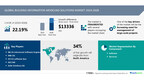
NEW YORK, Sept. 12, 2024 /PRNewswire/ — Report on how AI is driving market transformation- The global building information modeling solutions market size is estimated to grow by USD 13.33 billion from 2024-2028, according to Technavio. The market is estimated to grow at a CAGR of 22.19% during the forecast period. Increasing need for management of large-scale projects is driving market growth, with a trend towards growth of 5d building information modeling. However, high implementation and operational costs poses a challenge. Key market players include 4M SA Advanced Software Engineering Systems, ABB Ltd., ACCA software Spa, AECOM, Asite Solutions Ltd., Autodesk Inc., AVEVA Group Plc, Bentley Systems Inc., Cadsoft Corp., Dassault Systemes SE, GRAITEC Innovation SAS, Hexagon AB, Nemetschek SE, Pinnacle Infotech Inc, Plannerly, Planon Group, Schneider Electric SE, Siemens AG, The Beck Group, and Trimble Inc..
AI-Powered Market Evolution Insights. Our comprehensive market report ready with the latest trends, growth opportunities, and strategic analysis- View your snapshot now
Forecast period
2024-2028
Base Year
2023
Historic Data
2018 – 2022
Segment Covered
Component (Software and Services), Type (Commercial, Residential, Infrastructure, Industrial, and Institutional buildings), and Geography (North America, Europe, APAC, South America, and Middle East and Africa)
Region Covered
North America, Europe, APAC, South America, and Middle East and Africa
Key companies profiled
4M SA Advanced Software Engineering Systems, ABB Ltd., ACCA software Spa, AECOM, Asite Solutions Ltd., Autodesk Inc., AVEVA Group Plc, Bentley Systems Inc., Cadsoft Corp., Dassault Systemes SE, GRAITEC Innovation SAS, Hexagon AB, Nemetschek SE, Pinnacle Infotech Inc, Plannerly, Planon Group, Schneider Electric SE, Siemens AG, The Beck Group, and Trimble Inc.
Key Market Trends Fueling Growth
Building information modeling (BIM) solutions have been instrumental in enhancing the efficiency and accuracy of construction projects by providing a 3D representation of structures. However, the lack of integration of time and cost factors in 3D BIM solutions has necessitated the emergence of 5D BIM solutions. These advanced solutions offer additional dimensions, enabling investors to easily access crucial information such as deviations from the pre-determined project schedule and budget, an in-house database with cost and labor productivity rates, efficient preparation of cost schedules, and real-time cost estimation for quick comparison with the target cost. The ability to effectively manage time, cost, and resources will fuel the growth of the global building information modeling solutions market during the forecast period.
The Building Information Modeling (BIM) solutions market is experiencing significant growth due to increasing housing demand and the shift towards digital design tools in residential structure design. BIM software enables architectural planning by creating digital representations of buildings, including their physical and functional characteristics. This technology is revolutionizing the construction process by replacing paper-based design with computer-controlled manufacturing. CAD systems like Autodesk Revit and ArchiCAD are popular BIM solutions used in the construction sector for planning, design, management, and coordination. BIM capabilities extend beyond buildings to infrastructure projects, including public and private sectors, commercial and industrial projects. BIM solutions offer enhanced productivity through virtual reality (VR) and augmented reality (AR) technologies, allowing users to visualize and manipulate digital representations in a more efficient way. Data management technologies, such as remote servers and cloud-based solutions, facilitate inter-user coordination and data transmission, making BIM an essential tool for the digital engineering sector. BIM proficiency is crucial for construction projects, with HVAC systems and other building services being modeled in detail. The BIM market continues to evolve, offering advanced capabilities and integrating with other digital technologies like VR, AR, and data management systems.
Insights on how AI is driving innovation, efficiency, and market growth- Request Sample!
Market Challenges
The global building information modeling solutions market faces impeded growth due to the high cost of these solutions. Small architectural and engineering firms in the construction industry are hesitant to adopt these solutions because of their prohibitive price. Building information modeling solutions packages come with numerous modules for various applications, but they offer minimal value for small and medium enterprises (SMEs) due to the size of their projects. SMEs struggle to invest large amounts in small projects and are skeptical about the return on investment. Additionally, the support and maintenance costs of building information modeling solutions are high, posing a significant challenge. The implementation and operating costs increase due to additional design or configuration tools and services, which are often required to support the implementation of building information modeling solutions. These add-on services add to the product’s cost. While some configuration is included in the license fee, customization or significant changes in computation significantly increase the price. Consequently, the high implementation and operating costs will hinder the growth of the global building information modeling solutions market during the forecast period.The Building Information Modeling (BIM) solutions market is growing rapidly due to the increasing need for digital representations of infrastructure projects. BIM provides a more efficient way to manage the physical and functional characteristics of facilities, from public infrastructure like roads and bridges, to private infrastructure such as commercial and industrial projects. Digital technology, including Virtual Reality (VR) and Augmented Reality (AR), enhances BIM capabilities, improving inter-user coordination and data management. BIM solutions enable construction productivity gains, with software like Autodesk Revit and ArchiCAD leading the way. HVAC systems, sustainable buildings, smart cities, and smart offices are all benefiting from BIM. As the urban population grows, the demand for BIM proficiency in the construction industry and digital engineering sector increases. Data transmission and management technologies, including remote servers and cloud-based solutions, are essential for effective BIM implementation. BIM solutions are transforming the construction industry, from architecture and residential real estate to infrastructure and industrial projects. With the integration of VR, AR, and 3D BIM software, construction projects can be planned, designed, and executed more efficiently and effectively. The future of BIM lies in its ability to meet the demands of a rapidly changing world, from HVAC systems to smart cities.
Insights into how AI is reshaping industries and driving growth- Download a Sample Report
Segment Overview
This building information modeling solutions market report extensively covers market segmentation by
Component1.1 Software1.2 ServicesType2.1 Commercial2.2 Residential2.3 Infrastructure2.4 Industrial2.5 Institutional buildingsGeography3.1 North America3.2 Europe3.3 APAC3.4 South America3.5 Middle East and Africa
1.1 Software- The Building Information Modeling (BIM) Solutions market’s software segment plays a crucial role in the planning, designing, construction, and management of building projects. This segment comprises various applications such as architectural design, sustainability, structures, mechanical, electrical, and plumbing (MEP), and construction management. Key vendors in this segment include Autodesk Inc., Bentley Systems Inc., Nemetschek SE, and Trimble Inc. Autodesk Inc., based in the US, offers Revit, a widely-used building information modeling solution with features for architectural design, MEP, and structural engineering. Bentley Systems Inc., also based in the US, provides an overall solution with its MicroStation platform, known for its data integration capabilities. Nemetschek SE offers various BIM solutions through its brands like Allplan, Graphisoft, and Vectorworks, catering to different aspects of building design and construction. Trimble Inc. Offers Tekla Structures, specializing in structural engineering and construction management. Government initiatives and the need for transparency, efficiency, and cost savings are driving the adoption of BIM solutions. For instance, the UK government mandates the use of BIM solutions for all public construction projects. The software’s ability to provide detailed 3D models, clash detection, and precise cost estimations enhances project outcomes by reducing errors and rework. These factors contribute significantly to the growth of the BIM Solutions market during the forecast period.
Download complimentary Sample Report to gain insights into AI’s impact on market dynamics, emerging trends, and future opportunities- including forecast (2024-2028) and historic data (2018 – 2022)
Research Analysis
Building Information Modeling (BIM) solutions have revolutionized the construction industry by enabling digital design, planning, and management of residential structures. This technology allows for the creation of 3D models that contain essential information about a building’s design, engineering, and construction. Housing demand and sustainable buildings are major drivers of the BIM modeling sector, which includes software for architectural planning, HVAC design, and computer-controlled manufacturing. The construction process benefits from BIM solutions through improved collaboration, reduced errors, and enhanced visualization. Traditional paper-based design methods are being replaced by digital design tools like Autodesk Revit and ArchiCAD. Virtual Reality (VR) and Augmented Reality (AR) technologies further enhance the BIM experience, allowing for visualization and interaction with building models. BIM software is not limited to architecture but extends to residential real estate, smart cities, and smart offices. The integration of BIM with Computer-Aided Design (CAD) systems and the adoption of sustainable building practices are key trends shaping the future of the BIM market. The construction sector stands to gain significantly from the implementation of BIM solutions, leading to increased efficiency, cost savings, and better quality buildings.
Market Research Overview
Building Information Modeling (BIM) solutions have revolutionized the construction industry by enabling digital representations of buildings and infrastructure, integrating physical and functional characteristics. BIM solutions are essential for architectural planning, housing demand analysis, and design management in the residential structure sector. These digital design tools facilitate inter-user coordination, data transmission, and data management technologies, including remote servers and cloud-based solutions. BIM solutions are increasingly adopted in the construction sector for commercial, industrial, public, and private infrastructure projects. They offer significant benefits, such as increased construction productivity, improved planning, and enhanced BIM proficiency. The modeling sector leverages BIM capabilities to design HVAC systems, electrical installations, and other building components in 3D, using software like Autodesk Revit and ArchiCAD. BIM solutions also incorporate virtual reality (VR) and augmented reality (AR) technologies, allowing users to visualize and interact with digital models in a more efficient way. This innovation is particularly valuable for sustainable buildings, smart cities, and smart offices, catering to the growing urban population. General contractors and construction project managers can benefit from BIM solutions to streamline the construction process, reduce errors, and improve overall project efficiency. The digital engineering sector continues to innovate, offering new BIM capabilities and expanding the potential applications for these powerful digital design tools.
Table of Contents:
1 Executive Summary
2 Market Landscape
3 Market Sizing
4 Historic Market Size
5 Five Forces Analysis
6 Market Segmentation
ComponentSoftwareServicesTypeCommercialResidentialInfrastructureIndustrialInstitutional BuildingsGeographyNorth AmericaEuropeAPACSouth AmericaMiddle East And Africa
7 Customer Landscape
8 Geographic Landscape
9 Drivers, Challenges, and Trends
10 Company Landscape
11 Company Analysis
12 Appendix
About Technavio
Technavio is a leading global technology research and advisory company. Their research and analysis focuses on emerging market trends and provides actionable insights to help businesses identify market opportunities and develop effective strategies to optimize their market positions.
With over 500 specialized analysts, Technavio’s report library consists of more than 17,000 reports and counting, covering 800 technologies, spanning across 50 countries. Their client base consists of enterprises of all sizes, including more than 100 Fortune 500 companies. This growing client base relies on Technavio’s comprehensive coverage, extensive research, and actionable market insights to identify opportunities in existing and potential markets and assess their competitive positions within changing market scenarios.
Contacts
Technavio Research
Jesse Maida
Media & Marketing Executive
US: +1 844 364 1100
UK: +44 203 893 3200
Email: media@technavio.com
Website: www.technavio.com/
View original content to download multimedia:https://www.prnewswire.com/news-releases/the-building-information-modeling-solutions-market-is-projected-to-grow-by-usd-13-33-billion-from-2024-2028–driven-by-rising-demand-for-large-scale-project-management-ai-report–technavio-302245163.html
SOURCE Technavio









 Coin Market5 days ago
 Technology5 days ago
 Technology5 days ago
 Technology5 days ago
 Technology4 days ago


 Technology5 days ago