REDDING, Calif., Sept. 23, 2024 /PRNewswire/ — According to a new market research report titled, ‘3D Printing Materials Market by Type (Polymers, Metals & Alloys, Ceramics & Composites), Form (Powders, Filaments, Liquids), Technology (FDM, SLS, SLA, MJF, EBM, Others), End User (Automotive, Healthcare, Others), and Geography- Global Forecast to 2031.
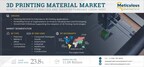
The 3D printing materials market is projected to reach $11.08 billion by 2031, at a CAGR of 23.8% from 2024 to 2031.
Download FREE PDF Brochure Of 3D Printing Materials Market – https://www.meticulousresearch.com/download-sample-report/cp_id=5083
Balancing Growth: Rising Demand and Innovation Drive the 3D Printing Market Amid Cost and Skill Challenges
The growth of this market is driven by the growing demand for polymers in 3D printing applications, the increasing focus of organizations on product development and prototyping, and government initiatives supporting the adoption of 3D printing technologies. However, the high costs of 3D printing materials restrain the growth of this market.
Furthermore, the application of 3D printing technologies in the education sector and enterprises’ increasing focus on hybrid material innovation are expected to generate market growth opportunities. However, the shortage of skilled professionals and limited material selection are major challenges impacting market growth.
Application of 3D Printing Technologies in the Education Sector
The use of 3D printing technologies in the education sector is expected to create growth opportunities for market stakeholders. 3D printing technologies help improve learning and skill development and increase student-teacher engagement. Also, working with 3D-printed models helps students improve creativity and solve complex problems with ease. 3D printing technologies improve students’ understanding by allowing them to physically touch and observe 3D-printed objects. Thus, the growing adoption of 3D printing technologies in the education sector is expected to drive the demand for 3D printing materials.
Get Insightful Data On Regions, Market Segments, Customer Landscape, And Top Companies (Charts, Tables, Figures And More) – https://www.meticulousresearch.com/request-sample-report/cp_id=5083
Nowadays, educators have started implementing 3D printing technologies at all levels, from primary to secondary school. 3D printing technologies enable educators to provide students with accurate physical prototypes and, thus, practical, and hands-on knowledge, allowing them to understand scientific concepts. Many countries have started introducing 3D printing technologies in schools and universities. For instance, the Japanese Ministry of Economy, Trade, and Industry (METI) chose several universities and technical schools to subsidize two-thirds of their expenses toward introducing 3D printing technology. Also, following the U.S., Japan joined Britain and Australia in introducing 3D printing technologies in schools and other educational institutions.
Many universities and technical colleges have incorporated 3D printing modules and projects into various courses, such as engineering and applied sciences. The third-level 3D printing module focuses on building 3D printers from scratch and fabricating 3D models using various materials. 3D printing technologies thus aid visual and practical learning across sciences. 3D-printed components are often used as test models for scientific experiments in disciplines such as mechanical engineering, aerospace, and robotics. The use of 3D printers in public libraries helps improve knowledge exchange between learners. Also, university libraries have started maintaining dedicated makerspaces with 3D printers that can be used by all library members.
3D Printing Materials Market Analysis: Key Segmental Findings
By Type: In 2024, the polymers segment is expected to account for the largest share of 79.0% of the 3D printing materials market. However, the ceramics & composites segment is expected to register the highest CAGR of 31.8% during the forecast period 2024–2031.By Form: In 2024, the powders segment is expected to account for the largest share of 46.3% of the 3D printing materials market. However, the filaments segment is expected to register the highest CAGR during the forecast period 2024–2031.By Technology: In 2024, the Fused Deposition Modeling (FDM) segment is expected to account for the largest share of the 3D printing materials market. However, the Electron Beam Melting (EBM) segment is expected to register the highest CAGR during the forecast period 2024–2031.By End User: In 2024, the aerospace & defense segment is expected to account for the largest share of 25.0% of the 3D printing materials market. However, the industrial segment is expected to register the highest CAGR during the forecast period 2024–2031.
Explore the Key Market Segments Driving Growth (Download Free Sample) – https://www.meticulousresearch.com/download-sample-report/cp_id=5083
Geographic Analysis:
Based on geography, the 3D printing materials market is segmented into North America, Europe, Asia-Pacific, Latin America, and the Middle East & Africa. In 2024, North America is expected to account for the largest share of 36.3% of the 3D printing materials market.
The consumer goods market is among the largest markets in North America. In recent years, many companies in the consumer goods space have started using 3D printing technology to manufacture products ranging from personalized headphones to customized footwear, which is expected to drive the demand for 3D printing materials in North America. Many companies have started setting up 3D printing material manufacturing plants in the region to cater to this growing demand. For instance, ARMOR Group, a France-based company, has set up 3D printing material manufacturing operations near Cincinnati, U.S. The plant also manufactures plastic products, such as thermal transfer ribbons.
The growing use of various 3D printing technologies for manufacturing orthopedic, cranial, and dental implants, surgical instruments, and prosthetics for the healthcare industry in the region is boosting the demand for 3D printing materials.
Browse In-depth Report Now – https://www.meticulousresearch.com/product/3d-printing-material-market-5083
Furthermore, various local players in the 3D printing space are collaborating with A&D companies to develop 3D printing technologies for the manufacture of high-performance aerospace & defense components. For instance, in October 2023, 3D Systems, Inc. (U.S.) launched its MJP 300W 3D printer and VisiJet Wax Jewel Ruby material. Thus, technological advances are also expected to support the growth of the 3D printing materials market in North America.
In 2024, the U.S. is expected to account for the dominant share of 95.0% of the 3D printing materials market in North America. The country’s large market share is mainly attributed to the growing adoption of 3D printing technology in healthcare, automotive, and industrial, among other applications, and the increasing demand for 3D printing technology in the country’s aerospace industry to manufacture stronger and lighter aircraft parts and components.
Asia-Pacific: The Fastest-growing Regional Market
Asia-Pacific is projected to register the highest CAGR of 28.6% during the forecast period 2024–2031. In 2024, China is expected to account for the largest share of the 3D printing materials market in Asia-Pacific. The manufacturing sector in Asia-Pacific is developing rapidly, with a growing interest in new technologies for efficient production. Additionally, increased digitization is driving the adoption of 3D printers in industries such as consumer goods, construction, healthcare, electronics, and semiconductors. China, India, Japan, South Korea, and Singapore are some of the largest economies in this region, with significant potential for the adoption of 3D printing technologies due to the rapid increase in industrialization.
Have specific research needs? Request a customized research report –https://www.meticulousresearch.com/request-customization/cp_id=5083
Manufacturing companies’ growing interest in new technologies and increasing government support for technology adoption have boosted the utilization of 3D printing technologies and materials in the region’s manufacturing sector. Increasing digitalization in the region has also fueled the adoption of 3D printing technology across the consumer goods, healthcare, construction, and education industries in Asia-Pacific.
The high adoption of 3D printing technology in the healthcare industry has accelerated the production and utilization of 3D printing materials. For instance, in February 2024, Lithoz GmbH (Austria) established a technology network to advance ceramic 3D printing. The network will initially consist of three Japanese ceramic companies—AS ONE (Japan), Mitsui Kinzoku ACT (Japan), and Yugyokuen Ceramics (Japan).
Germany Continues to Dominate the 3D Printing Materials Market in Europe
In 2024, Germany is expected to account for the largest share of the 3D printing materials market in Europe. Germany’s large share is attributed to the growing adoption of 3D printing technology among the country’s automotive companies.
Need Insights on Regional Data? Check Out Our Detailed Analysis (Download Free Sample) – https://www.meticulousresearch.com/download-sample-report/cp_id=5083
3D Printing Materials Market: Competition Analysis
This report offers a competitive analysis based on an extensive assessment of the leading players’ product portfolios, geographic presence, and key growth strategies adopted over the past 3–4 years. Major companies in the 3D printing materials market have implemented various strategies to expand their product offerings and global footprints and augment their market shares.
The key strategies followed by most companies in the 3D printing materials market include product launches, expansions, mergers & acquisitions, agreements, collaborations, and partnerships. The key players operating in the 3D printing materials market include Markforged, Inc. (U.S.), Sculpteo (France), Stratasys Ltd. (U.S.), Evonik Industries AG (Germany), Zortrax (Poland), 3D Systems, Inc. (U.S.), Proto Labs, Inc. (U.S.), MATERIALISE NV (Belgium), The ExOne Company (U.S.), IC3D, Inc. (U.S.), Desktop Metal, Inc. (U.S.), EOS GmbH (Germany), Tethon3D (U.S.), Lithoz GmbH (Germany), and Formlabs (U.S.).
Learn About the Top Companies Influencing Market Dynamics (Download Free Sample) – https://www.meticulousresearch.com/download-sample-report/cp_id=5083
3D Printing Materials Industry Overview: Latest Developments from Key Industry Players
In March 2024, HP Inc. (U.S.) launched a new polymer material, HP 3D HR PA 12 S, enabled by Arkema (France), establishing a new benchmark in surface finish with lower costs per part. The new PA 12 S material sets the standard for surface aesthetics while reducing costs for customers using HP’s Jet Fusion 5200 Series 3D printing solutions.In February 2024, Lithoz GmbH (Austria) established a technology network to advance ceramic 3D printing. The network will initially consist of three Japanese ceramic companies—AS ONE (Japan), Mitsui Kinzoku ACT (Japan), and Yugyokuen Ceramics (Japan).In October 2023, Desktop Metal, Inc. (U.S.) launched ETEC Pro XL, an industrial polymer 3D printer that delivers extreme accuracy, resolution, and surface finish in a large build area with high throughput speeds. Additional updates to ETEC Pro XL include a 4K ultra-high-definition projector and proven HyperPrint technology for continuous, isotropic printing.In March 2021, STRATASYS LTD. (Israel) launched the J5 DentaJet multi-material 3D printing system to enable dental professionals to load mixed trays of dental parts. The J5 DentaJet can handle up to five different materials and allows dental labs to manufacture several parts with multiple materials for partial denture applications or dental implant cases.In March 2021, Evonik Industries AG (Germany) launched a new ready-to-use PEEK filament for 3D printing industrial plastic parts. The high-temperature material called INFINAM PEEK 9359 F is compatible with extrusion-based 3D printing processes such as FDM and FFF. It is designed to replace metals in “infinite” industrial 3D printing applications.
IMMEDIATE DELIVERY AVAILABLE | BUY THIS RESEARCH REPORT (Insights, Charts, Tables, Figures and More) – https://www.meticulousresearch.com/Checkout/27404287
Scope of the Report:
3D Printing Materials Market Assessment—by Type
PolymersPhotopolymersPolyamide (PA)Polylactic AcidAcrylic Styrene Acrylonitrile (ASA)Polycarbonates (PC)Polypropylene (PP)Thermoplastic Elastomers (TPE)Other PolymersMetals & AlloysSteelTitaniumNickelAluminumCopperCobalt-ChromeOther Metals & AlloysCeramics & Composites
3D Printing Materials Market Assessment—by Form
PowdersFilamentsLiquids
3D Printing Materials Market Assessment—by Technology
Fused Deposition Modeling (FDM)Selective Laser Sintering (SLS)Stereolithography (SLA)Direct Metal Laser Sintering (DMLS)PolyjetMulti Jet Fusion (MJF)Digital Light Processing (DLP)Electron Beam Melting (EBM)Other Technologies
3D Printing Materials Market Assessment—by End User
Consumer Packaged GoodsElectronic AppliancesJewelry & Artistic ItemsOther Consumer Packaged Goods ApplicationsAutomotiveIndustrialEquipment & MachinesGoods & MaterialsHealthcareImplantsDentalMedical DevicesAerospace & DefensePrototypesBody & Spare PartsEnergyConstructionOther End Users
3D Printing Materials Market Assessment—by Geography
North AmericaU.S.CanadaEuropeGermanyFranceU.K.ItalySpainRussiaRest of Europe (RoE)Asia-Pacific (APAC)ChinaJapanIndiaSouth KoreaRest of Asia-Pacific (RoAPAC)Latin AmericaBrazilMexicoRest of Latin America (RoLATAM)Middle East & AfricaIsraelUAERest of Middle East & Africa
Browse More Related Reports:
Dental 3D Printing Market, worth $3.56B in 2023, is set to grow to $16.22B by 2031, driven by a CAGR of 20.9% from 2024 – https://www.meticulousresearch.com/product/dental-3d-printing-market-5487
3D Printing Plastics Market will reach $7.8 billion by 2031, growing at a CAGR of 23.2% from 2024 to 2031 – https://www.meticulousresearch.com/product/3d-printing-plastics-market-5950
Explore booming 3D Printing Construction Market, set to reach $1,617.5 Billion by 2030, growing at a staggering CAGR of 207.1% from 2024 to 2030 – https://www.meticulousresearch.com/product/3d-printing-construction-market-5450
Medical 3D printing market is projected to reach $9.6 billion by 2030, at a CAGR of 18.3% during forecast period – https://www.meticulousresearch.com/product/medical-3d-printing-market-5507
Dental 3D Printing Materials Market is Projected to Reach $5.4 Billion by 2031 at a CAGR of 27.3% From 2024 to 2031 – https://www.meticulousresearch.com/product/dental-3d-printing-material-market-5204
3D Printing Materials Market is projected to reach $11.08 billion by 2031, at a CAGR of 23.8% from 2024 to 2031 – https://www.meticulousresearch.com/product/3d-printing-material-market-5083
3D Printing PLA Market By Application (Consumer products, Automotive Parts, Industrial Applications, Healthcare, Aerospace & Defense, Others) And Geography – Global Forecast To 2027 – https://www.meticulousresearch.com/product/3d-printing-pla-market-5152
3D Printing Materials Market Report Summary
Particulars
Details
Number of Pages
250
Format
PDF
Forecast Period
2024-2031
Base Year
2023
CAGR
23.8 %
Estimated Market Size (Value)
$11.08 billion by 2031
Countries Covered
North America (U.S., Canada), Europe (Germany, France, U.K., Italy, Spain, Russia, Rest of Europe), Asia-Pacific (China, Japan, India, South Korea, Rest of Asia-Pacific), Latin America (Brazil, Mexico, Rest of Latin America), and the Middle East & Africa (Israel, UAE, Rest of Middle East & Africa).
Key Companies
Markforged, Inc. (U.S.), Sculpteo (France), Stratasys Ltd. (U.S.), Evonik Industries AG (Germany), Zortrax (Poland), 3D Systems, Inc. (U.S.), Proto Labs, Inc. (U.S.), MATERIALISE NV (Belgium), The ExOne Company (U.S.), IC3D, Inc. (U.S.), Desktop Metal, Inc. (U.S.), EOS GmbH (Germany), Tethon3D (U.S.), Lithoz GmbH (Germany), and Formlabs (U.S.).
Hot Industry Reports: Emerging Trends and Market Forecasts
Nutraceutical Ingredients Market by Size, Share, Forecasts, & Trends Analysis – https://www.meticulousresearch.com/product/nutraceutical-ingredients-market-5044
Speech Analytics Market by Size, Share, Forecasts, & Trends Analysis – https://www.meticulousresearch.com/product/speech-analytics-market-5364
Disinfection Robots Market Size, Share, Forecast, & Trends – https://www.meticulousresearch.com/product/disinfection-robots-market-5234
Clinical Trial Supplies Market Size, Share, Forecast, & Trends 2031 – https://www.meticulousresearch.com/product/clinical-trial-supplies-market-5072
Bovine Gelatin Market by Size, Share, Forecast, & Trends Analysis – https://www.meticulousresearch.com/product/bovine-gelatin-market-5794
Collaborative Robots Market: Types, Trends, & Forecasts 2031 – https://www.meticulousresearch.com/product/collaborative-robots-market-5014
Learning Management System (LMS) Market Size, Share 2030 – https://www.meticulousresearch.com/product/learning-management-system-market-5052
Research Antibodies and Reagents Market by Size, Share, Forecasts, & Trends Analysis – https://www.meticulousresearch.com/product/research-antibodies-and-reagents-market-5055
Digital Twin Market Size, Share, & Growth Analysis 2030 – https://www.meticulousresearch.com/product/digital-twin-market-5060
e-SUVs Market by Size, Share, Forecasts, & Trends Analysis – https://www.meticulousresearch.com/product/e-suvs-market-5958
Europe Orthodontics Market by Size, Share, Forecast, & Trends Analysis – https://www.meticulousresearch.com/product/europe-orthodontics-market-5701
Antimicrobial Susceptibility Testing Market by Size, Share, Forecasts, & Trends Analysis – https://www.meticulousresearch.com/product/antimicrobial-susceptibility-testing-market-5062
South East Asia Molecular Diagnostics Market by Size, Share, Forecast, & Trends Analysis – https://www.meticulousresearch.com/product/south-east-asia-molecular-diagnostics-market-5775
AI in Supply Chain Market by Size, Share, Forecasts, & Trends Analysis – https://www.meticulousresearch.com/product/ai-in-supply-chain-market-5064
Europe Microalgae Market by Size, Share, Forecasts, & Trends Analysis – https://www.meticulousresearch.com/product/europe-microalgae-market-5491
Vaccines Market Size, Share, & Industry Growth 2031 – https://www.meticulousresearch.com/product/vaccines-market-5076
Human Nutrition Market by Size, Share, Forecasts, & Trends Analysis – https://www.meticulousresearch.com/product/human-nutrition-market-5046
Feed Additives Market Industry Overview & 2030 Projections – https://www.meticulousresearch.com/product/feed-additives-market-5082
Healthcare IT Market Trends & Insights, Forecast to 2031 – https://www.meticulousresearch.com/product/healthcare-it-market-5084
Edge Computing Market: Components, Applications & Forecasts – https://www.meticulousresearch.com/product/edge-computing-market-5061
Vietnam Cartonboard Paper Market by Size, Share, Forecasts, & Trends Analysis – https://www.meticulousresearch.com/product/vietnam-cartonboard-paper-market-5572
Europe Water and Wastewater Treatment Market by Size, Share, Forecast, & Trends Analysis – https://www.meticulousresearch.com/product/europe-water-and-wastewater-treatment-market-5664
Pharmaceutical Processing Equipment Market by Size, Share, Forecasts, & Trends Analysis – https://www.meticulousresearch.com/product/pharmaceutical-processing-equipment-market-5296
Smart Waste Management Market by Size, Share, Forecasts, & Trends Analysis – https://www.meticulousresearch.com/product/smart-waste-management-market-5063
Cybersecurity Market Size, Share, Forecast, & Trends 2031 – https://www.meticulousresearch.com/product/cybersecurity-market-5069
Latin America IVD Market by Size, Share, Forecasts, & Trends Analysis – https://www.meticulousresearch.com/product/latin-america-ivd-market-5105
Weather Monitoring Systems Market by Size, Share, Forecasts, & Trends Analysis – https://www.meticulousresearch.com/product/weather-monitoring-systems-market-5417
Seed Treatment Market by Size, Share, Forecast, & Trends Analysis – https://www.meticulousresearch.com/product/seed-treatment-market-5075
Continuous Bioprocessing Market by Size, Share, Forecast, & Trends Analysis – https://www.meticulousresearch.com/product/continuous-bioprocessing-market-5079
Non-destructive Testing Services Market Size, Share, Forecast, & Trends Analysis – https://www.meticulousresearch.com/product/non-destructive-testing-services-market-5118
Europe Livestock Diagnostics Market by Size, Share, Forecasts, & Trends Analysis – https://www.meticulousresearch.com/product/europe-livestock-diagnostics-market-5751
Access Control Market by Size, Share, Forecast, & Trends Analysis – https://www.meticulousresearch.com/product/access-control-market-5097
Collagen Market by Size, Share, Forecasts, & Trends Analysis – https://www.meticulousresearch.com/product/collagen-market-5121
Organic Food Market: Types, Channels, & Forecasts 2031 – https://www.meticulousresearch.com/product/organic-food-market-5122
Europe Phycocyanin Market by Size, Share, Forecasts, & Trends Analysis – https://www.meticulousresearch.com/product/europe-phycocyanin-market-5488
Water and Wastewater Treatment Technologies Market Analysis – https://www.meticulousresearch.com/product/water-and-wastewater-treatment-technologies-market-5299
Dairy Alternatives Market Size, Trends & Analysis by 2031 – https://www.meticulousresearch.com/product/dairy-alternatives-market-5128
South East Asia Pharmaceutical Contract Development and Manufacturing Market by Size, Share, Forecast, & Trends Analysis – https://www.meticulousresearch.com/product/south-east-asia-pharmaceutical-contract-development-and-manufacturing-market-5675
South East Asia Smart Home Market by Size, Share, Forecast, & Trends Analysis – https://www.meticulousresearch.com/product/south-east-asia-smart-home-market-5674
Hydrocolloids Market by Size, Share, Forecasts, & Trends Analysis – https://www.meticulousresearch.com/product/hydrocolloids-market-5109
Contact:
Mr. Khushal Bombe
Meticulous Market Research Inc.
1267 Willis St, Ste 200 Redding,
California, 96001, U.S.
USA: +1-646-781-8004
Europe: +44-203-868-8738
APAC: +91 744-7780008
Email- sales@meticulousresearch.com
Visit Our Website: https://www.meticulousresearch.com/
Connect with us on LinkedIn- https://www.linkedin.com/company/meticulous-research
Meticulousblog.org | Top Market Research Reports Blog – https://meticulousblog.org/
Content Source: https://www.meticulousresearch.com/pressrelease/91/3d-printing-material-market
Photo: https://mma.prnewswire.com/media/2512505/3D_Printing_METICULOUS.jpg
Logo: https://mma.prnewswire.com/media/1757980/Meticulous_Research_Logo_1.jpg
View original content:https://www.prnewswire.co.uk/news-releases/3d-printing-materials-market-to-reach-11-08-billion-by-2031—growing-demand-for-polymers-in-3d-printing-applications-and-the-increasing-focus-of-organizations-on-product-development-and-prototyping–exclusive-report-by-meticulo-302255472.html










 Technology4 days ago

 Technology4 days ago

 Coin Market4 days ago

 Technology1 day ago

 Technology4 days ago

 Technology4 days ago

 Technology5 days ago
