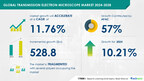
NEW YORK, Oct. 1, 2024 /PRNewswire/ — Report on how AI is driving market transformation- The global transmission electron microscope market size is estimated to grow by USD 528.8 million from 2024-2028, according to Technavio. The market is estimated to grow at a CAGR of over 11.76% during the forecast period. Increasing focus on nanotechnology is driving market growth, with a trend towards development of new forms of transmission electron microscopes. However, high cost and heavy excise duty of transmission electron microscopes poses a challenge. Key market players include Advantest Corp., Agilent Technologies Inc., AMETEK Inc., Angstrom Advanced Inc., Bruker Corp., Carl Zeiss Stiftung, Danaher Corp., DELONG INSTRUMENTS AS, Hirox Co. Ltd., Hitachi Ltd., IXRF Inc., JEOL Ltd, NanoScience Instruments Inc., Nikon Corp., Nion, Olympus Corp., Oxford Instruments plc, Roper Technologies Inc., Thermo Fisher Scientific Inc., and VIDEOTON HOLDING ZRt.
Key insights into market evolution with AI-powered analysis. Explore trends, segmentation, and growth drivers- View the snapshot of this report
Transmission Electron Microscope Market Scope
Report Coverage
Details
Base year
2023
Historic period
2017 – 2021
Forecast period
2024-2028
Growth momentum & CAGR
Accelerate at a CAGR of 11.76%
Market growth 2024-2028
USD 528.8 million
Market structure
Fragmented
YoY growth 2022-2023 (%)
10.21
Regional analysis
APAC, North America, Europe, South America, and Middle East and Africa
Performing market contribution
APAC at 57%
Key countries
China, US, Japan, South Korea, and Canada
Key companies profiled
Advantest Corp., Agilent Technologies Inc., AMETEK Inc., Angstrom Advanced Inc., Bruker Corp., Carl Zeiss Stiftung, Danaher Corp., DELONG INSTRUMENTS AS, Hirox Co. Ltd., Hitachi Ltd., IXRF Inc., JEOL Ltd, NanoScience Instruments Inc., Nikon Corp., Nion, Olympus Corp., Oxford Instruments plc, Roper Technologies Inc., Thermo Fisher Scientific Inc., and VIDEOTON HOLDING ZRt
Market Driver
The transmission electron microscope market is experiencing significant growth due to the development of new types of transmission electron microscopes. These advanced models include reflection electron microscopes (REMs), scanning-transmission electron microscopes (STEMs), low-voltage electron microscopes (LVEMs), and cryo-EM. Reflection electron microscopes (REMs) differ from traditional transmission electron microscopes by collecting electrons that are elastically scattered from the object, rather than those that pass through it. REMs are particularly useful when surface information of the specimen is required. Scanning-transmission electron microscopes (STEMs) are increasingly adopted in research laboratories due to their ability to produce images or results directly, without the need for interpretation. STEMs come in two types: conventional transmission electron microscopes, which require additional detectors, scanning coils, and circuitry, and dedicated STEMs, which have all the circuitry embedded. Low-voltage electron microscopes (LVEMs) combine the features of transmission electron microscopes, scanning electron microscopes, and STEMs. Operating at a low voltage, LVEMs provide high contrast images, which is essential for studying biological specimens. LVEMs are available in benchtop mode and are one of the smallest multimode desktop electron microscopes. Cryo-EM uses frozen samples, gentle electron beams, and sophisticated image processing to study biomolecules without the need for crystals. Cryo-EM allows scientists to observe biomolecules as they perform their functions, making it an invaluable tool in the field of biology. Liquid-phase TEM (LP-TEM) ensures in-situ observations of materials in liquids at the highest spatial and temporal resolution in controlled environments. LP-TEM is crucial for studying fluid properties and temperature, but caution must be taken for changes induced by electron beams in pH, nucleation rate, and radiolysis. Overall, the advancements in transmission electron microscopes are driving the growth of the global transmission electron microscope market. These new forms of microscopes offer unique benefits, making them indispensable tools in various industries, including materials science, biology, and electronics.
The Transmission Electron Microscope (TEM) market is experiencing significant growth due to its application in various industries. In life sciences, TEMs are crucial for cancer research and virology, providing 2D images of specimens at the nanoscale. In materials sciences, TEMs help analyze semiconductors and wafers, enabling the study of their 3D structure and properties. TEMs are also essential in pollution research, nanotechnology, paleontology, and palynology. Industries like automotive, aerospace, electronics, oil & gas, environmental, water treatment, hospitals, diagnostic centers, blood banks, and forensic labs rely on TEMs for their research and development. TEMs offer high throughput methods, super resolution, digitization, live-cell imaging, and expansion and multi-view microscopes. Sample preparation techniques have also advanced, making TEMs more accessible. Neutron spectroscopy, X-ray diffraction, and electron microscopy imaging are complementary techniques that enhance TEM’s capabilities. TEMs operate at the de Broglie wavelength, enabling the study of nanometers-scale objects. Overall, the TEM market is expanding, driven by its applications in various industries and advancements in technology.
Request Sample of our comprehensive report now to stay ahead in the AI-driven market evolution!
Market Challenges
The Transmission Electron Microscope (TEM) market faces significant challenges due to the high initial investment cost and the dependence on government and corporate funding for research institutes. This funding can be unpredictable, leading to market volatility. Additionally, high import duties and taxes, such as customs duties, imposed by various governments can increase the final product cost. Some countries, like the US, China, Canada, India, and Brazil, levy indirect taxes at both the national and state levels, with tax rates ranging from 11% to 17%. These taxes and excise duties contribute to the overall increase in product costs, potentially hindering the growth of the global TEM market during the forecast period.The Transmission Electron Microscope (TEM) market faces several challenges in various industries. In research centers, the use of licensed closed-source software limits the flexibility and collaboration among researchers. In electronics and medicine, the need for advanced microscopes for nanotechnology, surface physics, and surface analyses is growing, requiring significant investment. For solid specimens, TEMs offer unparalleled magnification, making them essential for gemology, medical sciences, forensic sciences, and more. However, the complex electron gun, condenser system, objective lens, movable specimen stage, image-recording system, and vacuum system make TEM instruments expensive and challenging to operate. The market for TEMs is expanding in nanomaterials, energy-related materials, polymers, glassy substances, biomolecular mechanisms, viruses, macromolecular complexes, and cellular structures. Industries, including catalysis research, environmental particles, and the nanoworld, rely on TEMs for scientific research and technological innovation. The electron source and electron optics system in a vacuum environment enable the study of ultrafast processes, making TEMs indispensable tools. Environmental TEMs and beam chopper technology, such as UTEM, offer solutions for specific applications. Overall, the TEM market’s growth is driven by the need for deeper understanding and discovery in various fields.
Discover how AI is revolutionizing market trends- Get your access now!
Segment Overview
This transmission electron microscope market report extensively covers market segmentation by
Application 1.1 Life science1.2 Material science1.3 Nanotechnology1.4 Semiconductor1.5 OthersEnd-user 2.1 Industries2.2 Academic institutes2.3 OthersGeography 3.1 APAC3.2 North America3.3 Europe3.4 South America3.5 Middle East and Africa
1.1 Life science- Transmission Electron Microscopes (TEMs) play a crucial role in the field of life sciences, particularly in microbiology, by enabling researchers to examine microorganisms and their structures at the atomic level. These advanced instruments allow scholars to study intricate details of cellular environments, contributing significantly to the understanding of cell behavior, structure, and growth. With the potential to develop new drugs and medicines, academic institutions and pharmaceutical firms invest heavily in TEM technology. For instance, the Pennsylvania State University’s acquisition of FEI Company’s Titan/Krios TEM, which operates at extremely low temperatures, enhances their research capabilities and opens new avenues for exploration. TEMs enable the creation of 3D images of biological molecules such as DNA, proteins, and viruses, including the SARS-CoV-2 virus causing COVID-19. This technology’s ability to produce high-resolution images of these structures aids in the development of new vaccines and treatments. The ongoing research on single-dose COVID-19 vaccines is expected to fuel the demand for TEMs in the global market during the forecast period.
Download a Sample of our comprehensive report today to discover how AI-driven innovations are reshaping competitive dynamics
Research Analysis
The Transmission Electron Microscope (TEM) market encompasses a wide range of industries and applications, driven by the need for high-resolution imaging and analysis of nanoscale objects. TEM utilizes the principle of de Broglie wavelength, allowing electrons to pass through thin samples and create detailed images. Applications span various fields such as cancer research, virology, materials sciences, nanotechnology, paleontology, and palynology. Industries like life sciences, automotive, aerospace, electronics, oil & gas, environmental, water treatment, and research institutes, hospitals, diagnostic centers, blood banks, and forensic labs all benefit from TEM technology. Semiconductors and X-ray diffraction are also significant applications. TEMs, including Scanning Transmission Electron Microscopes (STEMs), are essential tools for studying nanometers-scale structures, providing valuable insights into their properties and behavior.
Market Research Overview
Transmission Electron Microscopes (TEMs) use the principle of de Broglie wavelength to generate high-resolution 2D images of specimens at the nanoscale. TEMs differ from light microscopes as they employ an electron gun and condenser system instead of light to illuminate the specimen. TEMs have significant applications in various fields such as cancer research, virology, materials sciences, pollution analysis, nanotechnology, paleontology, and palynology. They provide detailed information on the 3D structure of nanoscale objects, semiconductors, wafers, and other materials. TEMs are used extensively in the life sciences, semiconductor industry, automotive, aerospace, electronics, oil & gas, environmental, water treatment, hospitals, diagnostic centers, blood banks, forensic labs, and other industries. TEMs offer advanced features like live-cell imaging, super resolution, high throughput methods, expansion microscopes, multi-view microscopes, and integrated microscopy workflows. Sample preparation is crucial for obtaining high-quality images, and TEMs require specialized equipment and expertise. TEMs use closed-source and proprietary software, which can be expensive, while open-source software like ImageJ/Fiji, Neuronstudio, and L-measure offer cost-effective alternatives for small-scale end users. TEMs require skilled operators, including physicists, laboratory technicians, and other experts. The electron gun and objective lens focus the electron beam on the specimen, while the condenser system controls the illumination. The electron beam interacts with the specimen, producing various signals that are used to form the image. Neutron spectroscopy, X-ray diffraction, and electron microscopy imaging are complementary techniques used in conjunction with TEMs for comprehensive material analysis.
Table of Contents:
1 Executive Summary
2 Market Landscape
3 Market Sizing
4 Historic Market Size
5 Five Forces Analysis
6 Market Segmentation
ApplicationLife ScienceMaterial ScienceNanotechnologySemiconductorOthersEnd-userIndustriesAcademic InstitutesOthersGeographyAPACNorth AmericaEuropeSouth AmericaMiddle East And Africa
7 Customer Landscape
8 Geographic Landscape
9 Drivers, Challenges, and Trends
10 Company Landscape
11 Company Analysis
12 Appendix
About Technavio
Technavio is a leading global technology research and advisory company. Their research and analysis focuses on emerging market trends and provides actionable insights to help businesses identify market opportunities and develop effective strategies to optimize their market positions.
With over 500 specialized analysts, Technavio’s report library consists of more than 17,000 reports and counting, covering 800 technologies, spanning across 50 countries. Their client base consists of enterprises of all sizes, including more than 100 Fortune 500 companies. This growing client base relies on Technavio’s comprehensive coverage, extensive research, and actionable market insights to identify opportunities in existing and potential markets and assess their competitive positions within changing market scenarios.
Contacts
Technavio Research
Jesse Maida
Media & Marketing Executive
US: +1 844 364 1100
UK: +44 203 893 3200
Email: media@technavio.com
Website: www.technavio.com/
View original content to download multimedia:https://www.prnewswire.com/news-releases/transmission-electron-microscope-market-to-grow-by-usd-528-8-million-2024-2028-driven-by-nanotechnology-focus-ai-powered-market-evolution-report–technavio-302264391.html
SOURCE Technavio










 Coin Market5 days ago
 Technology5 days ago
 Technology5 days ago

 Coin Market5 days ago
 Coin Market4 days ago

 Technology4 days ago