Connect with us

Technology

New study: Government GenAI optimism may be outpacing ability to deploy

Published

on

Despite high hopes and dedicated budgets for GenAI, government agencies need to increase guardrails, training; synthetic data could be missed opportunity

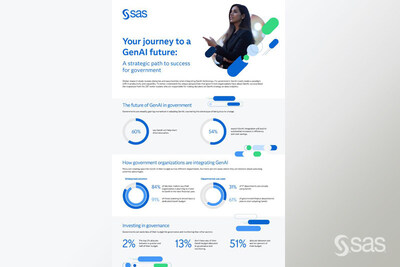
CARY, N.C., Oct. 3, 2024 /PRNewswire/ — A new global study, Your Journey to a GenAI Future: A Strategic Path to Success for Government from SAS and Coleman Parkes Research, reveals that government agencies lag well behind other sectors in the adoption of generative AI. However, 60% of government respondents believe GenAI will drive innovation, and those that have begun using it are already seeing improvements in employee satisfaction, compliance, and operational costs and time savings.

When properly planned and governed, GenAI will bring significant value to citizens and communities

Despite trailing other sectors by 10% (44% vs. 54%) in the current use of generative AI, the success of these early adopter agencies suggests enormous potential for the technology. Those benefits could arrive soon, with 84% of government decision makers saying their organizations are planning to invest in GenAI in the next fiscal year, and 91% of those respondents already having dedicated GenAI budget.

“While they haven’t been first to adopt GenAI, government agencies are poised to increase productivity and transform citizen services with this technology,” said Grant Brooks, Vice President of US Public Sector and Health Care at SAS. “Deploying AI in a measured and responsible manner is crucial, but when properly planned and governed, we can be confident that GenAI will bring significant value to our nation’s citizens and communities. We’ve partnered with government agencies through every major technological breakthrough of the last half century, and we’re excited to see what we can do together with GenAI.”

Need to overcome organizational obstacles with better governance, communication and policy

All sectors shared top concerns about data privacy, data security and AI governance. However, government respondents had larger concerns (52%) about cultural resistance to change compared to other concerns (46%) and believe compatibility with legacy systems could be a challenge.

Additionally, the promise of GenAI in government may be imperiled by inadequate regulatory preparedness and lack of understanding of GenAI, relative to other industries. While many organizations have rushed to put GenAI guidance in place, only 52% of government organizations have a policy stating how employees are and are not allowed to use GenAI at work, compared to 61% across all sectors.

The study found that government agencies set aside less of their budgets for governance and monitoring than other sectors; 64% have allotted one-tenth or less of their GenAI budgets to governance and monitoring. Additionally, 50% of public sector respondents said they either don’t have a framework or that it’s ad hoc or informal, in comparison to 39% across the board.

GenAI regulation is moving quickly, so keeping up with it while unlocking the technology’s value is a universal challenge. However, government may be less prepared than other sectors, as 51% of government leaders say they’re fully or moderately prepared to comply with current and upcoming GenAI regulations, compared to an average of 58% across all sectors.

Awareness is also a concern, as only 35% of public sector employees are familiar with their organizations’ adoption of GenAI, far less than the 46% average. These lagging indicators could be the result of a problem at the leadership level, as only 38% of senior government decision makers say they understand GenAI and its impacts on business processes well or completely, compared to 48% across all sectors.

There is good news though. Lower adoption rates in government corresponded with slightly lower policy preparedness and personal understanding, indicating that there is value in learning by doing. Government organizations that are implementing GenAI now are already seeing a range of benefits, in many cases outpacing other sectors. More government decision makers than the cross-sector average say that implementing GenAI has improved employee experience and satisfaction (94%) or created operational cost and time savings (84%).

“It’s natural that government would have some reticence to adopt GenAI, but the public sector pioneers are already showing that the more it’s used, the more confidence will grow, and innovation will accelerate,” said Jennifer Robinson, Global Government Strategic Advisor, SAS. “Large language models, digital twins and synthetic data hold tremendous potential for government agencies, once they have the processes and policies in place to maximize them.”

Low interest in synthetic data could inhibit innovation

Synthetic data is artificial data that accurately mimics real data. It reproduces the same statistical properties, probabilities, patterns and characteristics of the real-world data set from which the synthetic data is trained and has been found to be as much as 99% statistically valid.

For example, synthetic data of simulated traffic flows could help transportation departments test a road improvement with what-if scenarios even if they only have a few months of traffic data. Since it can mimic sensitive data, it can be created to train and test a system that processes health records, student records or tax information.

However, the study found that 32% of government decision makers would not consider using synthetic data. This exceeds the mere 23% of respondents across industries who are averse to its use.

“Synthetic data is particularly relevant for government agencies that must follow strict data privacy regulations,” said Robinson. “Governments can use synthetic data for various purposes, including research, testing and analysis, while mitigating risks of violating privacy regulations or exposing sensitive information.”

SAS: The past, present and future of public sector AI

Technologies like AI and generative AI are enabling fresh ideas about how public sector organizations can deliver services and are helping them rethink what services are offered. Gaze into the future of public service with a new e-book from SAS.

SAS has embedded AI capabilities into its software – from the powerful SAS® Viya® to targeted solutions for public sector organizations. With an emphasis on greater interpretability and transparency, SAS AI capabilities enable government agencies to better understand an algorithm’s outputs while better managing and protecting personal information. Learn more about how SAS analytics and AI are helping government agencies face today’s challenges at www.sas.com/en_us/industry/government/technology/ai.html.

About SAS
SAS is a global leader in data and AI. With SAS software and industry-specific solutions, organizations transform data into trusted decisions. SAS gives you THE POWER TO KNOW®.

SAS and all other SAS Institute Inc. product or service names are registered trademarks or trademarks of SAS Institute Inc. in the USA and other countries. ® indicates USA registration. Other brand and product names are trademarks of their respective companies. Copyright © 2024 SAS Institute Inc. All rights reserved. 

Editorial Contact:
Trent Smith
trent.smith@sas.com
919-531-4726
sas.com/news


View original content to download multimedia:https://www.prnewswire.com/news-releases/new-study-government-genai-optimism-may-be-outpacing-ability-to-deploy-302267084.html

SOURCE SAS

Continue Reading

Technology

Howard Hughes Holdings Set to Join S&P SmallCap 600

Published

on

By

NEW YORK, Oct. 23, 2026 /PRNewswire/ — Howard Hughes Holdings Inc. (NYSE: HHH) will replace Arcosa Inc. (NYSE: ACA) in the S&P SmallCap 600 effective prior to the opening of trading on Wednesday, October 28. S&P 500 constituent CRH plc (NYSE: CRH) has acquired Arcosa in a deal that closed today, October 23.

Following is a summary of the changes that will take place prior to the open of trading on the effective date:

Effective Date

Index Name  

Action

Company Name

Ticker

GICS Sector

October 28, 2026

S&P SmallCap 600

Addition

Howard Hughes Holdings

HHH

Real Estate

October 28, 2026

S&P SmallCap 600

Deletion

Arcosa

ACA

Industrials

ABOUT S&P DOW JONES INDICES

S&P Dow Jones Indices is the largest global resource for essential index-based concepts, data and research, and home to iconic financial market indicators, such as the S&P 500® and the Dow Jones Industrial Average®. More assets are invested in products based on our indices than products based on indices from any other provider in the world. Since Charles Dow invented the first index in 1884, S&P DJI has been innovating and developing indices across the spectrum of asset classes helping to define the way investors measure and trade the markets.

S&P Dow Jones Indices is a division of S&P Global (NYSE: SPGI), which provides essential intelligence for individuals, companies, and governments to make decisions with confidence. For more information, visit www.spglobal.com/spdji/en/. 

FOR MORE INFORMATION:

S&P Dow Jones Indices
index_services@spglobal.com

Media Inquiries
spdji.comms@spglobal.com

View original content:https://www.prnewswire.com/news-releases/howard-hughes-holdings-set-to-join-sp-smallcap-600-302918511.html

SOURCE S&P Dow Jones Indices

Continue Reading

Technology

Chelsea FC announces multi-year sleeve partnership with Sokin, the business payments and FX platform

Published

on

By

Chelsea FC name fast-growing fintech platform as Principal Partner

LONDON, Oct. 23, 2026 /PRNewswire/ — Chelsea Football Club has today announced a multi-year partnership with Sokin, the embedded finance and payments company used by businesses worldwide. Sokin will be named a Principal Partner and Official Business Payments and FX Partner of Chelsea FC and Chelsea FC Women.

As a Principal Partner, Sokin will be represented on the sleeves of the Chelsea FC men’s, women’s and academy home, away, and third kits from the 2026/27 season.

The partnership brings together two ambitious London-headquartered organisations with worldwide reach – a club with millions of fans across the world and a fintech platform through which businesses move more than $11 billion a year. A club of Chelsea’s scale works in many currencies every day, with partners, competitions and supporters around the world, and needs a financial partner built to handle that.

Sokin gives finance teams business payments, multi-currency accounts, foreign exchange, checkout and treasury in one place, so they spend less time juggling banks and providers and keep more of what they move.

As Official Business Payments and FX Partner, Sokin will simplify how Chelsea FC sends, receives and manages money in the currencies the club operates in.

The Sokin logo will feature on the sleeve of the Chelsea shirt for the first time [when the men’s team host Tottenham Hotspur at Stamford Bridge on Saturday 24th October.]

Jason Gannon, President at Chelsea FC said:

“At Chelsea, we seek to partner with organisations that share our ambition and innovative mindset. Sokin’s expertise in business payments, and their focus on making both simpler for the businesses they serve, makes them a natural fit for the Club. We are pleased to welcome Sokin to the Chelsea family and look forward to working together in the years ahead.”

Vroon Modgill, CEO and founder at Sokin said:

“Chelsea plays on the biggest stage in world football, and its business runs in dozens of currencies. Sokin was built for that with regulated, multi-currency payments and foreign exchange for organisations that operate internationally. We’re proud to be the platform behind the business payments and FX of one of the most iconic teams in football. Sokin’s platform serves businesses in more than 170 countries. We’re thrilled to be partners for the season ahead. An organisation as sophisticated as Chelsea doesn’t leave its finances to chance.”

About Sokin

Sokin is the financial layer global business runs on. Businesses can transact, convert and hold money in 70+ currencies across 170+ countries. Some businesses use Sokin to manage global finance in-house. Others build it into their products to power financial experiences for their customers. Businesses move more than $9 billion a year on licenses Sokin holds in 36+ countries and infrastructure Sokin owns. Founded in 2019, Sokin has raised over $100 million from investors including Morgan Stanley Expansion Capital and Prysm Capital.

About Chelsea Football Club

Chelsea Football Club is one of the biggest, most successful football clubs globally and our men’s team are reigning world champions, having won the four-yearly FIFA Club World Cup in 2025. Our women’s team, Chelsea Women, are also multiple trophy winners.

Founded in 1905, Chelsea is London’s most central football club, based at the iconic 40,000-capacity Stamford Bridge stadium. Nicknamed the Blues, the club lifted the Champions League for the first time in 2012 and domestically has won the Premier League five times, the FA Cup eight times, the Football League Cup five times and the Football League Championship once, in 1955.

The Chelsea Women’s team have enjoyed a huge amount of success and in 2025 won the FA Women’s Super League for a sixth consecutive year and the eighth time overall. The Women’s FA Cup has been won on six occasions. We have also captured the FA Women’s League Cup four times as well as reaching the UEFA Women’s Champions League final in 2021. In two seasons, 2020/21 and 2024/25, a domestic treble of trophies was secured.

The Chelsea Foundation boasts one of the most extensive community initiatives in sport, helping to improve the lives of children and young people all over the world.

Media Contacts:

Taina Biggs
taina.biggs@sokin.com 

Nerissa Chesterfield
nerissa.chesterfield@chelseafc.com 

View original content to download multimedia:https://www.prnewswire.co.uk/news-releases/chelsea-fc-announces-multi-year-sleeve-partnership-with-sokin-the-business-payments-and-fx-platform-302918466.html

Continue Reading

Technology

Amy Johnson Appointed President of GDIT

Published

on

By

RESTON, Va., Oct. 23, 2026 /PRNewswire/ — General Dynamics (NYSE:GD) announced today that Amy Johnson has been appointed as president of GDIT, effective November 3.

Johnson is a 27-year veteran of General Dynamics Mission Systems, where she held increasingly senior roles in engineering, engineering management and business leadership across cybersecurity, defense electronics, space and intelligence systems, most recently as vice president and general manager for Space, Cyber and Intelligence. She earned bachelor’s and master’s degrees in computer science and computer systems engineering. 

“Amy has a proven track record of leading teams to solve complex and highly technical challenges for our customers,” said Phebe Novakovic, CEO of General Dynamics. “I am confident that her dynamic leadership, operational rigor and deep commitment to our values and culture will deliver value to our customers, employees and shareholders.”

GDIT delivers digital modernization, cloud computing, artificial intelligence, cybersecurity and software development solutions to the U.S. federal government, defense, intelligence agencies and other customers. It is a business unit of General Dynamics, a global aerospace and defense company that offers a broad portfolio of products and services in business aviation; ship construction and repair; land combat vehicles, weapons systems and munitions; and technology products and services. General Dynamics employs more than 120,000 people worldwide and generated $52.6 billion in revenue in 2025. More information is available at gd.com.

View original content to download multimedia:https://www.prnewswire.com/news-releases/amy-johnson-appointed-president-of-gdit-302918411.html

SOURCE General Dynamics

Continue Reading

Trending